

Rockin Robin SongFlying The Web For News.


Consumer Daily Reports

The easy savings hiding behind your .edu email

By Kyle James of ConsumerAffairs
January 8, 2026
  • Verify once, save everywhere. A quick signup with a student verification service unlocks discounts across retail, tech, food, travel, and streaming.

  • Focus on everyday spending. Subscriptions, software, transit, and dining discounts add up faster than one-off purchases.

  • Never skip the ask. Re-verify yearly, use your .edu email, stack with sales, and always askmany discounts arent advertised.


With most college and high school students returning this week after their Christmas break, it had me thinking about ways to help them save money this semester.

With unending tuition hikes, textbookcosts, and rising food bills, every dollar definitely counts for students. Luckily, hundreds of companies offer student discounts on everything from tech and streaming to fashion, food, travel, and softwareyou just have to know where to look.

Student discount verification services: how they work

Before we dig into the saving thats available, youre going to need to prove youre a student.

Here are the key student verification services that the majority of retailers and companies use that you need to familiarize yourself with:

1. UNiDAYS

  • UNiDAYS is free service that verifies students online with a university email or student ID. Sometimes theyll ask for a transcript or letter from the school with official letterhead.
  • They work with hundreds of brands including fashion, tech, and entertainment.
  • You just open an account first, then shop with specific discount codes or app-based offers for students only.

2. Student Beans

  • Similar to UNiDAYS, Student Beans focuses on aggregating student deals.
  • Available both online and as an app.
  • Requires .edu or other valid student info.

3. ID.me

  • ID.me is a broader identity verification platform used by Amazon, Lenovo, Verizon, and more.
  • You typically sign in, verify via school email, then unlock the deals.

4. SheerID

  • Another verification provider is SheerID and it has student deals for select brands like Spotify, Amazon, and Groupon.
  • Like all the other, it requires proof of enrollment.

5. Your .edu Email & School ID

  • Many retailers accept a valid .edu email address or on-campus ID as proof of student status.
  • Even places that dont advertise discounts may apply savings if you politely ask in person. So, get in the frugal habit of ALWAYS asking about a possible student discount.

Its also worth noting that there are international options available such as the International Student Identity Card (ISIC), which unlocks global travel and cultural discounts for students abroad.

Pro tip: Be sure to always verify before checkout. Many websites will give discounted pricing only after student status is confirmed.

Top student discounts to use this semester

Here are the best deals for students in 2026, organized by category:

Fashion & retail discounts

Tech & Software Savings

Streaming & Digital Subscriptions

Food & Dining

  • Chipotle Via Chipotle U, students can earn rewards for free food and free add-ons.
  • McDonalds Some locations have a student discount, be sure to ask.
  • Buffalo Wild Wings Student often get a 10% discount, varies by location.
  • Dunkin Occasionally student deals near campuses.
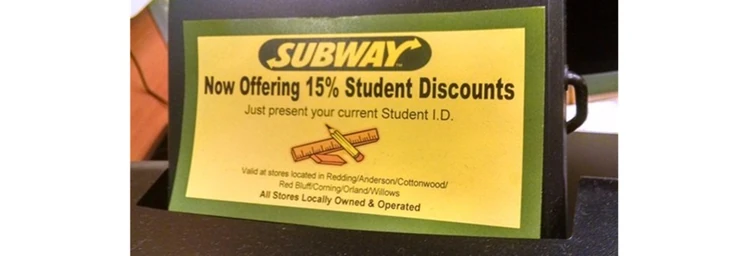
  • Subway Many local franchises offer students a 1015% discount. Always ask.

Travel & Transportation

  • Amtrak Student Fare Students between the ages of 17-24 score a 15% discount on all train fares.
  • Zipcar Student Membership Lower monthly fees and reduced rates.
  • Local Transit Discounts Must bus and subway services offers savings if you present your college ID.

Movies

  • AMC Theaters They offer everyday special student pricing. Just bring your student ID to the box office and save.
  • Cinemark They also offer student discounts, check this page and enter your zip code to find discounts in your area.
  • Regal Theaters Check their student discounts page to find offers at theaters in your area.

Tips to maximize your student discounts
Photo
  • Verify annually. Most student discount platforms require yearly re-verification.
  • Use your school email. If you have a valid .edu address youll unlock more deals.
  • Stack deals where possible. Combine student discounts with sales and cashback offers to double dip your savings.
  • Ask locally. Many small businesses near campuses offer unadvertised savings if you show your ID. Again, be sure to politely ask.

Keep in mind that this is just a partial list of all the student discounts that are currently available. I wanted to give you a taste of each category that offered discounts and show you how toverify your eligibility.

If youre a student, I urge you to do a Google search of STORE NAME student discount before you make any significant purchases. Youll be surprised how often youll find a 10-20% discount to help offset your costs.


Posted: 2026-01-08 23:17:46

Get Full News Story On Consumer Affairs


Listen to this article. Speaker link opens in a new window.
Text To Speech BETA Test Version.


More News From This Category
Consumer News: As prices rise, buying second-hand has become a mainstream shopping habit
Thu, 08 Oct 2026 19:07:08 +0000

A new report finds secondhand purchases extend beyond thrift-store clothing

By Mark Huffman of ConsumerAffairs
October 8, 2026
  • A new survey found that 76% of Americans bought something secondhand in the past year, while nearly nine in 10 have purchased used goods at some point.

  • Younger consumers lead the trend, and nearly half of Americans already buy luxury items secondhand or would consider doing so.

  • Rising prices could encourage more resale shopping, as 53% said they would likely buy used more often if new products become more expensive.


Browsing through thrift and second-hand stores has long been an enjoyable shopping experience for a niche group of consumers. With inflation, its gone mainstream.

Buying secondhand has become a routine part of shopping for many Americans, according to a new report from The Consumer Collective.

The consumer insights and advisory firms report, Second Nature: The State of Secondhand Shopping in America, found that 76% of Americans purchased used goods during the past year. Nearly nine in 10 have bought something secondhand at some point, according to the companys announcement.

The findings suggest resale is becoming an increasingly important competitor for retailers selling new merchandise.

Younger shoppers lead

Millennials had the highest rate of secondhand purchasing in the past year, at 89%, followed by Generation Z at 85%. Among Americans age 62 and older, 59% reported buying used.

The survey also found that 44% of respondents were buying more secondhand merchandise than two years earlier. That figure reached 66% among Gen Z consumers.

Luxury goods are part of the shift. Nearly half of respondents 49% already purchase luxury items used or would consider it. That figure measures both existing buyers and potential customers, rather than current purchases alone.

Prices could push more purchases toward resale

Higher prices for new products could strengthen demand for secondhand alternatives. Some 53% of respondents said they would likely shop secondhand more often if prices for new merchandise continued rising.

For some consumers, used goods already account for a substantial share of purchases: One in three said more than a quarter of what they buy is secondhand.

Jessica Ramrez, co-founder of The Consumer Collective, said the implications extend across product categories.

Over time, we expect to see consumers gravitation towards secondhand pull spend from other retailers, Ramrez said in the announcement.

That is the firms forecast, rather than a measured decline in traditional retail sales. But the survey points to a consumer audience increasingly willing to consider previously owned merchandise when deciding where to spend.

The findings come from an online survey of 400 U.S. adults conducted in August 2026. The firm says the figures were stratified to U.S. Census demographics unless otherwise noted. The results describe respondents reported shopping habits and intentions, rather than tracked retail transactions.


As prices rise, buying second-hand has become a mainstream shopping habit

Photo By CNET

Read More ...


Consumer News: Used-car prices have softened heading into the end of 2026
Thu, 08 Oct 2026 19:07:08 +0000

But bargains depend on the model

By Mark Huffman of ConsumerAffairs
October 8, 2026
  • Wholesale used-vehicle prices fell in September, and Cox Automotive cut its year-end forecast to a gain of just 0.2% over December 2025.

  • Models worth comparing include the Buick Encore GX, Nissan Rogue, and Lincoln Corsair hybrid, which posted price declines in an earlier national study.

  • Affordable cars remain scarce, making financing, condition, and expected ownership costs essential parts of finding a deal.


Consumers shopping for a used vehicle during the final months of 2026 may find a more favorable market, although the latest figures offer little evidence of an across-the-board price collapse.

Cox Automotives Manheim Used Vehicle Value Index fell to 205.9 in September, down 1.1% from August and 0.6% from a year earlier, after adjustments for vehicle mix, mileage, and seasonality. The company now expects the index to finish 2026 just 0.2% above its year-end 2025 level, compared with the 2% increase it projected in July.

Higher fuel costs and interest rates helped weaken wholesale values during the third quarter. Larger pickups and SUVs experienced declining demand and values, while older, less expensive vehicles held up better. Vehicles returning from leases are also becoming more plentiful, adding supply.

We are in the weakest season for wholesale valuations, and as September closed, depreciation was steeper than we typically see this time of year, said Jeremy Robb, chief economist, Cox Automotive. The first half of the year actually showed more appreciation than usual, even in the face of higher fuel prices. But with the conflict in the Middle East ongoing, diesel prices at record highs, and interest rates climbing rapidly increasingly worrying both businesses and consumers wholesale prices have felt the sting.

Those trends suggest shoppers may find more negotiating room on larger vehicles. But the Manheim Index measures wholesale transactions between industry buyers and sellers; it does not measure what consumers pay at dealerships.

Retail prices illustrate that distinction. Autotrader reported an average used-vehicle listing price of $27,239 in August, up 7% from a year earlier. Vehicles priced below $15,000 accounted for only 15.1% of inventory and had a relatively tight 29-day supply.

Models worth putting on the shopping list

An iSeeCars analysis of one- to five-year-old vehicles provides some leads. Its June figures showed several models getting cheaper even as others increased in price.

These are historical national averages, rather than current local offers or forecasts for December. Still, the declines make these models reasonable starting points for comparison shopping. The Corsair hybrids average price fell $6,454, while the Rogue and Encore GX offer lower purchase-price entry points.

For buyers focused on affordable transportation, another iSeeCars study assessed purchase prices alongside predicted remaining vehicle life. Among five-year-old vehicles, the Honda Fit ranked first overall, while the Buick Encore led SUVs.

Other candidates included the Toyota Corolla, Hyundai Elantra, and Volkswagen Jetta. Their average listing prices in the study were $17,104, $14,312, and $16,608, respectively. The five-year-old Encore averaged $16,030. These figures came from vehicles sold during July through December 2025, so they serve as value benchmarks rather than todays price quotes. Predicted longevity also cannot guarantee the condition of an individual car.

Financing can change the deal

A certified pre-owned vehicle deserves consideration when discounted financing offsets a higher asking price.

Kelley Blue Books October roundup lists 1.99% financing for up to 36 months on eligible 20252026 HondaTrue Certified Civics, with an advertised expiration of November 2. It also lists 2.99% financing for 36 months on eligible Lincoln Certified vehicles through January 4, 2027. Buyers should verify credit requirements, vehicle eligibility, and regional availability.

Shoppers should compare the full purchase price and total borrowing cost, obtain an insurance quote, and request a breakdown of dealer charges. A vehicle history report and an independent inspection can help determine whether a discounted car represents worthwhile savings.

Waiting for December may produce additional choices, but buyers should judge each vehicle against comparable local listings. A well-maintained car at a competitive price can offer better value than a larger discount on one facing expensive repairs.


Used-car prices have softened heading into the end of 2026

Photo By CNET

Read More ...


Consumer News: Cash App settlement payments are going out this month
Thu, 08 Oct 2026 19:07:07 +0000

Approved claimants will receive compensation, but the deadline to apply has passed

By Mark Huffman of ConsumerAffairs
October 8, 2026
  • Payments from the $15 million Cash App security settlement are scheduled for October 2026 for approved claimants.

  • Eligibility covered certain customers affected by unauthorized access, transactions, or account-error resolution problems between August 23, 2018, and August 20, 2024.

  • The claim deadline was November 18, 2024. Consumers who already filed can contact the administrator about their payment; new claims are no longer accepted.


Cash App customers with approved claims in a security-related class action settlement are scheduled to receive payments this month, according to an update on the official settlement website.

The administrator says it has completed its review of claim deficiencies and appeals. A federal court granted final approval on March 27, 2025.

The lawsuit alleged that Block, Cash Apps parent company, and Cash App Investing failed to adequately protect customers following security incidents disclosed in 2022 and 2023. It also challenged their handling of unauthorized transactions and customer complaints.

Both companies denied wrongdoing.

Who qualified?

The settlement covered current and former customers whose personal information or accounts were accessed without permission, who experienced unauthorized or fraudulent transfers, or who had qualifying problems with account-error resolution during the covered period.

Simply having a Cash App account did not qualify someone for compensation. Receiving a payment required a timely, valid, and approved claim.

How much compensation is available?

Claimants could request up to $2,500 for documented out-of-pocket losses, up to $75 for time spent addressing covered problems, and reimbursement for documented, unreimbursed transaction losses.

The $2,500 figure is an expense-reimbursement limit, rather than a guaranteed payment. Individual awards depend on approved claims and settlement terms. Legal fees and administrative expenses are paid from the fund.

How to get a payment

Consumers who submitted claims should check CashAppSecuritySettlement.com for distribution updates. The administrator explicitly says late claim forms are no longer accepted.

For questions about an existing claim or payment, contact the Cash App Security Settlement Administrator at 1-866-615-9740. Claimants can also write to 1650 Arch Street, Suite 2210, Philadelphia, PA, 19103.


Cash App settlement payments are going out this month

Photo By CNET

Read More ...


Consumer News: Starbucks sued over ‘sugar-free’ protein drinks that contain sugar
Thu, 08 Oct 2026 16:07:07 +0000

Consumers challenge the beverage names, but Starbucks says its nutritional disclosures are clear

By Mark Huffman of ConsumerAffairs
October 8, 2026
  • A proposed class-action lawsuit accuses Starbucks of misleading consumers by naming eight protein beverages sugar-free despite their sugar content.

  • The complaint alleges the drinks contain 13 to 21 grams of sugar per venti serving, largely from naturally occurring sugar in milk.

  • Starbucks disputes the allegations, saying it clearly discloses nutritional information and uses sugar-free syrups in the beverages.


Starbucks is facing a proposed class-action lawsuit alleging that eight of its protein beverages are misleadingly marketed as sugar-free even though they contain substantial amounts of naturally occurring sugar.

Filed Oct. 2 in the U.S. District Court for the Western District of Washington, the lawsuit challenges the names of the companys vanilla and caramel protein lattes and protein matcha drinks, including their iced versions. The plaintiffs allege the beverages contain between 13 and 21 grams of sugar per venti serving.

The dispute centers on whether consumers would understand sugar-free to describe the entire beverage or simply the syrup used to flavor it. The drinks contain milk, which supplies lactose, a naturally occurring sugar, according to the complaint.

The three consumers bringing the case purchased the beverages in California, New York, and Washington. Their attorneys argue that the product names are deceptive even when nutritional information is available elsewhere.

What the lawsuit alleges

The plaintiffs contend Starbucks beverage names violate federal labeling standards and state consumer protection laws.

Federal regulations generally require products bearing a sugar-free claim to contain less than 0.5 gram of sugar per labeled serving and per reference amount customarily consumed. The regulations establish separate requirements for no added sugar claims, recognizing that a product can contain sugar naturally present in its ingredients.

The lawsuit also alleges Starbucks failed to include required calorie disclaimers. Under the federal rule, a sugar-free claim must be accompanied by an appropriate disclaimer when the product does not qualify for specified low-calorie or reduced-calorie labeling.

The consumers, represented by Hagens Berman and Sterlington PLLC, seek compensation for purchases and a court order requiring changes to the allegedly misleading marketing. Those requests remain allegations and demands for relief, rather than findings that Starbucks violated the law.

Starbucks rejects the claims

Starbucks says the sugar comes from its protein-boosted milk, that it does not add sugar to the beverages, and that the flavoring syrups are sugar-free.

We believe these claims have no merit, a Starbucks spokesperson said.

The company said it consistently provides information about ingredients, customization options, and nutritional content through its menus, marketing, website, and app, and intends to defend itself vigorously.

For consumers, the case highlights a distinction worth checking before ordering: sugar-free syrup does not necessarily produce a beverage without sugar. Milk and other ingredients can contribute to the finished drinks total.

Customers trying to limit sugar can review the nutritional information for the complete beverage and selected serving size, paying attention to total sugars as well as any claim about added sugar.


Starbucks sued over ‘sugar-free’ protein drinks that contain sugar

Photo By CNET

Read More ...


Consumer News: Conagra discontinues Celeste frozen pizza
Thu, 08 Oct 2026 16:07:07 +0000

Remaining supplies will be sold as the food company shifts resources to other brands

By Mark Huffman of ConsumerAffairs
October 8, 2026
  • Conagra Brands has stopped producing Celeste frozen pizza, ending a longtime grocery-store staple.

  • Shoppers may still find the pizzas while existing inventory lasts, but the company says no more are being made.

  • The decision is part of Conagras effort to simplify its product lineup and focus spending on businesses with stronger growth potential.


Celeste frozen pizza is heading out of supermarket freezers, bringing an end to a familiar option for consumers looking for a quick, inexpensive meal.

Conagra Brands disclosed its decision to exit the Celeste business during its latest earnings call. A company spokesperson subsequently confirmed to FOX Business that production has stopped, although remaining inventory will continue to be sold.

We will continue to sell inventory, but we stopped producing it, the spokesperson told FOX Business. Once those supplies are exhausted, the company said, Celeste products will no longer be available.

The explanation means the pizzas could disappear from different stores at different times, depending on how quickly remaining supplies sell.

A victim of a portfolio review

Conagra CEO John Brase identified Celeste as an early example of the companys review of its product portfolio. The goal is to reduce complexity in manufacturing and purchasing while directing investment toward businesses with greater scale and better prospects.

Dropping Celeste reduced first-quarter net sales by about 0.15 percentage point, according to Conagras prepared remarks. However, the company expects the decision to improve profit margins going forward. Conagra also said most benefits from its broader effort to simplify its assortment should emerge over the next 12 to 18 months.

The changes come as the company faces softer sales. Conagra reported revenue of approximately $2.6 billion for its fiscal first quarter, which ended Aug. 30, down 1.4% from a year earlier. It maintained its forecast for organic sales to decline between 1% and 3% during fiscal 2027.

For longtime customers, Celestes departure also closes a chapter in frozen-food history. The brand traces its origins to Celeste Mama Lizio and her husband, Anthony, who opened a Chicago restaurant in 1937. Quaker Oats acquired the business in 1969, and Mama Celeste became its recognizable face on packaging and in television commercials. Conagra acquired the brand through its purchase of Pinnacle Foods in 2018.

News of the discontinuation has prompted customers to share memories online of after-school snacks and pizzas kept in their grandparents freezers. For those hoping for one more serving, the opportunity now depends on what remains on store shelves.


Conagra discontinues Celeste frozen pizza

Photo By CNET

Read More ...


Related Bing News Results
Consumer Reports Tested 7 Cottage Cheese Brands — These 2 Came Out on Top
Thu, 08 Oct 2026 05:01:00 GMT
Buy the best version of this versatile, high-protein dairy product.
Not Pyrex: Consumer Reports says this stainless steel food container set is nearly perfect
Sun, 04 Oct 2026 06:39:00 GMT
Your new favorite food storage container set could be this pick from Consumer Reports, which received an almost perfect rating from the platform.
New Study by Consumer Reports reveals 9 in 10 Americans targeted by a cyberattack or digital scam attempt
Thu, 01 Oct 2026 03:00:00 GMT
Washington, DC – Consumer Reports (CR), along with Aspen Digital and the Global Cyber Alliance, released the fifth annual Consumer Cyber Readiness Report today, marking the beginning of Cybersecurity ...
Consumer Reports' Top Fast Food Breakfast Sandwich Offers Major Nutrition
Sun, 27 Sep 2026 12:39:00 GMT
Consumer Reports ranked this chain's fast food breakfast sandwich highly when it comes to nutritional value, without compromising on overall taste.
Kia, Mazda among Consumer Reports' 10 least reliable cars for 2026
Thu, 18 Dec 2025 10:55:00 GMT
Here's a year-end list you don't want to see your car on. Consumer Reports issued their 2026 Automotive Report Card Dec. 4, and included among its findings was a list of the least reliable cars for ...

Blow Us A Whistle


RobinsPost Print On Demand Refund Policy With Printify
Printify

Related Product Search/Búsqueda de productos relacionados

Amazon Logo





