

Rockin Robin SongFlying The Web For News.


Consumer Daily Reports

Amazons best deals arent on the homepage heres where theyre hiding

By Kyle James of ConsumerAffairs
May 7, 2026
  • Use Amazon Outlet: Find overstocks and clearance deals in the hard-to-find Outlet with discounts often reaching 30%70% off the original price.

  • Stack extra savings: Try to combine sale prices with Amazons hidden coupon page and promo codes for even bigger discounts.

  • Shop Amazon Resale: Open-box and returned items in Like New condition can offer major savings for much less. (And there's no-risk, as you have a 30-day return window.


Shopping for clearance deals on Amazon can often feel like a no-win game. You search deals, scroll forever, and still end up paying close to full priceor the sale price is the same price its been for sixmonths.

But the truth is Amazon does actually have a solid clearance system; its just scattered across multiple hidden sections. Once you know where to look, you can consistently find 30%70% off without relying on Prime Day to make it happen.

Heres the smart shoppers Amazon playbook.

Start with Amazons hidden Outlet

Most people never find this or dont even know it exists.

Amazons Outlet section is where overstock items go when Amazon is trying to clear out inventory. Think of it like a physical outlet store, except its all online.

In the Outlet youll find:

  • Brand-new items (not used)
  • Seasonal clearance
  • Overstock from big brands
  • Discounts often up to 70% off

They dont really advertise the Outlet on their homepage. Heres how to find it:

  • Search Amazon Outlet in that actual Amazon search bar
  • Or go to Todays Deals then tap on Overstock Deals or Outlet

Some of the top brands you can find in the Amazon Outlet include Apple, Adidas, Calvin Klein, KitchenAid, Nike, UGG, JBL, and Kate Spade.

Stack deals with their secret coupon page
Photo

Even fewer shoppers know about the coupon section on Amazon.

Amazon has a hidden digital coupons page where you can clip extra discounts before checkout. They make no mention of this coupon section on the homepage, and most shoppers have no idea it exists.

What makes their coupons powerful:

  • Coupons stack on top of sale prices
  • Discounts apply instantly at checkout
  • New coupons rotate constantly

How to use it:

  • Visitthis page and bookmark it, or search Amazon Coupon before you shop.
  • Once you're on the coupon page, you can filter your search by category or price.
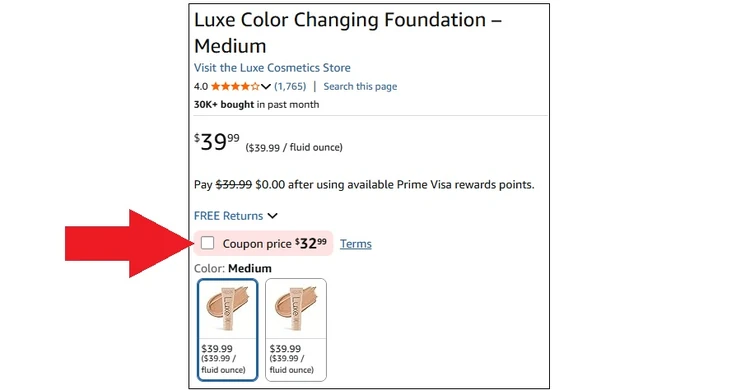
  • On the product page, click the Coupon price" box to activate the offer (see screenshot above).

Im a huge fan of the website Koupon.ai as they do a great job posting and verifying Amazon promo codes in real-time. They categorize all the Amazon products that currently have a coupon available, andthis makes it very easy to find 30-50% off deals on the products youre shopping for.

Also, if a promo code is tested and found to not be working, its removed instantly from their site and app.

Use Amazon Resale for open-box steals

Amazon Resale is where some of the biggest clearance discounts tend to live.

The Resale section on Amazon sells the following:

  • Returned items
  • Open-box products
  • Slightly imperfect items

Discounts often hit 30%70% off the retail price and some with the same 30-day Amazon return window.

Why it works:

Pro tip: Filter for Used Like New or Used Very Good condition first. Thats where you get near-perfect items at deep discounts.

Use the '% off'Amazon search trick

This is one of the most underused Amazon search hacks.

You can actually force Amazon to show you only heavily discounted items by editing the URL on your desktop or laptop.

For example:

After doing a search on Amazon, try adding &pct-off=50- to the end of the URL (in your browser search bar) to see all the items being sold at 50% off or more.

Or add &pct-off=70-90 to find extreme 70-90% off clearance items.

Pro tip: Try combining this hack with category searches like:

  • kitchen &pct-off=60-
  • headphones &pct-off=50-

Youll find that by adding this, it often cuts out 90% of the junk listings instantly.

Time your shopping withclearance patterns

Amazon doesnt run traditional markdown schedules, but clearance patterns still exist.

Here are the best times to find clearance items:

  • JanuaryFebruary: Post-holiday returns (huge Resale inventory spike)
  • End of quarters (March, June, Sept, Dec): Inventory cleanup leads to Outlet deals
  • Before new product launches: This is when older models tend to get discounted the most.

Clearance isnt always about one big sale, but more about understanding inventory shifts and timing your purchases around them.

The bottom line

Amazon isnt lacking in deals. Its just hiding them, as the company wouldrather have you pay full-price.

The key is to get in the habit of checking:

  • The Amazon Outlet
  • Their coupons page
  • Amazon Resale deals

Now that you know where to look, youll consistently find clearance-level prices without waiting for Prime Day.

And once you get the system down, youll find that it only takes minutes to find the real deals.


Posted: 2026-05-07 21:28:56

Get Full News Story On Consumer Affairs


Listen to this article. Speaker link opens in a new window.
Text To Speech BETA Test Version.


More News From This Category
Consumer News: Retired? Here are some tax moves to consider before the end of 2026
Thu, 01 Oct 2026 13:07:13 +0000

It starts with your required minimum distribution.

By Mark Huffman of ConsumerAffairs
October 1, 2026
  • Retirees and pre-retirees may still have time to reduce their long-term tax exposure through moves completed before Dec. 31.

  • Roth conversions, required minimum distributions and a temporary deduction for people 65 and older are among the areas worth reviewing.

  • Tax decisions should account for Social Security, pensions, investments and retirement-account withdrawals together, according to Gaines Capital Management.


If you are retired or approaching retirement, you have only a few months left to make certain tax-planning decisions for 2026, prompting advisers to encourage a broader review of how retirement income will be taxed.

Aaron Gaines, a certified financial planner and founder of Atlanta-based Gaines Capital Management, identified five areas retirees may want to examine before Dec. 31.

One potential strategy is a Roth conversion, in which money is moved from a tax-deferred retirement account into a Roth account. The converted amount is generally treated as taxable income in the year of the transaction, but qualified withdrawals from the Roth account can later be tax-free.

For some retirees, relatively low-income years before required minimum distributions begin can provide an opportunity to make partial conversions. The amount and timing require care, however, because a conversion can increase taxable income and potentially affect other costs or taxes tied to income.

Required minimum distributions

Retirees should also prepare for required minimum distributions, or RMDs. Under current federal rules, withdrawals generally begin at age 73 for owners of traditional IRAs and many workplace retirement accounts, although the precise deadline can depend on the type of account and employment status. The Internal Revenue Service says most subsequent annual RMDs must be taken by Dec. 31.

Planning before those withdrawals become mandatory may give retirees more control over when taxable income is recognized. Waiting until RMDs begin could leave less flexibility, particularly for people with substantial balances in tax-deferred accounts.

A temporary federal tax deduction may provide another planning opportunity. From 2025 through 2028, qualifying taxpayers age 65 or older can claim an additional deduction of as much as $6,000 per person. An eligible married couple filing jointly could receive up to $12,000.

The deduction begins to phase out when modified adjusted gross income exceeds $75,000 for single filers or $150,000 for joint filers, according to IRS guidance. It is available to qualifying taxpayers whether they take the standard deduction or itemize.

Gaines also recommends evaluating retirement income as a whole. Social Security benefits, pensions, IRA distributions, investment income and Roth conversions can interact under federal tax rules. A decision involving one source may therefore change the tax treatment or financial impact of another.

The importance of timing

The final consideration is timing. Some strategies intended to affect a taxpayers 2026 position must be completed by Dec. 31 and cannot be implemented retroactively when a return is prepared in 2027.

Tax preparation tells you what already happened, Gaines said. Tax planning asks what we can still do before it happens.

The appropriate approach will vary by household, and actions such as Roth conversions can create immediate tax liabilities. Retirees should consider consulting qualified tax and financial professionals before making changes based on their income, accounts and long-term plans.


Retired? Here are some tax moves to consider before the end of 2026

Photo By CNET

Read More ...


Consumer News: Inflation isn’t slowing consumer spending
Thu, 01 Oct 2026 13:07:13 +0000

The Feds preferred inflation gauge moderated in August

By Mark Huffman of ConsumerAffairs
October 1, 2026
  • Consumer spending jumped 0.9% in August, far outpacing the growth in household income.

  • The Federal Reserves preferred inflation gauge rose 3.4% from a year earlier, while core inflation eased to 3.0%.

  • The personal saving rate fell to 4.1%, suggesting some households may be dipping into savings or relying more heavily on credit.


American consumers opened their wallets in August, spending at a much faster pace even as inflation continued to take a bite out of household budgets.

Personal consumption expenditures increased 0.9% in August, according to the Commerce Departments Bureau of Economic Analysis report released Wednesday. That was a sharp acceleration from July and represented the largest monthly increase in consumer spending since March.

The spending surge is notable because incomes didn't keep pace. Personal income increased just 0.2% during the month, according to the report. After adjusting for inflation, disposable personal income was essentially flat.

That combination rapidly rising spending and relatively little growth in purchasing power could be an important warning sign for consumers.

The personal saving rate fell to 4.1%, its lowest level since November 2022. That suggests at least some households may be maintaining their spending by saving less or increasing their use of credit.

Inflation cooled, but remains elevated

There was somewhat better news on inflation.

The Personal Consumption Expenditures price index, or PCE, increased 0.3% from July and was 3.4% higher than a year earlier. The annual increase came in below economists' expectations.

Core PCE, which removes volatile food and energy prices and is closely watched by the Federal Reserve for underlying inflation trends, increased 0.2% for the month and 3.0% over the previous 12 months.

That's an improvement, but inflation remains well above the Federal Reserve's long-term 2% target.

The PCE index differs somewhat from the more familiar Consumer Price Index. While both measure inflation, PCE accounts for changes consumers make in their purchasing habits as prices change and covers a broader range of expenditures. The Federal Reserve therefore gives the PCE measure considerable weight when making interest-rate decisions.

Consumers aren't pulling back

Perhaps the most significant part of the August report is that consumers don't appear to be responding to higher prices by sharply cutting overall spending.

Spending increased on purchases including automobiles, restaurant meals and clothing, while higher prices for gasoline and other necessities also contributed to the increase in overall expenditures.

That's good news for economic growth because consumer spending represents the largest component of the U.S. economy. But the gap between spending and income could become harder to sustain if households increasingly have to tap savings or take on additional debt.

The August numbers also illustrate an important distinction for consumers: slower inflation doesn't mean prices are falling. It means prices are increasing more slowly.


Inflation isn’t slowing consumer spending

Photo By CNET

Read More ...


Consumer News: Congress officially ends the penny: Here’s what it means
Thu, 01 Oct 2026 13:07:12 +0000

Consumers paying with credit or debit cards wont see a change

By Mark Huffman of ConsumerAffairs
October 1, 2026
  • Congress has given final approval to the Common Cents Act, formally ending production of pennies for general circulation.

  • Existing pennies arent being canceled. They remain legal tender and consumers can continue spending them.

  • As pennies become harder to find, businesses will be able to round cash purchases to the nearest nickel; purchases made by credit card, debit card and other noncash methods can still be charged to the exact cent.


The pennys days at the U.S. Mint are over, but that doesnt mean the pennies sitting in your change jar have suddenly become worthless.

Congress has given final approval to the Common Cents Act, legislation that formally directs the Treasury Department to stop producing one-cent coins for general circulation. The Senate approved the measure Sept. 28 after House passage, sending it to President Trump, who supports the legislation.

In practice, penny production had already ended. The federal government stopped manufacturing new pennies in 2025 as the cost of making the coin climbed far above its face value. Treasury says producing a penny had risen to 3.69 cents and estimates stopping production will save about $56 million annually in material costs.

The legislation addresses one of the biggest practical questions created by that decision: What happens when a cash purchase comes to $10.22 but the store doesn't have pennies to make change?

Cash purchases can be rounded

The Common Cents Act establishes a framework allowing cash transactions to be rounded to the nearest five cents when exact change isn't available.

Under the system, a cash total ending in 1, 2, 6 or 7 cents can be rounded down to the nearest nickel. A total ending in 3, 4, 8 or 9 cents can be rounded up.

For example:

A $10.21 cash purchase could become $10.20, while a $10.24 purchase could become $10.25. A $10.26 purchase could become $10.25, while $10.29 could become $10.30.

Importantly, the federal legislation permits this type of rounding but does not require every transaction to be rounded. Businesses that have pennies available can continue making exact change.

The rounding also applies to the final transaction total, rather than individual prices. A retailer would not, for example, have to change a $2.99 price tag to $3.

Cards will still be charged to the penny

Consumers who rarely use cash may notice virtually no difference.

Credit cards, debit cards, checks and electronic payments can continue to be processed to the exact cent. A $19.98 purchase charged to a credit card would still cost $19.98 rather than being rounded to $20.

Treasury has similarly recommended that rounding apply only to cash transactions and that taxes and other charges be calculated before the final cash amount is rounded.

That distinction could become increasingly noticeable at stores: the amount displayed on the register might be $24.97, for example, but a customer paying cash could pay $24.95 if the retailer is using rounding, while a customer using a card would pay exactly $24.97.

Don't throw your pennies away

Perhaps the most important point for consumers is that the penny isn't being demonetized.

Treasury says roughly 114 billion pennies remain in circulation, and the Federal Reserve can continue recirculating them. Existing pennies retain their face value and their status as legal tender.

Consumers therefore don't need to rush to cash in jars of pennies before a deadline. They can continue spending them, and financial institutions can continue accepting penny deposits, although banks may have their own rules requiring large quantities of coins to be rolled or wrapped.

Treasury has actually encouraged Americans to spend the pennies they already have, which could keep more coins circulating and make the transition easier for businesses.

Will rounding cost consumers money?

In an individual transaction, it could by as much as two cents. But another transaction could save the consumer the same amount.

Treasury argues that symmetrical rounding should prevent either shoppers or retailers from gaining a systematic advantage because some purchases round up and others round down. It says there should therefore be no overall effect on consumer prices from rounding.

The legislation also calls for federal officials to examine how the transition affects groups that rely more heavily on cash. The Federal Reserve's required planning includes an assessment of penny-supply disruptions and rounding on low-income communities, older consumers and people who are unbanked or underbanked.

For consumers, the simplest way to think about the change is this: Prices can still be stated to the penny, electronic payments can still be made to the penny, and the pennies you already own are still worth a penny.

What is disappearing is the government's production of new ones. Over time, as the existing supply dwindles, paying with cash is increasingly likely to mean rounding the final bill to the nearest nickel.


Congress officially ends the penny: Here’s what it means

Photo By CNET

Read More ...


Consumer News: The IRS has launched a new app for taxpayers
Thu, 01 Oct 2026 13:07:12 +0000

The new app replaces IRS2GO

By Mark Huffman of ConsumerAffairs
October 1, 2026
  • The IRS has launched a new mobile app that replaces IRS2Go and provides access to more tax-account services from smartphones and tablets.

  • Taxpayers can use the app to check refunds, view balances, make payments, read certain IRS notices, download tax records and retrieve an Identity Protection PIN.

  • The IRS is warning consumers to watch for look-alike apps and and to download the app only through verified IRS links or official app stores.


The Internal Revenue Service is putting more of its services on consumers' smartphones, launching a new mobile app that provides taxpayers with access to information that previously often required visiting IRS.gov.

The new IRS app officially launched this month and replaces IRS2Go, the agency's mobile application that has been available for more than a decade. The IRS said the change is part of an effort to expand its digital services and make routine tax matters easier to handle from a mobile device.

"The new IRS app puts more services at taxpayers' fingertips," IRS CEO Frank J. Bisignano said in announcing the launch. He said the agency wants taxpayers to be able to interact with the IRS at home or while on the go.

The app is free and available through Apple's App Store and Google Play. It is offered in English and Spanish.

What taxpayers can do with the app

Some of the most useful features involve tasks that taxpayers may need to perform after filing a return.

After securely signing in, taxpayers may be able to:

  • Check the status of a refund or amended return

  • View their available tax balance

  • Make payments and review payment activity

  • Read selected IRS notices and letters

  • Access tax records and transcripts

  • Change certain profile and communication preferences

  • Retrieve an Identity Protection PIN, or IP PIN.

Some services don't require taxpayers to sign in. Consumers can check their refund status, make certain payments and find free tax-filing assistance without logging into an account.

Taxpayers who do sign in use the same secure authentication process used for the IRS Individual Online Account. The app opens a secure browser window for authentication and then returns the taxpayer to the app.

The IRS says tax-account information displayed after a taxpayer signs in isn't permanently stored on the device. Information transmitted between the app and IRS systems is encrypted.

Existing IRS2Go users don't need a new download

Consumers who already have IRS2Go don't need to search for and download another application.

If automatic app updates are turned on, IRS2Go will be updated to the new IRS app through the normal update process. Otherwise, users can manually update the application through Apple's App Store or Google Play.

The IRS app currently requires iOS or iPadOS 15.1 or later on Apple devices and Android 7.0 or later on Android devices.

The agency stressed that the app doesn't replace IRS.gov. The website will continue to provide the agency's full range of tax information, forms, guidance and online services. Business Tax Account and Tax Pro Account services also aren't being moved into the app at this point.

Beware of fake IRS apps

The launch also creates a potential new opportunity for scammers.

The IRS is specifically warning taxpayers to be cautious of look-alike apps, online advertisements and unsolicited messages claiming to provide access to IRS accounts.

Consumers should use links provided through IRS.gov or verified listings in the Apple App Store and Google Play to make sure they're getting the genuine application.

That warning is especially important because a fraudulent app could be designed to collect Social Security numbers, passwords, bank information and other data useful for identity theft.

The IRS says it will not send an unsolicited text, email or pop-up message asking consumers to provide sensitive personal or financial information. Consumers receiving such a message shouldn't click its links or provide information.

The new app isn't finished evolving. The IRS says it plans to add more capabilities and services over time, potentially allowing taxpayers to handle an increasing number of routine tax matters without calling the agency or visiting IRS.gov.


The IRS has launched a new app for taxpayers

Photo By CNET

Read More ...


Consumer News: Fontanini recalls pork sausage after pieces of hard plastic are found
Thu, 01 Oct 2026 13:07:12 +0000

More than a ton of frozen breakfast sausage was distributed to restaurants and foodservice establishments in four states

By Mark Huffman of ConsumerAffairs
October 1, 2026
  • Fontanini Foods is recalling about 2,320 pounds of frozen pork breakfast sausage because it may contain pieces of clear, hard plastic.

  • The recalled sausage was distributed in California, Florida, Michigan and Nevada for use by restaurants and other foodservice establishments.

  • No injuries have been reported, but USDA officials are concerned some of the sausage may still be stored in restaurant and foodservice freezers.


Fontanini Foods is recalling approximately 2,320 pounds of raw, frozen pork breakfast sausage after customers reported finding pieces of hard plastic in the product.

The McCook, Illinois-based company initiated the recall after receiving two customer complaints involving clear, hard plastic in the sausage, according to the U.S. Department of Agriculture's Food Safety and Inspection Service (FSIS).

There have been no confirmed reports of injuries or other adverse reactions associated with the recalled sausage.

The affected products were produced on June 23, 2026, and shipped to distributors in California, Florida, Michigan and Nevada. They were intended for restaurants and other foodservice establishments rather than sale directly to consumers at grocery stores.

How to identify the recalled sausage

The recall covers 10-pound cardboard cases containing "Fontanini PORK SAUSAGE LINKS."

The cases have:

  • "ITEM 393" printed on the box

  • "PACKED ON 06/23/2026" printed on the shipping label

  • Establishment number "EST. 6944" inside the USDA mark of inspection

Fontanini's parent company, Hormel Foods, said the action involves 232 cases totaling 2,320 pounds. The company said no other Fontanini products are affected.

Why consumers could still encounter the product

Although consumers could not buy the recalled sausage directly at retail stores, they could potentially encounter it at a restaurant or other establishment that received the product.

FSIS said it is concerned some of the sausage may remain in foodservice and restaurant freezers because it was distributed as a frozen product.

Restaurants and other foodservice establishments should not serve the recalled sausage. FSIS said the products should be thrown away or returned to the place of purchase.

Fontanini said all foodservice customers that received the affected sausage have been notified.

The recall underscores one of the challenges with foodservice recalls: consumers eating at restaurants generally don't have access to the packaging and lot information that would allow them to determine whether a recalled ingredient was used in their meal.

Anyone who believes they were injured after eating the product should contact a healthcare provider. Consumers with food-safety questions can also contact the USDA Meat and Poultry Hotline at 888-674-6854.


Fontanini recalls pork sausage after pieces of hard plastic are found

Photo By CNET

Read More ...


Related Bing News Results
The best Keurig coffee machine under $100, per Consumer Reports
Thu, 01 Oct 2026 03:39:00 GMT
If you're on a hunt for the best inexpensive Keurig coffee machine, Consumer Reports recommends this model for its affordability, retailing for under $100.

Consumer Reports' Top Fast Food Breakfast Sandwich Offers Major Nutrition
Sun, 27 Sep 2026 12:39:00 GMT
Consumer Reports ranked this chain's fast food breakfast sandwich highly when it comes to nutritional value, without compromising on overall taste.

The best mini-fridge for dorm season 2026, per Consumer Reports
Sat, 26 Sep 2026 13:39:00 GMT
Stocking up on dorm room supplies for the 2026 season? You should grab this dorm mini-fridge, according to Consumer Reports' recent ranking.

Consumer Reports Tested Baby Food for Microplastics for the First Time. Every Puree Had Them
Thu, 17 Sep 2026 03:00:00 GMT
The good news: Levels of some contaminants are improving, though heavy metals and phthalates still turned up in some products.

New study finds many prenatal vitamins fail to meet label accuracy
Mon, 14 Sep 2026 03:16:53 GMT
A Consumer Reports study of 17 prenatal vitamins found that most failed to meet label accuracy standards despite containing no harmful levels of contaminants.


Blow Us A Whistle


RobinsPost Print On Demand Refund Policy With Printify
Printify

Related Product Search/Búsqueda de productos relacionados

Amazon Logo





