Rockin Robin SongFlying The Web For News.
RobinPost Logo Amazon Prime Deals


Consumer Daily Reports

[unable to retrieve full-text content]

Nearly 40 states legalized sports gambling after a 2018 Supreme Court ruling

By Joanna Broder of ConsumerAffairs
January 14, 2025

Rob Minnick grew up in South Jersey near Philadelphiawhere people care a lot about their sports teams, he says. In high school, his get-togethers often centered around a sporting event like watching the Philadelphia 76ers. So, once he and his friends found out about daily fantasy sports, it became a natural addition.

"It was: 'Hey, let's put all the money that we have from working our high school jobs and let's go and gamble on sports, Minnick remembers.

He wasnt exactly new to fantasy sports, since he had played since he was 13, but back then a game took 17 weeks rather than just the few hours it does now. It was a much, much quicker timeline, he says.

Soon, Minnicks sports betting started to diverge from that of his friends. While they would place their bets for the 7 p.m. game and then go home to bed after the results came in around 10 p.m., Minnick continued to place bets on the later games played on the West Coast and then would stay up very late awaiting the results, even though he knew little about those teams and cared even less about them.

When he moved to college in 2017, things got worse. He had started using Bovada, an offshore gambling app that operated in a legal gray zone at the time. An online bookie extended Minnick a line of credit and would track his wins and losses, sending him a Venmo payment or request for funds depending on the situation. Eventually Minnick placed a large bet on a March Madness game and he lost.

He spent the next couple of weeks trying to extend his credit line and gambling more to recoup his losses. His efforts failed.

He sayshe prefers not to say exactly how much he lost, but admitted it took three months of working part-time on campus and then working full-time at home to eventually recoup it.

At the time, I had to tell my family, like, hey, I lost all this money gambling," Minnick says.
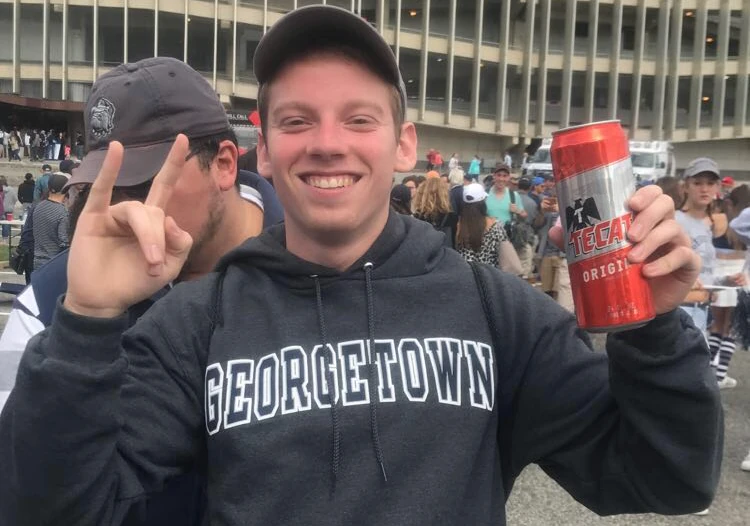
Photo

Minnick beforehe lost a bet at a Georgetown versus Harvard football game at RFK stadium in D.C.Image courtesy of Rob Minnick.

Sports betting legalization spurs massive growth

Minnick began betting on sports before it was legalized and took effect in New Jersey in 2018. In recent years, there has been a massive growth in legalized sports betting.

It became far more ubiquitous after the 2018 Supreme Court decision deeming the Professional and Amateur Sports Protection Act unconstitutional. Sports betting is now legal in 39 states and Washington, D.C. It is currently operational in all but one of those states, according to industry group the American Gaming Association.

It was going on to some extent, but now its being institutionalized and professionalized, Senator Dick Durbinsaid during a recent hearing of the Senate Judiciary Committee.

Lots of gambling was happening, but it wasnt in this much more formal way that they can do it quickly from their phone, says Michelle L. Malkin, director of The Gambling Research & Policy Initiative at East Carolina University. Literally people could be wagering every single minute of a game in some sort of way."

Consumer News: 'I lost all this money': Legal sports gambling is tempting young adults

Sports betting companies nudge college students, says Alison Wood, youth prevention coordinator for the North Carolina Problem Gambling Program. A college student may see sports betting, then sign up for an app and then they start to get push notifications and promotions where, 'Hey, we are going to give you X amount of money up front for you to come and gamble with us for free, and they [gambling operators] use these promotions as a way to keep people engaged and moving forward with the sports betting, Wood says.

A 2023survey of 3,527 18 to 22-year-olds, with about half studying at institutions, by the National Collegiate Athletics Association found that sports wagering is widespread in this population. Fifty-eight percent noted they had participated in at least one sports betting activity with 4% of them betting daily. About six percent of those participating in sports betting reported losing more than $500 in a single day. Additionally, around 28% of students have bet using a mobile app or website.

Part of the risk to college students and emerging adults is the ability to bet on amateur sports, says Keith Whyte, executive director of the National Council on Problem Gambling. In America, so much of our sports is college.

A survey by the groupfound that one of the biggest predictive factors for betting on sports is your involvement in higher education, Whyte says. Its so granular that graduate students spend more than undergrads and undergrads on campus bet sports more than folks who commute to school."

This generation is being bombarded by increased advertising about sports bettingincluding by celebrities such as Jamie Foxxbut they dont necessarily have the tools to understand the risks and rewards of gambling in a balanced way, Whyte says.

Malkin agreed that 18 to 24-year-olds are the most at risk right now because theres just been no outreach and education to them.

There is no federal funding for research on problem gambling and colleges are not doing enough, Whyte says. By and large, government and specifically state government is kind of turning a blind eye.

Consumer News: 'I lost all this money': Legal sports gambling is tempting young adults

Gambling provides a source of revenue for state governments.There was $1.08 billion in state gaming tax revenue generated across the nation for the first 10 months of 2024, says Dara Cohen, senior director of media relations at the American Gaming Association. The state gaming tax revenue goes back into programs like education, conservation and community efforts, she says.

However, Whyte argues that states have been unable to sufficiently fund programs to address problem gambling, prevention, treatment and research on their own and need federal support. Also, regulation on gambling at the state level is pretty minimal, he says.

The science behind sports betting

One of the risks for developing a gambling problem is thinking that you know the game better than others, believing that your skill is going to allow you to triumph over logic and luck, Whyte says.

Theres a science behind sports gambling, in terms of the strategy and why certain strategies are chosen because it's a way to make money, says Wood, from the North Carolina Problem Gambling Program.

For example, the way some skill-based games operate creates skill-based confusion, she says. The way the games are designed and the way they're marketed increases people's perception that they have control.

Signs of problem gambling, according to National Council on Problem Gambling, are:

  • Thinking often about gambling.

  • Feeling that you must bet more money more often.

  • Chasing losses by trying to win back money lost.

  • Feeling out of control.

Consumer News: 'I lost all this money': Legal sports gambling is tempting young adults

In addition to financial harms, there are also emotional harms including depression, stress and anxiety, says NCPGs Whyte. Anxiety may stem from a feeling of having to win the next bet or not knowing how youll cover what you lost, Whyte says.

Theres a tangled cluster of co-existing disorders, he explains. For example, anxiety, stress and depression can either be symptoms or causes of a gambling disorder.

Alcohol use and abuse and substance use and abuse are also heavily correlated or co-occurring with gambling addiction, Whyte says. We need to be looking at this as a mental health problem, Wood says.

People who engage at dangerous levels experience deeper levels of stress and isolation, Wood says.

Is sports betting that leads to problematic behaviors increasing on college campuses? We dont know, although anecdotally it appears it is, Whytesays.

But one of the biggest surprises in all of this is that most states that have legalized sports betting are not surveying the public or surveying college students about it, Whyte says.

The NCAA and the National Council on Problem Gambling have done surveys, but the federal government does not provide any funding for surveys and research, Whyte says. We tend to talk about the risk of problem gamblingnot the ratebecause nobodynot the National Institutes of Health or the Centers for Disease Control and Preventionis tracking the rate, Whyte says.

Building awareness at college

While colleges are doing some education about sports betting for athletes, most colleges offer no outreach to students about gambling, Malkin says. She says they dont screen students the way they do around drugs and alcohol. Very few colleges can treat a student for gambling disorder either, she added.

Malkin, who researches gambling behavior risk, gambling-related harms and gambling disorder, is developing a college student curriculum on responsible gambling and problem gambling and is piloting it at two schools in North Carolina. She hopes to make it more widely available next summer.

Her curriculumdelivered by peer educatorsincludes several modules on: How to gamble in a healthy way by ensuringyoure only gambling with money you can afford to lose, not chasing losses, setting time limits and never gambling alone; fitting gambling into a budget; and how to recognize the signs of problem gambling either for oneself or someone you care about.

One of the biggest things students need education about is budgeting, Malkin says, so they can identify how much money they should use to gamble. Hint:Malkin saysits aboutthe cost of a movie out.

What we see with young people is theyll take the money their parents gave them for their meals, and theyll gamble that away," she says.

To pay his parents back the money they loaned him to pay off his gambling debt, Minnick worked two jobs over eight months. But he didnt exactly come to terms with the fact that sports betting and gambling was impacting him in a negative way. So, he kept doing it.

"In the mind of a problem gambler is like, everything's fine. I'll take care of this. This is just a bad string of luck, right?

He decided to do a semester abroad in Australia. After landing in Sydney, he went straight to a nearby casino. He gambled there often. When Covid hit, he had to return home where he received government stimulus checks which he used for betting, he says.

"It was just win loss, win loss, ending up in debt, borrowing, lying about why I'm borrowingjust the same cycle, he says. He went into debt again and worked a second job.

Finally, when he was 21, he was able to fully recognize that he had a problem and decided to seek help through Gamblers Anonymous, he says.

These days Minnick, 25, spends his time creating content on his YouTube channel and his other social media. Originally, he hoped to share his personal experience along with resources and information about gambling disorder withothers who may be at risk of developing a problem. The groups that are working to provide outreach to problem gamblers dont see social media as a viable means of outreach yet, he says, which he is working to change.

But he soon realized that most of his audience is not yet ready to quit gambling. He hopes the content he creates will at least help them to see theyre not the only person with this problem and possibly create some motivation to change, he says.

They need that early seed planted that this could become a problem, he says. When betting started to feel like a problem for him, he didn't know where to go to get any help until it became really bad. He hopes his outreach can serve as an early intervention.

He doesnt like to share how much debt he ultimately fell into but admitted in a YouTube video that his net losses were in the range of five to six years of a U.S. salary and that he feltbehind his peers financially.

What happens when you talk about the dollar amounts youve lost, someone like that's 20-years-old right now hears that I lost X amount of money, they'll say: Oh, he lost more than me, so he's addicted and I'm not.

Consumer News: 'I lost all this money': Legal sports gambling is tempting young adults

Starting young

There should be a gambling curriculum for younger students too, Malkin says. There is an older curriculum, Stacked Deck, for middle schoolers and some high school students that needs to be updated, she says, but that focuses on gambling education. However, few schools use it.

According to the National Council on Problem Gambling, children and teens are at higher risk than adults for developing a gambling problem. Also, those who start gambling at younger ages are more likely to develop a gambling problem later.

A lot of young people, especially males, are already gambling with their family members on sports, Malkin says, and sports betting apps often resemble gaming apps. Sometimes a parent will ask their young child, who has experience gaming, to help them gamble on an app.

If the parent then wins, it can lead a child to think its a great way to make money and that they are good at it, Malkin says. Then that young person may start to experience gambling-related harms at younger ages, she says.

Theres also a close correlation between video gaming and gambling behaviors, Malkin says. For example, young people who play video games can buy a loot box or video box in hopes of getting something helpful in the game.

Wood points to a blurring of gambling and gaming. Sports betting has been gamified to create that enjoyment and desire to continue, she says. Some people have even become confused by what gambling is especially with skill-based gambling, she says, that makes you feel like youre playing a game.

It is important to teach young people about media literacythe ability to critically analyze media messages, she says. Social media is a place where kids are learning about sports betting and are getting reached, Wood says.

Its also about grooming kids. It's about, accessibility. It's about the way that it's marketed, she adds.

The American Gaming Associationhas two codes of conduct that it requires its members, which includemost major sports betting companies, to honor. One of them, AGA Responsible Marketing Code for Sports Wagering, promises to adhere to the legal age of sports betting in the state, limit advertising on university and college campuses and support responsible gaming practices for example eliminating the phrase risk free in messages about sports wagering and offering no messages that entice underage individuals to participate in sports betting.

AGA has many guidelines in place to avoid marketing to underage children, Cohen says.

If anyoneunderageis using legal apps in the legal, regulated market, they are proxybettingusing a parents account or that of another older family member or friend.That is illegal, Cohen says. She also saysthat the claim that problem gambling is increasing or soaring is not supported by comprehensive evidence.

The Responsible Online Gaming Association, an independent trade association founded by some of the industry's legal online gaming companies, recently announced the creation of a national college responsible gaming education campaign.

The curriculum is still being finalized, but the association'sexecutive director, Jennifer Shatley, says in a statement: Responsible gaming principles can help this age group set realistic expectations and see gaming asa form of entertainment not a way to make money. Herstatement also says the program will address myths and misperceptions around gaming and the illusion of control.

The efforts sports betting and gambling operators are making in this areasuch as encouraging customers to set limits and promoting problem gambling helplinesare good, Whyte says. Anyone who runs a gambling business has an obligation to minimize harms. Could they do more? Of course, he says.

But what he really wants to see happen is the passage of the Gambling Addiction, Recovery, Investment, and Treatment Act which would require the federal government to support state health efforts on gambling in the same way it supports state health efforts on alcohol, tobacco and other diseases and disorders. If passed, it would take half of the tax on every sports bet and put it back to a fund at the U.S. Department of Health and Human Services which would then spread the funds out to federal agencies that would provide grant funds to states, colleges and tribes.

Theres a precedent for the legislation, Whyte says, because a good chunk of alcohol and tobacco excise taxes go back into prevention, treatment and research.

They have to start putting some of that money back into gambling addiction, prevention, treatment and research, Whyte saysof the government.

****

Today Minnick is in recovery. He placed his last sports bet in Nov. 2022, he says.

In a YouTube video he described how he is focusing on delaying gratification and being productive, and that he is becoming happy with what he has.

At this point, any temptation to go and gamble, it just feels like I could find a better alternative, he says.


Photo Credit: Consumer Affairs News Department Images


Posted: 2025-01-14 20:17:56

Get Full News Story On Consumer Affairs


Listen to this article. Speaker link opens in a new window.
Text To Speech BETA Test Version.


More News From This Category
Consumer News: NYC gets a new mayor and a new consumer czar
Thu, 01 Jan 2026 23:07:07 +0000

Former head of FTC's Bureau of Consumer Protection named

By James R. Hood of ConsumerAffairs
January 1, 2026

It's been called New York City's FTC. The NYC Department of Consumer and Worker Protection is a powerful agency whose authority stretches into every corner of the city's life or, to be more precise, can do so if the mayor names an aggressive consumer champion to run the department.

And newly-inaugurated Mayor Zohran Mamdani has done just that, appointing Sam Levine to head the department. Levinewas formerly the director of the Federal Trade Commission's Bureau of Consumer Protection, where he led the FTC's groundbreaking work on junk fees, privacy protection, fraudulent auto dealer conduct, and other critical consumer and worker protections.

"We fight for people who often can't fight back on their own. And when companies are ripping people off or putting kids and teens at risk, there's nothing prudent about sitting on the sidelines," Levine said in farewell remarks to the FTC in January 2025. "There's nothing responsible about hoping someone else, somewhere else, steps in to do what must be done. For an agency like ours, inaction is a choice that has real consequences in people's lives."

Endorsements fromconsumer leaders

Sam has dedicated his career to making life better for others, and he has an unparalleled track record on consumer protection issues, particularly during his time at the FTC, said Erin Witte, director of consumer protection for Consumer Federation of America.

Witte said of Levine:

  • His strong enforcement program ensured that defrauded car buyers got their money back when car dealers overcharged them and stole their hard-earned money;
  • He helped to revive some of the FTC's long-ignored tools to level the playing field for honest businesses and consumers alike;
  • He led the FTC's overwhelmingly popular and commonsense work to fight subscription traps, which generated broad bipartisan support with voters, in Congress, and in states across the country;
  • He has taken on data brokers, AI discrimination, and surveillance pricing in a way that has changed the national conversation about our privacy protections.

Mayor-elect Mamdanis' choice in Sam Levine ensures that New Yorkers have a relentless, experienced advocate in their corner, and CFA is thrilled to have Sam leading the DCWP.

Levine is a graduate of Harvard Law School, where he spearheaded student-led efforts to challenge illegal foreclosures, and of Washington University in St. Louis.


Read More ...


Consumer News: Signs of life at comatose consumer watchdog agency
Thu, 01 Jan 2026 02:07:07 +0000

Judge rules White House can't cut off funding and states weigh in, saying CFPB is essential to their operations

By James R. Hood of ConsumerAffairs
December 31, 2025
  • Judge rules in favor of laid-off employees of the Consumer Financial Protection Bureau (CFPB)
  • Attorneys general from 21 states file suit to force Trump White House to restore funding
  • The agency has been essentially closed since shortly after Trump's inauguration

It was one of the most active federal agencies, sort of a contemporary Robin Hood. The Consumer Financial Protection Bureau (CFPB) patrolled the consumer beat, suing businesses that mistreated borrowers and other customers, winning case after case and returning millions of dollars to consumers.

Most consumers were unaware of it and, not enjoying acronyms, usually just scrolled past stories about the CFPB's exploits on their behalf. But businesses and bankers didn't ignore it. They had a strong case of the hates for the CFPB and wanted it gone. When Donald J. Trump took office, their dreams seemed to come true.

Trump named his budget director, Russell Vought, as acting director of the bureau and Vought lost no time firing and layiing off employees and basically putting the agency into a coma. The name was chipped off the building and its offices were largely abandoned. Settlements that companies had agreed to were reversed and manycompanies got their money back, their settlements reversed on grounds consumer advocates called unfair.

But things may be starting to turn around, thanks to two new developments:

  1. A federal judge this weekruled in a case brought by the CFPB employees unionthat the White House cannot cut off funding to the agency;and
  2. Democratic Attorneys Generals (AGs)from 21 states and the District of Columbia filed suit, asking a federal courtto require Vought to seek State AGs file suit to force CFPB to request funding from the Federal Reserve.

Funding mechanism is questioned ... again

The suit filed by the National Treasury Employees Union had already resulted in an injunction stopping the layoffs while the case worked its way through the courts. Then, earlier this week, U.S. District Judge Amy Berman ruled that the White House cannot stop funding the CFPB, rejecting the Trump administration's claim that the fundiing method is not valid.

When the CFPB was established by Congress during the Obama administration, it was set up to receive funding through the "combined earnings" of the Federal Reserve. The White House has argued that the Fed does not have any earnings since it has been operating at a loss since 2022 as a result of its efforts to combat inflation.

That argument is not new and has been floated in conservative legal circles for years but had never been tested in court, until now. In her opinion, Judge Berman said the White House was using the theory to get around the injunction instead of arguing the case on its merits. Her ruling is likely to be appealed but, for the moment, should result in the laid-off employees being paid.

The states weigh in

Meanwhile, Democratic Attorneys Generals (AGs)from 21 states and the District of Columbia have filed suit, asking a federal courtto require Vought to request funding from the Federal Reserve to operate the bureau.

Opening another front in his effort to unlawfully close the CFPB, DefendantVought has now decided to starve the agency of funds based on the implausibleproposition that Congress, in enacting the Dodd-Frank Act, intended for the CFPBto periodically shut down whenever the Federal Reserves interest expensesexceeded its interest income, the AGs said in their suit.

The AGs argue that, besides the funding question, the CFPB is essential to their efforts to protect consumers, as information about complaints filed with the CFPB are forwarded to the states.


Read More ...


Consumer News: Five states begin restricting SNAP purchases under new federal waivers
Wed, 31 Dec 2025 05:07:07 +0000

The ban and soda and candy is part of an effort to reduce chronic diseases

By Truman Lewis of ConsumerAffairs
December 31, 2025

  • New rules taking effect Thursday limit the foods SNAP recipients can buy in five states, including soda and candy.

  • The changes are part of a Trump administration push to curb chronic disease by restricting unhealthy foods.

  • Retailers, advocates and researchers warn the waivers could create confusion, stigma and higher costs without clear health benefits.

Starting Thursday, Americans in five states who receive government assistance to help pay for groceries will face new restrictions on what foods they can buy, marking a significant shift in the decades-old rules governing the Supplemental Nutrition Assistance Program.

Indiana, Iowa, Nebraska, Utah and West Virginia are the first states to implement federal waivers banning the purchase of certain foods including soda, candy and other items with SNAP benefits. At least 18 states have applied for similar waivers or signaled plans to do so.

The changes affect roughly 1.4 million people and represent a sharp departure from longstanding federal policy that allowed SNAP benefits to be used for nearly all foods intended for human consumption, with limited exceptions.

A push to reshape food assistance

The new restrictions stem from an initiative led by Health Secretary Robert F. Kennedy Jr. and Agriculture Secretary Brooke Rollins, who have urged states to remove foods they consider unhealthy from the roughly $100 billion program that serves about 42 million Americans.

We cannot continue a system that forces taxpayers to fund programs that make people sick and then pay a second time to treat the illnesses those very programs help create, Kennedy said in a December statement.

Administration officials say the effort is aimed at reducing chronic diseases such as obesity and diabetes, which they link to consumption of sugary drinks and processed foods. The policy is a central plank of Kennedys Make America Healthy Again agenda.

Retailers warn of logistical challenges

Retailers and policy experts say the rollout is likely to be rocky. Industry groups warn that SNAP systems are unprepared for the complexity of the changes, which vary by state and lack clear, standardized lists of prohibited items.

The National Retail Federation predicts longer checkout lines, more rejected transactions and rising frustration among customers and store employees.

A report from the National Grocers Association and other trade groups estimates that retailers will face $1.6 billion in upfront costs to implement the changes, followed by about $759 million in annual ongoing expenses.

Advocates say costs will ripple outward

Anti-hunger advocates argue the added costs will ultimately be passed on to consumers.

Punishing SNAP recipients means we all get to pay more at the grocery store, said Gina Plata-Nino, SNAP director for the Food Research & Action Center.

She and other advocates also say the restrictions risk increasing stigma for people who rely on SNAP, particularly when transactions are denied at the register.

A break from decades of policy

Since the programs creation in 1964, federal law has allowed SNAP benefits to be used for any food intended for human consumption, excluding alcohol, tobacco and ready-to-eat hot foods. The Food and Nutrition Act of 2008 reaffirmed that approach.

Past efforts to restrict SNAP purchases including proposals to ban steak, chips or ice cream were rejected after USDA research found such limits would be costly, difficult to enforce and unlikely to improve health outcomes. Under the second Trump administration, however, states have been encouraged and in some cases incentivized to seek waivers.

The new restrictions differ significantly across the five states.

Utah and West Virginia will prohibit SNAP purchases of soda and soft drinks. Nebraska will ban soda and energy drinks. Indiana will restrict soft drinks and candy. Iowas waiver is the most expansive, barring SNAP use for taxable foods, including soda, candy and some prepared items.

Health impact remains uncertain

While administration officials frame the waivers as a health intervention, research on whether SNAP purchase restrictions improve diet quality or reduce chronic disease has produced mixed results.

Public health experts say the waivers fail to address broader structural issues affecting nutrition.

This doesnt solve the two fundamental problems, said Anand Parekh, chief policy officer at the University of Michigan School of Public Health. Healthy food in this country is not affordable, and unhealthy food is cheap and ubiquitous.

The Agriculture Department says the waivers will initially run for two years, with an option to extend them for up to three additional years. States are required to evaluate the impact of the changes, a process that could shape whether the restrictions expand nationwide.

As more states consider similar moves, the debate over how far governments should go in regulating what low-income Americans can buy with food assistance is likely to intensify.


Read More ...


Consumer News: More older Americans are taking five or more medications a day, raising health concerns
Wed, 31 Dec 2025 05:07:07 +0000

High medication levels can lead to complications

By Truman Lewis of ConsumerAffairs
December 31, 2025
  • More than 40% of U.S. adults 65 and older now take at least five prescription drugs daily, a practice known as polypharmacy.
  • Studies link high medication use to falls, hospitalizations, drug interactions and slower recovery after illness.

  • Clinicians say routine medication reviews and deprescribing could reduce risks without compromising care.


As Americans live longer and manage more chronic conditions, a growing share of older adults are taking multiple prescription medications each day a trend researchers say carries both benefits and serious risks.

More than 40% of adults age 65 and older now take five or more prescription drugs daily, according to recent data, and nearly one in five takes 10 or more. The practice, known as polypharmacy, has become increasingly common as doctors prescribe medications to treat conditions such as high blood pressure, diabetes, heart disease and arthritis.

While many of these prescriptions are medically necessary, researchers warn that taking too many medications at once can put older adults at greater risk for adverse health outcomes.

What is polypharmacy?

Polypharmacy is generally defined as the concurrent use of five or more medications, though experts note there is no universally accepted cutoff. The concern is not simply the number of drugs a person takes, but whether each medication remains appropriate, effective and safe.

Some polypharmacy is unavoidable and appropriate, clinicians say, particularly for patients with multiple chronic illnesses. The problem arises when medications accumulate without regular reassessment.

Health risks tied to multiple prescriptions

A growing body of research has linked higher medication counts to negative outcomes for older adults.

Studies show that seniors taking multiple medications face an increased risk of drugdrug interactions, which can cause dizziness, confusion, falls and emergency room visits. Hospitalizations related to adverse drug effects are significantly more common among patients with high prescription burdens.

Research published in BMC Geriatrics also found that older adults discharged from hospitals on six or more medications experienced slower recovery and greater difficulty performing everyday tasks independently.

Other studies have found that among seniors with Alzheimers disease and related dementias, higher medication use is associated with more symptoms, more frequent hospital stays and lower overall physical functioning.

Experts say age-related changes in kidney and liver function can make it harder for older bodies to metabolize drugs, increasing the likelihood of side effects even at standard doses.

Why medication lists keep growing

The rise in polypharmacy is closely tied to multimorbidity the presence of multiple chronic conditions. Nearly 40% of adults over 65 have two or more long-term illnesses, making multiple prescriptions common.

But doctors acknowledge that medication lists often grow for other reasons. Some drugs are continued long after they are no longer needed, while others are added to treat side effects caused by existing prescriptions, a pattern known as a prescribing cascade.

Fragmented care can also play a role, particularly when patients see multiple specialists who may not be fully aware of one anothers prescriptions.

Push for medication reviews and deprescribing

To address the risks, clinicians and health systems are increasingly calling for regular medication reviews structured evaluations that assess whether each drug is still necessary and beneficial.

Deprescribing, a process that safely reduces or stops medications that no longer provide value, has gained traction as a way to improve patient outcomes without compromising treatment.

The goal isnt simply to reduce pill counts, researchers emphasize. Its to make sure every medication has a clear purpose and that the benefits outweigh the risks.

Better coordination among healthcare providers and clearer communication with patients are also seen as key steps in preventing unnecessary polypharmacy.

A growing public health challenge

As the U.S. population continues to age, experts say managing medication safety will become an increasingly urgent public health issue.

Balancing effective disease treatment with minimizing harm from excessive medication use, they say, will require ongoing attention from clinicians, patients and policymakers alike especially as longevity increases and more Americans live longer with chronic conditions.


Read More ...


Consumer News: At least a dozen states move to blunt impact of expired Obamacare subsidies
Tue, 30 Dec 2025 23:07:06 +0000

Millions of Americans face a health insurance crisis in 2026

By James R. Hood of ConsumerAffairs
December 30, 2025

  • States including California, Colorado and Maryland are stepping in after Congress failed to renew enhanced Affordable Care Act subsidies.

  • Most state efforts will only cover a fraction of residents facing sharp premium increases or loss of coverage.

  • Lawmakers warn state budgets cannot replace federal aid indefinitely, raising pressure on Congress to act.


At least a dozen states are scrambling to protect residents from soaring health insurance costs after Congress adjourned without extending enhanced Affordable Care Act subsidies that helped tens of millions of Americans afford coverage.

While states from California to Maryland have announced stopgap measures, nearly all acknowledge the same limitation: They lack the resources to fully replace the expired federal assistance, leaving many people exposed to higher premiums or loss of coverage.

We can carry the cost for a little bit, but at some point, we will need Congress to act, said Javier Martnez, speaker of the New Mexico House, in a Politico report. New Mexico is the only state so far to fully cover all lapsed subsidies. No state can withstand plugging every single budget hole that the Trump administration leaves behind.

Some states move quickly as coverage losses loom

The speed of the mostly Democratic-led state response reflects growing concern about the medical and political fallout from the subsidy expiration. Millions of Americans are expected to struggle to afford insurance, potentially straining already stressed state welfare programs and hospital systems.

State responses have varied widely. Georgia and Washington state are unlikely to replace the subsidies, though for different reasons, while states such as Connecticut and New Mexico moved earlier this year to allocate funds in anticipation of congressional inaction.

California, anticipating that a GOP-led Congress would allow the subsidies to expire, was among the first to act. The state is allocating nearly $200 million to replace lost federal subsidies for about 300,000 of its lowest-income residents. Even so, the majority of the states roughly 2 million marketplace enrollees remain vulnerable.

Covered California, as the state's program is called,estimates as many as 400,000 people could go uninsured. In Maryland, which faces a smaller affected population, the poorest residents will receive enhanced assistance, while higher-income enrollees will see more limited relief.

Political and budget constraints shape responses

In battleground states such as Maine, some lawmakers worry that state-funded solutions could reduce pressure on Congress to pass a federal fix, though many say immediate coverage concerns outweigh that risk.

Partisan divides remain stark. While blue states have been far more likely to intervene, some Republican-led states are quietly taking regulatory steps to soften the blow.Texas and Wyoming have adoptedpremium alignment, a market strategy designed to stretch remaining federal subsidies and reduce out-of-pocket costs.

Most states, however, have taken no action, including both conservative states opposed to the Affordable Care Act and some progressive-led states facing fiscal or political barriers.

Cost proves the biggest obstacle

In states weighing whether to act when legislatures reconvene in January, cost remains the central hurdle. In Minnesota, efforts to replace the subsidies have drawn opposition from both parties.Washington state officials citeda budget shortfall as the reason their state cannot step in.

In states with budget surpluses, politics rather than money often blocks intervention.States that never expanded Medicaid face especially severe consequences, with hundreds of thousands of residents at risk of losing coverage entirely.

Pressure builds on Congress

As states debate whether and how to intervene, many lawmakers stress that state-level fixes are temporary at best.

This is a matter of life or death, Georgia Democratic Rep. Sam Parksaid. Peoples lives are on the line. We all have a responsibility to do what we can with what we have.

For now, the patchwork response leaves millions of Americans facing an uncertain future and intensifies pressure on Congress to revisit the issue when lawmakers return to Washington.


Read More ...


Related Bing News Results
In Wake Of Consumer Reports Story, Instacart Scraps Price Testing
Tue, 23 Dec 2025 05:21:00 GMT
The investigation found that Instacart charged some customers nearly 25% more than others for the same products bought at the same stores.

Consumer Reports: Best kitchen gifts of 2025
Thu, 18 Dec 2025 02:29:00 GMT
Some of the most sought-after gifts each holiday season are items most of us use daily are kitchen items. 5 On Your Side's Ashley Rowe shares some of the top picks for gifts this year.

Consumer Reports |Experts warn against daily use of protein supplements
Mon, 20 Oct 2025 22:57:00 GMT
Protein powders and shakes are more popular than ever, often touted as workout fuel or even meal replacements. But a new Consumer Reports investigation reveals a hidden risk: some of these supplements ...

Use protein powder? New report reveals that some have high levels of lead
Wed, 15 Oct 2025 14:14:00 GMT
Some protein powders and shakes are riddled with high levels of lead, a Consumer Reports investigation has found. The organization purchased multiple samples of protein products over a three-month ...

Your Daily Protein Shake Might Be Exposing You to Lead, Consumer Reports Finds
Mon, 13 Oct 2025 17:00:00 GMT
A Consumer Reports investigation found that more than two-thirds of tested protein powders and shakes contained more lead per serving than what food safety experts deem safe for daily consumption.


Blow Us A Whistle


Related Product Search/Búsqueda de productos relacionados

Amazon Logo