Rockin Robin SongFlying The Web For News.
RobinPost Logo Amazon Prime Deals


Consumer Daily Reports

Manufacturing and employment cuts are also expected

By Dieter Holger of ConsumerAffairs
March 4, 2025

Car prices could rise by thousands of dollars because of tariffs on imports from Mexico and Canada that went into effect this week.

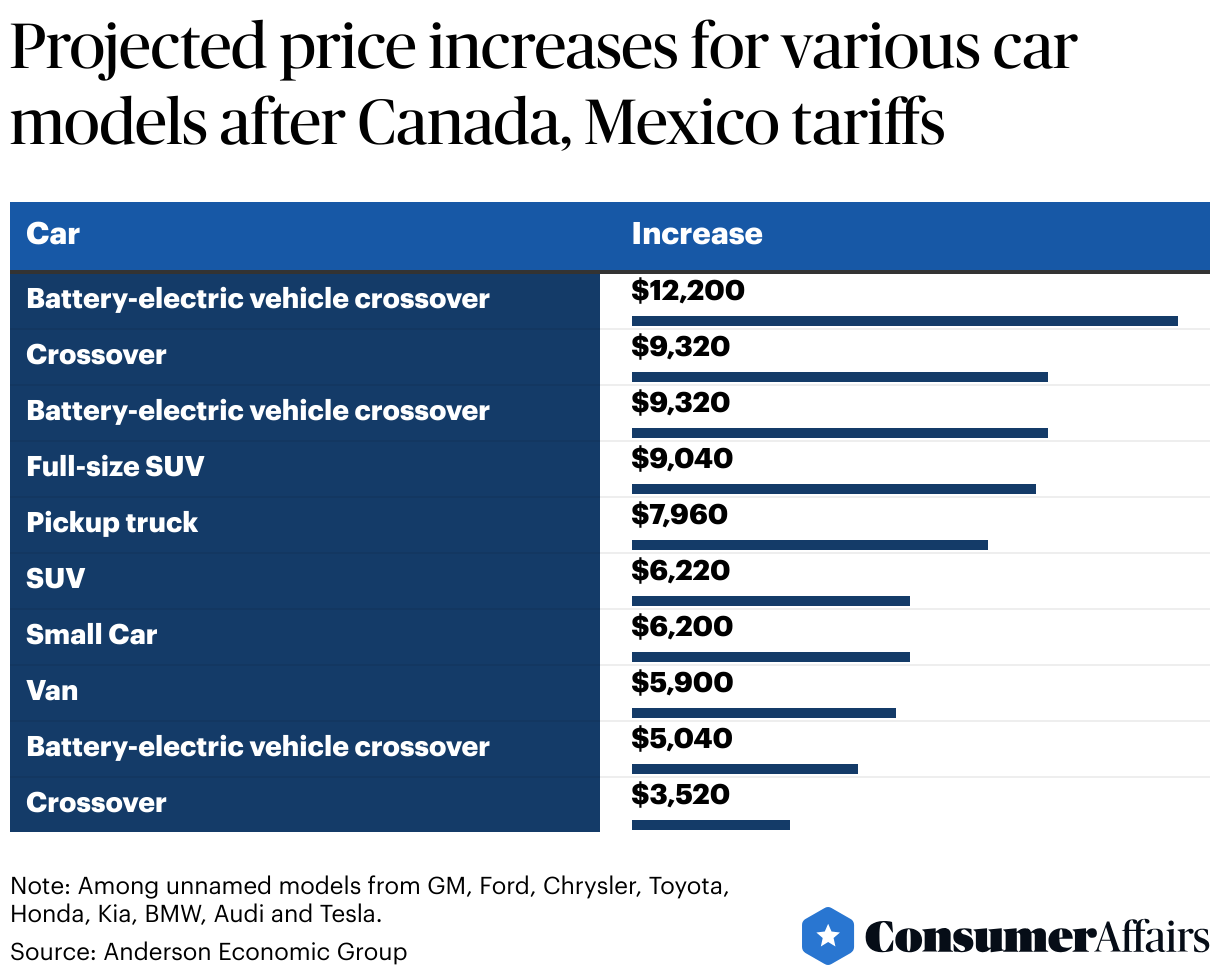
The price for a battery-electric crossover vehicle could rise as much as $12,000, a full-size SUV by $9,040 and a pickup truck by $7,960, according to a report from consultancy Anderson Economic Group, which reviewed unnamed models fromfrom GM, Ford, Chrysler, Toyota, Honda, Kia, BMW, Audi and Tesla assembled in North America.

The increases are because of tariffs, which are essentially taxes paid by exporters,on imported cars, car parts, steel and aluminum that President Trump slapped on Canada and Mexico, which resulted in retaliatory tariffs from the countries.

That kind of cost increase will lead directly and I expect almost immediately to a decline in sales of the models that have the biggest trade impacts, said Patrick Anderson, chief executive officer of Anderson Economic Group, in an interview with Bloomberg.

Consumer News: Tariffs to raise car prices as much as ,000, report says

Tariffs are also expected to result in production and employment cuts, Anderson Economic Group said.

Tariffs on the scale that President Trump has threatened would have a sharp negative effect on auto sales, the consultancy said.

U.S. auto sales could drop by half a million vehicles because of the tariffs even under a less severe situation, according to Dan Hearsch, leader of the Americas automotive practice at consultant AlixPartners, Bloomberg reports.

Some of those vehicles that cant be produced in the US just probably wont be made for a while, Hearsch said in an interview with Bloomberg.

And car insurance is another areagetting hit by tariffs.

Car insurance rates are expected to rise 60% faster, resulting in an average cost of $2,502 a year for full-coverage car insurance after tariffs by the end of 2025, instead of $2,435, which represents an 8% climb versus 5%, ConsumerAffairsreported in February.

Sign up below for The Daily Consumer, our newsletter on the latest consumer news, including recalls, scams, lawsuits and more.


Posted: 2025-03-04 22:37:24

Get Full News Story On Consumer Affairs


Listen to this article. Speaker link opens in a new window.
Text To Speech BETA Test Version.


More News From This Category
Consumer News: Could full-fat cheese and cream help protect the brain?
Fri, 19 Dec 2025 14:07:05 +0000

A new study suggests high-fat foods in moderation may be healthy

By Mark Huffman of ConsumerAffairs
December 19, 2025
  • Whats behind the study: Dementia cases are rising worldwide, and with no cure available, researchers are looking closely at everyday lifestyle factorslike dietthat might lower risk. Dairy foods have produced mixed results in past research, especially when it comes to fat content.

  • What the researchers wanted to know: Does eating high-fat dairy (like full-fat cheese or cream) affect dementia risk differently than low-fat dairy?

  • How the study was done: Swedish researchers tracked nearly 28,000 adults for about 25 years, comparing detailed dairy intake at midlife with later diagnoses of dementia, Alzheimers disease, and vascular dementia.


Spreads of high-fat cheeses are favorites at holiday parties, but as long as you keep calories under control, indulging in a bit of brie on a cracker may support your cognitive health.

For years, nutrition advice has tended to favor low-fat dairy products, especially for heart health. But a large new study from Sweden suggests that when it comes to brain health, some high-fat dairy foods may deserve a second look.

Researchers analyzing data from the long-running Malm Diet and Cancer cohort found that people who regularly ate high-fat cheese and high-fat cream had a lower risk of developing dementia over the next two decades compared with those who ate little or none.

The study followed 27,670 adults, mostly in their late 50s at the start, for a median of 25 years. During that time, more than 3,200 participants developed dementia, allowing researchers to compare long-term outcomes across different eating habits.

The standout findings

Two dairy products stood out:

  • High-fat cheese: People who ate at least 50 grams a day (about two slices) had a 13% lower risk of dementia overall. The reduction was even stronger nearly 30% lower risk for vascular dementia, which is linked to blood vessel problems in the brain.

  • High-fat cream: Those who consumed at least 20 grams per day had a 16% lower risk of dementia, with lower risks seen for both Alzheimers disease and vascular dementia.

By contrast, low-fat cheese, low-fat cream, milk, yogurt, and butter showed no clear link to dementia risk, positive or negative.

Genetics may matter

The researchers also looked at APOE 4, a genetic variant that raises the risk of Alzheimers disease. Interestingly, the protective link between high-fat cheese and Alzheimers disease was seen only in people who did not carry this gene variant. That suggests genetics may influence how diet affects brain health.

The study didnt test mechanisms directly, but scientists have some theories. Cheese and cream contain fat-soluble vitamins, bioactive peptides, and fermented compounds that may support brain health or reduce inflammation. The food matrix how nutrients interact within whole foods may matter more than fat content alone.

Despite the intriguing results, experts urge caution:

  • This was an observational study, meaning it can show associations but cannot prove cause and effect.

  • Eating more high-fat dairy doesnt guarantee protection from dementia.

  • Other lifestyle factorssuch as physical activity, education, smoking, and overall dietstill play major roles in brain health.

The takeaway for consumers

If you enjoy cheese or a splash of cream in your coffee, this study offers some reassurance that moderate intake of certain high-fat dairy foods is not linked to higher dementia risk, and may even be protective. However, its not a green light to overhaul dietary guidelines just yet.

For now, experts recommend focusing on a balanced, varied diet, paying attention to overall eating patterns rather than single superfoods. As researchers continue to untangle how diet and genetics interact, studies like this help refine, rather than replace, nutrition advice.


Read More ...


Consumer News: TikTok reportedly secures its US future with final sales agreement
Fri, 19 Dec 2025 14:07:05 +0000

The China-based social media company faced a Congressional ban in the US

By Mark Huffman of ConsumerAffairs
December 19, 2025
  • TikTok has signed binding agreements to sell a controlling stake in its U.S. business to a consortium of investors including Oracle, Silver Lake and Abu Dhabi-based MGX forming a new U.S. joint venture to run the platforms American operations.

  • The new company, TikTok USDS Joint Venture LLC, will be majority-American owned, with U.S. data storage, content moderation and algorithm security overseen domestically to satisfy national security requirements and avoid a U.S. ban.

  • ByteDance will retain a minority stake under U.S. law, with the transaction expected to close by January 22, 2026, ending years of regulatory uncertainty and legislative pressure.


TikTok, the massively popular short-video platform used by more than 170 million Americans, has signed binding agreements to divest a controlling share of its U.S. business to a consortium of predominantly American and allied investors, according to various media reports.

The deal, announced internally to employees Thursday and expected to be completed by January 22, 2026, creates a new entity TikTok USDS Joint Venture LLC that will operate TikToks U.S. platform under heightened oversight of data security, content moderation and algorithm governance.

The reported deal would secure TikToks presence in the U.S. after Congress passed legislation to ban it unless its China-based owner relinquished control.

New ownership structure

Under the terms of the agreement:

  • A group led by Oracle, private equity firm Silver Lake, and Abu Dhabi-based MGX will collectively hold roughly 50 % of the new U.S. ventures equity.

  • ByteDance, TikToks Beijing-based parent company, will retain a 19.9 % stake the cap permitted under U.S. foreign-ownership restrictions while existing ByteDance investors will hold about 30.1 %.

A majority-American board of directors will govern the U.S. entity, and Oracle is set to serve as a trusted security partner responsible for storing U.S. user data on local infrastructure.

Addressing national security concerns

The restructuring directly responds to bipartisan U.S. concerns that TikToks Chinese ownership could pose risks to national security and user privacy arguments that have propelled legislative and regulatory action for years. Under a 2024 law, commonly known as the divest-or-ban requirement, TikTok faced a potential nationwide prohibition unless it severed control by its foreign parent company.

As part of the new arrangement, TikToks recommendation algorithm will be retrained on U.S. user data to further insulate it from foreign influence a major sticking point throughout negotiations.

The finalized deal closes a chapter of uncertainty for TikTok in the U.S., where the app has been intermittently threatened with removal since national security concerns first bubbled into public view more than five years ago. Previous presidential administrations and Congress have repeatedly pushed for divestiture, leading to multiple deadline extensions and intense negotiation between Washington and Beijing.


Read More ...


Consumer News: Instacart will pay $60 million to customers for allegedly deceptive practices
Fri, 19 Dec 2025 14:07:05 +0000

The FTC charged the company misled consumers by promising free delivery services

By Mark Huffman of ConsumerAffairs
December 19, 2025
  • Instacart will pay $60 million in consumer refunds to settle Federal Trade Commission allegations that the grocery delivery company used deceptive practices that raised the cost of shopping.

  • The FTC says Instacart misled shoppers about free delivery, satisfaction guarantees, and automatic enrollment into its Instacart+ subscription program.

  • A proposed court order would bar the company from deceptive pricing and subscription tactics and require clearer disclosures and express consumer consent.


The Federal Trade Commission has announced that grocery delivery provider Instacart has agreed to pay $60 million in refunds to consumers as part of a settlement resolving allegations that the company engaged in widespread deceptive practices.

According to the FTC, those practices harmed shoppers and increased the overall cost of grocery delivery for Americans.

Under the proposed settlement, Instacart must also stop the misleading conduct identified by the agency. Consumers who were charged for Instacart+ memberships without their express, informed consent will be eligible for refunds.

Instacart misled consumers by advertising free delivery services, and then charging consumers to have groceries delivered, and failing to disclose to consumers who signed up for a free trial that they would be automatically enrolled into its subscription program, said Christopher Mufarrige, director of the FTCs Bureau of Consumer Protection. He added that the agency is closely monitoring online delivery services to ensure companies compete transparently on price and delivery terms.

As of now, the FTC has not yet provided detailed specifics about how affected consumers will receive their refunds in the Instacart settlement. The agency typically releases that information including the refund distribution process and whether consumers need to file a claim only after the court approves the final order and the refund program is established.

Not so free

The FTC alleges that Instacart falsely advertised free delivery on first orders, even though consumers were still required to pay mandatory service fees. Those fees, which can add up to 15% to the cost of an order, were not clearly disclosed to shoppers, according to the agency.

Regulators also took issue with Instacarts claims of a 100% satisfaction guarantee. The FTC says the language suggested consumers would receive full refunds if they were dissatisfied, but in practice, customers who experienced late deliveries or poor service were often offered only small credits for future orders rather than refunds. In addition, the FTC alleges that Instacart obscured refund options within its self-service menu, leading many consumers to believe credits were their only option.

Another major focus of the complaint was Instacarts handling of its Instacart+ subscription program. The FTC alleges that the company failed to clearly disclose that consumers who signed up for a free trial would be automatically charged at the end of the trial period. The agency also says Instacart did not adequately explain its restrictive refund policies, resulting in hundreds of thousands of consumers being charged membership fees without receiving benefits or refunds.

As part of the proposed settlement order, Instacart would be prohibited from misrepresenting delivery costs and satisfaction guarantees. The company would also be required to clearly and conspicuously disclose subscription terms and obtain express informed consent before enrolling consumers in programs that involve automatic charges unless customers actively opt out.

The FTC approved the stipulated final order by a 20 vote and filed it in the U.S. District Court for the Northern District of California. If approved and signed by a federal judge, the order will carry the force of law.


Read More ...


Consumer News: Gen Z is using AI to budget for the holidays. Here’s how to steal their playbook
Fri, 19 Dec 2025 02:07:04 +0000

You cant unspend this year, but you can copy Gen Z for next year

By Kyle James of ConsumerAffairs
December 18, 2025
  • Use AI to set spending caps. Split your budget by category and add rules like no gifts over $40

  • Add hard-stop banking alerts. Turn on every-transaction notifications and a holiday spending cap

  • Shop on a schedule. Plan your buy windows and stick to 12 purchase days to avoid impulse spending


If your December routine often includes a weekly why did I even buy that? panic, youre not alone. Holiday overspending has a way of sneaking in through dozens of small purchases. But new data suggests that one group is actually getting better at dodging the overspend trap and it just might surprise you, its Gen Z.

TD Banks 2025 Merry Money Survey found that 88% of Gen Z respondents are considering ways to limit holiday overspending. And the modern twist is that more than half (51%) of Gen Z budgeters are using AI to help build that holiday budget.

So, what are the lessons we can take away from Gen Zers? The bottom line is you dont need to be born between 1997-2007 or an AI power user to copy what theyre doing.

The Gen Z holiday spending playbook you can steal

1.Use AI to plan the budget, not to shop smarter

AI is great for helping you plan and coming up with a shopping list full of gift ideas that are within your budget. Consider these prompts that Gen Z is taking full advantage of:

  • Make me a holiday budget for 12 people with a $600 cap, including stocking stuffers, hostess gifts, and wrapping.
  • Then ask for a budget breakdown with what percent should go for gifts, food, travel, etc.
  • Example: If my holiday budget is $1,000, tell me what percent (and dollar amount) should go to gifts vs. food vs. travel vs. donations.

Then take the output and put it somewhere like your notes app, a spreadsheet, or your banking apps budgeting tool. The point is not the AI specifically, but getting an actual number you will follow.

Pro tip: If you want AI to actually help you savemoney, tell it your specific rules. Examples include: No gifts over $40. Two gifts max per kid. Include three backup gift ideas under $25.

2.Set hard stops with alerts

Lets face it, most budgets fail because they dont have enough 'tough love' built into them. To that end, its time to use some techy options that most banking and credit card apps have built into them.

Consider setting up these automatic tripwires:

  • Set a spending alert on your card for every purchase over, say, $50.
  • Set a monthly cap alert for your total holiday category.
  • Turn on notifications for every transaction for the month of December so you can better track your spending.

3.Time your shopping like Gen Z

The survey found young shoppers are intentionally planning around big deal days like Black Friday and Cyber Monday.

That doesnt mean you should buy everything on Black Friday next year. It means you should decide when youll buy each category:

  • Tech and appliances: you can often find deals before Black Friday and in the last week before Christmas.
  • Toys: buy them earlier than you think, starting in late October, keep in mind that the hot toys of the season tend to vanish come December.
  • Stocking stuffers: great deals can be found last-minute.
  • Gift cards: only from secure displays and only when you know youll use them soon.

Pro tip: If youre the type who keeps browsing just to check, youre paying the scrolling tax. Consider having just two planned purchase days and stop shopping in between those days.

4.Copy the set aside money all year trick

The survey also reported that Gen Z is more likely to stash money earmarked for the holidays throughout the year.

While it may be a little too late for 2025, you can easily set this up for next December:

  • Open a separate savings bucket labeled Holiday.
  • Auto-transfer a small amount daily or weekly.

Even a few bucks a day will become a significant amount of money come next holiday season. Money you can use for gifts, travel, and decorations. Plus, youll completely avoid that January credit card bill moment of panic.


Read More ...


Consumer News: Consumer Safety Recall Roundup - Week of Dec. 18, 2025
Thu, 18 Dec 2025 23:07:06 +0000

Bed rails, pools, dressers, beard growth serum, lidocaine ointment, power strips, chandeliers recalled

By News Desk of ConsumerAffairs
December 18, 2025

A wave of new federal recalls and safety warnings highlights continuing concerns about unsafe baby products, risky household items and defective gear of all kindsmany sold online through Amazon, Walmart and other major platforms. The Consumer Product Safety Commission (CPSC) this week announced this week's list of recalls and hazard advisories.

While no deaths have been reported, officials warn that several recalled products pose life-threatening risks, including electrocution, asphyxiation, entrapment, falls, drowning, burns and explosion hazards. Consumers are urged to stop using all affected items immediately.


JOKOSIS bed rail recall for entrapment hazard

About 12,000 JOKOSIS adult bed rails sold on Amazon have been recalled due to risk of entrapment and asphyxiation; customers should stop use immediately and request a refund.

  • Risk of entrapment and asphyxiation from improper design

  • About 12,000 bed rails affected, model HC0262

  • Consumers should stop use and request a refund

Photo

Thousands of JOKOSIS Bed Rails for adults have been recalled due to a serious risk of entrapment and suffocation. The recall affects model HC0262, which is black and features a zippered storage pouch. These products were sold on Amazon.com between August and November 2025. No injuries have been reported, but the design does not meet federal safety standards and lacks required hazard warning labels.

The hazard

When attached to a bed, the recalled bed rails can trap users within the rail or between the rail and mattress, posing a serious risk of entrapment and potential death by asphyxiation. Additionally, the rails are missing mandatory hazard warning labels.

What to do

Consumers should immediately stop using the recalled bed rails and contact JOKOSIS for a full refund.

Company contact

Email JOKOSIS at jokosisbedrailrecall@outlook.com.

Source

https://www.cpsc.gov/Recalls/2026/


Blue Wave pool recall due to drowning risk

Photo

About 13,400 Blue Wave above-ground pools are recalled after a design flaw creates a drowning hazard for children; owners should take immediate safety steps and request a free repair kit.

  • Compression strap allows child access, increasing drowning risk

  • About 13,400 48-inch and taller pools recalled, multiple models

  • Owners should keep children away and request a free repair kit

More than 13,000 Blue Wave above-ground pools have been recalled due to a drowning hazard. The recalled pools, 48 inches and taller, include several models sold at major retailers and online from January 2021 to July 2025. The issue stems from a compression strap on the outside of the pool that can act as a foothold for children. No injuries have been reported.

The hazard

The pool's compression strap may create a foothold, allowing a child to climb into the pool unsupervised, posing a drowning risk.

What to do

Consumers should ensure children cannot access the pool until the repair is made. Contact Blue Wave for a free repair kit and, if needed, drain the pool until the repair is installed.

Company contact

Blue Wave toll-free at (800) 603-0475 from 9 a.m. to 5 p.m. CT Monday through Friday, email at recall@bluewaveproducts.com or visit www.bluewaveproducts.com/pages/recall.

Source

https://www.cpsc.gov/Recalls/2026/


SereneLife Home pool recall for drowning hazard

Eighty SereneLife Home above-ground pools are recalled for a design flaw that could allow children unsupervised access, posing a drowning risk.

  • Compression strap creates foothold for children, posing drowning hazard

  • 80 SereneLife 48-inch and taller pools affected, models SLPORND15 and SLPORND18

  • Owners should stop use and request a refund

Photo

SereneLife Home has recalled 80 above-ground pool units due to a drowning hazard. The issue concerns specific 48-inch and taller models sold online from December 2021 through May 2025. The compression strap design can give children a foothold, increasing the risk of unsupervised entry into the pool. No incidents have been reported.

The hazard

The strap around the pool legs may allow children to climb into the pool, raising the risk of drowning.

What to do

Stop using the recalled pools immediately and contact SereneLife Home for a full refund. Consumers must provide photographic evidence of destruction or disposal.

Company contact

SereneLife Home toll-free at 888-619-6770 from 9 a.m. to 5 p.m. ET Monday through Friday, email at recall@serenelifehome.com or visit https://serenelifehome.com/pages/recalls.

Source

https://www.cpsc.gov/Recalls/2026/


KKL 9-drawer dresser recall for tip-over hazard

About 4,740 KKL Fabric 9-Drawer Dressers sold on Amazon are recalled for tip-over and entrapment risks; consumers should stop use and request a refund.

  • Unstable dresser poses serious tip-over and entrapment hazards

  • About 4,740 dressers recalled, various colors

  • Consumers should stop use and seek a refund

Photo

Thousands of KKL Fabric 9-Drawer Dressers have been recalled due to the risk they may tip over and trap children if not anchored to the wall. The dressers, available in black, brown and white, were sold on Amazon.com between September 2023 and November 2025. No injuries have been reported.

The hazard

If not anchored, these dressers are unstable and violate the mandatory safety standard for clothing storage units, creating serious tip-over and entrapment risks.

What to do

Stop using the dresser immediately and contact the company for a refund.

Company contact

Email HK Brilliant at support-us@kkl-home.com, or visit https://kkl-home.com/ and click Recall for more information.

Source

https://www.cpsc.gov/Recalls/2026/


Feel The Beard serum recall for child poisoning hazard

About 840 bottles of Feel The Beard Minoxidil Beard Growth Oil are recalled due to lack of child-resistant packaging, posing a poisoning risk to young children.

  • Non-child-resistant packaging of minoxidil product poses poisoning risk

  • About 840 bottles of beard serum affected

  • Consumers should secure product and request a replacement

Photo

Feel The Beard has recalled approximately 840 bottles of its Minoxidil Beard Growth Oil for Men due to child-resistant packaging violations. The product contains minoxidil, which must be packaged to prevent accidental poisoning by children. Sold on Amazon.com from April to September 2025, no incidents have been reported.

The hazard

The beard serum contains minoxidil and is not in child-resistant packaging, creating a risk of serious injury or death if ingested by children.

What to do

Immediately secure the bottles out of sight and reach of children. Contact Feel The Beard for instructions on safely destroying the bottle and obtaining a replacement.

Company contact

Email Feel The Beard at ziyad@feelthebeard.com.

Source

https://www.cpsc.gov/Recalls/2026/


Plantimex ointment recall for child poisoning risk

Tens of thousands of Mamisan Lidocaine Ointment jars from Plantimex are recalled due to lack of child-resistant packaging, posing a poisoning risk.

  • Ointment with lidocaine lacks required child-resistant packaging

  • About 50,330 jars affected, UPC 860006498115

  • Consumers should request free repair to address packaging issue

Photo

Plantimex has recalled about 50,330 jars of Mamisan Pain Relieving Topical Ointment because their packaging is not child-resistant. The ointment contains lidocaine, which is hazardous if ingested by children. The affected jars were sold nationwide at Walmart and Target stores and online from April 2024 to October 2025. No injuries have been reported.

The hazard

The ointments packaging does not meet child-resistant requirements, creating a risk of poisoning if the contents are swallowed by young children.

What to do

Consumers should contact Plantimex for a repair to address the packaging issue.

Company contact

Plantimex toll-free at 855-752-6869 from 9 a.m. to 4 p.m. PT Monday through Friday, email at customercare@plantimexusa.com with the subject RECALL, or visit http://plantimexusa.com/contact.php.

Source

https://www.cpsc.gov/Recalls/2026/


ANNQUAN power strip recall for fire risk

About 11,200 ANNQUAN power strips sold on Amazon are recalled due to fire risk from missing overcurrent protection; consumers should stop use and get a refund.

  • Missing overcurrent protection creates fire and burn risk

  • About 11,200 ANNQUAN power strips affected, models EX-D112-05 and EX-D106-25

  • Stop use and request a refund immediately

Photo

ANNQUAN power strips sold on Amazon.com from December 2023 through October 2025 have been recalled due to serious fire risks. The recalled models lack critical overcurrent protection, increasing the risk of fire if overloaded. Seven reports of fuses blowing have been received, but no injuries or fires.

The hazard

The power strips do not have supplementary overcurrent protection, making them susceptible to overheating and potential fire.

What to do

Consumers should stop using the recalled power strips immediately and contact ANNQUAN for a refund.

Company contact

Call 401-998-3366 from 9 a.m. to 5 p.m. ET Monday through Friday, email recall_annquan@163.com or visit https://annquanrecall.com/ for more information.

Source

https://www.cpsc.gov/Recalls/2026/


17 Stories Furniture dresser recall for tip-over hazard

About 2,800 17 Stories Furniture 18-Drawer Dressers are recalled for tip-over and entrapment risk; consumers should stop use and request a refund.

  • Unstable dresser risks tip-over and child entrapment

  • About 2,800 18-drawer dressers recalled, multiple models

  • Owners should stop using and request a refund

Photo

17 Stories Furniture has recalled approximately 2,800 of its 18-Drawer Dressers sold on Wayfair.com between September 2023 and November 2025. The dressers are unstable if not anchored to the wall, violating federal safety standards and posing a tip-over and entrapment hazard to children. No injuries have been reported.

The hazard

The dresser can tip over if not anchored, creating a risk of serious injury or death to children.

What to do

Consumers should stop using the recalled dressers and contact 17 Stories Furniture for a refund.

Company contact

Email Drawer18Recall@outlook.com.

Source

https://www.cpsc.gov/Recalls/2026/


Currey & Company chandelier recall for falling hazard

About 260 Currey & Company Electra Chandeliers are recalled due to improper ceiling connection, posing a risk of falling and injury.

  • Faulty ceiling connection can cause chandelier to fall

  • About 260 Electra and Electra Three Tier Chandeliers recalled

  • Consumers should contact the company for a free repair kit

Photo

Currey & Company has recalled about 260 Electra Chandelier and Electra Three Tier Chandelier light fixtures. The chandeliers, made of glass and iron, were sold from May 2024 to September 2025. The connection component to the ceiling is not threaded properly, creating a risk the fixture could fall. Two incidents of falling chandeliers have been reported, with one resulting in property damage.

The hazard

The chandelier can fall from the ceiling due to an improperly threaded connection, posing a risk of injury from impact.

What to do

Contact Currey & Company for a free in-home repair kit to replace the connection component. The company will cover installation costs.

Company contact

Currey & Company toll-free at 800-899-7047 from 8:30 a.m. to 5:30 p.m. ET Monday through Friday, by email at recall@curreyco.com, or visit https://www.curreyandcompany.com/legalities/recall/.

Source

https://www.cpsc.gov/Recalls/2026/


TopHomer pool drain cover recall for drowning hazard

About 1,040 TopHomer pool drain covers are recalled for failing entrapment protection standards, increasing drowning risk for swimmers.

  • Pool drain covers do not meet safety standards, creating entrapment and drowning hazard

  • About 1,040 8-inch drain covers affected, model SP-1053-B

  • Consumers should stop use and request a refund

Photo

TopHomerUS has recalled about 1,040 of its 8-inch pool drain covers sold on Amazon.com from August 2024 to October 2025. The recalled covers do not comply with entrapment protection standards required by the Virginia Graeme Baker Pool and Spa Safety Act, creating a risk of drowning.

The hazard

The drain covers violate entrapment protection standards, posing entrapment and drowning hazards to swimmers and bathers.

What to do

Consumers should stop using the recalled drain covers immediately and contact TopHomerUS for a refund.

Company contact

Email Tophomer.recall@outlook.com or visit the TopHomerUS Amazon Seller Profile page.

Source

https://www.cpsc.gov/Recalls/2026/


Read More ...


Related Bing News Results
Consumer Reports |Experts warn against daily use of protein supplements
Mon, 20 Oct 2025 22:57:00 GMT
Protein powders and shakes are more popular than ever, often touted as workout fuel or even meal replacements. But a new Consumer Reports investigation reveals a hidden risk: some of these supplements ...

A study found lead in popular protein powders. Here's why you shouldn't panic
Thu, 16 Oct 2025 12:07:00 GMT
A Consumer Reports investigation has found what it calls "concerning" levels of lead in roughly two dozen popular protein powder brands — but says that's not necessarily cause for tossing them. The ...

Consumer Reports Is Fearmongering Again
Thu, 16 Oct 2025 06:46:00 GMT
We preselected all newsletters you had before unsubscribing.

Your Daily Protein Shake Might Be Exposing You to Lead, Consumer Reports Finds
Tue, 14 Oct 2025 03:10:00 GMT
Plant-based powders, particularly those made with pea protein, were found to have the highest lead levels — and only a handful of brands were deemed safe for regular use in the nonprofit’s analysis. A ...

Your Daily Protein Shake Might Be Exposing You to Lead, Consumer Reports Finds
Mon, 13 Oct 2025 17:00:00 GMT
A Consumer Reports investigation found that more than two-thirds of tested protein powders and shakes contained more lead per serving than what food safety experts deem safe for daily consumption.


Blow Us A Whistle


Related Product Search/Búsqueda de productos relacionados

Amazon Logo