For the last year, cybersecurity experts have warned that artificial intelligence will make common scams more dangerous. A Netflix scam currently making the rounds is a good example.
Poor grammar and broken syntax are often signs that a message that appears to be from a major retailer like Amazon is actually from an imposter. However, consumers are now receiving messages that appear to be from Netflix, and thanks to AI experts say these messages are hard to distinguish from the real thing.
According to Mirror, a UK publication, the message subject line is lets tackle your payment details. It then goes on to advise that the Netflix account has been locked until payment information is updated.
Your account is on hold, the advisory reads. Please update your payment details. Were having some trouble with your current billing information. Well try again, but in the meantime you may want to update your payment details.
Because the message looks almost exactly like one that would come from Netflix, many consumers might accept it at face value. By clicking on the provided link, they download a Trojan horse that infects the device and compromises data.
According to people who have received the bogus message, it looks just like one from Netflix, down to the logo and colors. There are no misspelled words or odd sentences that give it away.
Consumers who click on the link are taken to a site that mimics a Netflix sign-in page, where they will be told to enter their log-in credentials, along with other personal information. Once provided, the scammers have all the information they need to steal the victims money.
What to do
So, what is a Netflix subscriber to do when receiving one of these convincing messages? The first thing to do is to go to Netflix.com and attempt to log in. If the login is successful, then there is no problem with the account and the message is a clever fake.
If you still have a concern, go to Netflix.com and send a message to customer service, asking for confirmation that there is nothing wrong with the account. Cybersecurity experts also point out that the fake messages originate from an iCloud email domain, not from an address ending in Netflix.com.
Netflix has also warned subscribers about the scam and points out it does not request bank account details, credit card numbers, or passwords in a message.
Verifying what appears to be a legitimate message from a company may seem like a bothersome extra step, but thanks to AI, its now necessary.
Sign up below for The Daily Consumer, our newsletter on the latest consumer news, including recalls, scams, lawsuits and more.
Ajinomoto Foods North America has expanded a recall of frozen meals to nearly 37 million pounds of products due to possible glass contamination.
The recall includes chicken and pork fried rice, ramen and dumpling products sold under brands such as Trader Joes, Kroger, Ling Ling, Tai Pei and Ajinomoto.
Consumers are urged not to eat the products and instead throw them away or return them to the store.
Ajinomoto Foods North America has dramatically expanded a nationwide recall of frozen meals after consumer complaints about glass found in some products.
The Portland, Oregon-based company is now recalling about 36.9 million pounds of frozen ready-to-eat (RTE) and not-ready-to-eat (NRTE) chicken and pork products, according to an announcement from the U.S. Department of Agricultures Food Safety and Inspection Service (FSIS).
The expansion adds 33,617,045 pounds of products to a recall first announced Feb. 19, bringing the total volume affected to nearly 37 million pounds.
The recalled items include fried rice, ramen and shu mai dumplings produced between Oct. 21, 2024, and Feb. 26, 2026. They were sold under several brand names, including Ajinomoto, Kroger, Ling Ling, Tai Pei and Trader Joes.
Products carry best-by dates ranging from Feb. 28, 2026, through Aug. 19, 2027 and bear establishment numbers P-18356, P-18356B or P-47971 inside the USDA mark of inspection.
The frozen meals were shipped to retail locations nationwide, and some Ajinomoto-branded items were also exported to Canada and Mexico.
Source of contamination
The recall was triggered after the company notified regulators that it had received multiple consumer complaints reporting pieces of glass in the food.
An investigation found that the likely source of the contamination was carrots used as a vegetable ingredient, which may have introduced glass fragments into the affected products.
So far, no injuries have been confirmed, but federal officials say anyone concerned about possible injury should contact a healthcare provider.
What consumers should do
FSIS warns that some of the products may still be stored in retailers inventories or in consumers freezers.
Consumers who purchased the affected products should not eat them. Instead, they should throw them away or return them to the place of purchase for a refund.
The agency said it will conduct recall effectiveness checks to ensure retailers remove the products and customers are properly notified.
Consumers with questions can contact Ajinomoto Foods North America Consumer Affairs at (855) 742-5011 or email customercare@ajinomotofoods.com. Food safety questions can also be directed to the USDA Meat and Poultry Hotline at 888-674-6854.
Oil prices have surged as the Iran war threatens global energy supplies, with Brent crude climbing above $80 per barrel amid fears of disruptions in the Middle East.
Shipping through the Strait of Hormuz a key route for about 20% of global oil has been disrupted, intensifying concerns about shortages and higher fuel costs worldwide.
U.S. officials and market analysts warn the conflict could push energy prices even higher, raising inflation risks and increasing pressure on consumers and policymakers.
Escalating conflict in the Middle East is sending shockwaves through global energy markets, pushing oil prices higher and raising concerns about fuel costs for consumers and businesses worldwide.
Oil prices climbed this week as traders reacted to the risk that the war could disrupt supplies from the Middle East one of the worlds most important energy-producing regions. Brent crude, the international oil benchmark, has risen sharply since the conflict intensified, with prices reaching more than $80 a barrel in recent trading.
There has been an immediate impact at the gas pump. According to AAA, the national average price of regular gasoline has risen by 25 cents per gallon since the U.S. and Israel launched attacks on Iran last weekend. The average price today is $3.25 a gallon.
The Strait of Hormuz is key
Market volatility reflects fears that fighting could interrupt the flow of crude oil and liquefied natural gas through the Strait of Hormuz, a narrow shipping route between Iran and Oman that handles roughly one-fifth of the worlds oil shipments.
Energy markets reacted quickly after the conflict widened, as investors priced in the possibility that supply from the region could slow or be cut off entirely. Early trading saw crude prices surge as attacks in the region threatened tanker traffic and energy infrastructure.
The war has already disrupted shipping in the Persian Gulf and forced some tankers and shipping companies to avoid the Strait of Hormuz due to safety concerns. The resulting uncertainty has driven a significant risk premium in oil markets and could lead to prolonged price increases if fighting continues.
Analysts say the price surge reflects the strategic importance of the region to the global energy system. Iran itself exports roughly 1.6 million barrels of oil per day, and neighboring producers in the Gulf rely heavily on the same shipping routes.
Broader economic impact
Higher energy prices are already beginning to ripple through the global economy. Gasoline prices in the United States have climbed above $3 per gallon for the first time in months, and economists warn that a prolonged conflict could fuel inflation and raise transportation and manufacturing costs.
The surge in oil prices is also affecting financial markets. Stocks have fluctuated as investors weigh the possibility of a broader regional conflict that could tighten energy supplies and slow global economic growth.
The rising cost of energy is becoming a political issue in Washington as the conflict unfolds. Policymakers are weighing how the war may affect domestic fuel prices and economic stability.
Officials have signaled concern that prolonged disruptions in oil flows could push crude prices even higher, potentially toward $100 per barrel if the conflict escalates further.
United Airlines will require passengers to use headphones when listening to audio on personal devices during flights.
The policy aims to reduce cabin noise and improve the onboard experience, according to the airline.
Passengers who refuse may be asked to stop using their devices audio functions during the flight.
United Airlines is rolling out a new onboard etiquette rule that will require passengers to wear headphones when listening to audio or watching videos on personal devices, a move the carrier says is intended to reduce cabin disturbances and improve the flying experience.
The policy, which applies to smartphones, tablets, laptops and handheld gaming devices, prohibits passengers from playing audio through external speakers while onboard. Travelers who want to watch movies, listen to music or play games with sound must use headphones or earbuds.
Airlines have increasingly faced complaints from passengers about others playing videos or music out loud during flights. United said the new rule is meant to address those concerns and bring consistency to expectations for in-flight behavior.
Shared cabin space means shared courtesy, the airline said in a statement announcing the policy. Requiring headphones helps ensure that customers can relax, work or sleep without unnecessary noise.
Violators can be removed from the flight
Under the new rule, flight attendants may remind passengers to use headphones if audio is audible to others nearby. If a traveler does not have headphones available, they may be asked to mute their device.
United already provides headphones for passengers using seat-back entertainment systems on many aircraft, and the airline noted that some flights may have earbuds available for purchase.
The airline said the rule will apply throughout the flight, including during boarding and taxiing, when many passengers begin watching videos or listening to music while settling into their seats.
Growing source of tension
Etiquette issues related to personal electronics have become a growing source of tension in crowded cabins. Complaints about passengers using speakerphone, playing games with loud sound effects or streaming videos without headphones have become common topics on travel forums and social media.
Travel analysts say formalizing the expectation could help cabin crews address the issue more easily.
United said it will communicate the policy through pre-flight announcements, onboard messaging and updates to its customer guidelines. The airline expects the rule to take effect across its network in the coming months.
The FDA has issued 30 warning letters to telehealth companies over misleading claims about compounded GLP-1 drugs.
Regulators say some companies implied their compounded products were equivalent to FDA-approved medications or obscured where the drugs were made.
The action is part of a broader crackdown on misleading direct-to-consumer pharmaceutical advertising launched last September.
The U.S. Food and Drug Administration (FDA) has issued warning letters to 30 telehealth companies for making false or misleading claims about compounded GLP-1 drugs promoted on their websites.
The agency said the companies marketed compounded versions of GLP-1 medications in ways that suggested the products were the same as FDA-approved drugs or failed to clearly disclose where the medications were produced.
Its a new era. We are paying close attention to misleading claims being made by telehealth and pharma companies across all media platformsand taking swift action, said FDA Commissioner Dr. Marty Makary.
Dr. Makary said compounded drugs can play an important role in addressing shortages or meeting specific patient needs, but warned that compounders should not attempt to bypass the FDAs drug approval process.
Second wave of actions
The warning letters mark the second wave of enforcement actions targeting telehealth companies since the FDA launched a broader effort last September to police misleading direct-to-consumer pharmaceutical advertising.
Over the past six months, the agency said it has sent thousands of warning letters to pharmaceutical and telehealth companies directing them to remove misleading advertisements more than were sent during the entire previous decade.
According to the FDA, the most common violations involved claims that compounded GLP-1 products were the same as FDA-approved medications. Other companies promoted drugs using their own brand names or trademarks without clarifying that a separate pharmacy actually compounded the medications.
The FDA emphasized that compounded drugs are not FDA-approved, meaning the agency does not review them for safety, effectiveness,or quality before they are sold. The agency also noted that compounded drugs are not equivalent to generic drugs, which must undergo FDA review and approval.
The warning letters require the companies to correct the violations and remove misleading claims from their marketing materials. Failure to comply could result in further regulatory action, the agency said.
Learn the four Target savings layers Circle offers, manufacturer coupons, gift card promos, and the 5% Circle Card discount can all stack if used correctly.
Combine store and manufacturer coupons You can stack one Target store coupon with one manufacturer coupon on the same item to drop the price fast.
Add rebate apps for extra savings After checkout, scan your receipt with apps like Ibotta or Fetch to earn cashback or points on top of Target discounts.
Using coupons strategically to save money at Target is all about stacking the right discounts. Behind Targets clean red aesthetic lies one of the most stackable savings systems in retail.
The catch? Its layered. And if you dont understand the layers, youll never unlock the real savings.
Heres how Target couponing actually works and how you can turn it into a repeatable system.
First: understand the 4 discount layers at Target
Before you clip anything, you need to understand how Target structures their discounts.
The key to saving big is stacking these different types of discounts in your order. Not by trying to double up the same type of discounts, as that wont work.
Most Target shoppers will only use one savings layer and call it a day. However, the serious savings comes from stacking two to fourat once.
Pro tip: Target coupons and offers refresh every Sunday between midnight and 2 a.m. central time. So, if youre shopping on a Friday or Saturday and not liking any of the deals that youre seeing, wait until Sunday morning and check again.
Target Circle: the engine behind most savings
Target Circle is their completely free loyalty program that lives inside the Target app. If youre not using it, youre overpaying, so youll want to create a free account today.
Inside Circle, youll find the following:
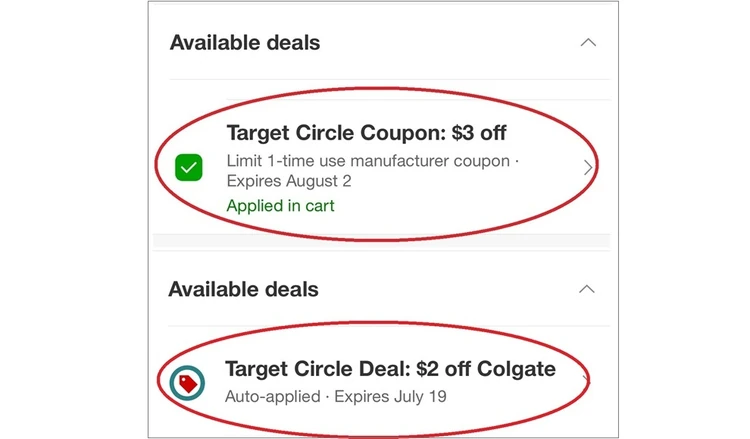
Target Circle coupons (these are auto-applied)
Manufacturer digital coupons (you must click the boxto add them)
Category-wide discounts (like 15% off beauty)
Gift card promos (like $5 gift card when you spend $30 on beauty products)
Personalized Bonus offers
Heres where people get confused:Some Circle offers are store coupons created by Target, and some are manufacturer coupons created by the company that made the product.
Why this matters:
You CAN stack a store coupon with a manufacturer coupon.
You CANNOT stack two manufacturer coupons on the same item.
The app will tell you exactly what type of coupon youre dealing with.
Pro tip: Ive found that the best way to familiarize yourself with the different deals on the Target app and website is to search for the product you want to buy, then tap Target Circle Deals.
This will quickly filter your search results for everything with a Circle discount attached. This will give you a good feel for the types of deals you can expect.
How stacking actually works (with a real breakdown)
Lets walk through a realistic example.
Lets say youre buying laundry detergent and its priced at $14.99.
Then in the app, you find:
$3 Target Circle store coupon
$3 manufacturer coupon
Spend $40 on household items, get $10 gift card promo
Then if you have a Circle Card, that takes another 5% off that $8.99.
Lastly, if this item helps you reach a $40 threshold in household goods, you also trigger a $10 gift card, which effectively reduces your net cost even further.
The cashier will hand you the $10 gift card when in-store, or it will show up in your Target account via their app if you order online.
So, in actuality, that $14.99 detergent will end up costing you closer to $6$7 after factoring in the gift card.
How to actually redeem the coupons
Okay, so you have a few items in your cart, all with Circle offers attached to them, and youre ready to complete your purchase. Youre probably asking yourself, Now what?
When shopping in-store, all you need to do is presentthe Wallet barcode, in the Target app, and the employee will scan it. Thats how their system knows whichsaved Circle offers to apply to your purchase.
When shopping online, you'll need to add any manufacturer coupons orbonus offers that you find before youcheckout. All other Circle discounts, including those free gift card deals, will automatically apply. The discounts will then show in your online order summary, be sure they are all there before you pay.
Pro tip: When I walk into Target, I like to set a reminder on my phone to pull up the Target app and barcode to be scanned at checkout. Because if you forget, they wont retroactively apply your discounts.
Now lets bring Ibotta and Fetch into the mix
Now that you have a good grasp of stacking Circle offers at Target, lets take your savings game to the next level.
Ive personally used Ibotta for years to scan my Target receipts and earn cashback on my in-store purchases. Earnings that you can withdraw to your bank, PayPal account, or via gift cards.
But the whole idea of strategically finding Target Circle Deals that also had Ibotta offers attached to them seemed daunting, and if Im being honest, more effort than it was worth.
But when I set out to find practical ways to make the app work in conjunction with Target offers, I was genuinely surprised at how easy it was to stack my savings.
Heres what I discovered:
1.Ibotta and Target Circle offers often coincide
I was surprised at how many items on the Target app had Circle coupons attached to them as well as Ibotta cashback. Big brands like Purina, Glade, Colgate, Tide, and Brawny to name a few.
2. Search Ibotta by category
Ibotta does a great job of breaking up Target products by category, so you can quickly search the app to see whats available.
When you find a cashback offer you want to use, you need to tap the + sign next to it so the cashback offer gets added to your Ibotta account.
Then when you upload your Target receipt, the cashback gets added to your account within a couple of days.
3. Be open to different brands
The Ibotta and Target Circle mashup works best if youre not stuck on a certain brand and youre willing to buy the brand with the best deal. Obviously, this wont work for everyone, as your dog might need a particular food, or your skin may need a particular laundry detergent.
But for stuff like paper products, trash bags, pastas and rice, cleaning supplies, and even canned vegetables, Ibotta is great as you can easily go off-brand without noticing much difference and save in the process.
Double dipping is easy. At first, I was concerned that if my Target receipt showed that I used a coupon on the item, Ibotta wouldn't accept it.
But thats definitely not the case, as Ibotta accepted my receipt without an issue on multiple items that had a Target coupon attached to it.
Now the Fetch app
The Fetch app is different from Ibotta, as it uses a point-based system where you earn points for scanning grocery receipts and buying specific products.
You then redeem your points for free gift cards at hundreds of different retailers and restaurants.
Heres what you need to know:
1. Offers are lacking when compared to Ibotta
Fetch is a great little companion app to Ibotta but I wouldn't spend a lot of time looking for offers before you go shopping.
They just dont have the quantity of offers to make it worth your while. Instead, focus your time on Ibotta and Target Circle offers.
2. Snap a picture of all receipts
Ive gotten in the habit of submitting all of my Target receipts to Fetch, as you never know what products you bought will trigger a nice little points bonus.
Theyll even occasionally give you points for buying generic products, like bananas and milk.
3. Beware of spending minimums
Some of the better offers on Fetch come with fine print, like having to spend $20 on a specific brand to unlock the bonus points.
Its annoying, and thats why I dont chase Fetch offers. I just scan my Target receipts like clockwork and let the surprise points stack up quietly in the background.
Related Bing News Results Consumer Reports tests caffeine levels in popular coffee brands Wed, 04 Mar 2026 06:14:00 GMT Consumer Reports examined caffeine levels in various coffee brands, revealing significant differences and emphasizing the importance of moderation. Consumer Reports investigates: Toxic beauty ingredients Wed, 18 Feb 2026 20:17:00 GMT Consumer Reports reveals some products in your bathroom may contain ingredients linked to cancer risk, hormone disruption, and other serious health problems. Consumer Reports retests protein powders, finds safer options Wed, 18 Feb 2026 17:22:00 GMT Researchers have tested more popular brands, including five reader-requested chocolate protein powders from Clean Simple Eats, Equate, Premier Protein, Ritual and Truvani. The Top 10 Cars And Trucks For 2026, According To Consumer Reports Sat, 07 Feb 2026 08:05:00 GMT Consumer Reports just released their 2026 Top Picks for autos, trucks and SUVs. They’ve chosen 10 vehicles, one per category, that score big on the stuff buyers actually live with such as road-test ... Consumer Reports finds five popular protein powders meet lead safety thresholds Fri, 30 Jan 2026 13:58:00 GMT TODAY. THIS IS DESPITE PRESIDENT TRUMP’S NEW NOMINEE FOR THE FEDERAL RESERVE CHAIR LAST YEAR, A CONSUMER REPORTS INVESTIGATION FOUND CONCERNING LEVELS OF LEAD IN SOME POPULAR PROTEIN POWDERS. THIS ...



 of ConsumerAffairs