Rockin Robin SongFlying The Web For News.
RobinsPost Logo RobinsPost Amazon


Consumer Daily Reports

There was a 37% jump in reports in 2024

By Dieter Holger of ConsumerAffairs
March 12, 2025

More consumers are reporting insurance identity theft, a sophisticated fraud that can drive up insurance premiums and cancel policies.

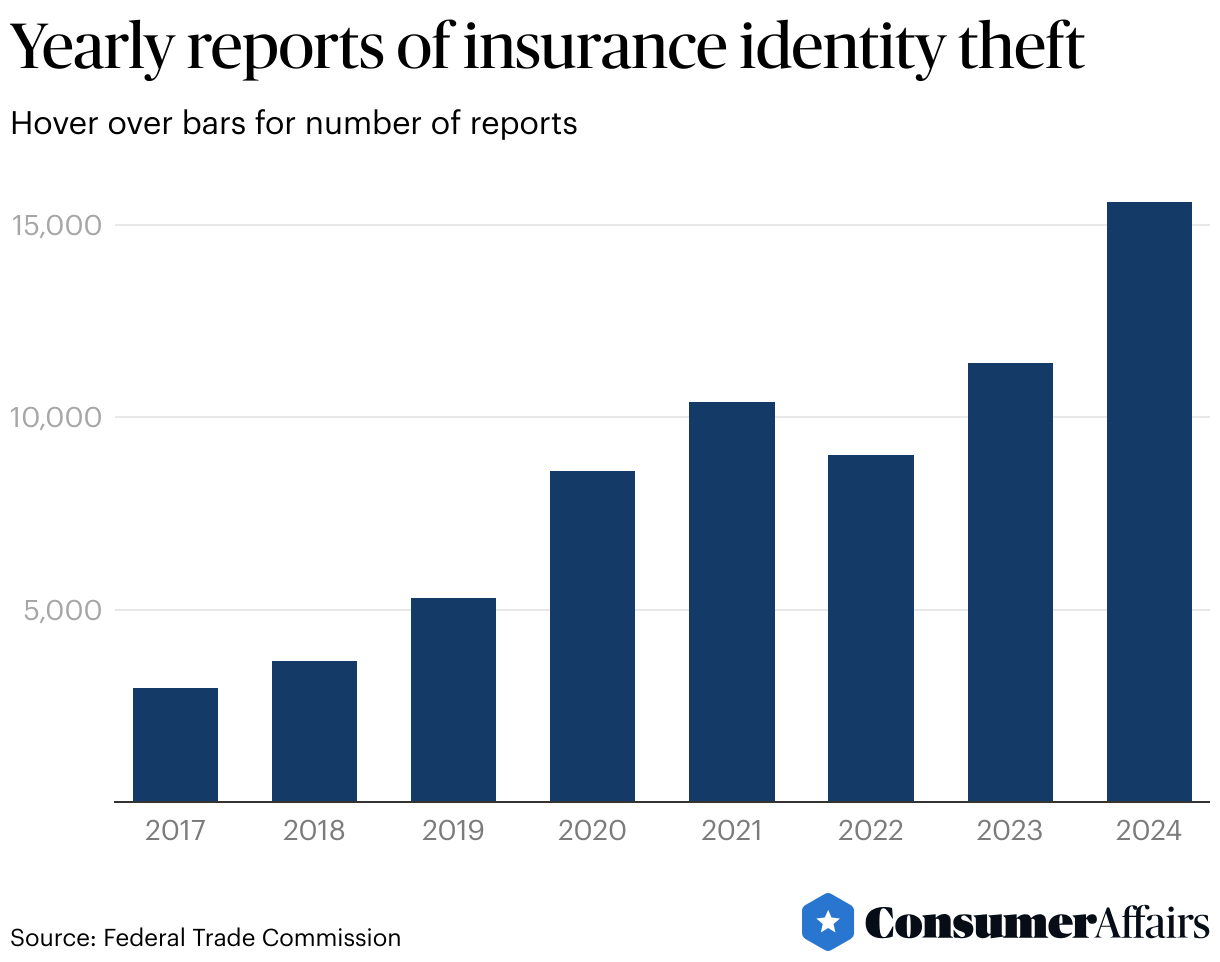
There were 15,587 reports of insurance identity theft in 2024, marking a 37%jump from 2023 and the most reports on record, according to a yearly report from the Federal Trade Commission.

Insurance identity theft also had the biggest increase in reports of any identity theft category in 2024.

The reports don't capture all fraud in the U.S., but represent complaintsfiled to the FTC, other government agencies and organizations such as the Better Business Bureau.

"With insurance becoming harder to obtain for many people, its sadly becoming a tempting target," said Charles L. Moore, a former deputy commander of the United States Cyber Command and now chief military advisor at cybersecurity company Aura, in an interview with ConsumerAffairs.
Consumer News: Insurance identity theft is on the rise

Insurance identity theft can use someone's personal information to obtain an insurance policy, exploit a current policy or receive medical services under someone else's policy, cybersecurity experts told ConsumerAffairs.

The fraud harmsa customer's insurance records, driving up premiums, damaging their claims history and even leading to a policy cancellation.

And the theft canbeundetected for months and is hard to resolve.

Victims often have to deal with multiple companies, including insurers and health care providers, to correct their personal information and the details of fradulent claims, compared with other forms of identity theft thataccess an established accountor open a new line of credit,said Ian Bednowitz, general manager at Norton LifeLock, in an interview with ConsumerAffairs.

"While other forms of identity theft can also be time consuming to resolve, the remediation process for these cases is generally clearer and more straightforward," said Ian Bednowitz, general manager at Norton LifeLock, in an interview with ConsumerAffairs.

Insurance identity theft is on the rise because the growing amount of personal information available online, weak fraud detection and complex insurance systems,Aura's Moore said.

Artificial intelligence, which can generate convincing text, images and websites, is also making it easier for scammers to ensnare victims and trick companies, he added.

"Scams now look so legitimate that it is difficult to detect them in real time," Mooresaid.

How to avoid insurance identity theft

  • Review statements: Check insurance statements to make sure there's nothing unusual, such as premium increases, unauthorized claims or unfamiliar medical providers.
  • Strong passwords: Use unique and strong passwords across different platforms.
  • Carefully disclose:Be cautious with sharing personal information over the phone, online or through email.
  • Report changes:Immediately tell insurers of any changes to your personal information or situation.
  • Dispose documents:Carefully destroy or throw away any documents with identifying information, such as medical records and insurance statements.
  • Identity theft protection: Various companies offer services that protect people fromidentity theft. ConsumerAffairs has reviews of identity theft services.

Sign up below for The Daily Consumer, our newsletter on the latest consumer news, including recalls, scams, lawsuits and more.


Posted: 2025-03-12 21:53:53

Get Full News Story On Consumer Affairs


Listen to this article. Speaker link opens in a new window.
Text To Speech BETA Test Version.


More News From This Category
Consumer News: Roomba maker iRobot files for bankruptcy protection
Mon, 15 Dec 2025 20:07:06 +0000

The company says the maneuver won't affect products or support

By Truman Lewis of ConsumerAffairs
December 15, 2025

Roomba maker seeks Chapter 11 protection as competition and tariffs squeeze margins
Company plans to go private under ownership of its main manufacturer
iRobot says customers should not see disruptions to products or support


iRobot, the maker of the Roomba robotic vacuum cleaner, filed for Chapter 11 bankruptcy protection on Sunday, saying it plans to go private after being acquired by Picea Robotics, its primary manufacturing partner.

The Bedford, Massachusettsbased company filed in Delaware bankruptcy court as it struggles with intensifying competition from lower-priced rivals and rising costs linked to new U.S. tariffs. iRobot had warned in March that its ability to continue operating as a going concern was in doubt.

Competition and tariffs erode profits

iRobot generated about $682 million in revenue in 2024, but mounting pressure from Chinese competitors such as Ecovacs Robotics has weighed heavily on profitability, according to court filings. While iRobot remains a market leader in the United States and Japan, competitors have forced the company to cut prices and invest heavily in technology upgrades to stay relevant.

Those challenges have been compounded by U.S. tariffs, particularly a 46% levy on imports from Vietnam, where iRobot manufactures vacuum cleaners for the U.S. market. The company said the tariffs added roughly $23 million in costs in 2025 and made long-term planning more difficult.

Debt tied to failed Amazon deal

At the time of the bankruptcy filing, iRobot carried about $190 million in debt. Much of that stems from a 2023 loan used to refinance operations while a European antitrust investigation delayed a proposed $1.4 billion acquisition by Amazon.

After the Amazon deal collapsed and iRobot fell behind on payments, Picea a China-based manufacturer acquired iRobots debt from a group of investment funds managed by the Carlyle Group, according to court documents.

Going private under Picea

Under iRobots Chapter 11 plan, Picea will take 100% ownership of the company and cancel the $190 million remaining on the 2023 loan. Picea will also forgive an additional $74 million that iRobot owes under the companies manufacturing agreement.

Other creditors and suppliers are expected to be paid in full, according to bankruptcy filings.

iRobot said the bankruptcy process is not expected to disrupt app functionality, customer programs, global partners, supply chain relationships or product support.

From pandemic boom to steep decline

iRobot was valued at about $3.56 billion in 2021, buoyed by pandemic-driven demand for home technology. Today, the company is worth roughly $140 million, according to data compiled by LSEG.

Founded in 1990 by three Massachusetts Institute of Technology roboticists, iRobot initially focused on defense and space-related work before launching the Roomba in 2002. The robotic vacuum quickly became a household name.

The Roomba still holds about 42% of the U.S. robotic vacuum market and 65% of the Japanese market, according to the company.

iRobot is headquartered in Bedford, Massachusetts, and employs 274 people, court documents show.


Read More ...


Consumer News: Gift card scam hits Giant Eagle: police warn shoppers to check cards before buying
Mon, 15 Dec 2025 20:07:06 +0000

Why you shouldnt grab the first gift card on the hook

By Kyle James of ConsumerAffairs
December 15, 2025
  • The scam: Thieves copy gift card numbers + PINs while cards are still on the rack

  • The hit: Once a cashier activates the card for a unknowingbuyer, the crookdrains it fastoften before its even used

  • Avoid it: Check the PIN/scratch area for tampering, grab from the back, pay with credit, report suspicious cards


Police are investigating a gift card scam reported at a Giant Eagle store near Pittsburgh that we all need to aware of.

Unfortunately, the scam is showing up in grocery and big-box stores nationwide. Police say scammers tamper with gift cards while theyre still hanging on the rack.

Heres how the scam works

Someone steals the gift card number and PIN. They dont steal the actual card, just the information off of it. Theyll then put the gift card back on display, and then wait.

Once an unsuspecting shopper buys the card and a cashier activates it, the scammer can quickly drain the balance before the recipient ever gets to use it.

The Better Business Bureau of Western Pennsylvania says criminals will repeatedly check balances online, sometimes using automated tools, and then move quickly to use the card the moment real money hits it.

In many cases, people dont even realize anything is wrong until they try to spend the gift card and find the balance is already gone.

Police officials said theyre looking to question a person in connection with the reports at the Verona Giant Eagle. Giant Eagle said its cooperating with investigators and has taken steps to help prevent fraud, but warned that card tampering can be difficult to spot. The company also said its working to make customers whole in fraud situations.

The BBB said it has logged hundreds of scam reports involving gift cards this year, and the holiday rush creates the perfect storm: crowded aisles, distracted shoppers, and racks full of easy-to-grab cards.

How to avoid getting burned

Consumer advocates recommend a quick gift card inspection before you toss one in your cart:

  • Check the PIN area. Make sure any tape, scratch-off strip, or protective covering looks intact and hasnt been peeled, replaced, or re-stuck.
  • Dont grab the first card on the rack. Pick one from the back, and avoid cards that look bent, scratched, or resealed. If the protective covering of the card looks comprised, put the card back or show it to an employee.
  • Buy from a trusted store and in person. Avoid sketchy online sources and third-party sellers.
  • Use a credit card when possible. It can be easier to dispute charges than if you pay with cash or debit.
  • Report suspicious cards immediately. If a card looks tampered with, hand it to an employee right away.

Bottom line

Gift cards are still a popularand easy holiday gift, but theyre also an easy target. In the last-minute shopping crush, a 5-second check of the packaging can be the difference between giving someone $50 or giving them an empty piece of plastic.


Read More ...


Consumer News: Star ratings may be fooling shoppers, a new study finds
Mon, 15 Dec 2025 17:07:05 +0000

Star ratings can feel like a shortcut but there are some serious drawbacks

By James R. Hood of ConsumerAffairs
December 15, 2025

Nearly all shoppers rely on star ratings, but new research says those numbers often mislead
Higher-priced products tend to be rated more harshly, skewing comparisons
Cheap, highly rated items may reflect low expectations not high quality


If youre shopping for gifts or hunting for deals, star ratings can feel like a shortcut to smart decisions. A 4.6 must beat a 4.2, and a cheap product with glowing reviews can seem like a no-brainer.

But new research suggests those assumptions are deeply flawed and could be leading shoppers to waste money on low-quality products while overlooking better ones.

A study published in Psychology & Marketing in November 2025 found that consumers routinely misinterpret what star ratings actually measure. While nearly 98% of shoppers check reviews before buying, most assume the stars reflect product quality alone. In reality, they often reflect expectations, price and even the reviewers mood.

When consumers are rating a product, they are giving a vibe rating to some extent, said Ying Zeng, an assistant professor of marketing at the University of Colorado Boulders Leeds School of Business and a co-author of the study. That vibe includes a lot of things what they paid, how the product looks, how well it performs, and what the rater is currently feeling.

How shoppers misread ratings

Zeng and her co-authors conducted six studies using everyday items such as power banks, home theater projectors and maps.

Each study followed the same structure. One group of participants rated products they had used. A separate group then interpreted those ratings as potential buyers.

Across all six studies, the same pattern emerged: People who rated higher-priced products were more critical, while readers of the reviews failed to account for that price effect. As a result, shoppers consistently underestimated the true quality of more expensive items and sometimes assumed cheaper products were better.

Rating is not just about quality, its about the quality-to-price ratio, Zeng said. Readers dont see that. They assume raters are very impartial and very sophisticated that they know how to disentangle price from product quality.

Why expensive products are penalized

Price shapes expectations, and expectations shape ratings.

When consumers pay more, they expect more and they judge more harshly when those expectations arent met.

If its an expensive product, consumers tend to have a higher standard because there is a pain of paying, Zeng said. So the more I pay, the more I discount my rating.

That dynamic can be especially misleading when a higher-end product later goes on sale. Its ratings may reflect disappointment at the original full price, not its actual performance relative to the discounted cost scaring off shoppers who take the stars at face value.

If an expensive product has a low rating but now its discounted, its probably worth considering that product, Zeng said. Compared to a cheap product with a high rating, the actual quality could be higher.

The trap of cheap, highly rated products

Low-priced products often benefit from the opposite effect. Because expectations are lower, even mediocre performance can earn high praise.

The combination of low price and high rating is very appealing, Zeng said. It may feel like a high-quality product at a very good deal, but thats not necessarily the case.

Even experts fall into the trap. Zeng said she still finds herself tempted by cheap items with glowing reviews, despite knowing the research.

I know I should be cautious, but I still get trapped by a product with a cheap price and high rating, she said.

Those purchases have broader consequences. Cheap, low-quality items are often not worth returning, leading consumers to keep or discard products they dont really want adding to waste and sustainability problems.

How to read reviews more wisely

Zengs advice is not to ignore ratings entirely, but to treat them as one signal among many.

Star ratings are popular because theyre quick and intuitive but they strip away context.

Numbers are easy to rely on, but they contain way less information than the text itself, Zeng said. She recommends focusing on patterns in written reviews, not isolated complaints or praise. Recurring issues and consistent strengths are far more revealing than the average star count.

AI-generated review summaries can also help, she said, by scanning hundreds of comments to highlight common themes. AI is a super powerful tool that summarizes the key complaints and key strengths, Zeng said. Use that information and evaluate it with your own needs.

Above all, shoppers should remember what star ratings really are: emotional, contextual judgments shaped heavily by price.

Ratings are contaminated by a lot of things, Zeng said. Theyre emotional, contextual and often heavily influenced by price. Understanding that especially during high-pressure shopping seasons could help consumers make smarter purchases and avoid piles of disappointing products.


Read More ...


Consumer News: Home listings fell sharply in early December
Mon, 15 Dec 2025 17:07:05 +0000

A lack of new inventory may provide a headwind for buyers in 2026

By Mark Huffman of ConsumerAffairs
December 15, 2025
  • New listings of U.S. homes for sale fell 1.7% year over year in the four weeks ending Dec. 7, marking the sharpest decline in more than two years, according to a new report from Redfin.

  • Pending home sales dropped 4.1%, the biggest annual decline in 10 months, as buyers remain cautious amid economic uncertainty and high housing costs.

  • Homes are taking longer to sell, with the typical property going under contract after 51 daysabout a week slower than a year ago.


Recent housing forecasts have been bullish or buyers in 2026, suggesting an improvement in home affordability. But new data from real estate broker Redfin may be clouding that rosy forecast.

Redfin reports new listings of homes across the U.S. are slipping at the fastest pace in over two years as both buyers and sellers pull back during what is shaping up to be a subdued end-of-year housing market. Fewer homes on the market reduces the advantage for buyers, at least heading into the new year.

According to Redfin, the slowdown reflects a mix of normal seasonal patterns and broader hesitation, tied to affordability challenges and lingering economic concerns.

Redfin reports that just under 62,700 new listings hit the market during the four-week period ending Dec. 7, down 1.7% from a year earlier. While late fall and early winter are typically slower for housing, the decline is being amplified by weak buyer demand. Pending home sales fell to about 64,000, down 4.1% year over year, signaling that fewer deals are moving toward completion.

The homes that do sell are lingering on the market for longer periods of time. The median time on market rose to 51 days, six days more than last year, underscoring the cooling pace of transactions. Fewer homes are selling above list price, and sellers are accepting slightly lower sale-to-list price ratios than a year ago.

Affordability remains an issue

Buyers, meanwhile, continue to grapple with high costs. The median home-sale price rose 2% from a year earlier to about $389,000, even as demand softened. Redfin attributes the continued price growth partly to tightening inventory, with active listings up just 4.6% the smallest increase since early 2024 and months of supply hovering near a balanced-market level of 4.6 months.

Mortgage rates have offered some relief, but not enough to spark a rebound. The weekly average 30-year fixed rate fell to 6.19%, its lowest level in more than a year, yet it remains well above the ultra-low levels that fueled earlier buying booms. Mortgage-purchase applications were up sharply from a year ago but dipped slightly week over week, reflecting ongoing volatility in buyer interest.

Some would-be sellers are sitting tight because the market is flat, said Josh Felder, a Redfin Premier agent in San Francisco. He noted that both sellers and buyers are waiting for clearer signals on interest rates, the stock market, and broader economic policies. Some homeowners will put their home on the market in 2026 when they have a better idea of how the economy will shape up.

Regional trends

Regional trends show wide variation. Prices jumped by double digits in metros such as Detroit and Pittsburgh, while cities including Dallas, Seattle, and Sacramento posted significant declines.

Pending sales surged in parts of South Florida but plunged sharply in tech-heavy markets like San Jose and Oakland. New listings increased in Northeastern metros such as Boston and Philadelphia, even as they dropped steeply across parts of Texas and Florida.

Taken together, the data point to a housing market ending the year in a holding pattern, with cautious buyers, hesitant sellers, and modest price growth driven more by limited supply than strong demand.


Read More ...


Consumer News: declined in 2024, except for seniors
Mon, 15 Dec 2025 14:07:03 +0000

Imposter were the most convincing and dangerous

By Mark Huffman of ConsumerAffairs
December 15, 2025
  • Older Americans continued to lose billions of dollars to fraud in 2024, with increasingly exploiting trust, urgency and new technologies.

  • The Federal Trade Commission said impostor , investment fraud and tech-support schemes remained the most damaging to people age 60 and older.

  • While older adults report fraud less often than younger consumers, their individual losses are typically far higher, according to the agency.


Fraud targeting older Americans remained a costly and persistent problem in 2024, even as overall fraud reports leveled off. Thats the conclusion of a new report released by the Federal Trade Commission.

While everyone is a potential victim, the FTC said consumers age 60 and older were disproportionately harmed by that drain retirement savings, pressure victims into quick decisions and exploit fear or isolation. Although older adults file fewer fraud complaints than younger people, the agency noted that their median losses are significantly higher, reflecting both larger financial assets and the devastating impact of a single successful scam.

Impostor topped the list of reported frauds against older Americans, with criminals posing as government officials, bank representatives, businesses or even family members. These often rely on urgent messages warning of supposed legal trouble, frozen accounts or overdue payments, pushing victims to send money before they can verify the claims.

Phony investments

Investment fraud remained another major threat, fueled in part by online pitches and social media outreach. The FTC said scammers frequently promise low-risk or guaranteed returns, sometimes tying the scheme to trending topics such as artificial intelligence, cryptocurrency or real estate opportunities. In many cases, victims reported losing tens or hundreds of thousands of dollars.

Tech-support also continued to target older consumers, often beginning with pop-up warnings or unsolicited calls claiming a computer or financial account has been compromised. Victims are persuaded to grant remote access to their devices or pay for unnecessary repairs, giving scammers a direct path to personal and financial information.

Payment methods are a dead giveaway

The report emphasized that payment methods play a critical role in fraud losses. Bank transfers, cryptocurrency and gift cards were among the most common ways scammers collected money, methods that are difficult to trace or reverse once funds are sent.

If consumers understand that a company requesting payment in Target gift cards is a scam, more people would be protected from these crimes.

FTC officials said the findings highlight the need for increased education, stronger safeguards by financial institutions and continued enforcement actions against fraud networks. The agency urged older Americans and their families to be skeptical of unsolicited requests for money or personal information, take time to verify claims and talk to a trusted person before making financial decisions under pressure.

Fraudsters are constantly adapting, the FTC said in the report, but awareness, verification and conversation remain some of the most effective tools for prevention.

Consumers who believe they have been targeted or victimized by fraud are encouraged to report it to the FTC, which uses the data to identify trends, guide investigations and warn the public.


Read More ...


Related Bing News Results
Consumer Reports |Experts warn against daily use of protein supplements
Mon, 20 Oct 2025 22:57:00 GMT
Protein powders and shakes are more popular than ever, often touted as workout fuel or even meal replacements. But a new Consumer Reports investigation reveals a hidden risk: some of these supplements ...

A study found lead in popular protein powders. Here's why you shouldn't panic
Thu, 16 Oct 2025 12:07:00 GMT
A Consumer Reports investigation has found what it calls "concerning" levels of lead in roughly two dozen popular protein powder brands — but says that's not necessarily cause for tossing them. The ...

Consumer Reports Is Fearmongering Again
Thu, 16 Oct 2025 06:46:00 GMT
We preselected all newsletters you had before unsubscribing.

Unsafe amounts of lead found in some protein powders, report says
Tue, 14 Oct 2025 17:08:00 GMT
More than a dozen protein powders tested for toxic metals were found to have unsafe or concerning amounts of lead, the nonprofit watchdog Consumer Reports said Tuesday, adding that the average lead ...

Your Daily Protein Shake Might Be Exposing You to Lead, Consumer Reports Finds
Tue, 14 Oct 2025 03:10:00 GMT
Plant-based powders, particularly those made with pea protein, were found to have the highest lead levels — and only a handful of brands were deemed safe for regular use in the nonprofit’s analysis. A ...


Blow Us A Whistle


Related Product Search/Búsqueda de productos relacionados

Amazon Logo