

Rockin Robin SongFlying The Web For News.
RobinPost Logo Amazon Prime Deals


Consumer Daily Reports

Other states and cities looking at similar measures to reduce traffic deaths

By James R. Hood of ConsumerAffairs
April 1, 2025

In brief ...

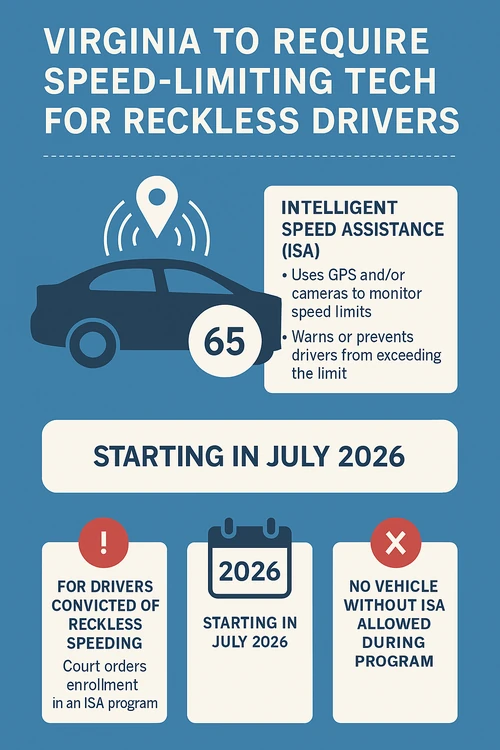
  • New law mandates speed-limiting technology for drivers convicted of reckless speedingspecifically those caught going over 100 mph.

  • Starting July 2026, judges will order enrollment in intelligent speed assistance (ISA) programs; repeat offenders may be offered the program in lieu of license suspension or jail.

  • Advocates say the tech could help reduce speeding-related fatalities, which accounted for over 12,500 U.S. deaths in 2022.

Details

A new Virginia law aimed at cracking down on reckless driving will require some convicted speeders to install intelligent speed assistance (ISA) technology in their vehiclesa move hailed by road safety advocates as a potential life-saver.

Signed into law as HB2096, the policy applies to drivers convicted of reckless driving at speeds exceeding 100 miles per hour. Starting in July 2026, courts will be required to enroll those individuals in an ISA program, which uses GPS and speed-limit databasesor cameras that detect road signsto either alert drivers when they're speeding or actively limit the vehicles speed.

This will make our streets safer, said Del. Patrick A. Hope (D-Arlington), a lead sponsor of the bill.
Photo

Better than jail ...

The law also offers ISA as an alternative to license suspension or jail time for repeat traffic offenders who have accumulated enough demerit points. Under the program, drivers will be barred from operating any vehicle not equipped with ISA and will be required to pay for installation themselves.

An emotional push for the bill came from Tammy McGee, whose teenage son, Conner Guido, was killed by a reckless driver. I hope that by installing speed-limiting technology on the vehicles of those who choose to repeatedly speed, we can save lives, she said.

A proposed amendment by Gov. Glenn Youngkin would give judges discretion over how long a driver remains in the programpending approval from the state legislature.

The law applies only to private passenger vehicles, not commercial ones, but it reflects growing national momentum for ISA. New York City, for example, has reported a 64% drop in high-speed driving in areas where ISA-equipped fleet vehicles are in use. Other cities, including Ventura County (CA), Somerville (MA), and Washington, D.C., have already launched pilot programs.

With speeding involved in nearly 30% of U.S. traffic fatalities, according to the National Highway Traffic Safety Administration, safety groups like the Insurance Institute for Highway Safety and Families for Safe Streets are calling for broader adoption of the techincluding federal mandates.

In January, the National Transportation Safety Board (NTSB) recommended ISA be required in all new vehicleseither as a passive alert system or one that actively limits speed.


Posted: 2025-04-01 17:33:53

Get Full News Story On Consumer Affairs


Listen to this article. Speaker link opens in a new window.
Text To Speech BETA Test Version.


More News From This Category
Consumer News: Dr. AI not the most reliable source of medical advice, study finds
Tue, 10 Feb 2026 14:07:06 +0000

Oxford researchers find subtle errors and oversimplification in the advice

By Mark Huffman of ConsumerAffairs
February 10, 2026
  • Researchers at Oxford University warn that popular AI chatbots can deliver medical advice that sounds confident but may be incomplete, misleading, or unsafe.

  • The study found that even when AI systems cite credible sources, they can misinterpret guidelines or fail to account for patient-specific factors.

  • Experts say the findings highlight the growing need for regulation, transparency, and human oversight as AI tools become more common in health care.


A new study from the University of Oxford is raising new concerns about the reliability of medical advice generated by artificial intelligence, warning that widely used AI platforms may inadvertently put users at risk.

The research, conducted by a multidisciplinary team of clinicians and computer scientists, examined how large language models respond to common health-related questions. According to the study, AI systems frequently produced answers that appeared authoritative and well-structured, yet contained subtle errors, oversimplifications, or advice that conflicted with established medical guidance.

One of the most troubling findings was the tendency of AI platforms to generalize. Researchers found that chatbots often failed to distinguish between symptoms that require urgent medical attention and those that can be managed at home.

In some cases, the systems offered reassurance where caution was warranted, while in others they suggested unnecessary alarm.

How useful is the advice?

Dr Adam Mahdi, senior author on the study, said that while AI is able to give medical information, people "struggle to get useful advice from it".

"People share information gradually", he told the BBC. "They leave things out, they don't mention everything. So, in our study, when the AI listed three possible conditions, people were left to guess which of those can fit.

The study also highlighted issues with sourcing. While AI-generated responses sometimes referenced reputable organizations or clinical guidelines, the models did not always apply those sources correctly. Advice could be outdated, taken out of context, or mismatched to the users situationparticularly for people with chronic conditions, multiple medications, or atypical symptoms.

Problematic design

The researchers stressed that the problem is not malicious intent, but design. Most AI platforms are not built to practice medicine, yet they are increasingly used that way as consumers turn to chatbots for quick answers about symptoms, medications, and treatments.

Oxfords team is calling for clearer warnings to users, improved training data, and stronger collaboration between AI developers and medical professionals. The team also emphasized that AI tools should supplement, not replace, qualified healthcare providers.


Read More ...


Consumer News: Grocery prices climb nearly 6% year over year in January
Tue, 10 Feb 2026 14:07:06 +0000

Coffee and cereal lead the increase

By Mark Huffman of ConsumerAffairs
February 10, 2026
  • The ConsumerAffairs Datasembly Shopping Cart Index rose 5.9% year over year in January, increasing from $147.71 in January 2025 to $156.43 in January 2026 an $8.72 jump for the same basket of everyday items.

  • Coffee, cereal and paper products drove much of the increase, while a handful of staples including eggs, butter and bottled water offered modest relief.

  • Food inflation remains uneven, with sharp increases in packaged and branded goods offset by flat or declining prices in select dairy and pantry items.


The cost of a typical grocery run continued to rise in January, according to the ConsumerAffairs Datasembly Shopping Cart Index, underscoring how inflation is still shaping household budgets in uneven ways.

The index, which tracks prices for a standardized basket of 24 common grocery and household items, increased from $147.71 in January 2025 to $156.43 in January 2026, a 5.9% year-over-year increase. While that gain is smaller than the double-digit spikes consumers saw earlier in the inflation cycle, it signals that price pressures have not fully eased.

Coffee and cereal lead price gains

Some of the biggest increases came from pantry and breakfast staples. Whole bean coffee jumped 26.9%, rising from $12.22 to $15.51 the largest dollar and percentage increase in the index. Coffee prices have been pressured by weather-related supply issues and higher transportation costs.

Cereal also stood out. Honey Nut Cereal (family size) climbed 24.3%, rising from $5.60 to $6.96, while American cheese singles rose 11.3%, reaching $6.02. Branded packaged foods have been especially sensitive to higher input and marketing costs, according to retail pricing data.

January Shopping Cart Index (Table)

Household essentials keep creeping up

Non-food essentials continued their slow upward march. Paper towels rose 4.3%, increasing by a dollar to $23.99, and toilet paper climbed 6.6%, reaching $12.48 for a 12-count pack. These products tend to move gradually, but their higher price points amplify the impact on monthly budgets.

Laundry detergent also edged higher, rising from $13.05 to $13.33. (Liquid dish detergent was included in the basket, but January 2026 pricing was unavailable and not factored into the year-over-year comparison.)

Some relief at the dairy case

Not every aisle saw increases. Organic eggs fell 7.9%, dropping from $6.68 to $6.15, a notable reversal after years of volatility. Salted butter declined 8.8%, and bottled spring water slipped 3.5%.

Other staples, including milk and bread, were flat year over year a welcome sign for shoppers who rely on these basics.

Inflation isnt gone its just selective

Overall, the January data suggests inflation has become more selective rather than universal. Prices for indulgences and branded packaged foods are climbing faster than staples, while some commodities are stabilizing or retreating.

For consumers, that means grocery bills may feel unpredictable not because everything is getting more expensive, but because the items people notice most often are.

As 2026 unfolds, the Datasembly Shopping Cart Index will continue to track whether these price pressures broaden again or remain concentrated in specific categories.


Read More ...


Consumer News: Gas prices tick higher but remain well below last year
Tue, 10 Feb 2026 14:07:06 +0000

Seasonal trends taking hold on the West Coast

By Mark Huffman of ConsumerAffairs
February 10, 2026
  • The nations average price of gasoline has risen 1.2 cents over the last week and stands at $2.84 per gallon, according to GasBuddy data compiled from more than 12 million individual price reports covering over 150,000 gas stations across the country.

  • The national average is up 5.4 cents from a month ago and is 24.9 cents per gallon lower than a year ago.

  • The national average price of diesel rose 2.9 cents in the last week and stands at $3.614 per gallon.


The national average price of gasoline edged slightly higher over the past week as seasonal forces, particularly on the West Coast, began to exert more influence on pump prices. While most states experienced only modest changes, California and neighboring states saw more pronounced increases as the region started its annual transition to more expensive summer gasoline blends.

Patrick De Haan, head of petroleum analysis at GasBuddy, said the broader trend points toward gradually rising prices as spring approaches.

Most states saw relatively minor fluctuations, but were now starting to see seasonal trends take hold on the West Coast, with those pressures expected to gradually push eastward in the weeks ahead, De Haan said in the GasBuddy Blog. He added that despite a slight dip in oil prices last week, strengthening seasonal demand could push the national average back above $3 per gallon for at least part of the spring.

Oil market impact

Oil markets, meanwhile, are showing signs of stabilization after weeks of volatility. Easing tensions between the U.S. and Iran have helped cap crude prices, even as they remain elevated compared with earlier months.

In early trading this week, West Texas Intermediate crude rose slightly to $63.58 per barrel, while Brent crude inched up to $68.07 per barrel. Ongoing diplomatic talks have kept prices largely confined to a narrow range between $62 and $65 per barrel.

Still, analysts caution that geopolitical risks remain a key wildcard. Giovanni Staunovo, commodities analyst at UBS, noted that markets are closely watching developments in the Middle East, as well as a series of oil market reports due this week from major energy agencies.

Those reports are expected to reflect lower U.S. oil output forecasts following recent weather-related disruptions.

Supply data from the Energy Information Administration underscore the mixed signals facing the market. U.S. crude oil inventories fell by 3.5 million barrels in the latest reporting week and remain below the seasonal average, while gasoline inventories rose and now sit above their five-year norm. Distillate supplies, which include diesel, dropped sharply and are running below average, helping explain the recent uptick in diesel prices. Refinery utilization also declined slightly, and implied gasoline demand fell by more than 600,000 barrels per day.

Price disparity

At the pump, price disparities remain wide across the country. The most common gasoline price motorists encountered last week was $2.59 per gallon, while the median price stood at $2.74. The gap between the cheapest and most expensive stations is stark, with the bottom 10% of stations averaging $2.26 per gallon and the top 10% averaging $4.14.

Oklahoma, Mississippi, and Arkansas currently boast the lowest statewide averages, while California, Hawaii, and Washington remain the most expensive. California also led the nation in weekly increases, rising 8.5 cents, while Michigan saw the largest decline, down 8.5 cents.

As spring approaches and summer driving season draws closer, analysts expect price pressures to build gradually, especially if seasonal demand strengthens and refinery or geopolitical disruptions emerge. For now, motorists are seeing relatively modest changes, but the calm may not last much longer.


Read More ...


Consumer News: Hate waiting for locked-up items? Here’s how shoppers are skipping the hassle
Mon, 09 Feb 2026 23:07:06 +0000

How to shop smarter when stores put essentials behind glass

By Kyle James of ConsumerAffairs
February 9, 2026
  • Skip the wait with pickup:Order locked items through apps from Walmart, Target, or CVS and choose curbside or in-store pickup so employees grab everything for you.

  • Price-check before you press the button:Scan the barcode and compare prices on Amazon or warehouse clubs like Costco to see if skipping the case saves both time and money.

  • Switch to store brands to avoid the glass:Many locked items are premium brands, while cheaper generics and store brands are often left accessible and cost less anyway.


More stores are locking up everyday items like deodorant, toothpaste, baby formula, razors, laundry detergent, and skincare.

Retailers say its about preventing theft. But shoppers say its a major hassle and many are walking out and buying elsewhere instead.

If youve ever stood there pressing a call button waiting and waiting you already know the frustration.

Major frustration in the aisles

Shoppers have taken to social media to vent about locked items at major retailers like Walmart, Target, CVS, Walgreens, and others.

Many shoppers say the delay in finding a staff member, and waiting for a key, is making them much more likely to use Amazon, especially Amazon pharmacy services.

Some shoppers also say they simply leave the store and buy the same item online or at a competitor where the product is easily accessible.

For retailers, that means what was intended to prevent loss may be creating lost sales instead.

Heres how to deal with locked displays without wasting your time or overpaying.

Check online inventory before you go

The next time you head to Target, Walmart, CVS, or Walgreens, look up the particular item in the stores app.

Why this helps:

  • Some stores flag items as in locked case or store assistance required.
  • If this is the case, you can choose curbside pickup instead and skip the case entirely.
  • This will also help you determine if another nearby location has the product more accessible.

Pro tip: If its a high-theft item (think razors, fragrance, detergent, baby formula), its smart to consider store pick-up for your ENTIRE purchase and not have to deal with any locked shelves.

Use pickup or delivery to bypass the lock

Locked shelves are obviously an in-store problem not an online shopping issue.

So, when you order online and select pickup, employees pull the item for you. This saves you the time it takes to flag someone down to open a lock to retrieve the item.

This works especially well at:

  • Walmart curbside
  • Target Drive Up
  • CVS pickup orders

You avoid:

  • Waiting for an employee.
  • Feeling rushed while they hover, waiting to lock the shelf back up when youre done.
  • Impulse buys while you stand there waiting.

If its locked, ask for multiple items at once

Once an employee opens a case, dont just grab one thing and let them walk away.

Say something like:

Could you grab two of these and that one next to it as well?

Or,

I need something unlocked on a different aisle; can you walk with me?

If you know youre going to need other items that are locked up, ask if the employee can hang with you for a minute and get it all done at once.

You save yourself from tracking someone down again and most workers actually prefer grabbing everything in one trip.

Pro tip: One place where you never find everyday essentials behind a lock is at warehouse clubs. For this reason alone, now may be the time to consider a Sams Club or Costco membership.

Compare prices before pressing the button

Many shoppers are pushing back by simply making the choice to buy elsewhere rather than deal with all the locked-up merchandise.

Try this the next time an item is locked and anemployee is nowhere in sight:

  • Scan the barcode with your phone.
  • Check Amazons price.
  • Check Costco's price if its a bulk item.

If the price is similar (or cheaper online), skipping the wait will save you both timeandmoney.

Pro tip: If I know Ill need something thats locked up, Ive gotten in the habit of politely asking for help as I walk in. This works especially well in smaller stores like CVS and Walgreens as theres almost always an employee in the front of the store who can walk back with me and unlock something.

Avoid peak hours for locked-item shopping

Evening and weekend shopping = fewer available employees with keys.

If you know you need locked items try this strategy:

  • Go earlier in the day.
  • Shop weekdays if possible.
  • Combine it with a pickup order.

Less waiting also means less temptation to abandon your cart out of frustration, which could easily lead to overspending elsewhere.

Use this moment to rethink brand loyalty

Locked cases are often for premium brands with quick resell value, which is why thieves target them.

But cheaper store brands are less desirable for thieves and thus are frequently left accessible and not locked-up.

Consider the following store brand swaps if you find yourself always waiting for an employees assistance:

  • Name-brand razors store brand blades
  • Prestige skincare dermatologist-recommended basics
  • Brand-name OTC meds generic equivalents
  • Name-brand batteries store brand alkaline
  • Designer pain relief patches generic lidocaine or menthol patches
  • Brand-name allergy meds store brand antihistamines
  • Name-brand reading glasses pharmacy or big-box store readers

Not only will you save some money, but theres a great chance youll be able to skip the locked case entirely.

Dont be afraid to walk away

Its a guarantee that retailers track their lost sales, so it might be time to start speaking with our dollars.

If enough customers skip locked items altogether, and sales start to slip, policies may start to change.

You can personally make it happen by purchasing items later online or by going to another store.

Stores like Target know that shoppers hate the inconvenience and are testing digital shelf-unlocking technology in the hopes of finding a better solution.

By continuing to put pressure on retailers, we can hopefully speed up the adoption of new technology and policiesthat don'trequire us to find an employee every time weneed a tube of toothpaste.


Read More ...


Consumer News: The FDA is redefining ‘no artificial colors’ on packaged foods
Mon, 09 Feb 2026 20:07:07 +0000

Food labels may look the same but mean something new starting now

By Kristen Dalli of ConsumerAffairs
February 9, 2026

  • No artificial colors can now be used on food labels even if natural dyes are added.

  • FDA will let companies use these claims voluntarily without penalty.

  • New natural color options are approved to help phase out synthetic dyes.


The U.S. Food and Drug Administration (FDA) recently announced a shift in how it interprets no artificial colors.

Under the new approach, food makers may use statements like Made without artificial food colors or No artificial colorings on labels as long as the product doesnt contain petroleum-based synthetic dyes.

That means if a drink or snack is colored with FDA-approved natural sources like spirulina extract or beetroot red it can still wear that reassuring phrase.

We acknowledge that calling colors derived from natural sources artificial might be confusing for consumers and a hindrance for companies to explore alternative food coloring options, FDA Commissioner Marty Makary, M.D., M.P.H., said in a news release

Were taking away that hindrance and making it easier for companies to use these colors in the foods our families eat every day.

Moving away from synthetic dyes

This isnt a mandatory rule that companies must follow its voluntary and backed by what the FDA calls enforcement discretion. In practice, that means the agency wont take legal action against companies that use these claims appropriately, even though theyre technically loosening the reins on old restrictions.

The change is part of a broader FDA and Health and Human Services push to encourage the food industry to move away from petroleum-based synthetic dyes and toward alternatives that come from more familiar sources.

The agency has also approved new natural color additives like beetroot red and expanded the use of others such as spirulina extract to give manufacturers more options.

What Consumers Should Know

  • No artificial colors now has a new meaning. It doesnt automatically mean there are zero added colors it just means no petroleum-based synthetic dyes. Natural colorings (even ones added purposely) are okay under the new policy.

  • This change is voluntary and not a guarantee of safety. It doesnt mean a product is healthier overall just that the specific synthetic dyes regulated under federal law arent present. Other ingredients like sugar, salt or preservatives may still be in the product.

  • Keep reading labels. Dont rely solely on marketing claims. Check the ingredient list if youre avoiding certain additives or have specific dietary concerns.

The FDA is trying to make front-of-package claims more flexible and clearer in the long run and to encourage the food industry to explore naturally-sourced color options. But as with any label claim, a little skepticism and some label reading go a long way.


Read More ...


Related Bing News Results
Consumer Reports Investigates: What you need to know about toxic beauty ingredients
Tue, 10 Feb 2026 06:24:00 GMT
Consumer Reports reveals that some shampoos, deodorants, lotions or makeup may contain ingredients linked to cancer risk, hormone disruption, and other serious health problems.

Consumer Reports Investigates: Toxic beauty ingredients
Tue, 10 Feb 2026 05:59:00 GMT
Consumer Reports Investigates: Toxic beauty ingredients ...

Eat a protein-packed diet without powders | Consumer Reports
Mon, 09 Feb 2026 13:04:00 GMT
A Consumer Reports investigation found high levels of lead in some protein powders and shakes, raising questions about supplement safety.

7 cars Consumer Reports says are smart buys for 2026
Mon, 09 Feb 2026 12:45:34 GMT
You want a smart car purchase that balances fuel economy, safety, and long-term value — […] ...

Consumer Reports' top 10 vehicles for 2026 — see which cars made the list
Wed, 04 Feb 2026 14:40:11 GMT
For the first time, the top 10 cars on Consumer Reports' annual list of best new vehicles also include electric or hybrid models.


Blow Us A Whistle


Related Product Search/Búsqueda de productos relacionados

Amazon Logo

Visit Our New Print-On-Demand Stores On Printify and Zazzle
Printify Zazzle













