Rockin Robin SongFlying The Web For News.
RobinPost Logo Amazon Prime Deals


Consumer Daily Reports

The warning follows a recall of cilantro

By Dieter Holger of ConsumerAffairs
April 14, 2025

Twelve cannedsoups and onebowl product, including from Campbell's and Molly's Kitchen, may contain wood, the U.S. Department of Agriculture said Friday in a public health alert.

The wood was mixed inwith cilantro and the public health alert was issued after a recall for the cilantro, the USDA said.

The USDA said the products, including Campbell's Chicken Tortilla Soup, Molly's Kitchen Baja Chicken Enchilada Soup and Life Cuisine Vital Pursuit Southwest Style Taco Bowl, shipped to retailers in Illinois, Indiana, Michigan and Ohio.

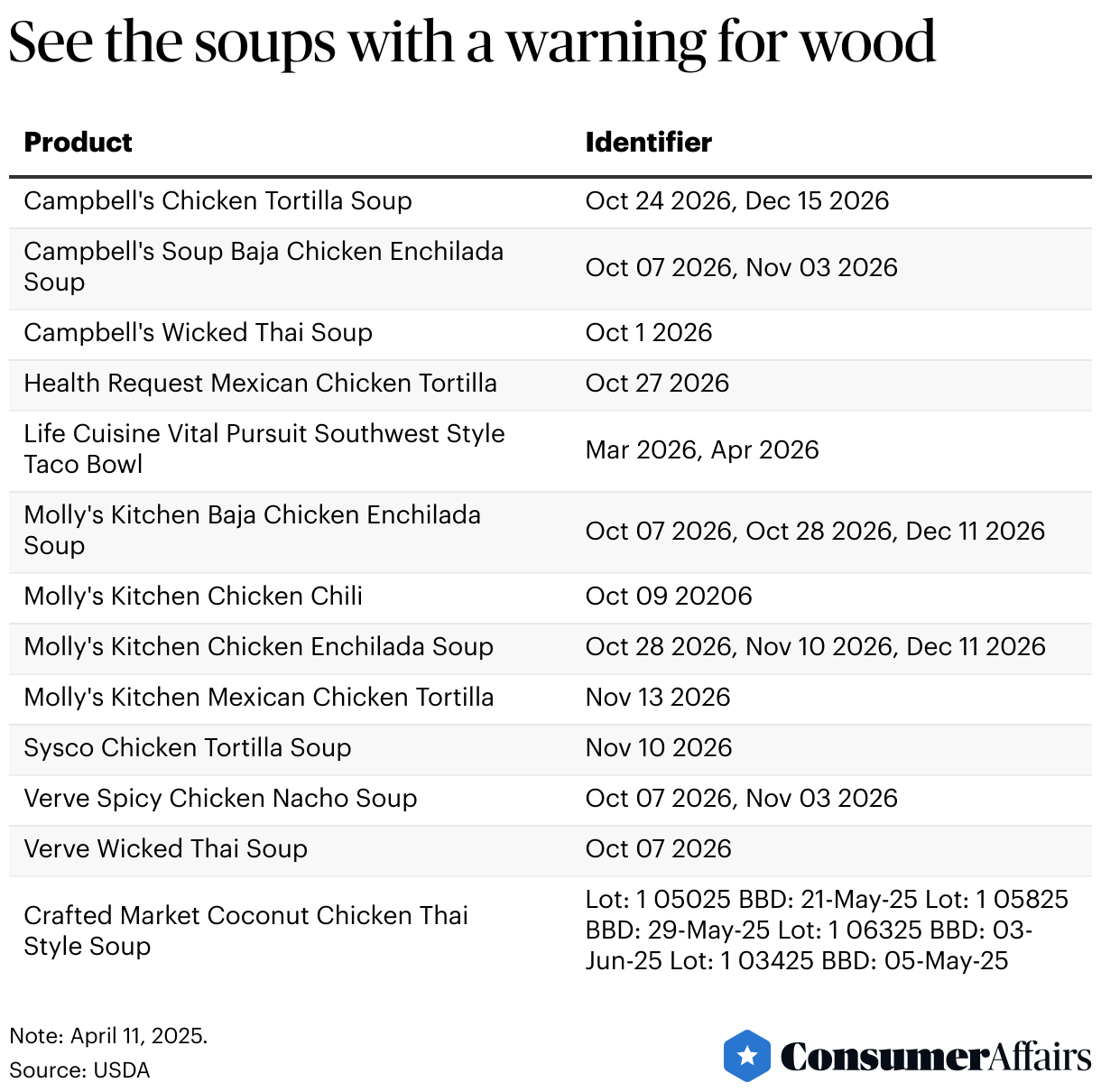
Below is a table listing all the soups with the health warningand how they can be identified.

Consumer News: Warning issued on Campbell's, Molly's Kitchen soups for containing wood

What to do

Buyers of the soups or the bowl should throw them away or return them to the place of purchase.

Sign up below for The Daily Consumer, our newsletter on the latest consumer news, including recalls, scams, lawsuits and more.


Posted: 2025-04-15 00:10:49

Get Full News Story On Consumer Affairs


Listen to this article. Speaker link opens in a new window.
Text To Speech BETA Test Version.


More News From This Category
Consumer News: Average gas price poised to hit $4 a gallon
Tue, 24 Mar 2026 16:07:07 +0000

It will likely happen before the end of the week

By Mark Huffman of ConsumerAffairs
March 24, 2026
  • The national average price of gasoline jumped 24.3 cents in the past week to $3.92 per gallon, according to GasBuddy data.

  • Prices are now 98.9 cents higher than a month ago and 84.1 cents above year-ago levels.

  • Diesel surged 27.0 cents to $5.227 per gallon, continuing a sharp upward trend.


Motorists are facing rapidly rising fuel costs as gasoline prices continue their upward climb, with the national average nearing the $4-per-gallon mark for the first time in years.

According to GasBuddy, the average price of gasoline rose 24.3 cents over the past week to $3.92 per gallon. The increase reflects a sharp acceleration compared to recent months, driven by the war with Iran, with prices now nearly a dollar higher than just a month ago and significantly above levels seen this time last year.

Diesel prices have climbed even more aggressively, rising 27 cents in the last week to reach $5.227 per gallon. In some parts of the country, diesel is approaching record highs, increasing transportation costs and fueling inflation.

Patrick De Haan, head of petroleum analysis at GasBuddy, said a combination of seasonal factors and geopolitical tensions is fueling the surge.

Gas prices continued to rise nationwide over the last week as seasonal factors, combined with ongoing supply concerns tied to the continued disruption in the Strait of Hormuz, pushed both gasoline and diesel prices sharply higher, De Haan said in the GasBuddy Blog. It now appears increasingly likely that the national average price of gasoline will reach the $4-per-gallon markpotentially as early as this week.

Oil market volatility driving prices

Oil markets have been highly volatile, reacting to geopolitical developments in the Middle East. Prices initially dropped sharply after former President Donald Trump announced a five-day pause on potential strikes targeting Irans energy infrastructure following reported diplomatic talks.

Early in the week, West Texas Intermediate crude fell $5.63 to $92.60 per barrel, while Brent crude dropped $6.58 to $105.61. Despite the decline, both benchmarks remain elevated, highlighting how quickly geopolitical risks have been priced into the market.

Supply data sends mixed signals

The latest federal data shows a mixed picture for fuel supplies. U.S. crude inventories rose by 6.2 million barrels but remain slightly below seasonal averages. Meanwhile, gasoline inventories fell by 5.4 million barrels, though they remain above typical levels for this time of year.

Distillate inventories, which include diesel, declined by 2.5 million barrels and are now below seasonal normshelping explain the sharper rise in diesel prices.

Refinery utilization edged higher to 91.4%, but implied gasoline demand fell significantly, suggesting consumers may already be cutting back as prices climb.

Wide regional price gaps persist

Fuel prices vary widely across the country. Oklahoma, Kansas and Iowa currently have the lowest average gasoline prices, all near or below $3.33 per gallon. In contrast, California leads the nation at $5.75 per gallon, followed by Washington and Hawaii.

At the station level, the most common gas price is $3.69 per gallon, while the median price stands at $3.79. However, the top 10% of stations average $5.57 per gallon, underscoring the disparity drivers face depending on location.

Weekly increases have also been uneven, with Illinois seeing the largest jump at nearly 40 cents per gallon, followed by Idaho and Oregon.

Diesel shows a similar pattern, with the lowest prices in the Midwest and the highest again concentrated on the West Coast. California drivers are paying an average of $6.88 per gallon for diesel, far above the national average.


Read More ...


Consumer News: FCC bans new foreign-made routers over national security concerns
Tue, 24 Mar 2026 13:07:06 +0000

The ban does not apply to routers consumers already own

By Mark Huffman of ConsumerAffairs
March 24, 2026
  • The FCC has added all foreign-made consumer-grade routers to its Covered List, effectively blocking approval of new models for sale in the U.S.

  • The move follows a national security determination that such devices pose unacceptable risks, including cyberattacks and infrastructure disruption.

  • Existing routers already in use or previously approved are not affected, and companies can seek exemptions through a federal review process.


The Federal Communications Commission (FCC) has moved to block the approval of new consumer-grade routers made in foreign countries, citing significant national security and cybersecurity risks identified by federal agencies.

In an update announced this week, the FCC added all foreign-produced consumer routers to its Covered List, a regulatory designation that prevents certain communications equipment from receiving authorization for sale or import in the United States.

Routerscommon household devices that connect phones, computers, and smart home products to the internetwere determined by a White House-convened interagency group to pose unacceptable risks to the national security of the United States or the safety and security of United States persons.

National security concerns drive the decision

According to the determination, foreign-made routers present two primary risks: vulnerabilities in the global supply chain and serious cybersecurity threats.

Officials warned that such devices could be exploited to disrupt critical infrastructure, harm U.S. consumers, and even impact national defense systems. The assessment also cited past cyber incidentsincluding the Volt, Flax, and Salt Typhoon attacksin which compromised routers were allegedly used to infiltrate networks, conduct espionage, and steal intellectual property.

The move aligns with broader policy goals outlined in President Trumps 2025 National Security Strategy, which emphasized reducing reliance on foreign sources for essential technologies and infrastructure.

What the rule changesand what it doesnt

The FCCs action does not amount to an immediate ban on existing devices. Consumers can continue using routers they already own, and retailers may still sell models that were previously approved through the FCCs equipment authorization process.

However, any new models of foreign-made routers will be barred from entering the U.S. market unless they receive special clearance.

FCC Chairman Brendan Carr said the agency is acting in coordination with national security experts.

I welcome this Executive Branch national security determination, Carr said in a statement. The FCC will continue to do our part in making sure that U.S. cyberspace, critical infrastructure, and supply chains are safe and secure.


Read More ...


Consumer News: The best time to sell your home is just weeks away
Tue, 24 Mar 2026 13:07:06 +0000

A property sales analysis found mid-April is prime time

By Mark Huffman of ConsumerAffairs
March 24, 2026
  • The week of April 1218, 2026, is projected to be the best time to list a home, offering a balance of higher prices, strong demand and faster sales.

  • Homes listed during this period historically receive 16.7% more views and sell about nine days faster than average.

  • Sellers could see median listing prices roughly $5,300 above the annual average and about $26,000 higher than at the start of the year.


If youre planning to sell your home, you should be getting ready. Prime time is rapidly approaching.

A narrow window in mid-April could offer home sellers the strongest opportunity in 2026, as improving affordability and seasonal demand converge, according to a new report from Realtor.com.

The analysis identifies the week of April 1218 as the years optimal time to list a home, describing it as a Goldilocks period when pricing power, buyer activity and market speed align in sellers favor.

After a sluggish 2025 that saw home sales hover near three-decade lows, market conditions are beginning to shift. Mortgage rates, which stabilized in the low 6% range late last year and dipped into the 5% range in early 2026, are expected to draw sidelined buyers back into the market. That renewed demand is forecast to peak in mid-April, coinciding with the traditional spring homebuying season.

After years of being squeezed by limited inventory and high rates, the 2026 housing market is starting to feel more approachable, said Danielle Hale, chief economist at Realtor.com. Lower rates and tempered price growth should give buyers some breathing room, while sellers can benefit from a seasonal pricing advantage.

Why mid-April stands out

Based on seasonal trends from 2018 through 2025, homes listed during this week tend to outperform the rest of the year across several key metrics:

  • Higher prices: Listings typically command about 1.3% more than the average week, translating to roughly $5,300 above the annual median in 2026.

  • Faster sales: Homes sell about 17% quicker, or roughly nine days faster than the yearly norm.

  • Stronger demand: Listings attract significantly more attention, with views per property rising by about 16.7%.

  • Fewer price cuts: Nearly 19% fewer homes see price reductions, indicating firmer pricing conditions.

Sellers also benefit from timing. While inventory has improved, it remains about 16.8% below pre-pandemic norms. Listing in mid-April allows homeowners to tap into rising demand before a surge of competing listings later in the spring.

A market still in transition

Despite the favorable timing, the housing market remains in a delicate rebalancing phase.

One key shift is the gradual easing of the so-called lock-in effect, where homeowners were reluctant to sell and give up ultra-low mortgage rates secured during the pandemic. As more mortgages now carry rates above 6%, more homeowners are re-entering the market, increasing supply.

At the same time, affordability remains a concern. While lower rates have improved purchasing power, economists warn that volatility could persist.

The path lower for mortgage rates remains bumpy, the report notes, urging both buyers and sellers to rate-proof their budgets against potential economic swings.

Competition heats up later in the year

Timing may be especially critical given how quickly competition intensifies. By late June, home prices typically approach their annual peak, but that coincides with a sharp increase in new listingsup more than 38% in 2025.

Listing earlier in April allows sellers to stand out before the market becomes crowded.

The housing market remains undersupplied, especially in the Northeast and Midwest, said Hannah Jones, a senior economic research analyst at Realtor.com. But in the South and West, where inventory is rebounding, timing becomes even more important to attract buyers before competition ramps up.

Local markets vary

While mid-April is the national sweet spot, the best listing window can vary by region.

  • Early-season markets: Tech-driven coastal metros like San Jose, Boston and Seattle tend to peak earlier, often in March.

  • Midwestern and Northeastern cities: More affordable markets such as Milwaukee and Hartford align closely with the mid-April timeline.

  • Southern and Western metros: Areas like Austin and Phoenix, where inventory has rebounded more significantly, may benefit most from the early spring window before listings surge.

In Richmond, Virginia, for example, the report also points to the week of April 12, 2026, as the optimal time to list, with expected listing prices about 7.4% higher than at the start of the yearroughly a $31,000 increase.

Even with favorable timing, sellers may need more preparation than in recent years. While more than half of sellers historically spend a month or less getting their homes ready, analysts suggest starting earlier in 2026 as buyers gain negotiating power.


Read More ...


Consumer News: Rising grocery costs push Americans to rethink how they shop
Tue, 24 Mar 2026 13:07:06 +0000

Brand loyalty is a lot less important now, survey finds

By Mark Huffman of ConsumerAffairs
March 24, 2026
  • Rising grocery prices are pushing most Americans to prioritize cost over brand loyalty

  • More than 90% of shoppers say theyve changed how they buy food in response to higher prices

  • A growing number of households are cutting back, switching to cheaper options, or seeking financial help


For many Americans, grocery shopping has become less about preference and more about price.

New research from consumer insights firm Zappi shows that inflation continues to reshape how people buy food, with 70% of shoppers now saying price or value is the most important factor when choosing snacks and beverages. Nearly one-third say they will simply buy the cheapest option that meets their needs, regardless of brand.

The findings reflect a broader shift: brand loyalty is weakening as household budgets tighten.

Consumers feel the strain

The survey of 2,000 U.S. consumers found that more than 80% have seen grocery prices rise in the past six months. For many, the increases are significant more than one in four reported paying at least $50 more per week, and nearly a quarter said their bills jumped by over $75 weekly.

Overall spending is also climbing. Nearly 60% of Americans now spend more than $150 a week on groceries, and one in four spends more than $250. Families with multiple children are feeling the pressure most, with more than half reporting weekly bills above $200.

In response, over 90% of shoppers say theyve changed their buying habits.

Common strategies include using coupons (46%), switching to store brands (40%), buying only essentials (38%) and purchasing fewer items overall (34%).

More households turning to assistance

For some, the financial strain is going beyond budgeting adjustments.

The report found that 22% of consumers now rely on food banks or community assistance to help cover grocery needs. Another 11% say theyve used Buy Now, Pay Later services to pay for groceries a sign that some households are struggling to cover basic expenses.

Brand loyalty declines as costs rise

As prices climb, fewer shoppers are sticking with name brands. The share of consumers who say they buy only brand-name products has dropped sharply, from 21% to 10% over the past year.

Instead, most shoppers are mixing in lower-cost alternatives. About two-thirds now buy a combination of brand-name and store-brand items.

At the same time, consumers are becoming less tolerant of price increases. Even modest hikes of 5% to 10% are enough to deter many from buying certain products, particularly snacks and beverages.

Health and values take a back seat

While some shoppers still care about nutrition and brand values, those factors are often outweighed by cost.

About 35% say they are more likely to buy healthier snacks than a year ago, and labels like high protein or low sugar still influence decisions. But price remains the deciding factor for many, with nearly one-third choosing the least expensive option regardless of other features.

Similarly, only a small share of consumers say they are willing to pay significantly more for brands that align with their personal values.

What it means for shoppers

The findings suggest that, for now, many Americans are in a defensive mode when it comes to grocery spending focused on stretching dollars rather than brand preferences or lifestyle choices.

With food prices still elevated, that shift may persist, especially for retirees and others on fixed incomes who are particularly sensitive to weekly cost increases.

For consumers, the trend underscores the importance of comparison shopping, using discounts where possible, and staying flexible about brands as grocery costs continue to evolve.


Read More ...


Consumer News: The spring home maintenance jobs that actually save you money
Tue, 24 Mar 2026 01:07:06 +0000

Smart spring cleaning can prevent expensive repairs later

By Kyle James of ConsumerAffairs
March 23, 2026
  • Smart spring cleaning is about small home maintenance tasks that can save hundreds of dollars a year and take as little as 1060 minutes each.

  • Jobs like replacing HVAC filters, cleaning dryer vents, sealing drafty gaps, and flushing your water heater can lower energy waste and help avoid bigger repair bills.

  • Other easy money-saving tasks, like cleaning fridge coils, clearing debris around your AC unit, and replacing cracked caulk, can help appliances run better and prevent costly fixes.


For many homeowners, spring cleaning means decluttering closets, scrubbing floors, and maybe finally dealing with the garage. Thats fine. However,the smartest spring cleaning jobs are the ones that can actually save you money.

Keep in mind that some of the most expensive home repairs start with tiny maintenance tasks people keep putting off. A dirty HVAC filter. A clogged dryer vent. Small gaps around doors and windows. A water heater quietly filling with sediment. None of it feels urgent until it suddenly is.

Heres the spring cleaning checklist that actually matters.

Note: If youre unsure about doing any of these jobs, make YouTube your new best friend. Youll be amazed atthe amount of extremely helpful DIY videos at your disposal for each of these home maintenance jobs.

Replace your HVAC filter before summer hits

This is one of those tiny jobs that gets ignored way too often.

ENERGY STAR says to check your HVAC filter every month during heavy-use seasons and change it at least every three months. A dirty filter slows airflow, forces the system to work harder, wastes energy, and can contribute to expensive maintenance or even early system failure.

Thats a pretty good return for a filter that might cost you $10 to $30. Spring is the perfect time to do it because your air conditioner is about to start working harder.

Actionable tip: Write the replacement month directly on the filter with a marker before installing it. This will help you remember the next time it needs to be replaced.

Pro tip: Its smart to buy multiple filters at once when they go on sale. Homeowners are much more likely to change them on time when the replacement is already sitting in the garage or hallway closet.

Clean your dryer vent line, not just the lint trap

A lot of people think cleaning the lint screen is enough. Its not.

The U.S. Fire Administration says failure to clean was the leading factor in the ignition of home clothes dryer fires from 2018 to 2020, accounting for 31% of incidents. The agency specifically warns that you are at a higher risk of a dryer fire if you dont clean your lint filter and dryer vents.

A clogged vent makes the dryer run longer, which wastes energy and adds wear to the machine.

Actionable tip: Unplug the dryer first, then carefully pull it out, vacuum behind it, and clean the inside of the vent hose if you can safely access it. If the vent run is long or hard to reach, it may be worth hiring this out.

Pro tip: If a load that used to dry in 45 minutes now takes 70, stop treating that like a minor annoyance. It often means your vent needs some attention.

Caulk and weatherstrip the little air leaks

This is not the sexiest spring project, but it may be one of the best money-savers.

The Department of Energy says caulking and weatherstripping are simple, effective air-sealing techniques that often deliver payback in one year or less.

It also says air leakage can account for 30% or more of a homes heating and cooling costs. Weatherstripping reduces heating and cooling costs around movable parts like doors and operable windows, while caulk is used for stationary cracks and gaps.

That is a pretty compelling reason to stop ignoring that drafty back door.

Actionable tip: Walk your house and check around exterior doors, windows, utility closets, and baseboards near drafty areas. If something wiggles, rattles, or lets in light, it needs attention.

Pro tip: Start with the obvious trouble spots, not the whole house. A $12 tube of caulk used in the right places beats a giant unfocused weekend project you never finish.

Flush your water heater before sediment builds up

Water heaters are easy to forget because they mostly sit there and do their job quietly. Until they dont.

I put in a new water heater last year and vowed to flush it of sediment once a year. A quick visit to YouTube and I found this great video that walked me through the steps. It took me about 30 minutes total, and was fairly easy. I used a permanent marker and wrote the date I did the flush right on the unit so I knew when to do it again.

For many homeowners, spring is a good reminder to at least do a partial flush or schedule service if theyre not comfortable doing it themselves.

Pro tip: If your water heater is older and youve never flushed it, read the manufacturer's guidance first or have a plumber handle it. On neglected units, aggressive DIY flushing can actually cause it to start leaking.

Clean your refrigerator coils

This one gets skipped all the time because people either forget about it or have no idea fridge coils even exist.

Dusty condenser coils can make a refrigerator work harder than it should, and anything that makes a major appliance run harder usually means more wear and energy use over time. Spring is a great time to roll out the fridge and clean them because youre already in maintenance mode, and it only takes a few minutes.

Usually, this means unplugging the fridge, locating the coils either behind or underneath the unit, and using a vacuum attachment to remove the dust buildup.

Actionable tip: If you have pets, move this small job up higher on your list. Pet hair builds up fast and can make this job much more important.

Pro tip: Take a quick photo before you start so you know how everything looked originally, especially if you have to remove a front grille to access the coils.

Clear debris around your outdoor A/C unit

Your air conditioners outdoor condenser needs some breathing room. If it is surrounded by leaves, weeds, cottonwood fluff, or overgrown plants, your airflow will suffer.

Spring is the obvious time to clear the area before peak cooling season begins. You do not need to turn this into a full HVAC tune-up, but some basic cleanup can help the unit run more efficiently.

I just did this recently at my house as I had a rosemary plant that decided to take over the entire area and was growing up the sides of my condenser. It was just a matter of weeks before the plant would have covered the top of the condenser and caused a serious airflow issue.

Pro tip: Dont blast those delicate thin metal slats too hard with water pressure. They bend quite easily, and a light cleaning goes a long way.

Re-caulk tubs, showers and sinks before damage starts

Sometimes the cheapest home-maintenance job is simply preventing water from sneaking into the wrong places.

Things like cracked or missing caulk around tubs, showers, and sinks can let moisture seep behind surfaces, which quickly turns into mold, rot, or wall damage.

This is a very inexpensive fix compared to what happens if you choose to ignore it.

Actionable tip: Look for cracked, peeling, or moldy caulk lines in bathrooms and kitchens. If it looks kinda rough, just replace it.

Pro tip: Do the guest bathroom too, not just the bathroom you use every day. Leaks dont care which sink gets more traffic.


Read More ...


Related Bing News Results
Consumer Reports’ top 10 vehicles of 2026 all have EV or hybrid options for the first time. How to find great value in an ever-more-expensive market
Tue, 17 Mar 2026 14:00:00 GMT
If you stack federal and state incentives, your next ride could be an amazing deal — with lower maintenance and fuel costs.

Consumer Reports investigates: Toxic ingredients in beauty products
Mon, 09 Mar 2026 21:01:00 GMT
Most of us don’t think twice about shampoo, deodorant, or lotion. Now, Consumer Reports reveals that some of those products may contain ingredients linked to cancer risk, hormone disruption, and other ...

Consumer Reports warns some personal product ingredients may pose health risks
Wed, 04 Mar 2026 19:38:00 GMT
PFAS, also known as "forever chemicals," can show up in waterproof or long-wear makeup and have been linked to serious health concerns.

Consumer Reports' 2026 top 10 cars all have one important feature
Tue, 03 Feb 2026 09:14:00 GMT
Consumer Reports' top 10 best new cars for 2026 all feature one important feature: electric boost. Consumer Reports, the nonprofit consumer advocacy organization that purchases all the equipment it ...

Consumer Reports tests more protein powders for lead
Mon, 26 Jan 2026 15:41:00 GMT
DENVER — Last fall, Consumer Reports tested dozens of protein powders and ready-to-drink shakes. What the lab found raised red flags: more than two-thirds contained more lead in one serving than CR’s ...


Blow Us A Whistle


Related Product Search/Búsqueda de productos relacionados

Amazon Logo

Visit Our New Print-On-Demand Stores On Printify and Zazzle
Printify Zazzle