Rockin Robin SongFlying The Web For News.
RobinPost Logo Amazon Prime Deals


Consumer Daily Reports

States attracting young homebuyers have lower prices compared with income

By Dieter Holger of ConsumerAffairs
April 14, 2025

Key takeaways:

  • Minnesota, West Virginia and Michigan are among the best states for young people to buy a home, based on homeowernship rates and income by age.

  • Hawaii, New York and California are some ofthe worst states for young people to buy a home.

  • Baby boomers overtook millennials for homebuying in 2024, showing thatthehomeownership gap isn't improving.

Young people are buying homes in more affordable states away from urban centers.

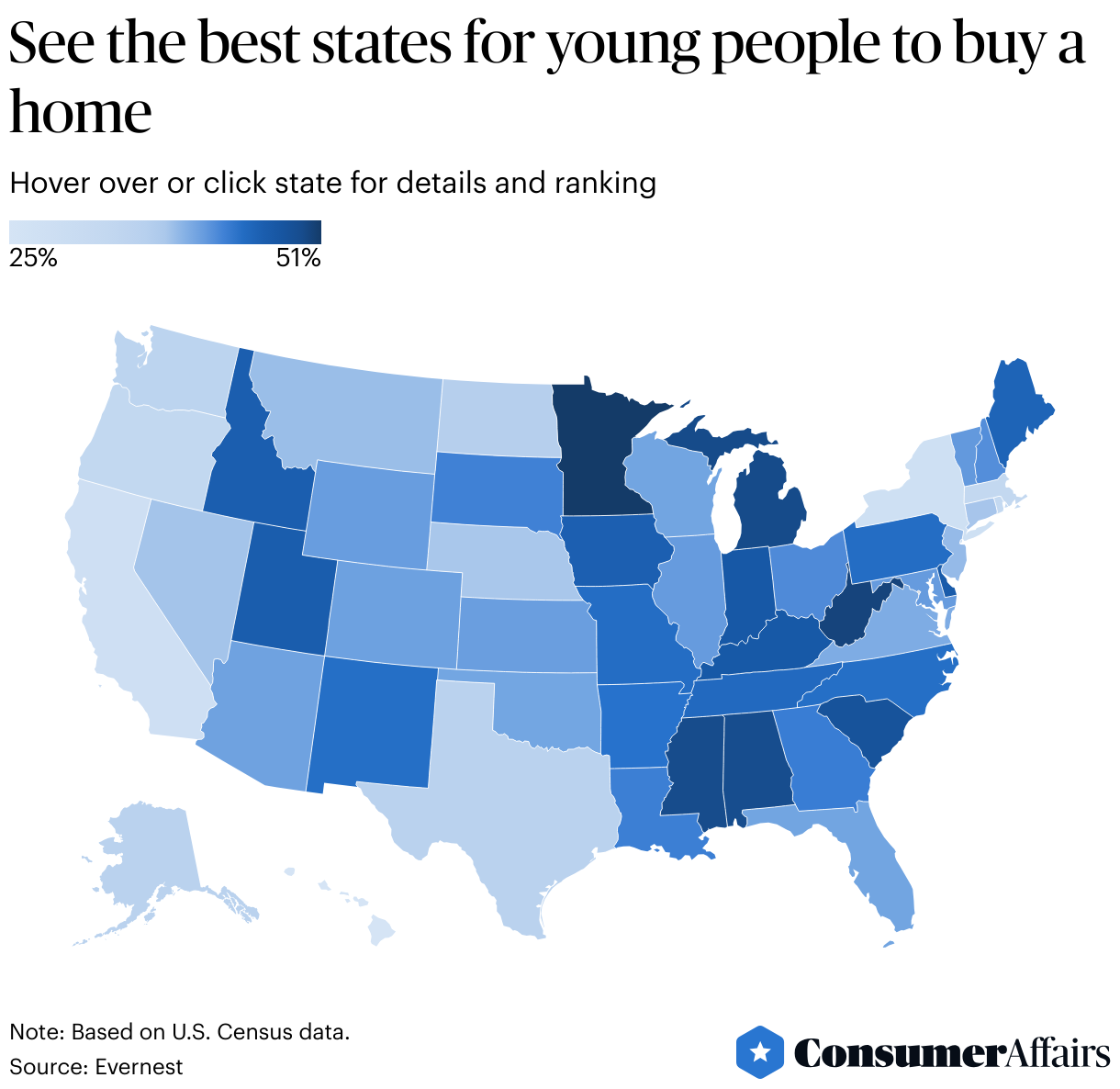
Non-coastal states with lower costs of living such as Minnesota, West Virginia and Michigan are among the best states for young people to buy a home,according to a report from property-management companyEvernest, which analyzed the latest U.S. Census homeownership data for people under 35 years old.

Minnesota, with a homeownership share of 51% among peopleaged 35 and under, is the best state for young people to buy a home.

"With over half of Minnesotans under 35 achieving homeownership nearly double the rate in high-cost coastal markets we're witnessing young Americans prioritize financial stability and space over traditional urban amenities," Evernest said.

Minnesota is followed by West Virginia (50%), Michigan (49%),Mississippi (49%) andAlabama (49%) in the rest of the top five best states for young people to buy a home.
Consumer News: Best states for young people to buy a home

States attracting younger homebuyers often have lower home prices compared to income, such as Minnesota with an average home price of $323,437 and average income of $94,870 among people aged 35 and under.

On the other hand, the worst state for young people to buy a home was Hawaii, with a homeownership share of 25% among people aged 35 and under.

Young people in Hawaii had an average income of $94,200, which is below Minnesota, and an average home price of $829,941.

The other five worst states for young people to buy a home are New York (28%), California (28%), Rhode Island (32%) andMassachusetts (33%).

The homeownershipgap among generations

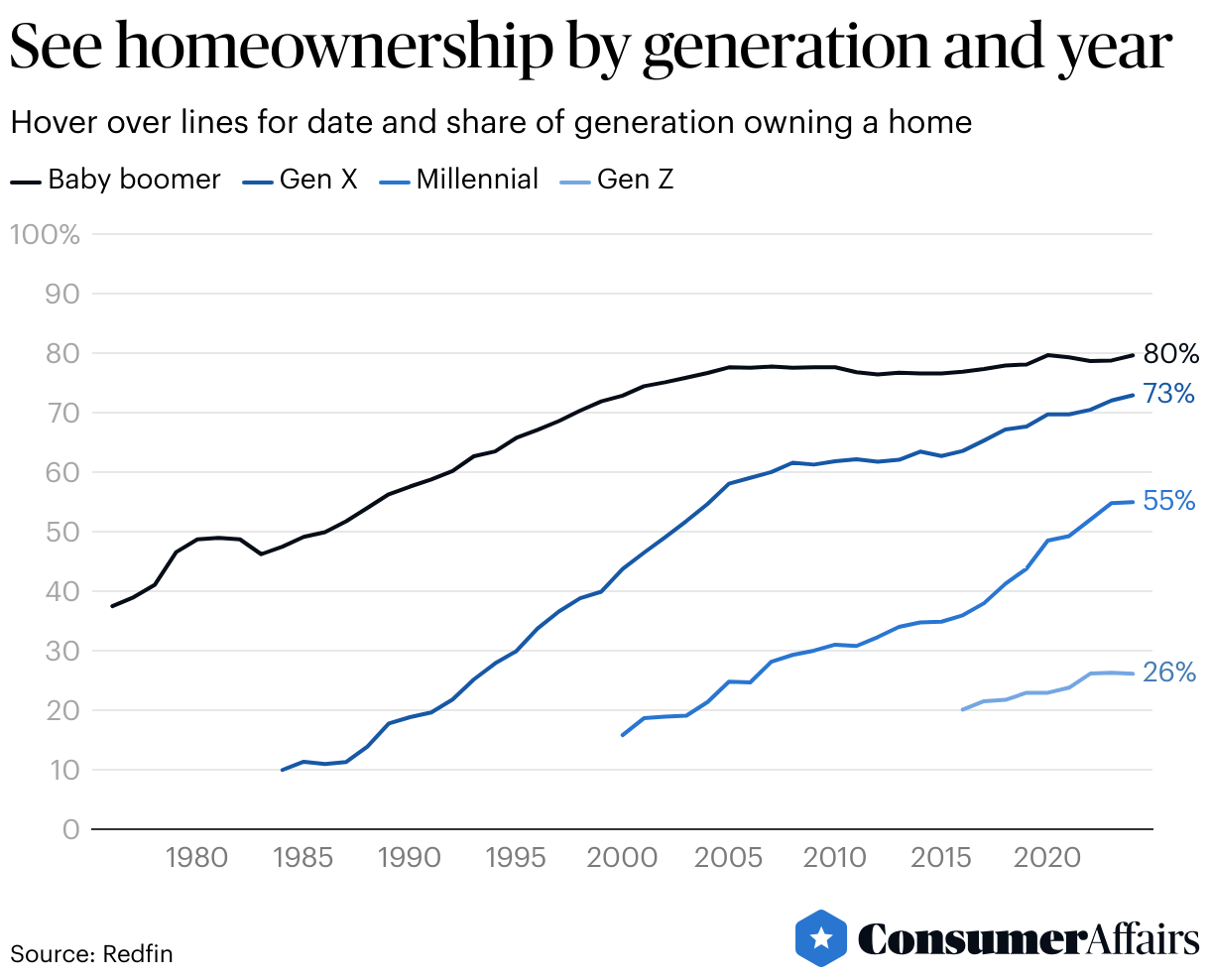
Younger people may want to consider more affordable states for buying a home after the struggle for homeownership among generations has shown little improvement.

Homeownership rates among millennials and Gen Z people flatlined in 2024 compared with 2023 and 2022, according to a report from real-estate brokerage Redfin.
Consumer News: Best states for young people to buy a home

Part of the reason is because some young people are choosing to rent because they can't afford to buy a home, Redfin Chief Economist Daryl Fairweather said in the report.

A median priced home now requires an income $52,473 higher than renting a median priced home in 2025, which is up from $46,808 in 2024, Redfin said.

"Buying a home is still typically a good financial investment, but for young people who dont have the desire or means to do so, there are other viable investments that, unlike buying a home, dont require a huge down payment," Fairweather said.

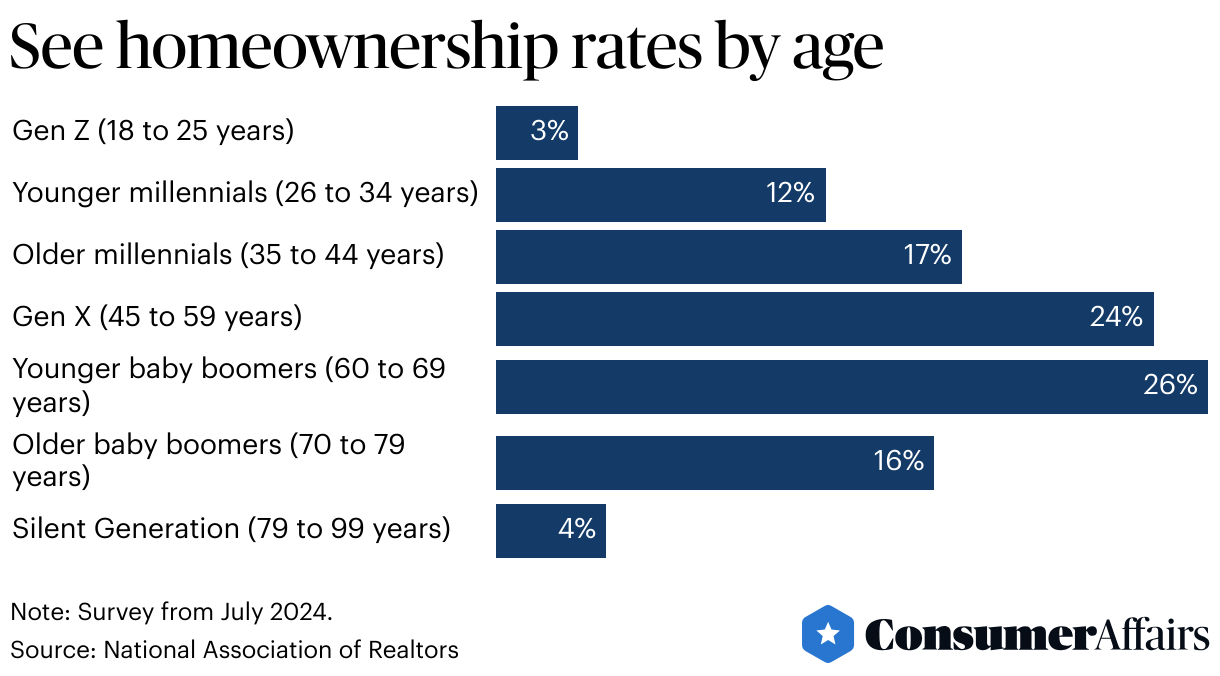
And baby boomers recently overtook millennials for homebuying in 2024, with a 42% share compared with 29% among millennials after the younger generationfell from 38% in 2023, according to a survey by the National Association of Realtors.

"In a plot twist, baby boomers have overtaken millennials the largest U.S. population to become the top generation of home buyers," said Jessica Lautz, NAR deputy chief economist and vice president of research, in a statement. "What's striking is that half of older boomers and two out of five younger boomers are purchasing homes entirely with cash, bypassing financing altogether."
Consumer News: Best states for young people to buy a home

People aged 60 to 99 years also accounted for 58% of home sellers, NAR said.

The generational gap in homeownership is stoking frustration among younger people in the economy,said Amy Nixon, a housing and economic analyst, ina poston X, formerly Twitter.

"Until this is corrected, populism rages on," she said."Imagine the outrage if young people made a run on walkers, wheelchairs, or diabetes medication, then colluded in agreement to only sell them to old people who really need them for a 300% markup."

Sign up below for The Daily Consumer, our newsletter on the latest consumer news, including recalls, scams, lawsuits and more.


Posted: 2025-04-14 21:42:04

Get Full News Story On Consumer Affairs


Listen to this article. Speaker link opens in a new window.
Text To Speech BETA Test Version.


More News From This Category
Consumer News: The cost of hosting a Super Bowl party is a little higher than last year
Wed, 04 Feb 2026 17:07:06 +0000

But prices vary, whether your party is in Boston or Seattle

By Mark Huffman of ConsumerAffairs
February 4, 2026
  • Tortilla chips: $4.76 vs. $4.50 last year (-5.46%); Seattle -1.6%, Boston -8.6%, Santa Clara -5.6%

  • Chunky chili with beans (19 oz.): $2.75 vs. $2.81 (+2.18%); Seattle -7.8%, Boston +4.4%, Santa Clara +7.2%

  • Frozen Supreme pizza: $9.03 vs. $9.25 (+2.44%); Seattle +2.3%, Boston -0.1%, Santa Clara +0.7%


As fans gear up for Super Bowl parties, the cost of filling the snack table is sending a mixed message: some staples are cheaper than a year ago, others are pricier, and where you shop still matters a lot.

New pricing data from Datasembly, which tracks grocery prices nationwide, shows modest overall inflation for a typical Super Bowl spread but notable regional differences in Seattle, Boston and Santa Clara.

Across a basket of popular game-day items from tortilla chips and salsa to frozen pizza, wings and beer prices this year rose about 1.5% overall, to roughly $80.49, compared with $79.27 last year. That relatively small bump masks bigger swings at the item level.

Snack chips and dippables offered some relief. Tortilla chips fell more than 5% nationally, while tater tots dropped more than 8%, with especially steep declines in Seattle. Chunky salsa also edged lower overall. Those decreases helped offset higher prices for items like burgers, queso and soda.

Proteins and prepared foods were a mixed bag. Beef chuck burgers (a six-count pack) climbed more than 3% year over year, while frozen buffalo wings dipped about 2.6% nationally though shoppers in Seattle saw prices jump more than 8% for wings, according to Datasembly. Frozen Supreme pizza posted a modest increase overall, with little variation across the three cities.

Drinks and dips leaned higher. Mini-can six-packs of cola rose more than 9% nationally, and French onion dip increased more than 7%. Beer prices were mostly flat, with slight increases in Boston and declines in Seattle and Santa Clara.

Regional trends

Regional trends underscore how local markets shape the Super Bowl bill. Seattle shoppers generally saw lower prices for snacks and chili but higher costs for wings. Boston posted notable declines for chips and salsa, while Santa Clara tended to run hotter on prepared foods and chili.

Bottom line: hosting a Super Bowl party this year wont break the bank, but smart shopping and knowing which items have cooled or heated up can still make a noticeable difference. Datasemblys data suggests that mixing brands, watching weekly specials and tailoring menus to local price trends remain the best ways to keep kickoff costs in check.


Read More ...


Consumer News: Feds overhaul credit score rules for conventional mortgages
Wed, 04 Feb 2026 17:07:06 +0000

The move may expand home ownership to more people

By Mark Huffman of ConsumerAffairs
February 4, 2026
  • FHFA and Fannie Mae have eliminated rigid minimum credit score floors (like 620) for conventional mortgages

  • Lenders now can use newer credit score models (including VantageScore 4.0 as well as Classic FICO) and take a more holistic view of borrower risk

  • Credit scores still matter, but underwriting focuses more on overall financial profiles than on single score cutoffs


In a major modernization of mortgage underwriting standards, the Federal Housing Finance Agency (FHFA) has ushered in rule changes that remove traditional minimum credit-score requirements for conventional mortgages backed by Fannie Mae and Freddie Mac a shift industry officials say could expand homeownership opportunities while maintaining risk controls.

For decades, borrowers seeking a conforming conventional mortgage the most common type of home loan in the United States typically needed a minimum credit score of around 620 to qualify for purchase by government-sponsored enterprises (GSEs) Fannie Mae and Freddie Mac. That numeric floor acted as a bright-line eligibility rule in automated underwriting systems.

Under the new FHFA-directed guidelines effectively implemented for loans submitted after Nov. 16, 2025 these rigid score thresholds have been removed. Fannie Maes Desktop Underwriter (DU) no longer requires a set minimum credit score to generate an approve/eligible finding, instead weighing a borrowers full financial profile including credit history, income, assets, and payment patterns in a more nuanced risk assessment.

A different view of creditworthiness

The FHFAs revamp reflects broader changes in how credit risk is measured in mortgage markets. Previously, lenders had to submit a borrowers Classic FICO score to the GSEs; now the rule allows lenders to deliver loans scored with either Classic FICO or VantageScore 4.0, with future plans to adopt additional models such as FICO 10T.

The newer models incorporate alternative data like rent and utility payments which can better assess credit for borrowers with limited traditional credit histories.

For borrowers, removing the minimum score requirement doesnt guarantee approval at any score, but more applicants particularly those with thin or non-traditional credit files may now see their overall financial strength considered more thoroughly. Credit scores remain important, but they are one of multiple inputs analyzed in automated underwriting systems.

For lenders and originators: The change signals a shift away from single-metric cutoffs toward layered risk evaluation. Many lenders still set internal minimums or overlays, and private mortgage insurers may maintain their own score thresholds. Clear documentation and robust underwriting remain critical.

What it means for home buyers

Market analysts say the FHFA changes could modestly expand mortgage access, particularly for first-time buyers, younger borrowers, and those with alternative credit histories. However, they caution that broader credit evaluation places greater emphasis on the quality of documentation and risk management practices across the industry.

As the mortgage sector adapts, the changes reflect a key policy evolution one that balances expanded access with prudent risk assessment in the nations housing finance system.


Read More ...


Consumer News: IRS urges taxpayers to establish Individual Online Accounts
Wed, 04 Feb 2026 17:07:05 +0000

The tax agency said the accounts will reduce fraud

By Mark Huffman of ConsumerAffairs
February 4, 2026
  • The IRS is urging taxpayers to create an Individual Online Account to securely access their tax information and reduce the risk of identity theft and fraud.

  • The online account gives taxpayers 24/7 access to refunds, transcripts, payments, notices, and other key tax services, similar to online banking.

  • In early 2025, the IRS expanded the service to let users view and download common tax documents such as W-2s and 1099s for recent tax years.


Among all federal agencies the Internal Revenue Service was among the first to fully embrace the internet.

Now, the tax agency is encouraging all taxpayers to set up an IRS Individual Online Account, a secure digital portal designed to make managing tax matters easier while strengthening protections against identity theft and fraud.

Available to anyone who can verify their identity, the Individual Online Account allows taxpayers to handle many routine tax tasks without waiting on the phone or mailing paperwork. The IRS is also asking tax professionals to support the effort by encouraging clients to create accounts and by using their own Tax Pro Accounts to carry out authorized actions on clients behalf.

Similar to online banking

With functionality similar to online banking, the IRS Individual Online Account lets taxpayers view important tax return details, including adjusted gross income, check the status of refunds and amended returns, and access account transcripts such as wage and income records.

Users can also request and retrieve an identity protection PIN, approve power of attorney or tax information authorization requests, and manage communication preferences, including language settings and alternative media.

The account also serves as a central hub for IRS communications and payments. Taxpayers can receive and review more than 200 types of IRS digital notices, make or cancel payments, set up or modify payment plans, and monitor their outstanding balances. Tax documents can also be accessed directly through the account, reducing the need to store paper copies.

In early 2025, the IRS expanded the Individual Online Account to include access to certain information return documents filed with the agency. Taxpayers can now view and download forms such as the W-2 (Wage and Tax Statement), 1095-A (Health Insurance Marketplace Statement), and several common 1099 forms, including those for nonemployee compensation, interest income, dividends, and miscellaneous income.

These information return documents are submitted to the IRS by employers, financial institutions, government agencies, and other payers, and they provide critical data taxpayers need to accurately file their returns. The documents are currently available for tax years 2023, 2024, and 2025 and can be found under the Records and Status tab within the IRS Individual Online Account.

The IRS says expanding digital access is part of its broader effort to improve customer service, increase transparency, and give taxpayers more control over their tax information in a secure online environment.


Read More ...


Consumer News: A growing number of American homes are in HOAs
Wed, 04 Feb 2026 05:07:12 +0000

HOA fees add to the cost of owning a home

By Mark Huffman of ConsumerAffairs
February 3, 2026
  • Nearly 44% of homes for sale in the U.S. now come with a homeowners association (HOA) fee, making monthly dues an increasingly common part of the cost of buying a home.

  • HOA fees continue to rise, with the median monthly payment hitting $135 in 2025, up sharply from pre-pandemic levels.

  • Florida stands out for both the prevalence and cost of HOAs, with several metros where dues consume a significant share of typical mortgage payments.


If you live in a neighborhood without a homeowners association, youre still in the majority, but barely.

Homeowners associations with monthly or annual dues are becoming a defining feature of the modern U.S. housing market. In 2025, 43.6% of homes listed for sale included a non-zero HOA fee, according to the newly released Homeowners Association Report from Realtor.com.

That marks a steady climb from 34.3% in 2019 and reflects how HOA obligations have moved well beyond condos and gated communities into the mainstream of homeownership.

HOAs are no longer confined to condos or brand-new developments, said Joel Berner, senior economist at Realtor.com.

HOA-heavy construction

He noted that a surge in HOA-heavy construction earlier in the decade is now reshaping the resale market, as those newer communities age and change hands. At the same time, rising insurance premiums, stricter building safety requirements, and higher labor and material costs are forcing many associations to raise dues, increasing the long-term financial commitment for homeowners.

The growth of HOAs is not just about how many homes are subject to them, but also how much they cost. The median HOA fee rose to $135 in 2025, up from $125 in 2024 and $108 in 2019, continuing a multi-year upward trend. Realtor.compreviously found that both HOA prevalence and fees were increasing between 2023 and 2024, and the latest data show that momentum carried into 2025.

Condo and townhomes

HOAs remain most common among condos and townhomes, where 84.8% of listings include monthly dues. Still, their presence among single-family homes is expanding, with about one-third (33.4%) of those properties now carrying HOA fees.

Homes governed by associations also tend to be larger and more expensive. Single-family houses with HOAs have a median size of 2,306 square feet, compared with 1,818 square feet for those without, and they sell for a higher price per square foot. Condos with HOAs, while similar in size to those without, also command higher per-square-foot prices.

New construction continues to lead the market in HOA prevalence. Nearly 68% of newly built homes are subject to HOA fees, compared with about 39% of existing homes. However, the share of resale homes with HOAs is growing faster, a sign that the construction boom of 2020 to 2022 is now feeding into the broader housing inventory.

On average, homes with HOAs list for $450,000, well above the $374,900 median for homes without associations. Much of that difference is tied to age: existing homes with HOAs were typically built around 1998, while those without date back to about 1968. Despite the added monthly cost, HOA status had little impact on how long homes stayed on the market overall in 2025.

Nevada has the most HOAs

Regionally, HOA prevalence varies widely. Nevada tops the list, with more than two-thirds of listings subject to HOA fees, while South Dakota has the lowest share at just over 12%. The West and South have seen the largest gains since the pandemic, reflecting high levels of new development in those regions.

When it comes to cost, Florida dominates. Several Florida metro areas rank among the most expensive in the country for HOA fees relative to mortgage payments, including Miami, Naples, and Cape Coral. In some markets, monthly dues account for more than a quarter of a typical mortgage payment.

Floridas status as an outlier is driven by a combination of climate-related insurance costs and regulatory changes. Following the 2021 Surfside condo collapse, new state requirements for inspections and reserve funding have increased expenses for condominium associations, which are often passed directly to homeowners.

Between rising insurance premiums and stricter safety and reserve requirements, many associations are facing higher operating expenses that ultimately get passed on to homeowners, Berner said.

As HOAs continue to spread across housing types and regions, buyers are increasingly forced to factor monthly dues into their affordability calculations making associations a central, and growing, part of the U.S. housing landscape.


Read More ...


Consumer News: What to buy in February: A savvy shopper’s guide to the best deals
Wed, 04 Feb 2026 02:07:06 +0000

Why February is a secret clearance goldmine

By Kyle James of ConsumerAffairs
February 3, 2026
  • February is prime time for big-ticket home upgrades, with Presidents Day sales driving major discounts on appliances, furniture, and mattresses.

  • Winter clearance is in full swing, meaning deep savings on cold-weather clothing, seasonal gear, and even Valentines candy right after the holiday.

  • Smart shoppers can also score on select electronics like TVs and home audio, as retailers clear out older models before spring releases.


Every month brings its own unique bargain opportunities, and February is no exception.

After the holiday rush, retailers hit the brakes and start clearing out winter inventory, launch some early spring promotions, and offer nice discounts around Valentines Day and Presidents Day.

If you know where to look, February can be one of the best months to shop for big-ticket items and some everyday essentials.

Heres what to buy this February, and how to maximize your savings.

Major appliances

February is a great month to shop for major appliances and the best stores to consider include Lowes, Home Depot, Costco, and even Best Buy.

What you can expect to find:

Refrigerators:Look for $300$800 off those mid to high-end models.

Washers and dryers:Presidents Day promos often bundle these with $200$500 off per unit or extra savings when you buy the pair.

Dishwashers:Discounts commonly land in the $100$300 off range, with bonus rebates on select brands.

Ranges and ovens:Expect $150$400 off depending on features like convection or air-fry modes.

Why February deals are strong:

Appliance sales always slow down after the holiday rush, so retailers use Presidents Day promotions to pump some life back into this quieter shopping period.

Because of this, youll often see:

  • Manufacturer rebates stacked on top of already reduced sale prices.
  • Free delivery or haul-away of your old appliance.
  • Special financing offers (like 2-3% interest for 1224 months).

Pro tip: If you know your fridge, washer, or dishwasher is nearing the end of its life, February is a smart time to buy before it breaks. Emergency replacements usually mean youre stuck paying full price and settling for whatever is in stock.

Shopping now can beat waiting for spring or summer, when demand rises during home improvement season and the best inventory and promos start to thin out.

Televisions and some electronics

While not all technology products are good deals in February, top tier TVs and some other electronics stand out as bargains this month.

Why its a deal:

Televisions historically go on sale right beforethe Super Bowl and again around Presidents Day as retailers clear older inventory for new models.

Deals to look for:

  • TVs:Big premium brands like Samsung, LG, and Sony often see 20-40% discounts on their 65 to 75 models.
  • Home theater bundles:Look for TV + soundbar bundles for $100$400+ off.
  • Some older model tech gear:Look for last years smartphones at 10%25% off or trade-in deals adding a ton of value.
  • Previous-gen laptops/tablets: These older model laptops and tablets are typically 15%35% off in February making them a solid buy.

Winter clothing, even while its still cold

February is when retailers start to clear out winter apparel and gear to make room for the new spring inventory.

This makes it a great time to look for deals at places like Old Navy, GAP, Kohls, Walmart, and even at Target. You can easily save 20-30% off stuff that will keep you warm.

Whats usually on sale:

  • The usual suspect of winter coats, boots, gloves, and scarves.
  • Discounts are also to be had on heated blankets and space heaters.
  • Dont forget about savings on cold weather sports gear for snowboarding, skiing, sledding, and snow shoeing.

Timing matters

Try to shop early in the month. This is because many of the most popular sizes disappear quickly once the markdowns start to happen.

If you have kids, consider stocking up for next winter by buying a size up and storing it for when it gets cold again next year. My wife and I used to do this all the time (when our kids were younger) at Old Navy and always saved a bunch of money in the process.

Valentines Day clearance items

The day after Valentines Day is a goldmine for bargain hunters, but probably not for the reasonyou might think.

Its not about buying candy thats 75% off that you dont really need, but instead its all about repurposing stuff that many stores are practically giving away.

What goes on sale:

  • Obviously candy and chocolates
  • Cards and party decorations
  • Giftable items like plush toys or boxed truffles
  • Gift bags and gift wrap that you can re-purpose later

Think about deals on stuff like candy for family movie nights, an upcoming birthday, lunchbox treats, or even baking projects.

Also, consider clearance deals on items like gift wrap, gift bags, and ribbons. All of which you can easily stash for birthdays and holidays later in the year.

If you dont mind the occasional red heart on the packaging, this is one of the easiest seasonal savings wins of the year.

Mattresses, bedding, and household linens

Presidents' Day weekend isnt just about furniture, as you can also finds deals on mattresses and bedding.

Why you see discounts

Major brands like Sealy, Serta, Tempur-Pedic, Beauty Rest, and Sleep Number all compete hard for your money this time of year and offer some of their best deals.

If you need a new mattress, this is the perfect time to start shopping.

Also, look for discounts in the 20-30% off range on bedding sets, pillows, and sheet sets.

What to look for:

  • Pillow top mattresses on sale
  • Memory foam sets with discount
  • Bundles (e.g., mattress + protector + pillows)

Mattress Firm already has their Presidents Day sale going on with savings up to $700 plus a free adjustable base on select mattresses.

Dont forget to also check any local mattress stores as well as Costco and Sams Club as they run deals this time of year too.

Online mattress brands like Helix Sleep, Nectar, and Saatva also compete hard during this window with site-wide percentage-off and dollar-off discounts.

Furniture and home goods

One of Februarys most overlooked smart buys is deep discounts on furniture and home goods.

Why its a deal:

Retailers start pushing out spring merchandise as winter winds down. Tomake room on their showroom floors, you'll find thatsofas, dining sets, desks, and other furniture often go on sale.

Presidents' Day weekend, traditionally falling mid-February, amplifies these price cuts even more.

How to shop:

Compare prices betweenstores like Macys, Home Goods, Wayfair, and IKEAstarting now, as somehave alreadylaunchedtheir Presidents' Day deals.


Read More ...


Related Bing News Results
Consumer Reports' top 10 vehicles for 2026 — see which cars made the list
Tue, 03 Feb 2026 06:05:34 GMT
For the first time, the top 10 cars on Consumer Reports' annual list of best new vehicles also include electric or hybrid models.

Consumer Reports finds five popular protein powders meet lead safety thresholds
Sat, 31 Jan 2026 05:01:00 GMT
The findings come after a CR investigation found certain protein powders exceeded safe daily lead levels ...

Consumer Reports: Stay home and kick that cold
Thu, 29 Jan 2026 14:07:00 GMT
A runny nose, scratchy throat, and deep cough can make even simple daily tasks feel miserable. While there’s no instant cure for the common cold, Consumer Reports says there are several effective ways ...

Consumer Reports finds lower lead levels in popular chocolate protein powders
Tue, 27 Jan 2026 09:18:00 GMT
New testing found five popular protein powders contain less lead and arsenic than other products flagged in an earlier Consumer Reports investigation.

The 4 Least Reliable Android Phones, According To Consumer Reports
Sun, 25 Jan 2026 13:47:00 GMT
Picking the right Android phone can be tough, but according to Consumer Reports' research, these unreliable ones should be avoided if possible.


Blow Us A Whistle


Related Product Search/Búsqueda de productos relacionados

Amazon Logo