A new Australian study finds that extreme heat can increase the burden of mental health and behavior disorders.
Using data from the Australian Burden of Disease database, and data on average temperatures across the continent, the researchers determined what the future burden of mental health conditions will look like moving forward.
The researchers are encouraging policymakers to address climate change as soon as possible to ensure optimal physical and mental health outcomes for citizens.
A new study conducted by researchers from the University of Adelaide explored how extreme heat can be detrimental to consumers mental health.
According to their findings, consistently rising temperatures across the continent could increase the prevalence of mental and behavioral disorders (MBD) as soon as the 2030s; by 2050, the risk of mental health disorders could reach nearly 50%.
"The detrimental impacts of climate change on good mental health and emotional states have been increasingly recognised worldwide, and it's only going to get worse unless we act," said lead author Professor Peng Bi, from the Universitys School of Public Health.
The study
The researchers analyzed data from the Australian Burden of Disease database, which analyzes the burden of disease in terms of years of life lost, years lived with disability, and disability-adjusted years of life.
For this study, the researchers looked specifically at the average disease burden of mental and behavioral disorders across Australia. They also analyzed temperature for over 2,300 regions across Australia.
From there, the team projected what average daily temperatures will look like in Australia in the next five to 20 years.
Location matters
One of the biggest findings from the study was that location played a key role in mental health outcomes. Regions that get the most heat, like the Northern Territory, were more likely to have more extreme heat, and residents were predicted to experience more mental health conditions.
However, the Southern Territory and Victoria showed a significant link between mental health conditions directly related to increased temperatures.
The impact of heat
Between 2003 and 2018, high temperatures were responsible for 8,458 disability-adjusted life years in Australia. This figure represents nearly 2% of the total mental and behavioral disorder burden across the continent. Based on the researchers findings, these numbers are only expected to increase over time.
Should no progress be made in terms of climate change, the burden of MBDs attributable to high temperatures is likely to increase as soon as the 2030s. The researchers project an increase of MBD burden to be between 11 and 17.2% in the 2030s; by 2050, that estimate jumps to 48.9%.
As a result, the team is urging policymakers to tackle the issue of climate change as soon as possible.
"Policymakers must step up with targeted, people-centered strategies to protect mental health as temperatures climb," said Professor Bi. This isn't just about health it's about building stronger, more resilient communities for the future.
Sign up below for The Daily Consumer, our newsletter on the latest consumer news, including recalls, scams, lawsuits and more.
Keep it simple and stack smart: At Dollar General, use one manufacturer coupon plus one store coupon per item. Start with just digital coupons in the app and only clip what you actually need.
Build around the $5 off $25: Hit $25 before coupons, stack that discount with your clipped deals, and your total drops fast with minimal effort.
Add easy cash back: Link and use Ibotta, add offers before shopping, and enter your phone number at checkout. Dont double-dip the same deal.
Couponing at Dollar General has this reputation of being confusing, time-consuming, and honestly a little intimidating.
But the reality is that Dollar General is actually one of the simplest places to coupon once you understand how their system works.
Once you get it down, you can consistently cut your bill in half (or more) on everyday essentials without turning it into a second job.
First: Understand the three types of coupons at Dollar General
Before you try to build a deal, you need to understand what youre working with.
This matters because not all coupons work together and heres the key rule that drives everything:You can only use one manufacturer coupon + one Dollar General store coupon per item.
Also important: most digital coupons in the app are manufacturer coupons, even though they live inside the Dollar General system. So, if you try to stack two digital coupons on one item, it usually wont work.
This is where beginners often get tripped up and get frustrated.
Think of it this way:
Youre not trying to use more coupons.
Youre trying to use the right combination of coupons.
The easiest way to start: Use digital coupons only
If youre new to couponing at Dollar General, its important to keep it ridiculously simple at first.
Inside the app, youll see dozens of digital coupons you can clip with one tap. Then when you check out, you just enter your phone number and the system applies whatever matches your purchase.
No paper. No printing. This is what makes couponing at Dollar General very user-friendly.
Think of it this way, youre already buying things like:
Paper towels
Dish soap
Snacks
Laundry detergent
Now youre just getting a digital discount on them. The mistake shoppers often make is trying to clip everything at once. Thats how you end up overwhelmed and quitting.
Instead, only clip coupons for the items you know your household will actually use. That keeps things very manageable and prevents you from buying random stuff just because its on sale.
The $5 off $25 trick (this is where things really click)
This is the single most important strategy at Dollar General.
Every week (usually Saturdays), theres a $5 off $25 coupon in the DG app. So, when your total hits $25 before coupons, you instantly save $5.
When you combine that with your digital coupons,all of a sudden the math really starts working in your favor.
Example:
Cart total: $25
$5 off $25 coupon
$7 in digital coupons
New total: $13
Thats nearly 50% off without doing anything complicated.
The reason this works so well is because youre stacking a whole purchase discount with those item-level discounts. And Dollar General is one of the few places where this stacking is really easy to make happen.
Build a simple plan (this is what separates savers from over-spenders)
Walking into Dollar General without a plan is where people lose money.
You grab a few things, maybe use a coupon or two, and leave thinking you saved but you probably didnt maximize anything.
Having a simple plan can change everything.
With that said, heres a realistic system that works:
Open the app.
Clip coupons for things you actually need.
Look at the weekly ad.
Build a cart that gets you to $25.
Make sure your coupons apply to those items.
This turns your trip from random shopping into a controlled strategy that saves you money. And once you do it a few times, it becomes second nature.
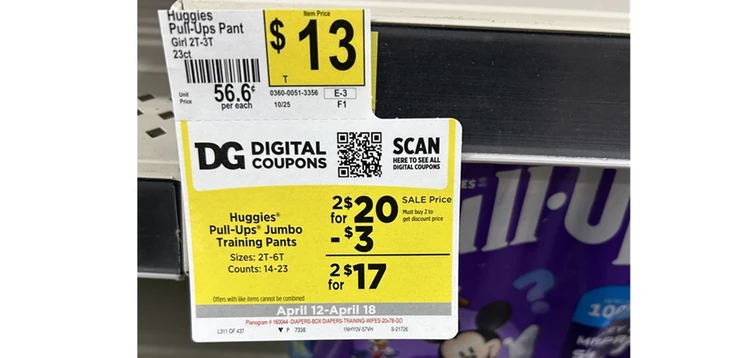
Pro tip: When using the DG app, be sure to set the app to the store youre shopping at. That way youll know the correct pricing, as the price in the app is always going to override whats shown on the shelf tag.
Ibotta and Dollar General play well together
Once you get the basic concepts of how couponing at Dollar General works, youll want to take your savings to the next level and download the Ibotta app and link your Dollar General account.
You simply open the Ibotta app find Dollar General tap Link account. Then either log into your DG account, or create a new one.
Then before you shop, you just open Ibotta and browse the Dollar General offers, then tap the + to add anything you plan to buy.
Once thats done, shop like you normally would, either in-store or online, making sure to purchase the exact items listed in your offers and paying as usual. At checkout, enter your phone number, which is how Dollar General tracks your purchase.
After that, everything is automatic. Theres no receipt to scan, and your cash back typically shows up in your Ibotta account within a couple of days.
Pro tip: Make sure you dont double-dip the same offer in both the DG and Ibotta app. If you clip a deal in Dollar General and also add it in Ibotta, the savings will usually go to Dollar General, not Ibotta. If you want the Ibotta cash back, stick to adding the offer there only.
Must-follows for Dollar General couponing
There are some folks on TikTok and Instagram that do a fantastic job matching weekly Dollar General (and Ibotta) coupons and deals to specific products and shopping categories.
Here are three that post regularly and explain how it all works in an easy-to-follow way.
Liz The Clearance Queen Follow her on TitTok and shell show you how to coupon at Dollar General and stack deals and coupons so you only pay a fraction of the retail price.
Nubia GonzalezHer TikTok page also shows you how to do weekly coupon matchups at Dollar General. She walks you through the process slowly so you dont miss a coupon and she'll help you save a bunch of money every time you shop at Dollar General.
Couponing 4 Beginners Melyssa runs a great Instagram page that walks you step-by-step through Dollar General's couponsand deal matchups. Every week, shell show you how to score a variety of products for a fraction of the original price.
Keep it simple (this is what actually works long-term)
Most people quit couponing at Dollar General because they overcomplicate it. They try to do everything at once, chase every deal, and they end up burnt out.
The people who stick with it tend to do lessand keep the whole thing simple.
For example, they:
Shop just once a week.
Focus on essentials.
Use a handful of coupons.
Stick to a simple system.
Thats it. Remember, even saving $10 a week adds up fast. And once you get comfortable, those savings grow naturally.
Breast cancer remains the most common cancer among women globally, with cases expected to surge by 2050.
Researchers analyzed decades of data across more than 200 countries to track trends and risks.
A significant share of the disease burden is tied to modifiable lifestyle factors like diet and smoking.
Breast cancer continues to be the most commonly diagnosed cancer among women worldwide and new research suggests the burden is only going to grow.
According to a large global analysis published in The Lancet Oncology, there were an estimated 2.3 million new cases and 764,000 deaths in 2023 alone. Even more concerning: those numbers are projected to rise sharply in the coming decades, with cases expected to exceed 3.5 million annually by 2050.
While advances in screening and treatment have improved outcomes in some parts of the world, the disease is increasingly impacting countries with fewer health care resources. Researchers emphasize that breast cancer isnt just a medical issue its also tied to broader factors like access to care, early detection, and prevention strategies.
Breast cancer continues to take a profound toll on womens lives and communities, lead author Kayleigh Bhangdia said in a news release.
While those in high-income countries typically benefit from screening and more timely diagnosis and comprehensive treatment strategies, the mounting burden of breast cancer is shifting to low- and lower middle-income countries where individuals often face later-stage diagnosis, more limited access to quality care, and higher death rates that are threatening to eclipse progress in womens health.
How the study was conducted
To understand the full scope of breast cancer worldwide, researchers used data from the Global Burden of Disease Study. This included information from cancer registries, national health records, and even interviews with family members of women who died from the disease.
The study examined trends from 1990 through 2023 across 204 countries and territories, offering one of the most comprehensive looks at breast cancer to date. Researchers also estimated years of healthy life lost, a metric that captures not just deaths but also the impact of illness and disability.
Importantly, the analysis didnt just track cases it also looked at risk factors. The team identified several modifiable contributors, including high red meat consumption, tobacco use, high blood sugar, elevated body weight, alcohol use, and low physical activity.
What the researchers found
The findings highlight a stark and uneven global picture. While high-income countries tend to have higher diagnosis rates, theyve seen improvements in survival likely due to better screening and treatment. Meanwhile, lower-income countries are experiencing faster increases in both cases and deaths, often due to later diagnoses and limited access to care.
Another key takeaway: lifestyle factors play a meaningful role. Researchers estimate that about 28% of the global breast cancer burden is linked to modifiable risks, suggesting that prevention efforts could make a real difference.
The study also found that although breast cancer is more common in older women, rates are rising among younger women as well a shift that may reflect changing risk patterns over time.
With more than a quarter of the global breast cancer burden linked to six modifiable lifestyle changes there are tremendous opportunities to alter the trajectory of breast cancer risk for the next generation, co-senior author Dr. Marie Ng said in the news release.
Targeting known risk factors through public health policies and making healthier choices more accessible, while working with individuals to take action to reduce obesity and high blood sugar, is crucial to halting the rise in breast cancers worldwide.
YouTube Premium prices are increasing across all major plans in the U.S.
The individual plan now costs $15.99/month, with bigger jumps for families.
The change reflects a broader trend of rising streaming subscription costs.
For millions of viewers, YouTube has become part of daily life whether its for music, workouts, or mindless scrolling before bed. But if youre paying to skip the ads, that convenience is about to cost you more.
YouTube has officially raised prices for its Premium and Music subscriptions in the U.S., marking the first increase since 2023 and putting it in line with a wider wave of streaming price hikes.
The changes are already in effect for new subscribers and will roll out to existing users over the next few months, meaning your next bill could look a little different.
Whats changing with YouTube Premium pricing
The biggest shift is to the standard individual plan, which now costs $15.99 per month a $2 increase from its previous price of $13.99.
Other plans are going up too:
Family plan:Now $26.99/month (up $4)
Student plan: Now $8.99/month (up $1)
YouTube Music Premium: Also seeing a roughly $1 increase, depending on the plan
YouTube says the price bump is meant to maintain and improve the service while supporting creators and artists. That includes perks like ad-free videos, background playback, offline downloads, and access to a massive music library.
Subscribers should receive at least 30 days notice before the new pricing hits their account, with most existing users seeing the change reflected starting in June 2026.
What this means for you
If youre already subscribed, nows a good time to take stock of how much you actually use the service. If you rely on YouTube daily especially for music or long-form content the ad-free experience and bundled features may still justify the higher price.
But if you signed up casually or mostly tolerate ads anyway, this could be the nudge to reconsider. Some users are already questioning whether the service delivers enough value compared to competitors, especially as prices continue to climb across the streaming industry.
One thing is clear: YouTube isnt alone. From Netflix to Hulu, subscription costs are rising almost everywhere, and streamflation is becoming the norm.
Turn on built-in filters first: Use your phones Silence Unknown Callers (iPhone) or spam protection settings (Android) to automatically block or send unfamiliar numbers to voicemail.
Use your carriers free tools: Services like AT&T ActiveArmor, Verizon Call Filter, and T-Mobile Scam Shield can stop robocalls before your phone even rings.
Layer in extra protection if needed: Block repeat offenders manually and consider apps like Hiya or RoboKiller for stronger filtering and spoofed-number detection.
Spam calls arent just annoying anymore; they seem to be constant. If youve stopped answering your phone unless you recognize the number, youre not alone.
But according to PC Mag senior writer, Kim Key, you dont have to put up with it anymore. Along with some clever third-party apps, she says there are some simple settings already built into your phone that can dramatically cut down on robocalls and scam attempts.
Heres how Key was able to silence them for good and how you can too.
Start with your phones built-in tools
Both iOS and Android devices already have spam-blocking features, buy many people just never turn them on.
On iPhones, you can enable Silence Unknown Callers, which automatically sends any number not in your contacts straight to voicemail. You find this by going to Settings Apps Phone.
On Android, you can block unknown numbers and flag spam calls directly from your call settings.
These tools do most of the heavy lifting without requiring any extra apps or subscriptions.
Use your carriers free spam filters
Key brings up the great point that your mobile provider likely offers built-in protection youre already paying for.
These services can label suspicious calls, block known robocallers, and send risky numbers straight to voicemail before your phone even rings.
Block repeat offenders (but dont rely on it alone)
You can and should block numbers that keep calling, especially if its the same telemarketer or scammer hitting you over and over. On both iOS and Android, it only takes a few taps to stop that number from reaching you again.
That said, this is more of a cleanup tool than a full solution. Many robocallers spoof or rotate phone numbers, meaning the next call might come from a completely different number that looks local or familiar.
So, while blocking helps reduce repeat annoyances, it works best alongside broader filters like silencing unknown callers or carrier-level protection.
Let your phone screen calls for you
This is where things have quietly gotten much better. Newer phone updates can act like a built-in gatekeeper. Instead of your phone ringing, it can automatically intercept unknown callers and prompt them to say why theyre calling.
If its a real person, like a doctors office or delivery driver, theyll usually respond clearly and youll see that message before deciding to pick up. If its a robocall or scam, it often hangs up or fails the screening entirely.
The end result is fewer interruptions, less guesswork, and you only have to deal with calls that actually matter.
Add a third-party app if the problem is persistent
If spam calls are still slipping through, Key recommends apps like Hiya or RoboKiller can really help. These apps rely on massive, constantly updated databases of known scam and robocall numbers.
They can automatically block suspicious calls, flag risky numbers before you answer, and in some cases even stop spoofed calls that mimic your area code. Some apps also let you customize your settings, like blocking calls that look similar to your own number or sending certain types straight to voicemail.
Just keep in mind that the free versions usually cover only the basics, while premium plans will unlock more advanced filtering.
To find out whether your specific vehicle is included in a recall, you can check by VIN or license plate on NHTSA's recall lookup page: NHTSA.gov/recalls.
If your vehicle has an unrepaired recall, contact your local dealership to schedule a repair recall remedies are provided at no cost.