Rockin Robin SongFlying The Web For News.
RobinsPost Logo RobinsPost Amazon


Consumer Daily Reports

Four of the 10 busiest airports are in the U.S.

By Dieter Holger of ConsumerAffairs
April 15, 2025

Key takeaways:

  • Hartsfield-Jackson Atlanta International,Dubai International Airport andDallas Fort Worth International Airport rank as the top three busiest airports in the world.

  • Shanghai Pudong International Airport had the biggest jump in traffic in 2024.

  • More people have been flying recently, but there are challenges ahead to sustain growth in air travel.

The world's busiest airports are getting busier, showing how air traffic has returned after falling off from the pandemic.

There were more flyersat all ofworld's top 10 busiest airports in 2024 compared with 2023, with passenger increases ranging from 3% to 41%,according to early numbers from trade association Airports Council International.

Amid global challenges, the resilience of the worlds busiest airports shines," saidACI World Director General Justin Erbacci in a statement.

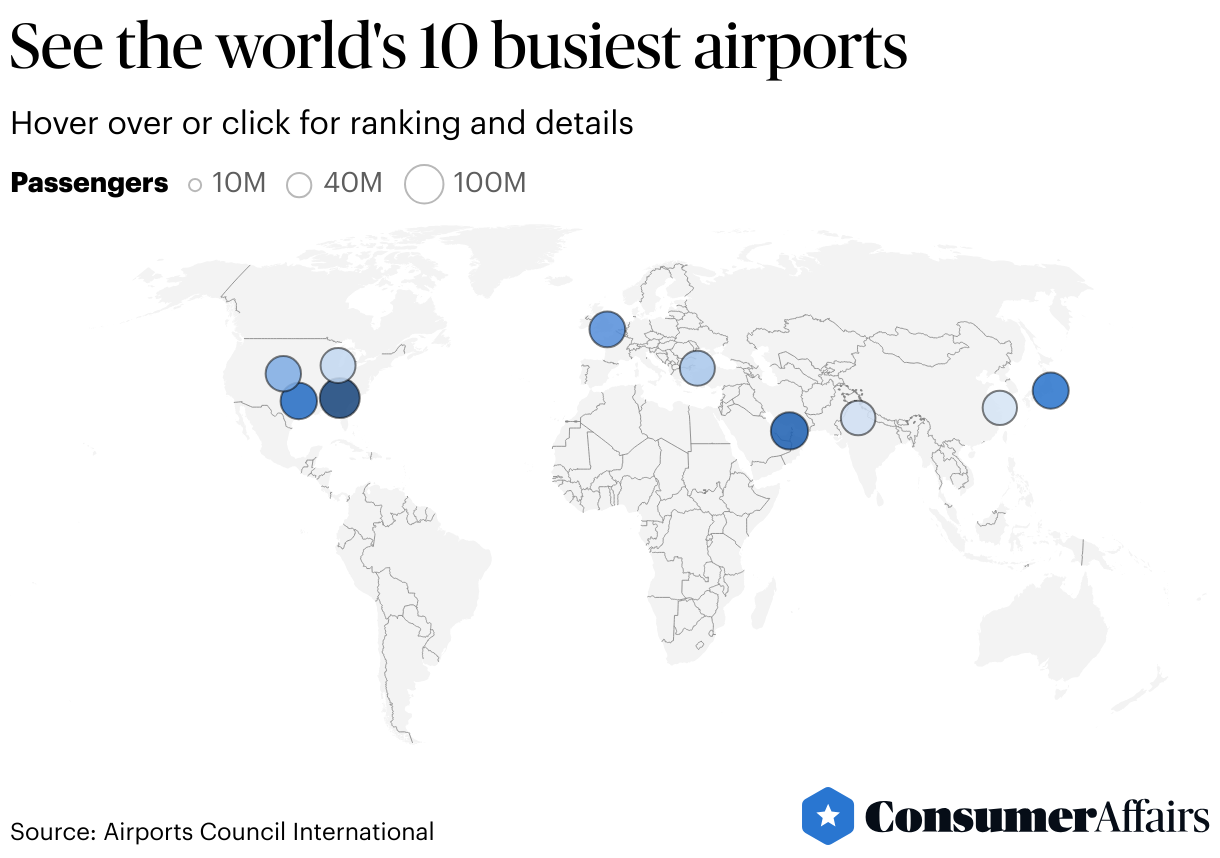
The busiest airport in the world isHartsfield-Jackson Atlanta International Airport, with more than 108 million passengers in 2024, which isup around 3% from 2023.Atlanta is followed by:

  • Dubai International Airport(92.3 million)
  • Dallas Fort Worth International Airport (87.8 million)
  • Tokyo's Haneda Airport (85.9 million)
  • London's Heathrow Airport (83.9 million), Denver International Airport (82.4 million)
  • Istanbul Airport (80.1 million)
  • Chicago O'Hare International Airport (80 million)
  • New Delhi's Indira Gandhi International Airport (77.9 million)
  • Shanghai Pudong International Airport (76.8 million)
Consumer News: The world's 10 busiest airports

Shanghai Pudong International Airport had the biggest increase in passengers, rising 41% in 2024 from 2023.

"The jump was fueled by expanded visa policies, the resumption and expansion of international flights, operational enhancements, and the recovery of the Asia-Pacific region, particularly China," ACI said.

Airports got busier after global flyers reached close to 9.5 billion in 2024, up nearly 10% from 2023 and around 4% from pre-pandemic levels in 2023.

Still, there are challenges ahead for flying to continue to grow in popularity, including economic uncertainty, geopolitical tensions and constraints on runways and gates.

"While passenger demand remains strong, the pace of expansion is expected to slow as markets shift from recovery-driven surges to structural, long-term growth patterns," ACI said."As the industry moves into a new era of growth, the airport industry must focus on financial viability, investment in infrastructure, operational efficiency, and sustainability."

Sign up below for The Daily Consumer, our newsletter on the latest consumer news, including recalls, scams, lawsuits and more.


Posted: 2025-04-15 03:44:24

Get Full News Story On Consumer Affairs


Listen to this article. Speaker link opens in a new window.
Text To Speech BETA Test Version.


More News From This Category
Consumer News: San Francisco sues major food makers, calling ultra-processed products a public health crisis
Wed, 03 Dec 2025 23:07:07 +0000

The suit is modeled on the giant tobacco lawsuit that resulted in a massive $206 billion settlement

By James R. Hood of ConsumerAffairs
December 3, 2025

  • Landmark lawsuit accuses top brands of knowingly creating addictive, disease-linked foods

  • City compares tactics of food giants to Big Tobaccos historic deception

  • Officials say companies must help offset billions in health care costs


San Francisco City Attorney David Chiu has filed a potentially groundbreaking lawsuit against 10 of the nations largest food manufacturers, accusing them of engineering and marketing ultra-processed foods that have fueled a nationwide health crisis. The defendants include Kraft Heinz, Mondelez, Post Holdings, Coca-Cola, PepsiCo, General Mills, Nestl USA, Kellogg, Mars, and ConAgra.

These companies created a public health crisis with the engineering and marketing of ultra-processed foods, Chiu said at a Tuesday press conference. They took food and made it unrecognizable and harmful to the human body These companies engineered a public health crisis, they profited handsomely, and now they need to take responsibility.

Mayor Daniel Lurie joined Chiu in supporting the lawsuit, calling it an effort to ensure that San Francisco families deserve to know whats in their food and arent misled about the products in our grocery stores.

What makes ultra-processed foods different

The citys complaint argues that ultra-processed foodsranging from sodas and chips to boxed macaroni, processed meats, and breakfast cerealspose unique health risks beyond their high sugar or fat content. These products are industrially reconstituted mixtures of additives, emulsifiers, flavor enhancers, and chemically modified ingredients designed to boost cravings and consumption.

According to the lawsuit, these foods now make up about 70% of the U.S. food supply, giving the illusion of consumer choice while fueling chronic disease.

Health toll tied to engineered foods

Public health officials say the shift toward ultra-processed foods has coincided with sharp increases in obesity, diabetes, colorectal cancer, heart disease, and depression. San Francisco Health Director Daniel Tsai called the lawsuit a critical step toward protecting the health of our communities, noting that low-income and minority populations have been hit hardest by aggressive marketing.

UCSF physician Dr. Kim Newell-Green added that research now links these products to serious diseasesincluding Type 2 diabetes, fatty liver disease, heart disease, colorectal cancer, and even depression at younger ages.

Big Tobaccos influence on Big Food

The complaint draws direct parallels to the tobacco industry, which entered the food business in the 1960s when companies like Philip Morris and RJ Reynolds bought up major food brands. San Francisco alleges those corporations transferred their knowledge of addiction science to the food sector, deliberately crafting productsand marketing campaignsdesigned to hook consumers, especially children.

By the 1990s, internal Kraft documents showed the companys Kids Task Force boasting that its promotions reached 95% of U.S. children ages 612. The lawsuit also cites marketing campaigns that disproportionately targeted Black and Latino children, who see 70% more ads for ultra-processed products than white children.

Industry knew the dangers, suit alleges

City lawyers say executives had actual knowledge of the harm decades ago. In 1999, top leaders from Kraft, Pillsbury, and other major food companies met to discuss the mounting health crisis caused by their products. When a Kraft vice president warned that the industrys tactics were inflicting a public health toll rivaling that of tobacco, his warnings were ignored.

Despite these warnings, the companies continued to push increasingly addictive foods, the lawsuit states.

Financial fallout and local impact

Health care costs linked to diet-related diseases have soared. U.S. health expenditures now account for nearly 20% of GDP, and by 2031 could hit $7 trillion. San Francisco alone spends billions each year on Medi-Cal, employee benefits, and public health programs, with diabetes alone responsible for $85 million in hospital charges in 2016.

Supervisor Shamann Walton, who joined the announcement, said the city will also examine its own food purchasing practices. For decades, our communities have paid the price for an industry that put profit ahead of people, Walton said.

Legal aims and next steps

Filed in San Francisco Superior Court, People of the State of California v. Kraft Heinz Company, Inc., et al. alleges violations of Californias Unfair Competition Law and public nuisance statute. The city seeks injunctions against deceptive marketing, restitution, and civil penalties to help offset health care costs.

Law firms Andrus Anderson, DiCello Levitt, and Morgan & Morgan are co-counsel on the case. DiCello Levitt partner Diandra Fu Debrosse said, San Francisco is leading the way in holding corporations accountable for engineering a public health crisis.

A precedent-setting case

This litigation is about more than accountability, said Jennie Lee Anderson of Andrus Anderson LLP. Its about giving San Francisco the tools to protect its residents for generations to come.

City officials say they hope the lawsuit will set a national precedentmuch as states tobacco lawsuits did a generation agoby forcing food giants to face the costs of a crisis they helped create.The landmark class-action settlement for the tobacco industry the Tobacco Master Settlement Agreement (MSA) committed major U.S. cigarette manufacturers to pay the states an estimated US$206 billion over the first 25 years.


Read More ...


Consumer News: Arizona sues Temu, alleging it uses 'deceptive and unfair' trade practices
Wed, 03 Dec 2025 20:07:06 +0000

The state also charges the Chinese company violates consumers' privacy

By James R. Hood of ConsumerAffairs
December 3, 2025

ArizonaAttorney General Kris Mayes has announced the filing of a lawsuit against Temu, the Chinese online shopping platform, for violations of the Arizona Consumer Fraud Act, including unlawful data collection, violations of customers privacy, and counterfeiting some of Arizonas most iconic brands.

We allege that Temu has repeatedly and willfully violated the Arizona Consumer Fraud Act and put the privacy of Arizonans, including minors, at extreme risk, said Mayes. Arizonans should be aware that behind Temus low prices and shiny advertising, there is real danger. The Temu app can infect users devices with malware to steal their private data while carefully hiding its tracks.

The complaint, filed in Maricopa County Superior Court, alleges that Temu deceives customers in multiple ways after luring them in with hard-to-beat prices.

After aggressive marketing efforts in Arizona and across the United States, Temus mobile app rose in popularity to become the most-downloaded shopping app in the U.S. in 2023 on both Apple iOS and Google Android operating systems. Temu is responsible for tens of millions of shipments to the United States each yearincluding purchases made, finalized, and received in Arizonathrough a network of more than 80,000 China-based sellers.

Harvests users' data

However, the complaint alleges that Temu does much more than provide Arizonans access to cheap goods. Modeled after an earlier Chinese app, Pinduoduo, the Temu app is allegedly designed to harvest sensitive user data without users knowledge or consent and to evade detection.

Temu allegedly collects an alarming amount of sensitive user data and personally identifiable information (PII) that goes far beyond what is necessary for a typical online shopping app. According to the lawsuit, the app secretly infiltrates users devices to access and harvest sensitive information, including the users precise physical location, the phones microphone and camera, and the users private activity on other apps installed on the phone, all without their knowledge or consent.

A review of the Temu apps code allegedly shows that it is purposely designed to evade front-end security review, using multiple layers of encryption to shield its processes from forensic inspection. The app is even able to edit its own code once downloaded to a consumers phone, potentially allowing it to exploit users PII and other dataor otherwise control the devicein unknown and unknowable ways.

These serious privacy risks are compounded by the fact that Temu is wholly owned by a Chinese company and subject to Chinese law, including laws that mandate secret cooperation with the Chinese Communist Partys intelligence apparatus, Mayes said.

Other accusations


In addition to the alleged privacy violations, the complaint also alleges that Temu has engaged in deceptive and unfair trade practices in the offer and sale of products and in the resolution of consumer complaints, including:

  • Advertising items that look nothing like the items that eventually arrive;

  • Faking customer reviews;
  • Using consumer payment information to order items the consumer never asked for;
  • Misappropriating the intellectual property of U.S.-owned companies, including some of Arizonas most iconic brands including the Arizona Cardinals, Fender Guitars, the University of Arizona, Arizona State University, and Northern Arizona University;
  • Charging for goods not ordered or not delivered;
  • Using bait and switch signup schemes to lure users to invite their friends to the app in exchange for the promise of prizes and rewards that never arrive; and
  • Using forced labor in clear violation of U.S. trade policies.

I will not stand by while a Chinese company vacuums up reams of sensitive data from Arizonans phones and profits from deception and abuse, said Attorney General Mayes. We are taking Temu to court to stop these practices, protect Arizonans privacy, and hold Temu fully accountable under Arizona law.


Read the Attorney Generals complainthere.


Read More ...


Consumer News: Costco is suing the U.S. government over tariffs, seeking full refund
Wed, 03 Dec 2025 20:07:06 +0000

The tariff fight hiding in your Costco cart

By Kyle James of ConsumerAffairs
December 3, 2025
  • Costco is suing the federal government to protect its ability to get refunds on Trump-era tariffs it paid on imported products

  • Those tariffs are already baked into prices, showing up as higher costs, fewer promos, and more Kirkland and non-tariff-country options

  • If Costco wins, you wont see instant price drops, but it gives them more room to hold prices down and avoid future hikes


Costco just filed a lawsuit that most club members will never read, but the outcome could shape what you pay for a lot of stuff in your cart over the next few years.

The warehouse club is suing the federal government to protect its ability to get refunds on Trump-era tariffs it already paid on imported goods. Those tariffs, imposed using emergency powers, are now being challenged at the Supreme Court.

Heres the simple version:

  • Costco has been paying extra fees (tariffs) on many imported items.
  • A big Supreme Court case may decide those fees were illegal.
  • Costco doesnt want to miss its chance to get that money back if possible.

If Costco wins, it wont mean instant rollbacks on every price tag, but it definitely will give them more wiggle room to keep prices low for their members.

How tariffs show up in your cart (even if you never see the word)

Tariffs are basically extra taxes on imported products. When they go up, someone has to eat that cost:

  • Sometimes shoppers eat the costs in the form of higher prices.
  • Sometimes Costco eats the costs in the form of smaller profit margins.
  • Most of the time its actually a mix of both.

Costco leans heavily on imports (produce, appliances, coffee, cooking oils) and has admitted tariffs raised some of their costs.

To soften the blow, the warehouse club has been doing the following:

  • Shifting more products into Kirkland Signature, where it controls the price and margins.
  • Sourcing more from countries that arent hit by the tariffs.
  • Quietly raising prices, or reducing the number of promos, in certain categories.

So even if youve never thought about tariffs, theyre already baked into the price of things like small appliances, some packaged foods, toys, clothing, and seasonal goods.

If Costco gets tariff refunds, will their prices drop?

Short answer: dont expect a Tariff Rebate Sale banner.

Costco is asking the court for a full refund of duties it has already paid under these contested tariffs. Analysts say companies across the board could be chasing as much as $90 billion in refunds if the Supreme Court says the tariffs went too far.

You probably wont see a line item that says tariff refund. But over the next couple of years, refund money makes it easier for Costco to hold prices steady instead of hiking them up every time their costs change.

Use Costcos strengths while the legal fight drags on

While courts and politicians argue, shoppers can still tap into Costcos strengths:

  • Executive membership math: If youre spending enough to make the 2% reward pay for the upgrade, youre essentially getting a built-in discount on everything, tariffs or not.
  • Price checks vs. Amazon and Walmart: Tariff pressure can hit all retailers, but Costcos bulk model often keeps it cheapest on per-unit pricing. Check per-ounce or per-count, not just sticker price.
  • Returns on big-ticket imports: If youre on the fence about a pricey imported appliance or gadget thats gotten more expensive because of tariffs, Costcos liberal return policy is there to help. If it underperforms or you regret the splurge, their return policy makes it much easier to bring it back than at most other stores.

How to future-proof your Costco spending

No matter how the Supreme Court ends up ruling, the tariff situation this year proved that policy can change the prices you pay quickly.

With that said, its smart to consider building a little tariff protection into how you shop these days:

  • Stock up smart and dont panic buy. If you see a sharp increase on a staple you use constantly, buy a bit more than usual. But be sure to stick to items that actually store, (or freeze) well.
  • Make Kirkland your default, brand names your splurge. Assume Kirkland is where Costco will pass along cost relief first if tariffs get rolled back or refunds come through.
  • Watch news about tariffs like you watch gas prices. Big shifts can hint that electronics, holiday goods, or certain foods may get more expensive down the road.

Read More ...


Consumer News: Greystar to pay $24 million for hiding rental fees from apartment hunters
Wed, 03 Dec 2025 20:07:06 +0000

Low prices looked good but mandatory fees weren't disclosed

By Truman Lewis of ConsumerAffairs
December 3, 2025

  • Nation's largest apartment manager deceived renters by advertising low prices then adding mandatory fees

  • $23 million will go directly to consumers who were overcharged by hidden fee practices

  • New court order requires upfront disclosure of all monthly costs before taking any payments

If you've been apartment hunting lately, you've likely encountered this frustrating scenario: You see an attractive rental price online, only to discover at lease signing that mandatory fees push your monthly cost hundreds of dollars higher.

Now federal regulators are cracking down on this deceptive practice in a major way.

What's happening with Greystar's settlement

On December 2, 2025, Greystar the nation's largest multi-family rental property manager agreed to pay $24 million to settle charges that it misled consumers about true rental costs.

The Federal Trade Commission and Colorado alleged that Greystar displayed deceptively low rental prices that excluded fixed, mandatory monthly fees. Instead of showing the total amount renters would actually pay each month, the company buried additional costs in the fine print.

"Greystar misled consumers by advertising low rent prices and then adding mandatory fees at the end of the sales process," said Christopher Mufarrige, Director of the FTC's Bureau of Consumer Protection.

The settlement requires Greystar to pay $23 million directly to harmed consumers, plus $1 million to Colorado.

New transparency requirements take effect

Under the court order, Greystar must now:

  • Display total monthly leasing prices prominently when advertising partial pricing

  • Clearly disclose all fees, their amounts, purposes, and whether they're mandatory before taking any payment

  • Stop misrepresenting rental costs and property services

This means no more surprise fees appearing after you've already invested time in the application process.

How to protect yourself from rental fee tricks

While this settlement addresses one major player, many rental companies still use similar tactics. Here's how to avoid getting trapped:

  1. Ask for the total monthly cost upfront, including all mandatory fees, before viewing any property

  2. Request a written breakdown of every fee you'll pay monthly, annually, and at move-in

  3. Don't pay application fees until you've seen the complete cost structure

  4. Screenshot or save advertised prices in case you need to dispute charges later

  5. Report deceptive rental advertising to the FTC at ReportFraud.ftc.gov

Red flags to watch for

Be especially wary when rental listings show prices that seem too good to be true for the area. Common hidden fees include:

  • Amenity fees for pools, gyms, or common areas

  • Utility administration fees

  • Trash and recycling charges

  • Pet fees beyond deposits

  • Parking fees not mentioned in base rent

The bottom line: This $24 million settlement sends a clear message that rental companies can't bait-and-switch consumers with hidden fees. While Greystar now faces strict transparency requirements, you still need to be your own advocate when apartment hunting. Always demand complete pricing upfront, and don't hand over any money until you know exactly what you'll pay each month.


Read More ...


Consumer News: Faulty diabetes devices prompt urgent alert from FDA
Wed, 03 Dec 2025 20:07:06 +0000

Hundreds of injuries and several deaths linked to inaccurate glucose readings, officials say

By Kristen Dalli of ConsumerAffairs
December 3, 2025

  • A newly issued alert links certain FreeStyle Libre 3 and 3 Plus glucose-monitoring sensors to at least seven deaths and hundreds of serious injuries.

  • The problem stems from sensors giving falsely low glucose readings which can lead to dangerous treatment decisions like skipping insulin or overconsuming carbs.

  • If you use these monitors, you should check the sensor serial number now and stop using it entirely if its part of the affected batch.


The U.S. Food and Drug Administration (FDA), together with manufacturer Abbott Diabetes Care, have sounded the alarm over certain FreeStyle Libre 3 and Libre 3 Plus sensors.

According to the FDA, certain sensors from these continuous glucose monitor (CGM) models have been shown to deliver incorrect low glucose readings.

If undetected, incorrect low glucose readings over an extended period may lead to wrong treatment decisions for people living with diabetes, such as excessive carbohydrate intake or skipping or delaying insulin doses, the FDA explained. These decisions may pose serious health risks, including potential injury or death, or other less serious complications.

As of mid-November 2025, Abbott has reported 736 serious injuries globally, and seven deaths possibly linked to these sensor problems. The FDA has classified the issue as a potentially high-risk one.

What consumers should do next

To fix the situation, Abbott sent letters to all customers on November 24, 2025, asking anyone using or storing the suspect sensors to immediately discontinue use and throw them away. The company is also offering free replacements for affected units.

Users are urged to check their sensor serial numbers www.freestylecheck.com and select Confirm Sensor Serial Number. The FDA has also shared some of the specifics of the affected products, which include:

  • FreeStyle Libre 3 Sensor

    • Model Numbers: 72081-01, 72080-01

    • Unique Device Identifiers (UDI-DI): 00357599818005, 00357599819002

  • FreeStyle Libre 3 Plus Sensor

    • Model Numbers: 78768-01, 78769-01

    • Unique Device Identifiers (UDI-DI): 00357599844011, 00357599843014

Importantly, if you use a FreeStyle Libre 3 system: the problem affects only the sensor units. The reader and app are not impacted.

Customers in the U.S. with adverse reactions, quality problems, or questions about this recall should contact Abbott Diabetes Care at 1-833-815-4273 or https://www.freestyle.abbott/us-en/support/contact-us.html


Read More ...


Related Bing News Results
Consumer Reports Revives “Bread & Butter” to Guide a New Generation on Substack
Mon, 24 Nov 2025 06:47:00 GMT
YONKERS, NY – Consumer Reports (CR) has launched the “Bread & Butter” newsletter on Substack as part of a broader effort to engage new audiences.  Bread & Butter is a free, weekly newsletter that ...

Consumer Reports |Experts warn against daily use of protein supplements
Mon, 20 Oct 2025 22:57:00 GMT
Protein powders and shakes are more popular than ever, often touted as workout fuel or even meal replacements. But a new Consumer Reports investigation reveals a hidden risk: some of these supplements ...

Your Daily Protein Shake Might Be Exposing You to Lead, Consumer Reports Finds
Tue, 14 Oct 2025 03:10:00 GMT
Plant-based powders, particularly those made with pea protein, were found to have the highest lead levels — and only a handful of brands were deemed safe for regular use in the nonprofit’s analysis. A ...

Your Daily Protein Shake Might Be Exposing You to Lead, Consumer Reports Finds
Mon, 13 Oct 2025 17:00:00 GMT
A Consumer Reports investigation found that more than two-thirds of tested protein powders and shakes contained more lead per serving than what food safety experts deem safe for daily consumption.

CONSUMER REPORTS: Food safety regulation rollback
Mon, 09 Jun 2025 03:50:00 GMT
BATON ROUGE, La. (WAFB) - Just how safe is the poultry on your plate? Each year, more than 1.3 million Americans get sick from salmonella, and chicken and turkey are often to blame. And the problem ...


Blow Us A Whistle


Related Product Search/Búsqueda de productos relacionados

Amazon Logo