

Rockin Robin SongFlying The Web For News.
RobinsPost Logo RobinsPost Amazon


Consumer Daily Reports

There are few home improvements that return nearly all of their cost

By Dieter Holger of ConsumerAffairs
April 15, 2025

Key takeaways:

  • A garage door replacement, fiber-cement siding replacement and vinyl siding replacement are among the best home improvements for their recovered value.

  • A finished basement, upscale bathroom remodel and midrange primary suite addition are among the worst home improvements for their value.

  • Some home improvements, such as swimming pools, can even harm the home price.

Some home improvements offer way more bang for their buck.

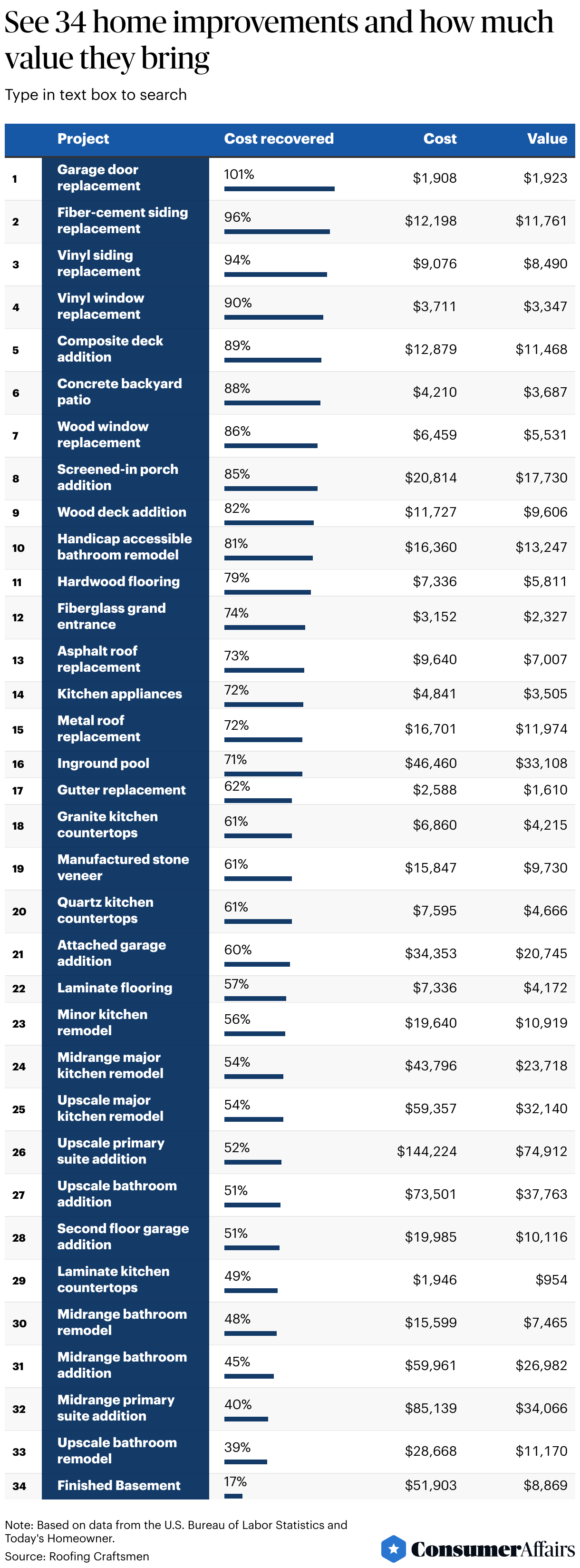
There are only four among 34 home improvements that recover 90% or more of their value, according to a report from roof-replacement company Roofing Craftsmen, which analyzed data from the U.S. Bureau of Labor Statistics and home-improvement website Today's Homeowner.

The best home improvement is a garage door replacement, costing around $1,908 and returning a tiny profit with a value of $1,923, Roofing Craftsmen said.

"Exterior improvements like a garage door replacement are some of the only projects that can actually return more than you spend. Entry door replacements are another high-ROI upgrade, improving both appearance and energy efficiency," said Jose D. Escalante of Roofing Craftsmen to ConsumerAffairs."Even more substantial updates like HVAC system replacements can pay off by assuring buyers they wont face big expenses after moving in."

The rest of the top five best home improvements for boosting a home's price are largely for walls and windows, including

  • a fiber-cement siding replacement ($12,198cost versus $11,761 value),
  • a vinyl siding replacement($9,076 cost versus $8,490 value),
  • a vinyl window replacement ($3,711 cost versus $3,347 value) and
  • a composite deck addition ($12,879 cost versus $11,468 value).

"Features like smart thermostats and outdoor living spaces, such as a composite deck or low-maintenance patio, are sought after and can set your home apart in a competitive market," Escalante said.

Below is a table listing the best home improvements with their recovered value.
Consumer News: Best home improvements to drive up your home's sales value

On the other hand, a finished basement is the worst home improvement for a home price, costing $51,903 and returning only $8,869 in value.

Bathroom and bedroom remodels or additionsalso often don't fare well.

The other five worst home improvements for a home price are an upscale bathroom remodel ($28,668 cost versus $11,170 value), a midrange primary suite addition ($85,139 cost versus $34,066 value), a midrange bathroom addition ($59,961cost versus $26,982value) and a midrange bathroom remodel ($15,599 cost versus $7,465 value).

"Some renovations are best avoided if your goal is to boost resale value," Escalante said."Upscale bathroom remodels, for instance, can quickly spiral into costly endeavors that recover far less than youd expect at sale. The same goes for major kitchen overhauls."

Some home improvements may even harma home price.

Escalante said that swimming pools are a major investment and may harm a home's value in colder climates.

"Pools are expensive to install, ranging anywhere from $15,000 to $150,000, and require constant upkeep, which many buyers see as a burden," he said.

Other costly and more niche home improvements that might want to be avoided are sunrooms and home theaters, Escalante said.

"For the best financial outcome, sellers should focus on upgrades that are practical, cost-effective, and appealing to the widest pool of buyers, he said.

The remodeling market has experienced "phenomenal" growth, with spending reaching unprecedented heights in recent years, according to a report from Harvard Joint Center for Housing Studies.

Spending on home remodeling reached an estimated $603 billion in 2024 and is expected to tick up to $608 billion in 2025, Harvard JCHS said.

Sign up below for The Daily Consumer, our newsletter on the latest consumer news, including recalls, scams, lawsuits and more.


Posted: 2025-04-15 22:43:38

Get Full News Story On Consumer Affairs


Listen to this article. Speaker link opens in a new window.
Text To Speech BETA Test Version.


More News From This Category
Consumer News: Big Tech wins: Trump to create single national AI rule
Tue, 09 Dec 2025 17:07:06 +0000

The rule will presumably override any state laws regulating AI

By James R. Hood of ConsumerAffairs
December 9, 2025

  • President plans One Rulebook for artificial intelligence, aiming to override state regulations
  • Big Tech backs a unified federal standard, while state leaders in both parties warn of lost consumer protections
  • Order expected to challenge state authority through preemption, lawsuits and potential funding restrictions

President Trump says he'll issue an executive order that will block state attempts to protect consumers from abuses by artificial intelligence (AI), responding to the pleas of the Big Tech companies that are in a race to dominate the fast-evolving technology.

The action would mark a major victory for tech giants that have urged the administration to preempt state laws including those intended to protect children that they view as fragmented and burdensome. It is also likely to spark sharp backlash from governors, attorneys general and lawmakers who say states must retain the ability to protect consumers.

There must be only One Rulebook if we are going to continue to lead in AI, Trump wrote on Truth Social, adding that companies cannot be expected to secure 50 approvals every time they want to do something.

Details unclear, but preemption strategy expected

Though Trump did not provide specifics, Reuters reported last month that the White House is considering an order that would challenge state AI laws through federal preemption, court action and restrictions on federal funding.

The proposal represents an escalation of Trumps earlier push for Congress to insert language blocking state AI regulations into a major defense bill. Lawmakers from both parties rejected that idea, and the Senate voted 991 to preserve state authority over AI legislation.

Companies including OpenAI, Google, Meta and venture firm Andreessen Horowitz have lobbied heavily for federal rules that override state statutes. Industry leaders argue that complying with disparate regulations would slow innovation, burden developers and allow China to outpace the U.S. in AI leadership.

They say a unified national framework would provide consistent expectations and reduce legal uncertainty across jurisdictions.

States insist on guardrails to protect residents

State leadersRepublican and Democrat alikesay local governments must retain the ability to respond to AI risks affecting their citizens.

Florida Gov. Ron DeSantis last week proposed an AI bill of rights that would include privacy protections, parental controls and consumer safeguards. Other states have enacted laws banning nonconsensual sexual imagery, prohibiting unauthorized political deepfakes, restricting discriminatory AI practices, and regulating high-risk AI systems. California will soon require major developers to document how they plan to address catastrophic-risk scenarios.

North Carolina Attorney General Jeff Jackson, a Democrat, rebuked Trumps earlier attempt to block state oversight. Congress cant fail to create real safeguards and then block the states from stepping up, he said.

A new federal-state clash over tech regulation

The anticipated order sets the stage for a sweeping legal and political battle over AI governance, with implications for privacy, innovation and consumer protection.

If the White House proceeds with the One Rule directive, courts will likely be asked to decide whether the federal government can sharply limit state authority in an area where Congress has yet to enact comprehensive legislation.

State officials warn that, absent robust federal standards, a preemption effort would leave millions of residents exposed to risks ranging from fraud to civil-rights violations. Tech companies counter that only a uniform national rule will allow the U.S. to maintain global AI competitiveness.

The executive order is expected later this week.

Examples of state AI/deepfake and AI-systems laws

  • Colorado AI Act Colorado in 2024 passed legislation regulating high-risk AI systems that affect areas such as employment, housing, insurance and government services.

  • ELVIS Act (Tennessee) This 2024 law prohibits unauthorized AI-generated voice or likeness impersonations. It was touted as a protection against AI-enabled voice cloning and deepfakes.

  • State laws banning or restricting distribution of AI-generated or otherwise manipulated deepfake sexual imagery or nonconsensual intimate content Forty-six states have enacted laws prohibiting creation or distribution of explicit deepfakes, including revenge porn, to protect individuals privacy and prevent abuse.

  • State laws regulating use of deepfakes in political or election-related communications As of 2025, roughly 28 states have passed laws restricting AI-generated media used in political campaigns or elections, aiming to curb misinformation and deception.

What these laws seek to do and what preemption could erase

These state-level laws typically aim to:

  • Ban nonconsensual or exploitative sexual content created by AI.

  • Prohibit impersonation or unauthorized use of a persons likeness or voice via AI (e.g., the ELVIS Act).

  • Regulate AI-generated content used in elections or political messaging.

  • Impose transparency or safety requirements on use of high-risk AI systems for example, to prevent discriminatory outcomes in housing, employment or insurance (as with the Colorado law).

If a federal executive order imposed a single national rule that preempts state laws, many or all of those protections could be voided along with any state-level enforcement mechanisms.

Why state-level action has surged

  • Rapid expansion of generative-AI and deepfake tools has made misuse easier and cheaper; lawmakers responded with targeted bans on nonconsensual deepfakes and AI-enabled impersonation. (multistate.us)

  • Growing awareness that discrimination, bias or safety harms could arise from AI systems used in sensitive areas (hiring, housing, public services) prompting laws like Colorados targeting high-risk systems. (Wikipedia)


Read More ...


Consumer News: Hassan presses corporate mobile-home park owners over rent hikes, poor conditions
Tue, 09 Dec 2025 17:07:06 +0000

Senator targets corporate owners as complaints surge

By James R. Hood of ConsumerAffairs
December 9, 2025

  • Senator seeks answers from six major investment firms amid rising lot rents and complaints of deteriorating living conditions
  • Letters cite growing corporate consolidation in manufactured housing and heightened risks for residents with limited mobility
  • Inquiry follows reports of sharp rent increases, alleged retaliation and maintenance failures in communities across New England

U.S. Sen. Maggie Hassan (D-NH), the ranking member of the Joint Economic Committee, is demanding answers from six corporate owners of manufactured housing communities amid mounting concerns about affordability and living conditions for millions of residents.

Hassan sent letters to Alden Global Capital (parent of Homes of America), Patriot Holdings, Philips International, Legacy Communities, the BoaVida Group and Sun Communities, asking each to explain how their business practices are affecting manufactured housing communities in New England. Roughly 22 million Americans live in manufactured homes, commonly located in land-lease communities where residents own their homes but rent the ground beneath them.

Corporate consolidation raises affordability concerns

Hassans letter notes that investment firms have rapidly expanded their ownership of mobile-home parks in recent years, with acquisitions reaching an estimated $9.4 billion in 2021. Between 2019 and 2021, such firms accounted for 23% of manufactured housing community purchases, including properties acquired by Alden Global Capital.

The senator warned that residentswho include significant numbers of seniors, people with disabilities, low-income families, and rural householdshave limited ability to move because manufactured homes are expensive to relocate and often hard to sell. As a result, she said, residents have few if any options when confronted with steep rent hikes, lease changes or other decisions by corporate owners.

Rent hikes far outpace traditional housing

Hassan cited reports showing that rents in manufactured housing communities rose more than five times faster than apartment rents between 2023 and 2024. In Maine, communities owned by the BoaVida Group and Philips International reportedly saw rent increases exceeding 50% since 2021.

Some companies explicitly highlight rent growth as part of their investment strategy. Patriot Holdings, which owns several communities in New England, promotes expected rent increases in line with market demand, which it describes as booming.

The senator also noted recent legal scrutiny: in 2024, Homes of America agreed to repay residents in West Virginia after settling claims over an allegedly unlawful rent increase that plaintiffs called unconscionable.

Allegations of collusion and deteriorating conditions

Beyond rent hikes, Hassan pointed to broader allegations of anticompetitive behavior. A 2023 federal complaint in Illinois accused Sun Communities and others of sharing sensitive, non-public data through a third-party analytics provider to systematically and unlawfully raise lot rents above inflation and historical norms. Attorneys general in Connecticut and Minnesota have launched similar inquiries into investor-owned properties.

Residents have also reported worsening living conditions under some corporate owners. Complaints include insufficient maintenance, staffing cuts, decaying infrastructure, pest infestations, poor water quality and health hazards such as respiratory illness. In New Mexico, residents said Legacy Communities raised rents while allowing property conditions to deteriorate. Similar concerns have been raised at BoaVida and Philips International properties in New England and at Homes of America communities nationwide.

Reports of retaliation and barriers to legal action

Hassan additionally highlighted claims that some firms have sought to intimidate or legally pressure residents who challenge business practices. Residents in West Virginia alleged that Homes of America threatened substantial rent increases unless they waived rights under state law. In another case, the same company reportedly sued a resident for interfering with its contractual relationships after she organized rights-education clinics.

Meanwhile, complex ownership structures and arbitration provisions may hinder residents ability to pursue claims. A study cited by Hassan found that some firms use onerous arbitration clauses that raise costs and reduce procedural protections, while multiple shell companies often obscure who actually owns a community. The Government Accountability Office has similarly warned that ownership information for manufactured housing communities is often limited or opaque.

Inquiry aims to inform congressional oversight

Hassan said the requested information will help Congress better understand how corporate consolidation is affecting affordability and safety in a critical segment of the nations housing stock. Given this impact on our economy and the pressing need to increase access to safe, reliable housing that people can afford, I seek more information on your business practices, she wrote.

The six companies have been asked to respond to the committee with detailed information about their rent-setting practices, ownership structures, maintenance policies and procedures for addressing resident complaints.


Read More ...


Consumer News: Homeowners sue Big Oil over soaring insurance rates
Tue, 09 Dec 2025 17:07:06 +0000

Climate deception alleged as insurance costs spike

By Truman Lewis of ConsumerAffairs
December 9, 2025

Washington homeowners file first lawsuit linking climate deception to rising insurance premiums
Class action seeks to hold major oil companies liable for climate-driven insurance costs
Case claims decades of misinformation fueled a crisis now hitting consumers wallets


Two Washington state homeowners who have watched their insurance premiums surge in recent years have filed a groundbreaking federal lawsuit aimed at holding major oil companies responsible for climate-driven increases in home insurance costs.

The caseKennedy v. Exxon et al., filed last week in the U.S. District Court for the Western District of Washingtonargues that decades of deception by fossil fuel companies about the dangers of burning oil and gas have accelerated climate change. That, in turn, the suit says, has helped create a home-insurance crisis marked by skyrocketing rates and shrinking availability in high-risk areas.

Washington homeowners have seen rates rise 51% in six years. For plaintiff Richard Kennedy of Normandy Park, premiums have more than doubled since 2017, climbing from $1,012 to $2,149. Co-plaintiff Margaret Hazard of Carson has seen a similar jump. Their suit seeks class-action status for all homeowners who have purchased insurance after 2017 in Washingtonand potentially nationwide.

Extreme weather drives insurers to retreat

Federal data suggests the trend is broad and accelerating. A January report from the Treasury Departments Federal Insurance Office found that average home insurance premiums grew nearly 9% faster than inflation from 2018 to 2022 as storms, floods and wildfires intensified.

As climate-related disasters multiply, insurers are absorbing higher losses and pricing the added risk into their ratesor pulling back from high-risk markets altogether. Insurance really is the bleeding edge right now of the climate crisis, said Aaron Regunberg of Public Citizens climate accountability project.

Suit claims oil companies ran Big Tobacco playbook

The lawsuit accuses ExxonMobil, BP, Chevron, ConocoPhillips, Shell and its subsidiary Equilon Enterprises, along with the American Petroleum Institute (API), of engaging in a coordinated, decades-long campaign to sow doubt about climate science, obstruct climate policies and mislead the public about the oil industrys role in warming the planet.

The companies have collectively generated $2.4 trillion in profits since 1990, according to the complaint. Plaintiffs argue those profits were protected by delaying the transition to clean energy while consumers now shoulder the economic fallout.

The complaint cites federal claims under the Racketeer Influenced and Corrupt Organizations (RICO) Act, as well as state claims including fraudulent misrepresentation, civil conspiracy, unjust enrichment, nuisance and violations of the Washington Consumer Protection Act.

Steve Berman of Hagens Berman Sobol Shapiro LLPlead counsel for the plaintiffs and a veteran of major tobacco litigationsaid the fossil fuel industry took its playbook directly from Big Tobacco and forced homeowners to pay for climate damages the companies helped cause.

Industry dismisses allegations as baseless

API senior vice president and general counsel Ryan Meyers called the case baseless and part of a coordinated campaign against an industry that powers everyday life. Meyers said climate policy belongs in Congress, not in a patchwork of courtrooms. Major oil companies contacted by Inside Climate News did not respond.

Sen. Sheldon Whitehouse (D-R.I.), a frequent critic of the industrys climate record, said higher premiums are a direct result of the fossil fuel sectors decades-long campaign of disinformation. He warned of a looming Great Climate Insurance Collapse that could trigger widespread declines in property values.

A new legal front with national implications

Legal scholars say the suit opens another significant front in the growing wave of climate accountability litigation brought by states, cities, tribes and now individuals. Michael Gerrard of Columbia University noted it may be difficult to quantify exactly how deception worsened climate impacts, but said the link between climate change and higher insurance premiums is clear.

The Washington case follows a series of recent filings, including a first-of-its-kind wrongful death claim in Washington last spring tied to the 2021 heat dome. It also comes after a federal court in Puerto Rico dismissed a similar racketeering-based climate case on procedural groundsan issue Berman says his case avoids because the harm is newly caused.

Meanwhile, the U.S. Supreme Court is considering whether to take up a petition from oil companies seeking to halt a climate deception case out of Boulder, Coloradoa move that could reshape more than two dozen related cases nationwide. The justices are expected to discuss the petition on Dec. 12.

Rising risks, rising stakes

Experts warn that climate-driven insurance instability poses broad financial dangers that extend beyond homeowners. Pat Parenteau, an emeritus professor at Vermont Law and Graduate School, likened the situation to the run-up to the 2007-08 financial crisis. Without insurance, he noted, buyers cannot obtain mortgages, property values fall and defaults multiply.

Climate breakdown is causing a cascade of disasters, including an insurance crisis that threatens another financial meltdown, Parenteau said. The damages are real and provable.

As the climate warms and the insurance market strains, the Washington lawsuit may become a key test of whether courts will hold fossil fuel companies financially accountable for climate-related consumer harmsa question with stakes running far beyond the plaintiffs premium bills.


Read More ...


Consumer News: Feds plan major initiative to improve travel experience for families
Tue, 09 Dec 2025 17:07:06 +0000

Its a follow-up to the Thanksgiving weekend civility push

By Mark Huffman of ConsumerAffairs
December 9, 2025
  • $1 billion initiative aims to make airports easier and healthier for families

  • Federal officials highlight need for kid-friendly spaces, nursing rooms, and better screening options

  • Effort builds on Secretary Duffys Thanksgiving push for more civil, compassionate air travel


U.S. Transportation Secretary Sean P. Duffy has introduced a new initiative designed to make American airports friendlier for families, expanding on the Make Travel Family Friendly Again campaign he previewed during his Thanksgiving weekend call for more civil air travel.

The announcement comes as airports prepare for one of the busiest travel seasons of the year and as public frustration over the difficulties of traveling with children continues to grow.

At the center of the effort is a $1 billion federal investment to incentivize airports to create more family-centric spaces and services. The funding can be used for a wide range of improvements, including childrens play zones, exercise areas, dedicated family screening lanes, mothers rooms or nursing pods, and sensory rooms designed to support children with special needs.

Duffy emphasized that airports will have flexibility to propose creative terminal projects that meaningfully improve the travel experience for parents and kids alike.

Public-private effort

The campaign launch brought together federal leaders and private-sector partners, including Health and Human Services Secretary Robert F. Kennedy Jr., nutrition specialist Dr. Paul Saladino, content creator and young mother Isabel Brown, and Farmers Fridge founder Luke Saunders. Their presence underscored the administrations broader goal: pairing infrastructure upgrades with expanded access to healthy, convenient food options in terminals nationwide.

Bringing about a Golden Age in travel has to involve making the family travel experience happier and healthier, Duffy said.

Kennedy echoed that message, arguing that fresh, whole foods should be as accessible during a long layover as they are at home.

Healthy eating is part of daily life

Secretary Duffy and I are working to ensure our airports set the standard for a future where healthy eating is part of daily lifetravel days included, Kennedy said.

The agencies pointed to the rising popularity of grab-and-go healthy vending options, such as Farmers Fridge, as evidence that travelers are eager for better food choices. They urged airport operators to seize the moment by expanding partnerships and rethinking outdated concession models.

The initiative builds on Duffys recent holiday-travel messaging, in which he urged airlines, airports, and passengers to take steps toward making air travel more courteous and humane.


Read More ...


Consumer News: How long does it take to get your dog an appointment with the vet?
Tue, 09 Dec 2025 14:07:07 +0000

In a rural area, it can take a long time

By Mark Huffman of ConsumerAffairs
December 9, 2025
  • Most pet owners can book vet appointments fairly quickly, a new study shows.

  • But rural pet owners face longer waits and farther drives for basic veterinary care.

  • Researchers say boosting the veterinary workforce could help close the gap.


A new multi-state study suggests that while most dog owners can get timely veterinary appointments, access to care drops sharply in rural communities, revealing a growing concern for pet health, owners well-being, and even public health.

Access to veterinary care appears to be generally pretty good and the wait times arent too long, particularly if you compare it to how long people often have to wait to establish primary care, said Simon Haeder, lead author and associate professor at Ohio States College of Public Health. But theres clearly room for improvement in less populated areas. The findings were published in the Journal of the American Veterinary Medical Association.

Secret shoppers reveal uneven access

To measure real-world availability, researchers posed as dog owners and called more than 5,000 randomly selected veterinary practices across California, Minnesota, Ohio, Pennsylvania, Texas, and Washington in early 2025.

Overall, callers were able to secure an appointment 67% of the time. When unsuccessful, it was usually because no one answered or callers were left on hold for more than five minutes, long enough to count as a failed attempt in the study. In nearly 4% of cases, clinics reported they were not accepting new patients.

Among successful appointments, wait times averaged 6.4 days, and the typical travel distance was also 6.4 miles, suggesting most pet owners dont have to go far or wait long for routine care.

Rural pet owners face steeper challenges

The picture changed dramatically in rural communities:

  • Appointment success rate dropped to less than 62%

  • Average wait time increased to 8.6 days

  • Average travel distance more than doubled to 13 miles

These barriers could leave pets without timely preventive care or treatmentissues that can snowball into more serious health problems for animals and financial or emotional strain for their owners.

Haeder notes that after cost, access is the most common concern among pet owners. Delayed or inconsistent care doesnt only affect petsit can have wider public health implications, especially when it comes to vaccine-preventable diseases like rabies.

When pets dont receive prompt preventive care, diagnoses and treatment, both the pets and their owners suffer, Haeder said. And gaps in access can pose broader public health threats.

Potential solutions on the horizon

Efforts to expand the veterinary workforce may help narrow the rural gap. Ohio States College of Veterinary Medicine is part of a new statewide initiative, Protect One Health in Ohio, aimed at strengthening the veterinary workforce, safeguarding public health, and supporting the agricultural economy.

In a recent companion paper, college leaders outlined plans to train more veterinarians specifically to serve rural areas, where shortages are most pronounced.

As pet ownership continues to rise and rural communities struggle to attract veterinary professionals, the researchers suggest that expanding training programs could play a major role in ensuring all pets whether in cities or quiet farm towns receive the care they need.


Read More ...


Related Bing News Results


Blow Us A Whistle


Related Product Search/Búsqueda de productos relacionados

Amazon Logo













