

Rockin Robin SongFlying The Web For News.
RobinPost Logo Amazon Prime Deals


Consumer Daily Reports

North Dakota has been attracting renters from other states in recent years

By Dieter Holger of ConsumerAffairs
April 22, 2025

Key takeaways:

  • North Dakota, Oklahomaand Arkansasare the three best states for price of rent per square foot.
  • New York, Massachusetts and Hawaiiare the three worst states for price of rent per square foot.
  • States in the Midwest, South and West typically have better rent prices forthe cost of space.

It's no secretrenters end uppaying a lot more for less space across the country.

But some states have much lower rents based on the cost of space.

Rent prices per square foot variedwidely from as little as $1.10 a square foot to as much as $3.23 amongstates, according to data provided to ConsumerAffairs by Cash For Home, which analyzed the average rent price per square foot by state.

North Dakota is the best state for renters by price per square foot, costing $1.10 a square foot, followed by Oklahoma ($1.19), Arkansas ($1.20), South Dakota ($1.25) and Wyoming ($1.27).
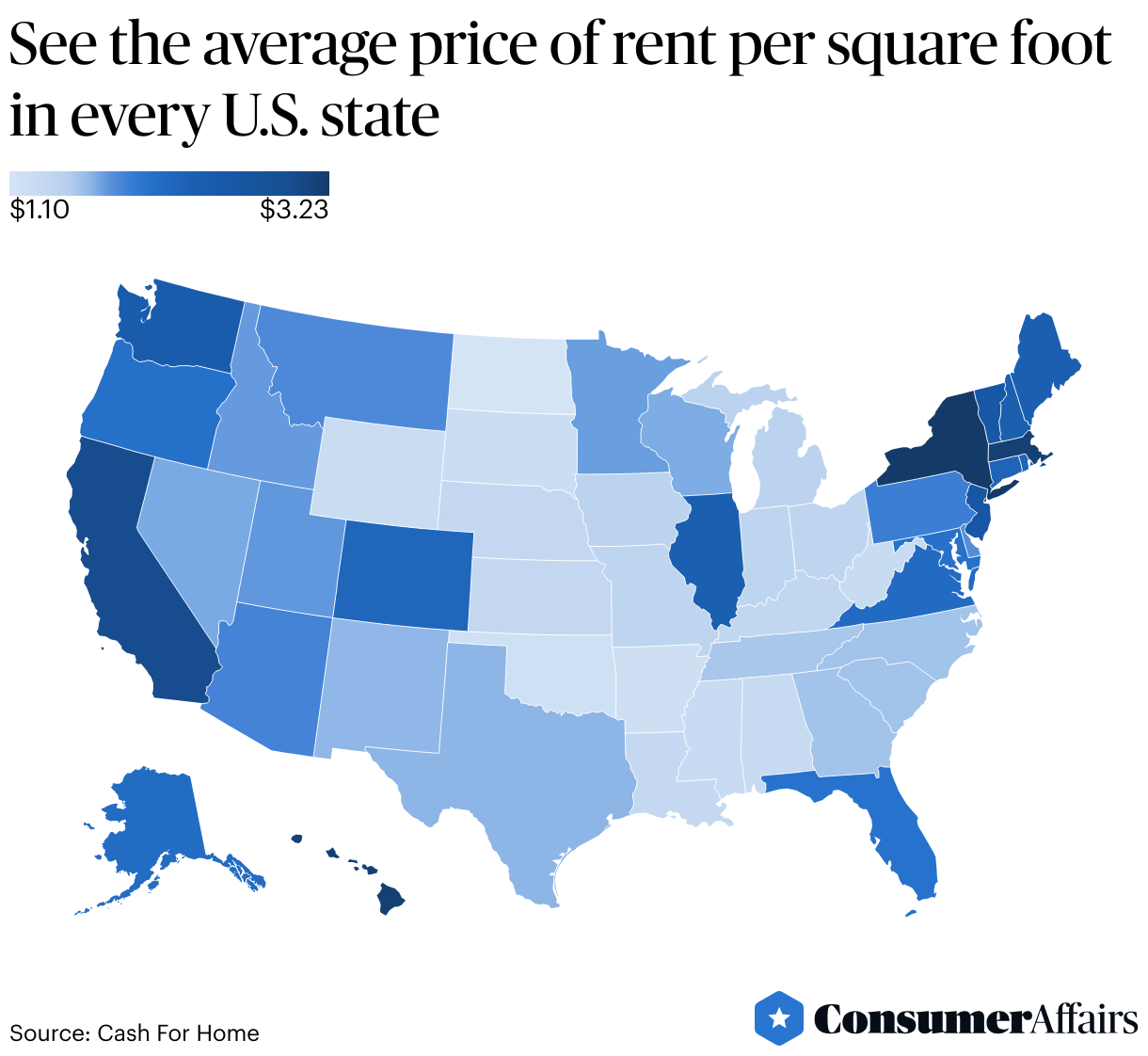
Consumer News: Best states for price of rent per square foot

North Dakotaoutpaced the rest of the U.S. in domestic migrationin 2023, the latest year of data from the U.S. Census, in part because of its low cost of living and and economic opportunity attracting Americans from other states, ConsumerAffairs previously reported.

"In states like New York, youre paying top dollar for less room," Nathan Richardson, real estate expert and founder of Cash For Home, told ConsumerAffairs. "In places like North Dakota, the same money gets you space to live, growand breathe."

The worst state for price of rent per square foot is New York, costing $3.23 a squarefoot. The other five worst states are Massachusetts ($3.16), Hawaii ($3.16), California ($2.99) and New Jersey ($2.64).

"Affordability in real estate isnt just about monthly rentit's about what you're getting in return," he said.

Cost per square foot is an often overlooked figure in the rental market that gives a more accurate picture of value when comparing across locations, he said.

"In lower-density areas, you're not only getting more space for your dollar, but often a better quality of life: less congestion, more privacy, and room to grow, literally and figuratively," Richardson said. "With remote and hybrid work becoming the norm, renters are no longer tied to high-cost urban centres, making states like North Dakota or Arkansas even more appealing."

Sign up below for The Daily Consumer, our newsletter on the latest consumer news, including recalls, scams, lawsuits and more.


Posted: 2025-04-22 11:17:25

Get Full News Story On Consumer Affairs


Listen to this article. Speaker link opens in a new window.
Text To Speech BETA Test Version.


More News From This Category
Consumer News: Americans aren’t slowing down their spending—even with higher prices
Fri, 17 Apr 2026 19:07:06 +0000

The gap between rising costs and consumer behavior

By Kyle James of ConsumerAffairs
April 17, 2026
  • In many states, spending is still rising faster than inflation meaning people are actually buying more, not just paying higher prices.

  • States like Massachusetts, California, and DC are leading the trend, with spending gaps as high as 5% despite modest price increases.

  • The takeaway: higher costs arent slowing consumers down theyre just making everyday life more expensive while spending habits stay the same.


Youd expect higher prices to force people to cut back. But thats not really whats happening.

A recent report from SensaPay shows that in many parts of the country, consumers are still spending more, even after accounting for inflation. The interesting part is that people arent just paying more because things cost more. Theyre actually buying more.

Thats a key distinction. It means higher prices havent fully changed consumer behavior theyve just made everyday life more expensive.

The states where spending is still climbing

The data highlights a group of states where spending is outpacing price increases the most:

  • Massachusetts: +5.3% spending gap (prices up just 0.8%)
  • California: +4.8% spending gap (prices up 1.3%)
  • Washington, DC: +4.7% spending gap (prices up 1.9%)
  • Vermont: +3.9% spending gap (prices up 1.3%)
  • Connecticut: +3.9% spending gap (prices up 1.9%)
  • Maine: +3.7% spending gap (prices up 2.0%)
  • Arizona: +3.6% spending gap (prices up 2.9%)
  • New York: +3.6% spending gap (prices up 2.4%)
  • Washington: +3.6% spending gap (prices up 2.3%)
  • Florida: +3.5% spending gap (prices up 3.5%)

In general terms, people in these states arent just absorbing higher prices or finding cheaper alternatives, theyre actually increasing how much they consume.

What the data actually tells us

The key metric in the report is the spending gap, which is the difference between how much spending increased and how much prices increased.

For example: If spending rises 6% and prices rise 2%, that extra 4% reflects real growth in purchases.

Across these states, that gap is consistently positive. In other words, inflation isnt slowing spending, but rather, its just raising the cost of keeping up.

Why people keep spending anyway

On the surface, it doesnt make sense. When prices go up, you would think that spending would go down. But behavior doesnt work that cleanly.

1. Most spending isnt flexible

A big chunk of your budget is already locked in:

  • Rent or mortgage
  • Insurance
  • Car payments
  • Subscriptions

These arent things people cut overnight. So even if prices rise, total spending stays high because the biggest expenses dont move easily.

2. People adjust slower than prices do

Inflation shows up gradually with slightly higher groceries, gas, and services. Individually, these increases dont feel urgent, but together they quietly raise your monthly costs.

3. Small increases add up fast

An extra $10 here or $15 there doesnt seem like much. But over time, it turns into hundreds of dollars a year without a noticeable lifestyle change.

4. Convenience spending fills the gap

Instead of cutting back, many people lean into convenience:

  • Food delivery
  • Rideshare
  • Time-saving services

These feel justified, but in actuality, they raise overall spending in ways that are easy to overlook.

5. Lifestyle expectations dont reset quickly

Once youre used to a certain way of living, its hard to scale back. So instead of changing behavior, people often adjust to higher prices.

How to stay ahead of the trend

You dont need to overhaul your life completely, but you do need to be intentional.

1. Find your quiet increases

Look for areas that crept up without you noticing. Things like:

  • Food delivery
  • Subscriptions
  • Everyday convenience spending

2. Pressure-test your budget

Ask yourself, if costs went up another 510%, would you be okay?

If not, then thats where to adjust first. A good place to start is with store-brands at the grocery store, some of which are actually made by the popular name-brand.

3. Redirect instead of cutting everything

Shift some spending toward things that help you financially:

  • Paying down high-interest debt
  • Building a small emergency fund
  • Locking in predictable costs

Read More ...


Consumer News: Mortgage rates drop to a four-week low
Fri, 17 Apr 2026 19:07:06 +0000

Rate peaked at nearly 6.5% earlier this month

By Mark Huffman of ConsumerAffairs
April 17, 2026
  • Mortgage rates have fallen to about 6.3%, a four-week low and below last years levels.

  • The decline offers modest relief to buyers but rates remain high enough to limit affordability.

  • Economists say continued volatility and economic uncertainty could keep the housing market subdued.


After jumping in March at the start of the Iran war, mortgage rates in the U.S. are edging lower again, offering a small but notable boost to prospective homebuyers as the critical spring selling season unfolds.

Freddie Mac said in its latest weekly survey that the average rate on a 30-year fixed mortgage declined to 6.30%, marking a four-week low and a meaningful drop from 6.83% a year ago. The dip represents the second consecutive weekly decline and the lowest level since mid-March.

Mortgage rates declined this week to a four-week low a meaningful improvement for homebuyers, said Freddie Mac Chief Economist Sam Khater in the companys press release.

Relief for buyers but not a breakthrough

While the easing in rates is welcome news, borrowing costs remain elevated compared with the ultra-low levels seen earlier in the decade. Rates hovering above 6% continue to stretch affordability, especially as home prices remain high and inventory is limited.

Recent data shows the housing market is still struggling to regain momentum. Existing-home sales fell in March and are hovering near 30-year lows, reflecting a combination of high costs and cautious buyers.

Even with the recent drop, economists say many would-be buyers are still sidelined.

Affordability challenges and economic uncertainty continue to constrain demand, analysts note, despite early signs of increased activity like rising refinance applications.

Volatility remains a key risk

Mortgage rates have been particularly volatile in recent weeks, driven by shifting inflation expectations and geopolitical tensions. Rates climbed sharply in March amid concerns tied to global conflicts and rising energy prices, before easing as those fears subsided.

Because mortgage rates tend to track the 10-year Treasury yield, they remain sensitive to inflation data and Federal Reserve policy. The Feds decision to keep interest rates elevated to combat inflation could limit how far mortgage rates fall in the near term.

What it means for the housing market

The recent decline could provide a modest tailwind for the housing market during its busiest season. Lower rates can improve purchasing power and encourage both buyers and sellers to re-enter the market.

However, the broader outlook remains uncertain. While some forecasts suggest rates could drift below 6% later this year, that trajectory depends heavily on inflation cooling and economic stability.

For now, the market appears stuck in a middle ground: rates are improving enough to spark interest, but not enough to fully unlock demand.

In practical terms, that likely means a gradual, uneven recovery rather than a sharp rebound with affordability continuing to be the biggest constraint for U.S. homebuyers in 2026.


Read More ...


Consumer News: In a sign of shifting consumer behavior, QVC files for bankruptcy
Fri, 17 Apr 2026 19:07:06 +0000

The shopping networks have struggled to compete with influencers

By Mark Huffman of ConsumerAffairs
April 17, 2026
  • QVC has filed for Chapter 11 bankruptcy protection amid declining sales and mounting debt.

  • The home shopping giant says it will continue operating while restructuring its business.

  • Industry analysts point to shifting consumer habits and e-commerce competition as key factors.


For a generation or two of consumers, it was must-see TV. Continuous shopping shows on cable, where hosts tried to entertain as they sold products directly to callers.

But times have changed.

QVC, the long-running television and online shopping network known for its live product demonstrations, has filed for Chapter 11 bankruptcy protection, according to court documents.

The move comes as the company grapples with declining revenues, rising operational costs, and increased competition from digital-first retailers.

The company said in a statement that it intends to use the bankruptcy process to restructure its debt and streamline operations while continuing to serve customers.

QVC remains committed to delivering engaging shopping experiences across platforms, the statement read. This restructuring will position us for long-term stability in a rapidly evolving retail environment.

TV shopping pioneer

Founded in 1986, QVC became a pioneer of televised shopping, building a loyal customer base through charismatic hosts and real-time product showcases. However, the rise of e-commerce giants and social media-driven shopping has steadily eroded its market share.

Consumers have increasingly shifted toward on-demand, mobile-first purchasing apps, leaving traditional TV retail struggling to adapt.

Industry analysts say QVCs challenges reflect broader trends affecting legacy retailers. They note that the convenience and personalization offered by online platforms have fundamentally changed how people shop.

In recent years, QVCs parent company, Qurate Retail Group, has attempted to pivot toward streaming and online sales, but those efforts have yet to fully offset declining television viewership. Supply chain disruptions and inflationary pressures have also weighed on margins.


Read More ...


Consumer News: Trader Joe’s settles receipt lawsuit: Who qualifies and how to claim
Fri, 17 Apr 2026 16:07:07 +0000

The retailer settled charges that it printed too many credit card digits on receipts

By Mark Huffman of ConsumerAffairs
April 17, 2026
  • Trader Joes agreed to a $7.4 million class action settlement over claims it printed too many digits of customers card numbers on receipts.

  • Eligible shoppers could receive about $100 each, depending on how many claims are filed.

  • Consumers must file a claim by June 9, 2026 to receive compensation.


Trader Joes customers who paid with a credit or debit card several years ago may now be entitled to a cash payout as part of a newly announced class action settlement.

The grocery chain agreed this week to pay $7.4 million to resolve allegations that it violated the federal Fair and Accurate Credit Transactions Act (FACTA), a law designed to protect consumers from identity theft.

What the lawsuit claims

The lawsuit centered on receipts issued at some Trader Joes stores between March 5, 2019, and July 19, 2019. According to court filings, certain receipts displayed both the first six and last four digits of customers credit or debit card numbers more information than allowed under federal law.

Plaintiffs argued that exposing those digits increased the risk of identity theft, though Trader Joes has denied wrongdoing and says no cases of fraud were reported.

Who is eligible for compensation

Consumers may qualify for a payout if they meet all of the following criteria:

  • Used a credit or debit card at a Trader Joes store.

  • Made the purchase during the window from March 5 to July 19, 2019.

  • Received a receipt that showed both the first six and last four digits of their card number.

Not every transaction or store was affected, meaning eligibility depends on whether the receipt formatting issue occurred in that specific purchase.

Roughly 757,000 customers are estimated to fall within the eligible class.

How much money consumers could receive

Each valid claimant is expected to receive around $102, though the final amount may vary depending on how many people file claims and the deduction of legal fees and costs.

In general, fewer claims mean larger individual payouts, while more claims reduce the per-person amount.

How to file a claim

Consumers who believe they qualify can submit a claim in several ways:

  • Online through the official settlement website

  • By mail using a printed claim form

  • By phone via the settlement administrator

Some consumers may have received a notice with a Claim ID and PIN, but claims can still be submitted without it in many cases.

Key deadlines to know

  • June 9, 2026 Deadline to file a claim or opt out

  • August 10, 2026 Final court approval hearing

  • Payments are expected about 45 days after final approval, assuming no appeals

Filing a claim comes with a tradeoff: those who accept payment will give up the right to sue Trader Joes separately over the same issue. Consumers who prefer to retain that right must opt out of the settlement before the deadline.


Read More ...


Consumer News: Mortgage rates drop to a four-week low
Fri, 17 Apr 2026 16:07:06 +0000

Rate peaked at nearly 6.5% earlier this month

By Mark Huffman of ConsumerAffairs
April 17, 2026
  • Mortgage rates have fallen to about 6.3%, a four-week low and below last years levels

  • The decline offers modest relief to buyers but rates remain high enough to limit affordability

  • Economists say continued volatility and economic uncertainty could keep the housing market subdued


After jumping in March at the start of the Iran war, mortgage rates in the U.S. are edging lower again, offering a small but notable boost to prospective homebuyers as the critical spring selling season unfolds.

Freddie Mac said in its latest weekly survey that the average rate on a 30-year fixed mortgage declined to 6.30%, marking a four-week low and a meaningful drop from 6.83% a year ago. The dip represents the second consecutive weekly decline and the lowest level since mid-March.

Mortgage rates declined this week to a four-week low a meaningful improvement for homebuyers, said Freddie Mac Chief Economist Sam Khater in the companys press release.

Relief for buyers but not a breakthrough

While the easing in rates is welcome news, borrowing costs remain elevated compared with the ultra-low levels seen earlier in the decade. Rates hovering above 6% continue to stretch affordability, especially as home prices remain high and inventory is limited.

Recent data shows the housing market is still struggling to regain momentum. Existing-home sales fell in March and are hovering near 30-year lows, reflecting a combination of high costs and cautious buyers.

Even with the recent drop, economists say many would-be buyers are still sidelined.

Affordability challenges and economic uncertainty continue to constrain demand, analysts note, despite early signs of increased activity like rising refinance applications.

Volatility remains a key risk

Mortgage rates have been particularly volatile in recent weeks, driven by shifting inflation expectations and geopolitical tensions. Rates climbed sharply in March amid concerns tied to global conflicts and rising energy prices, before easing as those fears subsided.

Because mortgage rates tend to track the 10-year Treasury yield, they remain sensitive to inflation data and Federal Reserve policy. The Feds decision to keep interest rates elevated to combat inflation could limit how far mortgage rates fall in the near term.

What it means for the housing market

The recent decline could provide a modest tailwind for the housing market during its busiest season. Lower rates can improve purchasing power and encourage both buyers and sellers to re-enter the market.

However, the broader outlook remains uncertain. While some forecasts suggest rates could drift below 6% later this year, that trajectory depends heavily on inflation cooling and economic stability.

For now, the market appears stuck in a middle ground: rates are improving enough to spark interest, but not enough to fully unlock demand.

In practical terms, that likely means a gradual, uneven recovery rather than a sharp rebound with affordability continuing to be the biggest constraint for U.S. homebuyers in 2026.


Read More ...


Related Bing News Results
Consumer Reports gives tips on how to keep your current electronics clean and working longer
Thu, 16 Apr 2026 17:40:00 GMT
If your phone, TV, or computer has been acting glitchy lately, Consumer Reports says you may not need to replace it just yet. Sometimes, a little routine maintenance can solve common tech problems and ...

Driving smarter to maximize gas mileage | Consumer Reports
Tue, 14 Apr 2026 06:00:00 GMT
How you drive and maintain your vehicle can have a profound effect on how much fuel you use on a daily basis ...

Consumer Reports highlights caffeine concerns in energy drinks for teens
Mon, 13 Apr 2026 14:46:00 GMT
Consumer Reports tested 23 energy drinks and found some exceeded their labeled caffeine content, raising health concerns for teens.

Consumer Reports: Energy drinks risky for teens
Sat, 11 Apr 2026 00:14:00 GMT
Consumer Reports found that many drinks contain 2 to 3 times the daily caffeine limit recommended for teens: 100 mg. Too much caffeine has been linked to insomnia, anxiety, jitters, and heart-related ...

Consumer Reports tests products to ease daily tasks for those with limited mobility
Mon, 06 Apr 2026 19:51:00 GMT
Everyday tasks like opening jars, picking up a mug, or holding a knife may seem simple to some, but others struggle.


Blow Us A Whistle


Related Product Search/Búsqueda de productos relacionados

Amazon Logo

Visit Our New Print-On-Demand Stores On Printify and Zazzle
Printify Zazzle













