Rockin Robin SongFlying The Web For News.
RobinPost Logo Amazon Prime Deals


Consumer Daily Reports

Whooping cough, polio, rubella all waiting to stage a comeback

By Truman Lewis Consumer News: Measles, polio rising steadily as vaccinations fall of ConsumerAffairs
April 25, 2025

Childhood vaccination rates have been falling in the United States, especially since the start of the COVID-19 pandemic. Lower levels of immunity have resulted in a resurgence of measles cases, including a recent outbreak in western Texas that infected more than 620 people, leading to 64 hospitalizations and the deaths of two children.

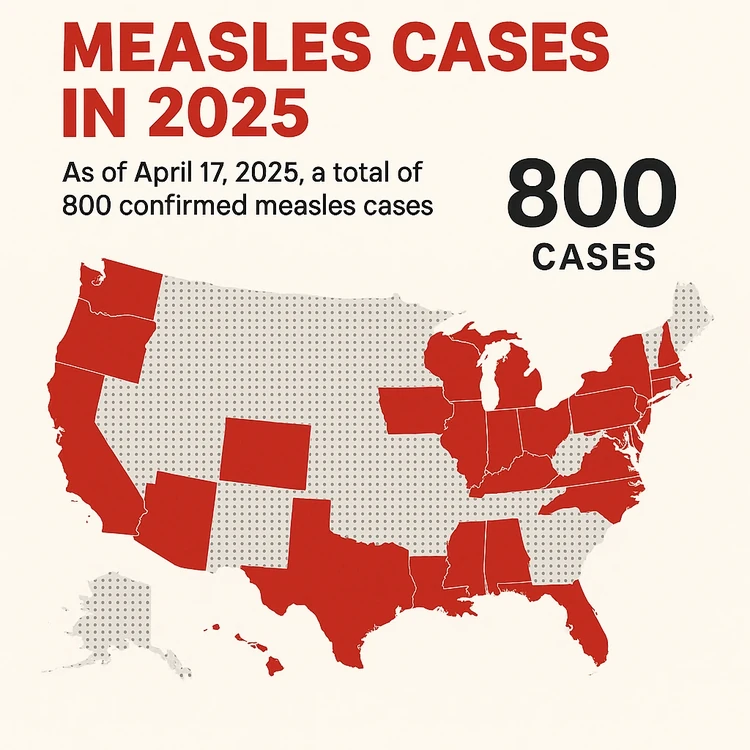
Tennessee health officials confirmed a measles outbreak on Thursday, bringing the number of U.S. states with outbreaks to 10. Nearly a week ago, the U.S. was up to 800cases of measlesnationwide.Texashas more than 600 known cases with the outbreak in the western part of the state approaches the three-month mark.

Two unvaccinated elementary school-aged childrendied from measles-related illnesses inthe epicenter in West Texas,and anadult in New Mexicowho was not vaccinated died of a measles-related illness.
Photo
Data via CDC

Otherstates with active outbreaks defined as three or more cases include Indiana,Kansas, Michigan, Montana, Oklahoma, Ohio, Pennsylvania and New Mexico. The U.S. has more than double the number ofmeasles casesit saw in all of 2024.

Other once nearly-extinct diseases are also coming back.

Whooping cough

Whooping cough cases are rising, and doctors are bracing for yetanother tough year.

There have been 8,485 cases reported in 2025, according to preliminary data from theU.S. Centers for Disease Control and Prevention. Thats twice as many cases as this time last year, based on the CDCs final tally.

Rates of whooping cough, or pertussis, soared last year, which experts said wasnt unexpected. The number of cases fell during COVID-19 because of masking and social distancing. Plus, experts said, the illness peaks every two to five years.

Whooping cough tends to peak around this time of year and in the fall. Its usually spread through respiratory droplets in the air, when people with pertussis cough, sneeze or breathe close to others. The symptoms are similar to a cold but the cough becomes increasingly severe with a distinctive sound a whoop as the person tries to take in air. It is treated with antibiotics.

Rubella and polio

If immunization rates drop further over a prolonged period of time, measles and even other wiped-out diseases such as rubella and polio could one day make a comeback in the United States, according to a newstudyby researchers at Stanford Medicine and other universities.

About the study

The study, which was published in theJournal of the American Medical Associationon April 24, used large-scale epidemiological modeling to simulate the spread of infectious diseases in the United States at various childhood vaccination levels.

Even at current immunization rates, researchers predict that measles may become endemic again circulating in the U.S. within two decades; with small declines in vaccination, this could happen more quickly. However, small increases in vaccine coverage would prevent this.

Lead authorMathew Kiang, ScD, assistant professor of epidemiology and population health, and senior authorNathan Lo, MD, PhD, assistant professor of infectious diseases, hope the study will provide useful data for decision makers setting vaccine policy.

The researchers speak

Stranford Medicine spoke with Kiang and Lo to learn more. This interview has been edited for clarity and length.

Why did you think this research was important?

Nathan Lo:Weve seen a worrisome pattern of decreasing routine childhood vaccinations. There was a disruption to health care services during the pandemic, but declines preceded this period and have accelerated since then for many reasons. People look around and say, We dont see these diseases. Why should we vaccinate against them? Theres a general fatigue with vaccines. And theres distrust and misinformation about vaccine effectiveness and safety.

Mathew Kiang:As vaccinations decline, the effect wont be immediate. We wanted to know: When will we see the impact of decisions being debated and made now?

Lo:Specifically, we wanted to look at some key diseases that have been eliminated from the U.S. through vaccination, which means theyre not spreading within the country on an ongoing basis. These include measles, polio, rubella and diphtheria, which can have awful complications, like lifelong paralysis, birth defects and death.

How did you model what would happen?

Lo:We used a large-scale epidemiological model to simulate all individuals living in the U.S. and assigned them an age, vaccination status, immunity, state of residence, etc. We then simulated how infections would spread under different vaccine conditions. The model assumes that diseases are introduced by someone who travels abroad and brings them back, most commonly a U.S. citizen who isnt vaccinated. Right now, so many people are immune through vaccination that diseases dont spread far. But if vaccinations decline over a longer period, you start to see outbreaks increase in size and frequency. Eventually you see sustained, ongoing transmission, meaning these diseases become endemic they become household names once again.

What is likely to happen with these diseases if vaccinations stay at current levels?

Kiang:For current rates, we took a conservative approach by using average vaccination levels between 2004 and 2023. With measles, we found that were already on the precipice of disaster. If vaccination rates remain the same, the model predicts that measles may become endemic within about 20 years. That means an estimated 851,300 cases over 25 years, leading to 170,200 hospitalizations and 2,550 deaths. The other diseases are not likely to become endemic under the status quo.

Why is measles likely to become endemic and not the others?

Lo:Measles is one of the most infectious diseases that exists, so the number of people who have to be immune to prevent it from spreading is extremely high. Polio, diphtheria and rubella are still far more infectious than COVID-19, for example, but measles is in a different ballpark, with one person infecting up to 20 others (though our model took a conservative estimate of 12) in a fully susceptible population. Also, the MMR (measles, mumps and rubella) vaccine has become particularly controversial, partly due to a history of fraudulent medical research that raised safety concerns; it has been conclusively shown that there is no link with autism. Measles is also more common around the world, so travelers are more likely to bring it back.

Kiang:Travelers importing a disease are like matches, and U.S. under-vaccination is the tinder. With measles, youre throwing a lot of matches in, and eventually something is going to happen.

What do you predict will happen if fewer people get their kids vaccinated?

Kiang:If vaccination were to fall by even 10% today, measles cases would skyrocket to 11.1 million over the next 25 years. If vaccination rates were cut in half, wed expect 51.2 million cases of measles, 9.9 million cases of rubella, 4.3 million cases of polio and 200 cases of diphtheria over 25 years. This would lead to 10.3 million hospitalizations and 159,200 deaths, plus an estimated 51,200 children with post-measles neurological complications, 10,700 cases of birth defects due to rubella and 5,400 people paralyzed from polio. Measles would become endemic in less than five years, and rubella would become endemic in less than 20. Under these conditions, polio became endemic in about half of simulations in around 20 years.

What differences did you find at the state level?

Kiang:Massachusetts has high vaccination rates and was consistently low risk. Both California and Texas were higher risk, even after accounting for larger population size, because vaccination rates in both have dropped and theres a lot of travel to those states. Our model assumed there was no spillover of infections across state lines, so the numbers could be an underestimate.

If these diseases become more widespread, who is in danger?

Lo:Folks who are unvaccinated are most at risk of infection and the awful complications. That includes babies, especially those between the ages of 6 and 12 months, who have waning antibodies from their mothers but are not yet eligible for their first dose of an MMR vaccine. Others are also at risk. People who are immunocompromised, which is a sizable segment of the U.S. population, can also be at risk. While the effects of declining vaccination wont be immediate, we could eventually see the return of awful complications from diseases that most clinicians today have not encountered thanks to decades of successful immunization.

Which of your scenarios is most likely to play out?

Lo:One thats conceivable is that vaccine coverage continues to drop, measles outbreaks become larger and more frequent, and eventually measles becomes endemic again. Hopefully, some fraction of the unvaccinated population seeks vaccination as a result, and state and local public health departments continue to do their vital work in outbreak response, allowing us to reestablish elimination. We might get into that kind of pattern. If we start to see major changes to the childhood vaccination schedule and policy and coverage really drops, you get into a world where you worry about diseases like polio and rubella, but that would likely take well over a decade or more. If that were to happen, you cant just flip a switch once these diseases get unleashed, it would take time eliminate them again.

What should parents, providers and others do based on these results?

Lo:I would encourage parents who arent sure about vaccination to discuss this with their pediatrician and believe in our health care providers. We hope our research also provides the data for federal and state officials, vaccine guideline committees, and others to understand what will happen if decisions are made that lead to declines in vaccination.

With measles, were right on the cusp. Increasing vaccination levels by just 5% brings the number of measles cases down, safely away from returning to endemic levels. These are the kinds of small percentages that can really be a tipping point. Its empowering that a small segment of the population can make a difference here.

Kiang:Its worth emphasizing that there really shouldnt be any cases at this point, because these diseases are preventable. Anything above zero is tragic. When youre talking about potentially thousands or millions, thats unfathomable.


Sign up below for The Daily Consumer, our newsletter on the latest consumer news, including recalls, scams, lawsuits and more.


Posted: 2025-04-25 11:59:00

Get Full News Story On Consumer Affairs


Listen to this article. Speaker link opens in a new window.
Text To Speech BETA Test Version.


More News From This Category
Consumer News: This smart toilet has a camera—here's what it tells you about your health
Fri, 16 Jan 2026 20:07:06 +0000

What your toilet can reveal about hydration and gut health

By Kyle James of ConsumerAffairs
January 16, 2026
  • A toilet that tracks health data - Kohlers Dekoda uses a bowl-mounted camera to analyze urine and stool. A hands-on review from Good Housekeeping found it less invasive than it sounds.

  • Helpful insights, not medical advice - It flags hydration, digestion patterns, and possible blood traces, offering awareness rather than diagnoses.

  • The price keeps it niche - At roughly $600 plus a monthly fee, its likely for early adopters, not the average household.


Smartwatches track your steps. Apps track your sleep. Now, one company wants your toilet to track your health.

Yes, really.

Kohler has introduced a new smart device called Dekoda, which is a toilet-mounted camera that analyzes your urine and stool and then gives you health insights.

The idea sounds a little uncomfortable at first, but according to a recent hands-on review from Good Housekeeping, the tech is less invasive than it sounds and surprisingly informative.

Heres what consumers should know before deciding whether a camera in the toilet bowl is the futureor just a pricey novelty.

What exactly is this thing?

Dekoda isnt a new toilet. Its simply a small device that clamps onto the rim of an existing toilet bowl and looks down into the water. Using optical sensors and machine learning, it analyzes waste and sends wellness insights to a companion app.

Importantly, the camera is NOT aimed at you. It only captures whats in the bowl, not your body, and Kohler says images are encrypted and protected behind fingerprint authentication.

But the privacy question is a big one, and its one Good Housekeeping addressed directly in its review. While the idea may feel odd, the reviewer noted that the system is designed to avoid collecting any identifying images.

So, what exactly does it track?

Dekoda focuses on three main areas of your health:

Hydration

By analyzing urine color and clarity, the device estimates whether youre under-hydrated. In the Good Housekeeping test, the reviewer found he was dehydrated more often than expected, even on days when he thought he drank enough water.

Digestive health

The smart device also evaluates your stool consistency and overall regularity. Both of which can help you spot patterns related to your diet, stress levels, or even food sensitivities.

Blood detection

One of the more serious features is the ability to detect trace amounts of blood in your stool. Something that could prompt users to follow up with a doctor.

The app also allows users to add notes about meals or symptoms, making it easier to connect habits with outcomes over time.

How hard is it to use?

Setup is fairly simple by smart-home standards. You just charge the device, attach it to the toilet, connect it to your Wi-Fi, and sync it with the Kohler Health app.

For households with more than one toilet user, the device has a fingerprint-enabled remote that tells the toilet whos about to use it, allowing it to track multiple users.

The Good Housekeeping reviewer noted that while the concept felt strange at first, the device faded into the background once it became part of his daily routine. Reminds me of how fitness trackers once felt awkward, and somewhat invasive, before becoming mainstream.

The real question: Is it worth the money?

Dekoda is not cheap. It costs around $600, then youll have to pay a monthly subscription of about $7 to access your data and insights. Its definitely a significant investment for a wellness device that doesnt replace professional medical testing.

This is not a medical device. It wont diagnose conditions or replace a doctor. Its value comes from awareness by spotting trends and noticing any changes. And perhaps most importantly, it can encourage healthier habits.

But for most consumers, the smart toilet is more of glimpse of future health tech than something you'll rush out to buy anytime soon.


Read More ...


Consumer News: Affordability returning to 20 large housing markets, Zillow reports
Fri, 16 Jan 2026 17:07:06 +0000

Mortgage rates are at the lowest level in three years

By Mark Huffman of ConsumerAffairs
January 16, 2026
  • Mortgage payments on a typical home are projected to be affordable in 20 of the nations 50 largest metro areas by the end of 2026, up from far fewer in recent years, with Chicago, Atlanta and Raleigh newly joining the list.

  • Affordability is expected to improve in nearly every major housing market this year, with Hartford, Connecticut, the lone exception even as Zillow forecasts it will be the hottest market of 2026.

  • Nationwide monthly mortgage costs have dropped $92 from a year ago and are down $177 from their peak in October 2023, offering buyers modest but meaningful relief.


Freddie Mac reports its Primary Mortgage Market Survey shows the 30-year fixed-rate mortgage (FRM) averaged 6.06% this week, the lowest level in three years.

The impacts are noticeable, as weekly purchase applications and refinance activity have jumped, underscoring the benefits for both buyers and current owners, said Sam Khater, Freddie Macs chief economist. Its clear that housing activity is improving and poised for a solid spring sales season.

In fact, a new Zillow forecast shows mortgage affordability is slowly returning to the U.S. housing market, due to improving incomes, easing mortgage rates and subdued home price growth.

By the end of 2026, Zillow expects a mortgage payment on a typical home to consume no more than 30% of median household income in 20 major metropolitan areas the most affordable metros since 2022. The company defines affordability using the long-standing benchmark that housing costs above 30% of income represent a financial burden.

Improving affordability

At the national level, a typical mortgage payment currently takes up about 32.6% of median household income, the best reading since August 2022. Zillow projects that share will fall further to 31.8% by the end of the year, moving closer to pre-pandemic norms, when housing costs generally ranged between 22.5% and 26.5% of income.

This is what a small-wins year looks like for housing, said Kara Ng, senior economist at Zillow. Rising incomes, subdued price growth, and gradually easing mortgage rates would help buyers regain their footing while allowing homeowners to continue building wealth.

The improvement follows several turbulent years for the housing market. Home prices surged beginning in 2020, while sharply higher mortgage rates in 2022 pushed affordability to historic lows. By October 2023, the typical mortgage required 38.2% of median household income, and only seven of the nations largest metro areas were considered affordable for buyers.

The typical mortgage payment

Conditions have since eased. Using an average mortgage rate of 6.2% in December and assuming a 20% down payment, Zillow estimates the monthly cost of a typical U.S. home is now about $2,337, including taxes, insurance and maintenance. That figure is lower than a year ago and well below the peak reached in late 2023. If Zillows outlook holds, monthly payments may edge slightly higher by year-end, but affordability would still improve as incomes rise.

Zillows forecast assumes mortgage rates drift toward 6%, home values increase a modest 1.9% nationally, and household incomes grow about 3.3% this year. Even with those gains, the down payment remains a significant hurdle: a 20% down payment on the typical home already approaches $72,000 and is expected to rise further.

Where affordability is changing

Affordability gains are expected across most of the country, including in markets where home values are still rising. Chicago, Atlanta and Raleigh are projected to cross into affordable territory by the end of the year, while dozens of other metros are expected to see incremental improvement.

Hartford stands apart. Zillow expects affordability there to worsen slightly in 2026, driven by strong price growth, even as the company predicts the metro will be the hottest housing market in the nation.

Zillow notes that buyers can improve their own affordability by exploring down payment assistance programs and carefully matching their home search to current mortgage rates. Tools that track rates and monthly costs, the company says, can help buyers stay within budget and compete without stretching their finances too far.

While the gains may be modest, Zillow suggests they represent a healthier, more sustainable path forward for a housing market still recovering from years of volatility.


Read More ...


Consumer News: Here’s a warning to last-minute tax filers
Fri, 16 Jan 2026 14:07:06 +0000

Dont assume your return will be postmarked April 15 if you mail it on that day

By Mark Huffman of ConsumerAffairs
January 16, 2026
  • A new USPS postmark rule could trip up last-minute filers: Postmarks now reflect when mail is processed by USPS, not when its dropped offso mailing your return on April 15 doesnt guarantee an April 15 postmark.

  • That matters because the IRS relies on postmarks: Under the mailbox rule, a return is considered filed on time only if the postmark is dated by the deadline; a later processing date could make an on-time mailing look late.

  • Taxpayers should take precautions: To avoid penalties, file electronically, ask for a manual postmark at the counter, or use certified/registered mail or a certificate of mailing for proof of timely filing.


For years, procrastinating taxpayers have made a mad dash to the post office at night on April 15 to get their return in the mail before the stroke of midnight. This year, thats not going to work.

Effective December 24, 2025, the U.S. Postal Service updated how it defines and applies postmark dates in its Domestic Mail Manual (Section 608.11). Under the new rule:

The date printed on most postmarks will now reflect when the mailpiece is first processed by an automated USPS facility, not when you drop it into a mailbox or take it to the post office.

USPS says the change clarifies existing practice rather than altering operational proceduresit reflects how postmarks have already been applied in much of the network.

How this can affect taxpayers

The postmark date is important because the IRS and many state tax authorities treat it as the official filing date for mailed returns and payments under the so-called mailbox rule (Internal Revenue Code 7502):

  • That rule says a mailed tax return, payment, extension request, or refund claim is treated as filed on time if it has a postmark dated on or before the due date.

But now:

  • If you drop your return in a postal collection box on April 15 (Tax Day), the mail might not actually be processed and postmarked until April 16 or later because of how mail travels through processing centers.

  • When that happens, the postmark on the envelope could show a later date than the day you mailed iteven though USPS accepted it on time.

Potential consequences

Because of this shift in how postmark dates are determined:

  • Tax returns or payments could be considered late if the processing date falls after the deadlineeven if you deposited them on time. That could subject you to late-filing penalties or interest.

  • The risk is higher for items mailed very close to a deadline, especially from collection boxes or locations that dont get regular pickups before processing.

Besides getting an earlier start on preparing your tax return, there are ways to avoid this situation:

  • File electronically when possiblee-filing gives immediate proof of submission.

  • Request a manual postmark at the post office counter (no extra charge) to get the actual acceptance date stamped.

  • Use Certified or Registered Mail or get a Certificate of Mailing to document when the item was accepted by USPS.

In short, this change means postmarks may no longer reliably reflect the day you mailed your returnjust when USPS processed itso planning ahead or using alternative proof of timely mailing is more important than ever.


Read More ...


Consumer News: Verizon offers $20 credit after Wednesday’s service outage
Fri, 16 Jan 2026 14:07:06 +0000

Customers must ask for the credit: Heres how

By Mark Huffman of ConsumerAffairs
January 16, 2026
  • Verizon is offering a $20 bill credit to customers impacted by a widespread service outage on Wednesday.

  • The credit is not automatic and must be claimed by eligible customers through Verizons website or app.

  • The outage disrupted voice, text, and data service for customers in multiple parts of the country.


Verizon is offering a $20 bill credit to customers affected by a service outage that disrupted wireless service on Wednesday, according to the company.

The outage, which began earlier in the day and lasted several hours for some users, affected voice calls, text messaging, and mobile data. Customers across multiple regions reported difficulty making calls, sending messages, and accessing the internet, prompting a wave of complaints on social media and outage-tracking sites.

In response, Verizon said it is providing a $20 credit as a goodwill gesture to eligible customers who experienced service interruptions.

How to claim the $20 credit

The credit is not being applied automatically, meaning customers must take action to receive it.

Verizon customers can claim the credit by logging into their account through the Verizon website or the My Verizon app.

Once logged in, customers should navigate to the support or billing section, where Verizon has posted instructions for requesting the outage-related credit. Some customers may also be able to access the offer through a notification or message within their account.

Verizon said the $20 credit will appear on a future bill after the request is processed. The company did not specify how long customers have to submit a claim, but advised doing so as soon as possible.

Who is eligible

The credit applies to customers who were impacted by Wednesdays outage, though Verizon has not released detailed eligibility criteria. Both postpaid and prepaid customers may qualify, depending on the extent of service disruption in their area.

Customers who believe they were affected but do not see an option to claim the credit online are encouraged to contact Verizon customer support directly.

Verizon response

Verizon apologized for the disruption, saying it understands how critical reliable service is for customers. The company has not publicly detailed the cause of the outage but said service was fully restored later in the day.

For customers still experiencing issues or who have questions about the credit, Verizon recommends checking its support pages or contacting customer service through the My Verizon app.


Read More ...


Consumer News: GLP-1 microdoses not a good idea, doctors warn
Fri, 16 Jan 2026 05:07:06 +0000

Microdosing GLP-1 sounds good but scientists say it's not proven and could be harmful

By James R. Hood of ConsumerAffairs
January 16, 2026

  • Consumers say that smaller doses of a popular weight-loss drug eased side effects and improved theirhealth

  • Telehealth companies are increasingly marketing GLP-1 microdosing for longevity and wellness

  • Scientists say theres little evidence that nonstandard doses are safe or effective


The anecdotes are everywherestories of consumers who switched from full doses of GLP-1 drugs to microdosesand saw outstanding results: more energy, fewer gastrointestinal effects and big financial savings. But all of the blather is just thatnoise and unproven claims backed up by sub rosa public relations efforts.

There is virtually no published scientific evidence showing that taking smaller-than-standard doses of tirzepatide or semaglutide the active ingredients in drugs like Zepbound and Ozempic is safe or effective. Yet the Washington Post recently reported that it identified at least 15 telehealth companies and medical practices across the country that promote microdosing GLP-1 drugs specifically for longevity. Many more market tiny doses for weight loss, another strategy that has not been validated in clinical trials.

Why patients are intrigued

Studies using standard doses of GLP-1 drugs have revealed links between the gut where the hormone is naturally produced and the brain. Researchers have found that stimulating GLP-1 can prompt the brain to send signals that reduce inflammation throughout the body. There is also evidence that activating the GLP-1 pathway may help protect against inflammation in the brain, which is associated with diseases such as Alzheimers and Parkinsons.

Those findings have fueled hopes that the drugs could play a role in preventing or slowing age-related decline. Some patients and providers interviewed say theyve seen real-world benefits from microdosing, and argue that taking less medication should reduce the gastrointestinal side effects common with GLP-1 drugs.

Cost is another factor. Brand-name GLP-1 medications can list for more than $1,000 a month, making smaller doses an appealing option for patients paying out of pocket.

But scientists caution that anecdotes are not evidence.

Whether these low doses actually combat inflammation is uncertain, said Daniel Drucker, a University of Toronto professor whose research has been cited by some proponents of microdosing and who was quoted in The Washington Post report.

From buzz to business

For drugmakers Novo Nordisk and Eli Lilly, which produce Ozempic and Zepbound respectively, microdosing is the latest example of their blockbuster drugs being repurposed beyond FDA-approved uses.

While patients can technically take smaller-than-standard doses using official Ozempic pens or Zepbound vials, many are turning to compounding pharmacies. These pharmacies became major suppliers of imitation GLP-1 drugs during nationwide shortages.

Although the Food and Drug Administration declared earlier this year that shortages had ended, some pharmacies and medical practices argue they are still allowed to compound the drugs by personalizing doses for individual patients.

Eli Lilly and Novo Nordisk are pushing back aggressively, filing lawsuits that accuse companies of mass-prescribing compounded versions under the guise of customization.

Lilly does not have any data on the benefits or risks of microdosing of Zepbound or Mounjaro, the company said in a statement, adding that its vials contain no preservatives and are intended for single use.

Novo Nordisk echoed those concerns, saying it is deeply concerned about companies promoting and selling compounded, non-FDA approved knock-off versions of semaglutide and sources spreading misinformation about GLP-1s to the public.

For now, experts say patients tempted by microdosing should proceed with caution and with their eyes open.

The science behind GLP-1 drugs is advancing rapidly. But when it comes to tiny doses taken for longevity, researchers say the evidence simply isnt there yet.


Read More ...


Related Bing News Results
Consumer Reports tested 5 chocolate protein powders. Here’s what it found
Fri, 16 Jan 2026 08:33:00 GMT
Consumer Reports tested five reader-requested chocolate protein powders: Clean Simple Eats, Equate from Walmart, Premier Protein, Ritual, and Truvani. This time, the results were notably different.

Consumer Reports’ Rich, 90-Year History Comes to Life at Duke University
Thu, 15 Jan 2026 08:30:00 GMT
The Consumer Reports Archives,” a new exhibit at Duke University’s David M. Rubenstein Rare Book & Manuscript Library, celebrates the nine-decade influence of Consumer Reports through its research, ...

Consumer Reports investigation: Testing protein powders
Wed, 14 Jan 2026 20:41:18 GMT
Consumer Reports tested five reader-requested chocolate protein powders: Clean Simple Eats, Equate from Walmart, Premier Protein, Ritual, and Truvani.

Consumer Reports experts test protein powders for lead levels
Wed, 14 Jan 2026 08:15:00 GMT
Last year, a Consumer Reports investigation found concerning levels of lead in some popular protein powders—raising big questions for the millions of people who use them every day.

Stay home and use these remedies to kick that winter cold
Wed, 14 Jan 2026 07:52:00 GMT
A runny nose, scratchy throat, and deep cough can make even simple daily tasks feel miserable. While there’s no instant cure for the common cold, Consumer Reports says there are several effective ways ...


Blow Us A Whistle


Related Product Search/Búsqueda de productos relacionados

Amazon Logo