Rockin Robin SongFlying The Web For News.
RobinPost Logo Amazon Prime Deals


Consumer Daily Reports

False claims on social media lured young people into costly programs

By James R. Hood of ConsumerAffairs
May 5, 2025
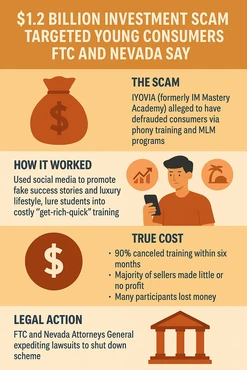
  • The FTC and Nevada Attorney General allege IYOVIA (formerly IM Mastery Academy) defrauded consumers out of $1.2 billion.
  • The scheme used false claims and social media marketing to lure young people into costly, deceptive training and MLM programs.

  • The action aims to halt the scam, which promoted fake success stories and promised quick riches with little evidence of actual profits.


In a major crackdown, the Federal Trade Commission (FTC) and the state of Nevada are jointly suing an expansive investment and business venture scam that, according to authorities, has drained more than $1.2 billion from consumers. The case centers around IYOVIA, formerly operating under brand names like IM Mastery Academy, iMarketsLive, and IM Academy.
DescriptionThe complaint, filed by both agencies, alleges that IYOVIA and its top executives enticed consumersespecially young adultsthrough false promises of easy earnings and flashy marketing on social media.

The scam offered training in financial topics and a multi-level-marketing (MLM) opportunity, convincing people to pay up to $400 a month to participate and recruit others.

Christopher Mufarrige, Director of the FTCs Bureau of Consumer Protection, called the scheme remarkable in its scope, criticizing its aggressive marketing tactics and unqualified trainers. The harm to consumersespecially young people seeking to earn a livingis immense and ongoing, Mufarrige said in a news release.

Success stories, fast money

The investigation revealed disturbing facts:

  • Social media posts often flaunted supposed success stories, luxury lifestyles, and promises of fast money, enticing students and young professionals.

  • Despite big claims, IYOVIAs own records show 60% of customers canceled within one month, and 90% quit within six months.

  • The majority of MLM participants made little to no profit, with many losing money altogether.

Named in the lawsuit are company owners Chris and Isis Terry, and key figures Jason Brown, Alex Morton, Matthew Rosa, and Brandon Boyd. The defendants are accused of violating multiple laws, including the FTC Act, the Telemarketing Sales Rule, and Nevadas consumer protection laws.

The lawsuit is seen as a critical step in curbing predatory practices that exploit vulnerable consumers, with officials urging the public to remain skeptical of get-rich-quick promises, especially those proliferating across social media.


Sign up below for The Daily Consumer, our newsletter on the latest consumer news, including recalls, scams, lawsuits and more.


Posted: 2025-05-05 17:06:05

Get Full News Story On Consumer Affairs


Listen to this article. Speaker link opens in a new window.
Text To Speech BETA Test Version.


More News From This Category
Consumer News: Ultra-processed foods may be linked to fertility struggles
Tue, 28 Apr 2026 22:07:06 +0000

New research suggests diet quality not just calories could play a role

By Kristen Dalli of ConsumerAffairs
April 28, 2026
  • Recent research found that higher intake of ultra-processed foods was associated with lower odds of fertility in U.S. women.

  • The link remained even after accounting for factors like age, weight, and lifestyle.

  • Women experiencing infertility tended to consume more ultra-processed foods and follow less healthy dietary patterns.


If youve ever wondered whether what you eat could affect your chances of getting pregnant, new research suggests the answer might be yes especially when it comes to ultra-processed foods. These are the packaged, ready-to-eat items that make up a big part of many modern diets, from snack foods to frozen meals.

A recent study from researchers at McMaster University found that women who ate fewer ultra-processed foods had a higher likelihood of conceiving. Importantly, this connection held up even after researchers accounted for other factors that are typically linked to fertility, like age, body weight, and lifestyle habits.

The findings dont prove that ultra-processed foods directly cause infertility. But they do point to a meaningful relationship between diet quality and reproductive health one that goes beyond the usual focus on calories or weight alone.

Most of what we hear about ultra-processed foods focuses on calories and obesity, researcher Anthea Christoforou said in a news release.

But our findings suggest something potentially more complex: There seems to be another mechanism at play which may reflect pathways beyond calories or weight, including chemical exposures that have been hypothesized in prior literature.

How the study worked

To explore this link, researchers analyzed data from U.S. women collected through the National Health and Nutrition Examination Survey (NHANES) between 2013 and 2018.

They looked at participants dietary habits specifically how much of their daily food intake came from ultra-processed foods alongside self-reported fertility status. Ultra-processed foods were identified using a standard classification system that groups foods based on how heavily theyre industrially processed.

The researchers also considered how closely participants followed a Mediterranean-style diet, which emphasizes whole foods like fruits, vegetables, whole grains, and healthy fats.

To make the results more reliable, the analysis adjusted for a range of variables that could influence fertility, including obesity and other lifestyle factors. This helped isolate the potential role of ultra-processed foods themselves, rather than other overlapping health behaviors.

What the researchers found

The results showed a clear pattern: women who reported infertility tended to consume more ultra-processed foods than those who did not. In fact, ultra-processed foods made up about 31% of daily intake among women with infertility, compared to lower levels among those who were fertile.

Overall, higher consumption of these foods was linked to significantly lower odds of fertility even after accounting for other health and lifestyle factors.

Researchers also noted that women experiencing infertility generally had lower adherence to healthier eating patterns, like the Mediterranean diet.

While the study doesnt establish cause and effect, it suggests there may be something about ultra-processed foods beyond just their calorie content that could influence reproductive health. That could include factors like additives or the way these foods are manufactured, though more research is needed to fully understand the mechanisms.

For now, the takeaway is fairly straightforward: diet quality may be one piece of the fertility puzzle, and the degree of food processing could matter more than many people realize.

Processing affects foods in ways that arent reflected in nutrients alone from chemical exposures during manufacturing to ingredients that displace whole, protective foods, researcher Angelina Baric said.

Its not about perfection its about noticing how food is processed, choosing more foods in their natural states and picking ingredients you recognize. Even that simple shift can lower exposure to things we still dont fully understand.


Read More ...


Consumer News: City living and stroke risk: A surprising link researchers are starting to understand
Tue, 28 Apr 2026 22:07:06 +0000

Why more developed neighborhoods may offer unexpected protection against first-time strokes

By Kristen Dalli of ConsumerAffairs
April 28, 2026
  • Findings from a recent study found that living in more developed areas was linked to a slightly lower risk of a first-time stroke.

  • Researchers tracked over 25,000 adults in the U.S. for more than a decade.

  • The built environment not just personal health may play a role in stroke risk.


City life doesnt exactly have a reputation for being relaxing. Noise, traffic, and pollution tend to dominate the conversation.

But new research from the University of Michigan suggests there may be a surprising upside: living in more developed, urban-style neighborhoods could be linked to a lower risk of stroke.

The idea flips a common assumption on its head. Instead of focusing only on individual habits like diet or exercise, the study highlights something broader your surroundings. Specifically, researchers looked at how development intensity (think buildings, sidewalks, and infrastructure) might shape long-term health outcomes.

High-intensity development typically includes greater housing density and more commercial/retail outlets, researcher Cathy Antonakos said in a news release.

These areas are more likely to feature compact land uses with access to health care, food stores, public transport and physical activity infrastructure like sidewalks, bike facilities and parks.

How the study worked

To explore this, the researchers analyzed data from more than 25,000 adults across the U.S., following them for over a decade. The data came from a large, ongoing project known as REGARDS (Reasons for Geographic and Racial Differences in Stroke), which focuses on stroke patterns and disparities, particularly in the southeastern stroke belt.

Instead of labeling areas simply as urban or rural, the researchers took a more detailed approach. They used satellite data to measure how developed each participants neighborhood was over time, looking at areas within about a five-mile radius of their homes.

Importantly, they also accounted for factors that could influence stroke risk including age, race, sex, and existing conditions like diabetes or high blood pressure to better isolate the role of the environment itself.

What the researchers found

The results showed a modest but meaningful pattern: people living in more highly-developed neighborhoods had about a 2.5% lower risk of experiencing a first-time stroke compared to those in less developed areas.

While the study didnt pinpoint exactly why this link exists, researchers point to several features commonly found in denser areas. These include easier access to healthcare, grocery stores, public transportation, and spaces that encourage physical activity like sidewalks, parks, and bike paths.

At the same time, the study stops short of making sweeping claims. It didnt directly measure specific neighborhood features or factors like stress or pollution, and researchers say more work is needed to understand whats driving the connection.

For physicians, the study suggests that neighborhood-level factors may influence first-time stroke risk, in addition to individual-level factors, Antonakos said. For planners, the findings suggest that enhancing environments with features that support cardiovascular health and physical activity may help lower the risk of first-time stroke.


Read More ...


Consumer News: Google is trying to reinvent video search
Tue, 28 Apr 2026 19:07:06 +0000

Ask YouTube is currently in testing mode

By Mark Huffman of ConsumerAffairs
April 28, 2026
  • Google is reportedly testing a new feature called Ask YouTube, aimed at making video search more conversational and AI-driven.

  • The tool allows users to ask natural-language questions and receive curated clips or answers pulled directly from YouTube content.

  • The experiment signals Googles broader push to integrate generative AI across its search and media platforms.


You might not think of it this way, but YouTube is actually a search engine as well as a video platform. People use it not just for entertainment but also to perform tasks such as changing the oil in a lawnmower.

Google may be making the process easier for users. The company said it is experimenting with a new feature called Ask YouTube, a move that could fundamentally change how users discover and interact with video content on the platform. The feature is currently available to adult Premium users.

The test, which appears to be part of the companys ongoing push into generative AI, allows users to pose questions in plain language and receive tailored responses drawn from YouTube videos.

Interpreting user intent

Rather than relying on traditional keyword searches, Ask YouTube is designed to interpret user intent more deeply. For example, instead of typing how to fix a leaky faucet, users could ask a question like, Whats the easiest way to stop a faucet from dripping overnight? The system would then surface relevant clips or summarize insights from multiple videos, effectively turning YouTube into a more interactive knowledge tool.

Early indications suggest the feature may combine video search with AI-generated summaries, highlighting key moments within clips or stitching together information from different creators. This could significantly reduce the time users spend scrubbing through videos to find specific answers.

The test aligns with Googles broader strategy of embedding AI into its core products, including Search, Maps, and Workspace. By enhancing YouTube with conversational capabilities, the company said it is positioning the platform not just as an entertainment hub, but as a direct competitor in the growing field of AI-powered information retrieval.

Questions for content creators

However, the approach also raises questions. Content creators may be concerned about how their material is used or summarized, particularly if users can get answers without watching full videos. There are also potential challenges around accuracy, context, and attribution issues that have surfaced across many generative AI applications.

Ask YouTube appears to be in limited testing, with no official timeline for a broader rollout. Still, the feature suggests a clear trend: the future of search whether text or video is becoming increasingly conversational, personalized, and AI-driven.


Read More ...


Consumer News: Taylor Swift files to trademark her voice
Tue, 28 Apr 2026 19:07:06 +0000

The singer is taking a proactive move to prevent deepfake rip-offs

By Mark Huffman of ConsumerAffairs
April 28, 2026
  • Taylor Swift has reportedly filed new trademark applications covering both her likeness and her voice.

  • The move is widely seen as a preemptive strike against the growing threat of AI-generated deepfakes.

  • Legal experts say the filings could set a precedent for how celebrities protect their identity in the age of generative AI.


If you are a famous person, people without fame increasingly try to cash in by using AI to rip off your likeness even your voice. Taylor Swift is taking an aggressive step to protect her identity in the digital age, filing trademark applications that extend beyond her image to include her voice, an increasingly valuable and vulnerable asset in an era of rapidly advancing artificial intelligence.

According to filings submitted to the U.S. Patent and Trademark Office, the global pop star is seeking expanded protections that would give her greater control over how her likeness and vocal identity are used commercially. While celebrities have long trademarked their names and images, Swifts attempt to formally secure rights over her voice signals a new frontier in intellectual property law.

The move comes amid a surge in AI-generated deepfake content, including songs that mimic the voices of well-known artists. In recent years, viral tracks using AI-generated versions of major performers including Swift have circulated widely online, raising concerns about consent, compensation, and reputational harm.

Entertainment industry unease

Legal analysts say Swifts filing reflects growing unease within the entertainment industry. According to legal analysts, voices are becoming just as recognizable and monetizable asfaces. If courts uphold these kinds of protections, they sayit could fundamentally reshape how identity rights are enforced.

Swift has been particularly proactive in managing her intellectual property. Her ongoing efforts to re-record her early albums to regain control over her master recordings have already positioned her as a leading figure in artist rights. This latest legal maneuver appears to extend that strategy into emerging technological territory.

Whos next?

The implications could reach far beyond the music industry. Actors, influencers, and even public figures in politics and media are facing similar challenges as AI tools make it easier to replicate voices and appearances with minimal effort.

Tech companies, meanwhile, are under increasing pressure to address misuse. Some platforms have begun implementing watermarking and detection tools for synthetic media, but enforcement remains inconsistent.

For Swift, the trademark filings are as much about prevention as enforcement. By formally staking a legal claim to her voice, she may be better positioned to challenge unauthorized uses before they spread widely.

Whether the filings will be approved and how broadly they will be interpreted remains to be seen. But one thing is clear: as artificial intelligence blurs the line between real and replica, the battle over who owns a persons identity is just beginning.


Read More ...


Consumer News: The Iran war is beginning to affect supply chains
Tue, 28 Apr 2026 19:07:06 +0000

But for now, consumers are only seeing higher prices, not shortages

By Mark Huffman of ConsumerAffairs
April 28, 2026
  • Global shipping disruptions tied to the Iran war are slowing deliveries and raising costs.

  • Higher oil prices are pushing up the cost of making and transporting everyday goods.

  • So far, consumers are seeing price increases and delays more than widespread shortages.


Consumers have plenty of experience with supply chain bottlenecks. There were severalduring the COVID-19 pandemic, leading to shortages and higher prices.

The ongoing conflict involving Iran is starting to ripple through global supply chains, creating delays, driving up costs, and raising concerns about potential shortages of consumer goods. But despite significant disruptions behind the scenes, American shoppers have so far been largely spared from widespread empty shelves.

Instead, the more immediate impact has been felt in the form of higher prices and sporadic delays.

At the center of the disruption is the Strait of Hormuz, a critical shipping chokepoint through which a large share of the worlds oil and cargo typically flows. Military activity in the region has forced shipping companies to reroute vessels or delay transit altogether, adding days or even weeks to delivery times and significantly increasing freight costs.

Those higher costs are compounded by a surge in oil prices. Energy is a fundamental input in nearly every product, from plastics and packaging to transportation, so rising fuel prices are cascading across industries. Manufacturers and retailers are increasingly passing those costs along to consumers.

Logistical hiccups

Some sectors are already showing signs of strain. Companies in the food and consumer goods industries have reported logistical hiccups tied to fuel costs and shipping delays. Meanwhile, products that rely heavily on petrochemicals such as medical supplies, plastics, and packaging materials are facing tighter supply conditions.

Shortages, where they do occur, have been uneven and limited, according to industry analysts. Certain specialized or imported items may be harder to find, and some businesses report longer restocking times. But for most everyday goods, supply has held up.

That resilience is due in part to lessons learned during the pandemic. Many companies have diversified suppliers, increased inventory buffers, or shifted production closer to home. Governments and industries are also tapping stockpiles to cushion the impact of energy disruptions.

Early signs of supply strain in specific categories

There are documented stress points already:

  • Consumer goods & food.Large companies like Nestl report supply-chain hiccups from fuel and logistics disruptions. Businesses broadly warn of rising costs and disrupted supply chains across consumer goods sectors.
  • Medical and petrochemical-based products. Shortages are expected (and in some cases emerging) for items like:gloves, IV bags, syringes, plastics, and packaging.These depend heavily on petrochemicals affected by the conflict.
  • Industrial inputs (which feed consumer goods). Disruptions are affecting:
    • Fertilizers

    • Semiconductors

    • Pharmaceuticals

Shortages tend to appear first in inputs, then trickle down to finished goods. Still, experts warn the situation could worsen if the conflict drags on or intensifies.

For now, the clearest sign of strain isnt whats missing from store shelves its whats showing up on price tags.


Read More ...


Related Bing News Results


Blow Us A Whistle


Related Product Search/Búsqueda de productos relacionados

Amazon Logo

Visit Our New Print-On-Demand Stores On Printify and Zazzle
Printify Zazzle