Rockin Robin SongFlying The Web For News.
RobinPost Logo Amazon Prime Deals


Consumer Daily Reports

The decision by OPEC+ to boost production may provide relief

By Mark Huffman Consumer News: Gas prices tick higher but could be under  a gallon this summer of ConsumerAffairs
May 6, 2025
  • The nations average price of gasoline has risen for the first time in nearly a month, climbing 2 cents over the past week to $3.12 per gallon.

  • The national average is down 12.0 cents from a month ago and 49.6 cents per gallon below where it stood a year ago.

  • Diesel prices also ticked up slightly, rising 0.2 cents to an average of $3.501 per gallon.


Motorists across the U.S. saw a modest increase in gasoline prices this week the first such rise in nearly a month according to the latest data from GasBuddy. The national average climbed 2 cents to $3.12 per gallon, based on more than 12 million price reports from over 150,000 stations. Although prices are slightly up week-over-week, they remain significantly lower than both last month and last year.

Patrick De Haan, head of petroleum analysis at GasBuddy, called it a "mixed bag" for drivers as regional volatility continued. Slightly more than half of U.S. states saw prices go up, De Haan said in the GasBuddy blog, highlighting sharp cyclical price jumps in areas such as the Great Lakes, Florida, Texas, and Maryland.

However, he pointed to potentially positive developments ahead, especially the announcement from OPEC+ to boost oil production beginning in June.

OPEC+ decision and oil market trends

Oil markets reacted sharply to news that OPEC+ will increase production by over 400,000 barrels per day next month. West Texas Intermediate crude fell to $57.47 per barrel in early Monday trading, a drop of over $5 from the previous week. Brent crude also saw a significant decline, falling to $60.51 per barrel.

This downward pressure on oil prices which are now nearing pandemic-era lows could pave the way for a meaningful drop in gas prices this summer, according to GasBuddy projections. That said, some caution remains as U.S. oil production continues to dip. The domestic rig count fell by three this week and is now 21 rigs lower than a year ago, signaling a slowdown in drilling activity by U.S. producers.

Inventories and refinery outlook

The U.S. Energy Information Administration reported that gasoline inventories dropped by 4 million barrels, now 4% below the five-year seasonal average. Refinery utilization rose slightly to 88.6%, and implied demand for gasoline decreased by over 300,000 barrels per day, likely a result of regional price cycling and consumer caution.

With the spring refinery maintenance season wrapping up, gasoline output is expected to rebound. This could bolster supply just in time for peak summer travel potentially pushing the national average below the $3 mark if oil prices remain low and demand doesn't surge unexpectedly.
Photo

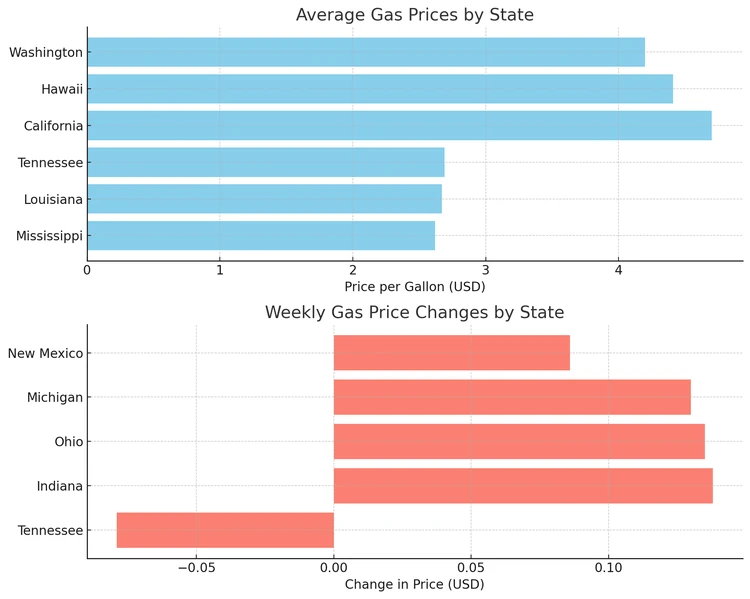
Gas prices remain highly uneven across the country. Mississippi, Louisiana, and Tennessee continue to boast the lowest averages, all under $2.70 per gallon. In stark contrast, California tops the charts at $4.70 per gallon, followed by Hawaii and Washington.

Notably, states like Indiana, Ohio, and Michigan experienced the largest weekly price hikes all over 13 cents driven by localized pricing cycles. Meanwhile, Tennessee saw one of the steepest declines, with prices dropping nearly 8 cents per gallon.

Summer outlook: Under $3 gas possible

Despite the recent uptick, analysts remain optimistic that gas prices could soon dip below the $3 mark nationally. With OPEC+ bringing more oil to market, and U.S. refiners resuming full operations, a softening in fuel prices may be on the horizon welcome news for drivers preparing for summer road trips.

For now, the most commonly encountered gas price remains $2.99 per gallon, and the median price sits just below the national average at the same level signs that cheaper fuel is accessible for many Americans.

Sign up below for The Daily Consumer, our newsletter on the latest consumer news, including recalls, scams, lawsuits and more.


Posted: 2025-05-06 11:36:32

Get Full News Story On Consumer Affairs


Listen to this article. Speaker link opens in a new window.
Text To Speech BETA Test Version.


More News From This Category
Consumer News: Google is trying to reinvent video search
Wed, 29 Apr 2026 07:07:06 +0000

Ask YouTube is currently in testing mode

By Mark Huffman of ConsumerAffairs
April 28, 2026
  • Google is reportedly testing a new feature called Ask YouTube, aimed at making video search more conversational and AI-driven.

  • The tool allows users to ask natural-language questions and receive curated clips or answers pulled directly from YouTube content.

  • The experiment signals Googles broader push to integrate generative AI across its search and media platforms.


You might not think of it this way, but YouTube is actually a search engine as well as a video platform. People use it not just for entertainment but also to perform tasks such as changing the oil in a lawnmower.

Google may be making the process easier for users. The company said it is experimenting with a new feature called Ask YouTube, a move that could fundamentally change how users discover and interact with video content on the platform. The feature is currently available to adult Premium users.

The test, which appears to be part of the companys ongoing push into generative AI, allows users to pose questions in plain language and receive tailored responses drawn from YouTube videos.

Interpreting user intent

Rather than relying on traditional keyword searches, Ask YouTube is designed to interpret user intent more deeply. For example, instead of typing how to fix a leaky faucet, users could ask a question like, Whats the easiest way to stop a faucet from dripping overnight? The system would then surface relevant clips or summarize insights from multiple videos, effectively turning YouTube into a more interactive knowledge tool.

Early indications suggest the feature may combine video search with AI-generated summaries, highlighting key moments within clips or stitching together information from different creators. This could significantly reduce the time users spend scrubbing through videos to find specific answers.

The test aligns with Googles broader strategy of embedding AI into its core products, including Search, Maps, and Workspace. By enhancing YouTube with conversational capabilities, the company said it is positioning the platform not just as an entertainment hub, but as a direct competitor in the growing field of AI-powered information retrieval.

Questions for content creators

However, the approach also raises questions. Content creators may be concerned about how their material is used or summarized, particularly if users can get answers without watching full videos. There are also potential challenges around accuracy, context, and attribution issues that have surfaced across many generative AI applications.

Ask YouTube appears to be in limited testing, with no official timeline for a broader rollout. Still, the feature suggests a clear trend: the future of search whether text or video is becoming increasingly conversational, personalized, and AI-driven.


Read More ...


Consumer News: Taylor Swift files to trademark her voice
Wed, 29 Apr 2026 07:07:06 +0000

The singer is taking a proactive move to prevent deepfake rip-offs

By Mark Huffman of ConsumerAffairs
April 28, 2026
  • Taylor Swift has reportedly filed new trademark applications covering both her likeness and her voice.

  • The move is widely seen as a preemptive strike against the growing threat of AI-generated deepfakes.

  • Legal experts say the filings could set a precedent for how celebrities protect their identity in the age of generative AI.


If you are a famous person, people without fame increasingly try to cash in by using AI to rip off your likeness even your voice. Taylor Swift is taking an aggressive step to protect her identity in the digital age, filing trademark applications that extend beyond her image to include her voice, an increasingly valuable and vulnerable asset in an era of rapidly advancing artificial intelligence.

According to filings submitted to the U.S. Patent and Trademark Office, the global pop star is seeking expanded protections that would give her greater control over how her likeness and vocal identity are used commercially. While celebrities have long trademarked their names and images, Swifts attempt to formally secure rights over her voice signals a new frontier in intellectual property law.

The move comes amid a surge in AI-generated deepfake content, including songs that mimic the voices of well-known artists. In recent years, viral tracks using AI-generated versions of major performers including Swift have circulated widely online, raising concerns about consent, compensation, and reputational harm.

Entertainment industry unease

Legal analysts say Swifts filing reflects growing unease within the entertainment industry. According to legal analysts, voices are becoming just as recognizable and monetizable asfaces. If courts uphold these kinds of protections, they sayit could fundamentally reshape how identity rights are enforced.

Swift has been particularly proactive in managing her intellectual property. Her ongoing efforts to re-record her early albums to regain control over her master recordings have already positioned her as a leading figure in artist rights. This latest legal maneuver appears to extend that strategy into emerging technological territory.

Whos next?

The implications could reach far beyond the music industry. Actors, influencers, and even public figures in politics and media are facing similar challenges as AI tools make it easier to replicate voices and appearances with minimal effort.

Tech companies, meanwhile, are under increasing pressure to address misuse. Some platforms have begun implementing watermarking and detection tools for synthetic media, but enforcement remains inconsistent.

For Swift, the trademark filings are as much about prevention as enforcement. By formally staking a legal claim to her voice, she may be better positioned to challenge unauthorized uses before they spread widely.

Whether the filings will be approved and how broadly they will be interpreted remains to be seen. But one thing is clear: as artificial intelligence blurs the line between real and replica, the battle over who owns a persons identity is just beginning.


Read More ...


Consumer News: Ultra-processed foods may be linked to fertility struggles
Tue, 28 Apr 2026 22:07:06 +0000

New research suggests diet quality not just calories could play a role

By Kristen Dalli of ConsumerAffairs
April 28, 2026
  • Recent research found that higher intake of ultra-processed foods was associated with lower odds of fertility in U.S. women.

  • The link remained even after accounting for factors like age, weight, and lifestyle.

  • Women experiencing infertility tended to consume more ultra-processed foods and follow less healthy dietary patterns.


If youve ever wondered whether what you eat could affect your chances of getting pregnant, new research suggests the answer might be yes especially when it comes to ultra-processed foods. These are the packaged, ready-to-eat items that make up a big part of many modern diets, from snack foods to frozen meals.

A recent study from researchers at McMaster University found that women who ate fewer ultra-processed foods had a higher likelihood of conceiving. Importantly, this connection held up even after researchers accounted for other factors that are typically linked to fertility, like age, body weight, and lifestyle habits.

The findings dont prove that ultra-processed foods directly cause infertility. But they do point to a meaningful relationship between diet quality and reproductive health one that goes beyond the usual focus on calories or weight alone.

Most of what we hear about ultra-processed foods focuses on calories and obesity, researcher Anthea Christoforou said in a news release.

But our findings suggest something potentially more complex: There seems to be another mechanism at play which may reflect pathways beyond calories or weight, including chemical exposures that have been hypothesized in prior literature.

How the study worked

To explore this link, researchers analyzed data from U.S. women collected through the National Health and Nutrition Examination Survey (NHANES) between 2013 and 2018.

They looked at participants dietary habits specifically how much of their daily food intake came from ultra-processed foods alongside self-reported fertility status. Ultra-processed foods were identified using a standard classification system that groups foods based on how heavily theyre industrially processed.

The researchers also considered how closely participants followed a Mediterranean-style diet, which emphasizes whole foods like fruits, vegetables, whole grains, and healthy fats.

To make the results more reliable, the analysis adjusted for a range of variables that could influence fertility, including obesity and other lifestyle factors. This helped isolate the potential role of ultra-processed foods themselves, rather than other overlapping health behaviors.

What the researchers found

The results showed a clear pattern: women who reported infertility tended to consume more ultra-processed foods than those who did not. In fact, ultra-processed foods made up about 31% of daily intake among women with infertility, compared to lower levels among those who were fertile.

Overall, higher consumption of these foods was linked to significantly lower odds of fertility even after accounting for other health and lifestyle factors.

Researchers also noted that women experiencing infertility generally had lower adherence to healthier eating patterns, like the Mediterranean diet.

While the study doesnt establish cause and effect, it suggests there may be something about ultra-processed foods beyond just their calorie content that could influence reproductive health. That could include factors like additives or the way these foods are manufactured, though more research is needed to fully understand the mechanisms.

For now, the takeaway is fairly straightforward: diet quality may be one piece of the fertility puzzle, and the degree of food processing could matter more than many people realize.

Processing affects foods in ways that arent reflected in nutrients alone from chemical exposures during manufacturing to ingredients that displace whole, protective foods, researcher Angelina Baric said.

Its not about perfection its about noticing how food is processed, choosing more foods in their natural states and picking ingredients you recognize. Even that simple shift can lower exposure to things we still dont fully understand.


Read More ...


Consumer News: City living and stroke risk: A surprising link researchers are starting to understand
Tue, 28 Apr 2026 22:07:06 +0000

Why more developed neighborhoods may offer unexpected protection against first-time strokes

By Kristen Dalli of ConsumerAffairs
April 28, 2026
  • Findings from a recent study found that living in more developed areas was linked to a slightly lower risk of a first-time stroke.

  • Researchers tracked over 25,000 adults in the U.S. for more than a decade.

  • The built environment not just personal health may play a role in stroke risk.


City life doesnt exactly have a reputation for being relaxing. Noise, traffic, and pollution tend to dominate the conversation.

But new research from the University of Michigan suggests there may be a surprising upside: living in more developed, urban-style neighborhoods could be linked to a lower risk of stroke.

The idea flips a common assumption on its head. Instead of focusing only on individual habits like diet or exercise, the study highlights something broader your surroundings. Specifically, researchers looked at how development intensity (think buildings, sidewalks, and infrastructure) might shape long-term health outcomes.

High-intensity development typically includes greater housing density and more commercial/retail outlets, researcher Cathy Antonakos said in a news release.

These areas are more likely to feature compact land uses with access to health care, food stores, public transport and physical activity infrastructure like sidewalks, bike facilities and parks.

How the study worked

To explore this, the researchers analyzed data from more than 25,000 adults across the U.S., following them for over a decade. The data came from a large, ongoing project known as REGARDS (Reasons for Geographic and Racial Differences in Stroke), which focuses on stroke patterns and disparities, particularly in the southeastern stroke belt.

Instead of labeling areas simply as urban or rural, the researchers took a more detailed approach. They used satellite data to measure how developed each participants neighborhood was over time, looking at areas within about a five-mile radius of their homes.

Importantly, they also accounted for factors that could influence stroke risk including age, race, sex, and existing conditions like diabetes or high blood pressure to better isolate the role of the environment itself.

What the researchers found

The results showed a modest but meaningful pattern: people living in more highly-developed neighborhoods had about a 2.5% lower risk of experiencing a first-time stroke compared to those in less developed areas.

While the study didnt pinpoint exactly why this link exists, researchers point to several features commonly found in denser areas. These include easier access to healthcare, grocery stores, public transportation, and spaces that encourage physical activity like sidewalks, parks, and bike paths.

At the same time, the study stops short of making sweeping claims. It didnt directly measure specific neighborhood features or factors like stress or pollution, and researchers say more work is needed to understand whats driving the connection.

For physicians, the study suggests that neighborhood-level factors may influence first-time stroke risk, in addition to individual-level factors, Antonakos said. For planners, the findings suggest that enhancing environments with features that support cardiovascular health and physical activity may help lower the risk of first-time stroke.


Read More ...


Consumer News: Costco’s $4.99 rotisserie chicken might soon be SNAP-Eligible
Tue, 28 Apr 2026 19:07:05 +0000

Heres why it matters as food costs continue to rise

By Kyle James of ConsumerAffairs
April 28, 2026
  • A new bill could change SNAP rules:The Hot Rotisserie Chicken Act would allow hot rotisserie chicken purchases, instead of only cold versions.

  • Its about convenience and savings:Options like the $4.99 Costco Rotisserie Chicken offer an easy, low-cost alternative to expensive takeout.

  • One chicken can stretch into multiple meals:Use leftovers and pair with a low-cost side to maximize your grocery value.


A small policy change could soon have a big impact on grocery budgets.

A new proposalintroduced by a bipartisan group of U.S. senators, titled the Hot Rotisserie Chicken Act, aims to make hot rotisserie chicken eligible for SNAP benefits for the first time.

Right now, SNAP (the Supplemental Nutrition Assistance Program) doesnt allow purchases of hot, ready-to-eat foods. That means something like Costcos Rotisserie Chicken is off-limits when its fresh out of the warmer.

Ironically, the exact same chicken becomes eligible once its cooled and placed in the refrigerated section.

That rule has long frustrated shoppers and retailers alike. Theres no real nutritional difference between hot and cold rotisserie chicken, as its purely a technical restriction. The proposed bill would fix that by allowing SNAP recipients to purchase hot rotisserie chicken from any grocery store, not just Costco.

And for many households, that convenience matters just as much as cost.

Rotisserie chicken has quietly become one of the best budget hacks in grocery stores. Priced at $4.99 at Costco ($6-8 at other grocery stores), its often cheaper than buying raw chicken and cooking it yourself.

For busy families, its an easy dinner solution that doesnt require planning ahead.

Why this could be a big deal

This isnt about adding luxury items to SNAP, but rather its about removing an outdated barrier. A hot rotisserie chicken is:

  • Affordable Often one of the lowest-cost protein options in the store.
  • Convenient Fully cooked and ready to eat.
  • Versatile Can stretch into multiple meals.

For families juggling work, school, and tight budgets, having access to a ready-to-eat meal can reduce stress and help avoid more expensive takeout options.

How to make the most of it (if it passes)

If this change goes through, here are a few simple ways to stretch that chicken even further:

  • Turn one chicken into multiple meals:Start with a classic dinner (chicken + sides), then use leftovers for tacos, sandwiches, salads, or pasta. You can easily get two to threemeals out of one bird.
  • Pair it with low-cost staples:Add rice, beans, frozen vegetables, or bread to round out meals without spending much more. This keeps the cost per serving extremely low.
  • Use every part:Dont toss the bones! Instead, use them to make a simple broth for soup. Its an easy way to get even more value from a single chicken purchase.

The bottom line

The Hot Rotisserie Chicken Act is still early in the process, so nothing has changed yet. But if it passes, it could be one of the simplest, most practical updates to SNAP in years.

Sometimes saving money isnt about a complicated strategy, but about removing a small barrier for consumers. And in this case, it might be as simple as letting shoppers buy a hot chicken instead of waiting for it to cool down.


Read More ...


Related Bing News Results
Need a digital detox? Here are some simple ways to reduce your screen time
Tue, 28 Apr 2026 11:32:00 GMT
A recent survey found Americans check their phones nearly 200 times a day on average and spend more than four hours daily on them.

What's inside those popular energy drinks teens consume
Mon, 27 Apr 2026 10:14:00 GMT
Consumer Reports says many drinks double the daily caffeine limit recommendation ...

Parents should keep an eye on what energy drinks their teens are drinking
Mon, 27 Apr 2026 08:12:00 GMT
Energy drinks are everywhere these days. Many of them look like sports hydration drinks and taste like candy. “They have flavors like Jolly Rancher flavor and sour gummy worms," said Consumer Reports ...

Does your favorite Energy drink have MORE caffeine than the label says it does?
Thu, 23 Apr 2026 12:12:00 GMT
Energy drinks are colorful, sweet, and hugely popular with teens. A new Consumer Reports investigation finds what’s inside those drinks may be more than you’re bargaining for. Energy drinks are ...

consumer reports
Thu, 23 Apr 2026 03:11:00 GMT
Eken Group has issued a firmware update to resolve major security issues with its doorbell cameras that were uncovered by Consumer Reports. The cameras are sold under the brands Eken, Tuck, Fishbot, ...


Blow Us A Whistle


Related Product Search/Búsqueda de productos relacionados

Amazon Logo

Visit Our New Print-On-Demand Stores On Printify and Zazzle
Printify Zazzle