Rockin Robin SongFlying The Web For News.
RobinPost Logo Amazon Prime Deals


Consumer Daily Reports

The password substitute is nearing prime time

By Dieter Holger of ConsumerAffairs
May 23, 2025
  • Passkeys aim to replace passwords, but they aren't yet a perfect solution, cybersecurity experts tell ConsumerAffairs.
  • Some issues with passkeys are how widely they are supported,how they aren't cross platform and how accounts with passkeys still have passwords that can be exploited.
  • But passkey adoption is growing and if they replace passwords altogether, they will provide even better security for online accounts.

Passkeys have some kinks that need to be ironed out.

Since 2022, passkeys have emerged as a convenient, secure way to login through a PIN code, fingerprint or face without a password.

Passkeys, which are linked to devices such as a smartphone or computer, aim to solvethe problems with passwords:Data breaches expose billions of passwords every year and people often use the same phrases or combinations, such as "admin" or "1234," that can be guessed.

More than 15 billion accounts now have the option to use passkeys, according to FIDO Alliance, an industry cybersecurity group that developed passkeys.
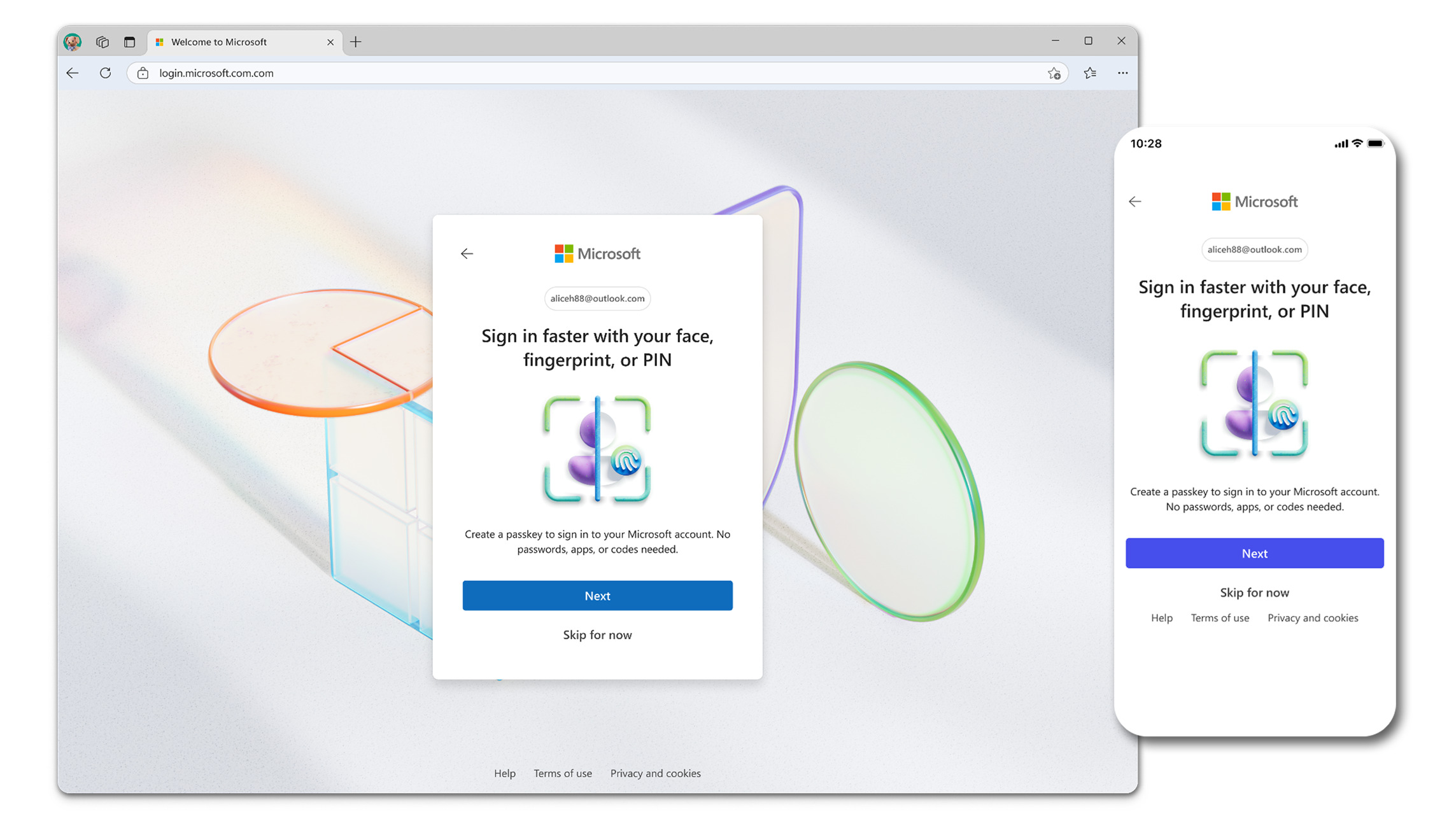
PhotoImage via Microsoft.

But cybersecurity experts tell ConsumerAffairs there are issues with passkeys that need to be solved before they fully live up to their promise.

Namely, passkeys have a fewcompatibility challenges, they aren't cross-platform, they are tied todevices that can be lost and accounts with passkeys still require passwords that criminals can use to exploit accounts.

"For now, passkeys are an excellent leap forward but consumer education, robust device securityand broader cross-platform support will be essential to ensure they deliver on their promise of safer, simpler authentication for everyone,"Ensar Seker, CISO at cybersecurity firm SOCRadar, told ConsumerAffairs.

Accounts with passkeys still have vulnerable passwords

Passkeys are more convenient than passwords, but they can offer a "false sense of security" since they aren't yet disabling passwords, Roger Grimes, analyst at cybersecurity firm KnowBe4, told ConsumerAffairs.

He said this means that hackers and scammers can still get people's passwords from data breaches or trick them into handing them over even if passkeys are activated.

"What you are really getting is a log-in method of convenience," Grimes said. "The attacker can still use your password so you haven't really increased the security on your account at all."

In May, Microsoft became the first major company to give consumer accounts, including for Outlook and Office,the option to disable passwords and use passkeys instead, saying all new accounts would be "passwordless by default."

But going passwordless comes with a catch: Microsoftusers have to use an authenticator app, which verifies it is them logging in, to sign on only with a passkey.

Still, having a passkey as an extraverification on topof a password adds more security,Andras Cser, principal analyst security and risk management atForrester Research, told ConsumerAffairs.

"When passkeys replace passwords, they add additional security by ensuring a non-crackable, non-phishable, non-snoopable authentication credential," Cser said.

In response to the concerns around vulnerable passwords existing alongside passkeys, Andrew Shikiar, executive director and CEO of passkey developer FIDO Alliance, told ConsumerAffairs that passkeys are a path to getting rid of passwords, are more secure and convenient.

"Every service provider that rolls out passkeys needs to determine for themselves the best approach for eventually eliminating passwords altogether," he said. "Some of our initial research showed that consumers are more likely to enroll a passkey if they know that theyre not losing their password so maintaining that option may encourage broader passkey utilization ... "

Until passkeys are fully adopted and have replacedpasswords entirely, some cybersecurity experts recommend that users enablemulti-factor authentication, which can involve an authenticator app or a text message,to protect their accounts.

"This mean users are forced to use a mixture of passwords and passkeys until passkeys are adopted industry wide," Chris Hauk, owner of cybersecurity blog Pixel Privacy, told ConsumerAffairs."Multi-factor authentication can be used to protect accounts until passkeys are available."

Passkeys can be device dependent and aren't cross platform

Passkeys work by having a public key and a private key.

The private key, stored on asmartphone or computer, provides the strong security.

For example, Windows 11 lets users have a PIN code to verify the passkey stored on the device to log onto supported online accounts, such as Outlook and Gmail.

But if a device is lost, the passkey can be, too.

"Passkeys can also sometimes be device dependent, which could be problematic if a device is lost," Pixel Privacy's Hauk said.

Microsoft and Apple do allow passkeys to be shared across devices usingtheir operating systems. But passkeys on a Windows computer can't be natively shared withan Apple computer and vice versa.

For now, users who want to share passkeys across different operating systemswill have to rely on third-party software, such as password managers from1Password, Dashlane andKeeper, Forrester Research's Cser said.

"These password managers mean extra software subscription and operations cost for enterprises," he said.

Passkeys support is still improving

Major web browsers, such as Chrome, Safari and Edge, support passkeys, but support is still improving among browsers such as Firefox and Opera, depending on the operating system.

"Clearly there is a need for developers to add support; the pressure to do so will only increase," Ant Allan, cybersecuritry analyst at Gartner, told ConsumerAffairs.

Until passkey support is on all operating systems, browsers and devices, some users will face challenges using them.

"This means users could experience inconsistencies or limitations when trying to use passkeys across different devices and browsers, particularly outside the Apple and Google ecosystems," SOCRadar's Seker said.

In response, FIDO Alliance's Shikiar said that between 91% to 95% of operating system, device and browser combinations support passkeys, including even Chrome and Edge on Ubuntu Linux.

A list of all devices, operating systems and web browsers supporting passkeyscan be found here.


Posted: 2025-05-23 13:12:11

Get Full News Story On Consumer Affairs


Listen to this article. Speaker link opens in a new window.
Text To Speech BETA Test Version.


More News From This Category
Consumer News: Here are the airlines making passengers the happiest in 2026
Wed, 06 May 2026 16:07:06 +0000

Overall, the industry recorded gains in the latest J.D. Power survey

By Mark Huffman of ConsumerAffairs
May 6, 2026
  • Overall passenger satisfaction with North American airlines rose eight points year over year despite widespread flight delays, cancellations and higher ticket prices.

  • JetBlue Airways, Delta Air Lines and Southwest Airlines ranked highest in customer satisfaction in their respective travel segments.

  • J.D. Power warned that rapidly rising airfare and baggage fees could threaten future customer satisfaction gains.


Despite crowded airports, rising fares and the occasional close call, consumers seem to be fairly pleased with the flying experience. North American airlines improved customer satisfaction scores in 2026, according to the latest J.D. Power North America Airline Satisfaction Study.

The study found overall passenger satisfaction increased by eight points on a 1,000-point scale compared with 2025, with gains recorded across first/business, premium economy and economy/basic economy classes.

J.D. Power said the biggest gains came from premium cabins, where satisfaction among first and business class passengers climbed 17 points. Premium economy satisfaction rose 14 points, while economy and basic economy passengers reported a six-point increase.

Returning to basics

Despite many challenges, the airlines returned to basics of passenger communication, friendly service and providing slightly better value for money compared to past years, said Michael Taylor, senior managing director of travel, hospitality, retail and customer service at J.D. Power.

Taylor cautioned also said that airlines could struggle to maintain those gains as ticket prices and baggage fees continue to rise sharply in 2026. He noted that airfare on some routes has tripled in recent weeks due to higher fuel costs.

According to the report, improved passenger experiences were driven largely by stronger scores for onboard service, smoother day-of-travel experiences and better perceptions of value for the price paid. J.D. Power said airlines focus on customer service and communication helped offset frustration caused by delays and higher costs.

The winners

In the rankings, JetBlue Airways topped the first/business class segment for the second consecutive year with a score of 759. Delta Air Lines ranked second at 750, followed by Alaska Airlines at 720.

Delta Air Lines led the premium economy segment for the fourth straight year with a score of 736. Alaska Airlines placed second at 720, while JetBlue ranked third at 701.

Southwest Airlines ranked highest in the economy/basic economy category for the fifth consecutive year with a score of 670, narrowly edging Delta Air Lines at 667. JetBlue Airways ranked third at 655.

J.D. Power noted that only three points separated Southwest and Delta in the economy/basic economy category, signaling intensifying competition among carriers serving budget-conscious travelers.

The study surveyed 10,914 passengers who had flown on a major North American airline within one month of completing the questionnaire. Research was conducted between March 2025 and March 2026.


Read More ...


Consumer News: UnitedHealthcare pledges to reduce some prior authorization requirements
Wed, 06 May 2026 16:07:06 +0000

The move addresses a major pain point for both doctors and patients

By Mark Huffman of ConsumerAffairs
May 6, 2026
  • UnitedHealthcare says it will eliminate prior authorization requirements for a range of tests, therapies, and outpatient procedures, cutting review volume by nearly one-third.

  • The insurer plans to use AI-driven analytics to identify unusual billing patterns instead of broadly requiring approvals for routine care.

  • The move comes amid mounting criticism of prior authorization practices from physicians, patients, and policymakers concerned about delays in treatment.


One of the biggest criticisms of health insurance companies is the requirement to get prior authorization from the insurance company before undergoing some medical procedures. In some cases, that authorization is denied.

UnitedHealth Group has announced that it will significantly reduce the number of medical procedures requiring authorization.

The company said UnitedHealthcare, the nations largest health insurer, will stop requiring advance approval for a range of services, including echocardiograms, some chiropractic treatments, certain outpatient surgeries, and select outpatient therapies. The changes are expected to reduce prior authorization reviews by nearly 30% later this year.

Source of frustration

Prior authorization has long been a source of frustration for both patients and physicians, who argue the process can delay treatment and add significant administrative burdens. Insurers, however, maintain that the reviews help prevent unnecessary or overly expensive procedures.

UnitedHealthcare CEO Tim Noel said the company is attempting to strike a balance between safeguarding patients and reducing barriers to care.

Prior authorization is an essential safeguard but should only be used when it truly protects patients and improves care, Noel said in a statement.

Why the change

Eliminating these requirements is one more way we are working to make it easier for patients to get the care they need when they need it, and ensure doctors can spend more time with their patients. We are committed to further improving and refining our processes to make reviews quicker, simpler, and more efficient, the company said.

The insurer said it currently requires prior authorization for only about 2% of medical services, with roughly 92% of requests approved within 24 hours.

A key part of the initiative involves expanded use of artificial intelligence and data analytics. Rather than applying broad authorization requirements across categories of care, UnitedHealthcare said it will increasingly use AI tools to identify providers whose billing or utilization patterns appear unusual. Executives emphasized that AI would not be used to deny claims automatically.

The announcement is part of an industry shift. Health insurers, including CVS Healths Aetna and Cigna, have also pledged to streamline prior authorization processes following growing public backlash and scrutiny from healthcare providers and regulators.


Read More ...


Consumer News: Apple agrees to $250 million settlement over delayed Siri AI features
Wed, 06 May 2026 16:07:06 +0000

Affected consumers could receive between $25 and $95

By Mark Huffman of ConsumerAffairs
May 6, 2026
  • Apple has agreed to pay $250 million to settle a lawsuit alleging it misled consumers about AI-powered Siri features that were heavily promoted but delayed or unavailable.

  • Eligible U.S. customers who bought certain iPhone 15 and iPhone 16 models could receive between $25 and $95 per device if the settlement is approved.

  • The case highlights growing scrutiny over how tech companies market artificial intelligence features before they are fully ready.


Apple has agreed to pay $250 million to settle a class-action lawsuit accusing the company of misleading consumers about the capabilities of its AI-enhanced Siri assistant. If approved, it would be one of the largest consumer-related settlements in the companys history.

The lawsuit centered on Apples rollout of Apple Intelligence, the companys artificial intelligence platform introduced alongside the iPhone 16 lineup in 2024. Consumers alleged Apple aggressively marketed a more advanced, personalized Siri experience that was not actually available when the devices launched.

Court filings show the settlement would apply to U.S. consumers who purchased eligible iPhone 15 Pro, iPhone 15 Pro Max, or iPhone 16 models between June 10, 2024, and March 29, 2025.

Depending on how many claims are filed, consumers could receive payments ranging from $25 to as much as $95 per device.

Apple denied wrongdoing but agreed to settle the claims to avoid prolonged litigation. In a statement reported by multiple outlets, the company said it wanted to remain focused on delivering the most innovative products and services to customers.

Why consumers sued

The complaint argued that Apple created unrealistic expectations by advertising Siri features that either arrived much later than promised or had not yet launched at all. Plaintiffs claimed they purchased expensive new iPhones, believing the AI functionality would be immediately available.

The lawsuit also cited findings from the Better Business Bureaus National Advertising Division, which reportedly concluded that Apples marketing language including claims that Apple Intelligence was available now could mislead consumers into thinking the upgraded Siri experience was already active.

Apple did release some AI features over time, including Genmoji, writing tools, and ChatGPT integration. However, the more ambitious Siri overhaul remained delayed, frustrating some customers and fueling criticism that the company announced capabilities before they were ready for users.

What it means for consumers

The settlement could become an important test case for how technology companies market artificial intelligence products.

Consumer advocates say the lawsuit demonstrates the need for clearer disclosures when companies advertise future AI capabilities. As AI becomes a major selling point for smartphones and other electronics, regulators and courts may increasingly scrutinize whether advertised features are fully functional at launch.

For consumers, the case is also a reminder to treat coming soon technology claims cautiously. Many AI tools are still evolving, and companies sometimes announce features months before they are ready for widespread use.

The proposed settlement still requires court approval before payments can be distributed.


Read More ...


Consumer News: Moving in with Mom and Dad is becoming more common
Wed, 06 May 2026 16:07:06 +0000

Nearly four million U.S. homes now house multiple generations

By Mark Huffman of ConsumerAffairs
May 6, 2026
  • Nearly four million U.S. homes now include multiple generations living under one roof, according to a new Realtor.com report.

  • Affordability pressures and caregiving needs are driving more families to combine households.

  • The trend reflects a broader shift in housing demand toward flexible, family-oriented living arrangements.


During the Great Depression and the years immediately following World War II, it was not uncommon for two or three generations to live in the same house. Now, because of the high cost of housing, as well as other factors, that trend is once again emerging.

A new report from Realtor.com found that nearly fourmillion homes now house multiple generations under one roof. The findings show a significant shift in housing patterns, as economic pressures and changing family dynamics reshape how Americans live.

Rising home prices, elevated mortgage rates, and the high cost of living are pushing more households to pool financial resources, making multigenerational living an increasingly practical option.

Affordability is key

Realtor.coms analysis highlights affordability as a key driver. By sharing housing costs, families can better manage expenses that might otherwise make homeownership unattainable. At the same time, caregiving needs such as supporting aging parents or adult children are also fueling the trend, reflecting broader demographic changes in the U.S. population.

The rise in multigenerational households aligns with long-term trends. Census data show millions of U.S. households already include multiple generations, a number that has steadily increased over the past decade.

Housing experts say the shift is also influencing the types of homes buyers seek. Demand is rising for properties with flexible layouts, separate living areas, or accessory dwelling units that can accommodate extended families while preserving privacy.

The trend has gained momentum in recent years as affordability challenges intensify. Data from the National Association of Realtors show a record share of homebuyers are purchasing homes for multigenerational living, accounting for about 17% of purchases.

While multigenerational living was once more common in the U.S., it declined during the mid-20th century as single-family households became the norm. Todays resurgence suggests a return to shared living arrangements driven less by tradition and more by economic necessity and evolving family needs.

Analysts say the shift could have lasting implications for the housing market, from home design to inventory demand. As more families opt to live together, the definition of the typical American household continues to evolve.


Read More ...


Consumer News: Feds are investigating meatpackers in the wake of record-high meat prices
Wed, 06 May 2026 16:07:06 +0000

Investigators will try to determine if there are antitrust violations

By Mark Huffman of ConsumerAffairs
May 6, 2026
  • The Justice Department has launched an investigation into potential antitrust violations in the U.S. meatpacking industry.

  • Federal officials are examining whether major processors engaged in price-fixing or unfair market practices.

  • The probe comes amid rising meat prices and long-standing concerns from ranchers and consumer advocates.


The U.S. Department of Justice (DOJ) has opened a major antitrust investigation into the meatpacking industry, focusing on whether dominant companies have engaged in anti-competitive practices that could be driving up prices for consumers and suppressing earnings for livestock producers.

In the background are record-high beef prices. According to their March Consumer Price Index, the price of beef and veal was up 12% over the last 12 months.

According to officials familiar with the matter, the inquiry is examining the conduct of the nations largest meat processors, which together control a significant share of beef, pork, and poultry production. Investigators are exploring whether these companies coordinated pricing, limited supply, or otherwise manipulated the market in ways that violate federal antitrust laws.

Complaints from producers

The probe follows years of complaints from ranchers and farmers who argue that consolidation in the industry has left them with fewer buyers for their livestock, reducing their bargaining power. At the same time, consumer groups have pointed to rising grocery store prices, questioning whether they reflect true market conditions or artificially inflated costs.

The Justice Department notes that the meatpacking sector has become highly concentrated, raising serious questions about competition. The DOJ said it is committed to ensuring markets remain fair for producers and consumers alike.

Four companies Tyson Foods, JBS, Cargill, and National Beef are estimated to control roughly 80% of the U.S. beef processing market. Critics say such dominance can create conditions ripe for collusion or coordinated behavior, even without explicit agreements.

Industry representatives have pushed back on those claims, arguing that price fluctuations are largely driven by external factors such as feed costs, labor shortages, and supply chain disruptions. They saythe market is dynamic and competitive.

Taking a stance against monopolistic behavior

The investigation also comes amid wider efforts by federal regulators to scrutinize consolidation across multiple sectors of the economy. Recent administrations have made competition policy a central focus, directing agencies to take a more aggressive stance against monopolistic behavior.

Legal experts say the case could hinge on whether prosecutors can demonstrate coordinated action among firms or abuse of market power. Even without criminal charges, the investigation could lead to regulatory changes or civil enforcement actions aimed at increasing competition.

For ranchers like those in the Midwest and Great Plains, the outcome could have significant implications.

The Justice Department has not announced a timeline for the investigation, and officials caution that such inquiries can take months or even years to complete.


Read More ...


Related Bing News Results
Consumer Reports: What to buy in May 2026
Wed, 06 May 2026 07:43:00 GMT
May brings a wave of deals on all sorts of products thanks to two major holidays. Consumer Reports shares how you can save big while honoring the mothers and veterans in your life. With Mother's Day ...

This Instant Coffee Delivers the Most Caffeine, According to Consumer Reports
Tue, 05 May 2026 03:19:00 GMT
Consumer Reports analyzed caffeine levels in both instant coffees and takeout brews — and found they can vary widely. In some cases, a large cup can approach or even exceed the FDA’s 400-milligram ...

Consumer Reports investigation: Energy drinks risky for teens
Wed, 29 Apr 2026 06:54:00 GMT
Energy drinks are colorful, sweet, and hugely popular with teens. But they come with an important warning for parents. A new Consumer Reports investigation finds what’s inside those drinks may be more ...

consumer reports
Thu, 23 Apr 2026 03:11:00 GMT
Eken Group has issued a firmware update to resolve major security issues with its doorbell cameras that were uncovered by Consumer Reports. The cameras are sold under the brands Eken, Tuck, Fishbot, ...

Consumer Reports explores digital minimalism
Wed, 22 Apr 2026 17:38:00 GMT
A survey shows Americans spend over four hours daily on their phones, with nearly half feeling addicted, as experts highlight the impact on mental health and suggest ways to cut back.


Blow Us A Whistle


Related Product Search/Búsqueda de productos relacionados

Amazon Logo

Visit Our New Print-On-Demand Stores On Printify and Zazzle
Printify Zazzle