Rockin Robin SongFlying The Web For News.
RobinPost Logo Amazon Prime Deals


Consumer Daily Reports

Consumers who have been supporting local stations may lose programming

By James R. Hood of ConsumerAffairs
July 18, 2025

As expected, Congress has clawed back funding for public broadcasting in the U.S., culminating an effort that started during the Nixon Administration, led by conservatives who objected to what they say is a liberal taint in the system's programs.
Photo

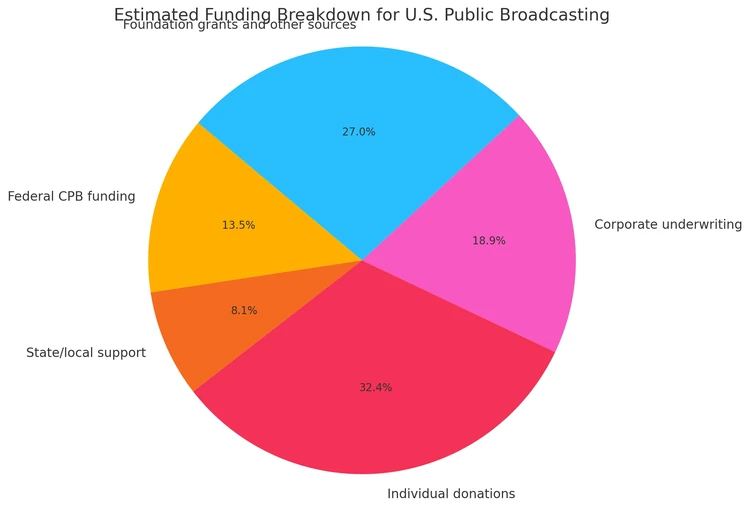
Despite extensive coverage, there has been little attention paid to the consumers who are a major source of funding for public programmingeven though they contribute the largest share, approximately 30%, most of it coming from occasional fund-raising drives and monthly contributions.

Other major sources include foundation grants at 25% and corporate underwriting, about 15% to 20%. Federal funding amounts to 10% to 15%, depending on the station, with states, cities and other sources making up the rest.

Listening to National Public Radio newscasts this morning, there were frequent mentions of impending doom, ignoring the old journalistic principle that one should downplay one's own involvement in a story. There was next to no mention of the $8 billion clawback of foreign aid, which dwarfs the $1.1 billion snatched back from public broadcasting.

One Washington, D.C., station sent out urgent emails Thursday afternoon, hours before the House voted to go along with the Senate to cut public broadcasting's funding.

"Im writing today as someone who shares your belief that trusted journalism is essential for our community and for our democracy.Federal funding for public media has been eliminated."

The email went on to say the loss would amount to "$1.5 million each year about 4-5% of our budget." Given the prominence awarded the story, one might have expected that figure to be higher.

Did it outgrow its roots?

What has come to be known as "public" broadcastingwas originally described as educational broadcasting when it was launched during the Johnson Administration.

There had been educational stations long before 1967, when the Public Broadcasting Act was signed. They were licensed mostly to universities or public school systems and broadcast programming that was intended primarily for use in schools, targeting rural school systems and those in impoverished areas.

Educational radio stations often broadcast mostly classical music and some carried lectures and other instructional programming. Stations licensed to universities trained students who were seeking careers in broadcasting.

Initially, the stations were prohibited from carrying advertising and were warmly supported by commercial broadcasters, who were relieved at not having to produce low-profit educational programming themselves.

Eventually, both the radio and TV stations formed networks to share programming and soon NPR and PBS were producing live news broadcasts, syndicating supposedly high-brow entertainment programming and seeking corporate and foundation underwriting which in many cases grew to closely resemble advertising.

Opinions aside ...

Leaving aside the question of political bias, critics contended that much of what public broadcasting does today needlessly duplicates the content to be found on the internet and on the hundreds of cable and streaming channels now available nearly everywhere.

Stations are now expected to urgently increase their campaigns for funds from viewers and listeners while also stepping up appeals to foundations and corporate underwriters.

They may also have to take a page from the commercial broadcasters and publishers who deal daily with declining audience share, risingcosts and changing audience tastes.

Consumers who for years have invested funds in their local stations may want to make their feelings known and encourage their stations to work harder to stretch every dollar, or to willingly increase their donations if they find public broadcasts to be worthy of increased support.


Posted: 2025-07-18 14:08:00

Get Full News Story On Consumer Affairs


Listen to this article. Speaker link opens in a new window.
Text To Speech BETA Test Version.


More News From This Category
Consumer News: Businesses are getting tariff refunds: How much will consumers receive?
Fri, 01 May 2026 13:07:07 +0000

Consumers should expect to see some discounts in some industries, but no direct rebates

By Mark Huffman of ConsumerAffairs
May 1, 2026
  • The federal government has begun issuing tariff refunds to importers after recent policy reversals and legal challenges.

  • Several major retailers and manufacturers say they plan to pass at least part of the savings on to consumers.

  • Analysts caution that how much relief shoppers actually see will vary widely by industry and company strategy.


A growing number of U.S. businesses say they will share the benefits of newly issued tariff refunds with customers, following the federal governments decision to return billions of dollars collected under disputed trade policies

The refunds stem from a combination of court rulings and administrative reviews that found certain tariffsparticularly those imposed on imported goods over the past several yearswere improperly applied or calculated. As a result, importers across sectors, including retail, manufacturing, and automotive supply chains, have begun receiving payments.

Now, attention is shifting to whether consumers will see any of that money reflected in lower prices.

Retailers signal price cuts

Several large retail chains, including big-box stores and online marketplaces, have publicly stated they intend to pass along savings. Companies in the home goods, electronics, and apparel sectorsindustries heavily impacted by tariffs on imports from Asiahave been among the most vocal.

Executives at some firms have said the refunds would create room for targeted price reductions in key categories. Smaller retailers, particularly those operating on thin margins, say the refunds could help them lower prices more aggressively or run promotions heading into peak shopping seasons.

Manufacturers take a mixed approach

Manufacturers have been more cautious. Some say refunds will be reinvested into operations, supply chain diversification, or debt reduction rather than immediately passed on.

However, a handful of consumer-facing brandsespecially in appliances and consumer electronicshave indicated they will reduce wholesale prices, which could eventually trickle down to retail shelves.

Auto parts suppliers and construction materials firms, both heavily affected by tariffs on steel and components, say any consumer impact will likely be gradual.

Restaurants and food distributors watching closely

Food distributors and restaurant groups, which faced higher costs on imported ingredients and equipment, are also evaluating their options. Some regional chains have hinted at modest menu price adjustments if savings prove significant and sustained.

Still, many operators say they are more likely to use refunds to stabilize finances after years of elevated costs rather than cut prices immediately.

Economists say consumers should temper expectations. While tariff refunds inject liquidity into businesses, there is no requirement that companies pass those funds along.


Read More ...


Consumer News: Feds issue public health alert for some meat and poultry products
Fri, 01 May 2026 13:07:07 +0000

The products may contain ingredients tainted with Salmonella

By Mark Huffman of ConsumerAffairs
May 1, 2026
  • USDA issues public health alert for meat and poultry products containing recalled dairy ingredients

  • Possible Salmonella contamination linked to dry milk powder used in the products

  • Consumers urged to avoid affected items and watch for updates as more products are identified


When one contaminated food gets into the food supply, it can spread to other food products that use it as an ingredient. Federal food safety officials are warning consumers about a wide range of meat and poultry products that may be contaminated with Salmonella due to recalled dairy ingredients.

The U.S. Department of Agricultures Food Safety and Inspection Service (FSIS) announced the public health alert after the Food and Drug Administration (FDA) identified a problem with dry milk powder used in certain foods. That ingredient, which has been recalled, was distributed to multiple manufacturers that produce FSIS-regulated meat and poultry items.

Because the affected ingredient was widely used, the alert covers various downstream products, and officials say additional items may be identified as the investigation continues.

Whats behind the alert

According to FSIS, the issue began when FDA alerted the agency that several meat and poultry establishments had received dairy ingredients formulated with the recalled dry milk powder.

The concern is potential contamination with Salmonella, a bacterium that can cause serious foodborne illness, particularly in young children, older adults and people with weakened immune systems.

Why theres no recall

FSIS issued a public health alert rather than a recall because the affected products may no longer be available for purchase. However, they could still be in consumers refrigerators or freezers.

What consumers should do

Officials are urging consumers to:

  • Check their refrigerators and freezers for products that may contain the recalled ingredient

  • Avoid eating any suspect items

  • Throw them away or return them to the place of purchase

A full list of affected products, including labels and distribution details, is available through FSIS, and the agency says it will update the alert as more information becomes available.

FSIS emphasized that the situation is evolving and that more products could be added as the scope of the ingredient recall expands.

Consumers with questions or concerns about possible illness are advised to contact a healthcare provider.


Read More ...


Consumer News: Here are some simple ways to improve your vehicle’s gas mileage
Fri, 01 May 2026 13:07:07 +0000

Regular maintenance and smooth driving can yield savings at the gas pump

By Mark Huffman of ConsumerAffairs
May 1, 2026
  • Smooth drivingavoiding hard acceleration and brakingcan boost fuel economy by up to 30% in city conditions

  • Proper tire pressure and regular maintenance are among the simplest ways to improve mileage

  • Reducing speed and excess weight can significantly cut fuel consumption, especially on highways


In the last six weeks, consumers have seen gasoline prices increase well over $1 a gallon in many areas. Without getting rid of your vehicle, there are some driving hacks that can actually make your fuel go farther.

Automotive experts say that while no single trick will dramatically transform fuel economy overnight, a combination of small, proven changes can add up to meaningful savings.

One of the biggest factors is how a car is driven. Rapid acceleration, speeding, and hard braking all increase fuel consumption. By contrast, smoother drivinggradually accelerating and anticipating stopscan improve gas mileage by as much as 10% to 30% in city driving, according to transportation studies. Maintaining a steady speed on the highway, ideally with cruise control, also helps conserve fuel.

Vehicle maintenance

Vehicle maintenance plays a key role as well. Underinflated tires create more resistance on the road, forcing the engine to work harder and burn more fuel. Keeping tires properly inflated can improve gas mileage by several percentage points. Routine upkeepsuch as replacing air filters, changing oil, and ensuring spark plugs are functioning properlyhelps engines run more efficiently.

Speed is another major factor. Fuel economy tends to drop sharply at speeds above 60 to 65 miles per hour due to aerodynamic drag. Experts recommend moderating highway speeds when possible to maximize efficiency.

Drivers can also improve mileage by reducing unnecessary weight and drag. Carrying heavy items in the trunk or using roof racks and cargo boxes when not needed can lower fuel efficiency, particularly at higher speeds. Even something as simple as removing a rooftop carrier can improve gas mileage by up to 25% on the highway.

Make fewer trips

Trip planning can make a difference as well. Combining errands into a single outing allows the engine to stay warm, which is more efficient than making multiple short trips from a cold start. Avoiding heavy traffic and excessive idling also reduces wasted fuel.

Finally, experts emphasize using the correct fuel grade for your vehicle. Premium gasoline does not improve mileage unless the cars manufacturer specifically requires it.

While each of these steps may seem minor on its own, together they can lead to noticeable savings over time. For drivers looking to cut costs without changing vehicles, adjusting habits behind the wheel remains one of the most effective strategies available.


Read More ...


Consumer News: Can having a pet extend your lifespan?
Fri, 01 May 2026 13:07:07 +0000

A team of researchers is exploring that question

By Mark Huffman of ConsumerAffairs
May 1, 2026
  • New research will examine whether pet ownership can influence how long older adults live.

  • The study will analyze how factors like loneliness, physical activity and companionship may affect mortality.

  • Researchers say the findings could help clinicians better understand pets role in healthy aging.


Researchers are taking a closer look at whether owning a pet could help older adults live longer and why.

A newly announced study will explore how pet ownership may influence life expectancy, focusing on both direct health impacts and indirect effects such as reduced loneliness and increased physical activity. The findings could give clinicians clearer insight into the role pets play in healthy aging.

The research is being funded by the Human Animal Bond Research Institute (HABRI) and conducted by a team at the University of Guelph. Led by Dr. Lauren Grant, an assistant professor of environmental and public health, the study will analyze data from the Canadian Community Health Survey Healthy Aging alongside mortality records from the Canadian Vital Statistics Death Database.

By combining long-term health survey data with death records, researchers aim to better understand how pet ownership may affect survival outcomes among older adults.

Examining companionship and health behaviors

The study will go beyond earlier research by using a statistical method known as path or mediation analysis. This approach allows researchers to examine how different factors interact, including psychosocial elements like companionship, loneliness and social isolation, as well as behavioral factors such as physical activity and body mass index.

Grant said this is the first study to apply this type of analysis to pet ownership and multiple mortality outcomes in older adults. The goal is to identify the specific pathways that could explain any link between pets and longevity.

Building on mixed evidence

Previous research has suggested that pet ownership may be associated with better health outcomes, but results have been inconsistent. One challenge has been separating the effects of pet ownership itself from differences between people who choose to own pets and those who do not.

HABRI President Steven Feldman said the new study aims to build on existing evidence.

Solid science links pet ownership to healthy aging, increased longevity and reduced loneliness, Feldman said.

Researchers hope the findings will help clarify whether pets truly contribute to longer, healthier lives and how that relationship works.

If successful, the study could help healthcare providers better understand the potential benefits of the human-animal bond and incorporate those insights into guidance for older adults.


Read More ...


Consumer News: Maryland bans surveillance pricing in grocery stores
Fri, 01 May 2026 01:07:07 +0000

Will other states take the same action?

By Mark Huffman of ConsumerAffairs
April 30, 2026
  • Maryland has become the first state to ban surveillance pricing in grocery stores.

  • The new law targets the use of personal data to set individualized prices.

  • Supporters say it protects consumers, while retailers warn of unintended consequences.


Maryland is breaking new ground on consumer protection, becoming the first state in the nation to prohibit so-called surveillance pricing in grocery stores a practice that uses shoppers personal data to charge some consumers higher prices than others.

Gov. Wes Moore signed the legislation into law this week, marking a significant shift in how retailers can use customer information. The measure bans grocery stores from adjusting prices based on data, such as a shoppers purchase history, location, income level, or online behavior.

Supporters say the move is designed to ensure transparency and fairness at a time when digital tools are increasingly shaping the shopping experience.

What is surveillance pricing?

Surveillance pricing refers to the use of algorithms and consumer data to set different prices for different shoppers, even for the same item. While retailers have long used loyalty programs and coupons to offer discounts, critics argue that newer technologies could allow companies to quietly charge higher prices to certain customers based on what they are willing or able to pay.

Maryland lawmakers said the practice raises concerns about privacy and potential discrimination.

"People deserve to know what price is on the shelf, and the price on the shelf is exactly the price they are going to pay at the checkout," Moore said at the signing ceremony.

"People deserve to know that the price that they pay is not different (from) the customer who walked in just before them, or different from the customer who walked in right after them. People deserve to know that their data will not be used against them to charge them more."

What the law does

The new law prohibits grocery retailers from using personal data to determine individualized pricing in-store or online. It does not ban traditional sales, coupons, or loyalty rewards programs, as long as those discounts are applied uniformly and transparently.

Retailers are still allowed to collect customer data, but they cannot use it to set different base prices for identical products.

Violations could result in fines and enforcement actions by the states consumer protection office.

Industry concerns

Retail groups have raised concerns about how the law could affect innovation and pricing strategies. Some argue that data-driven pricing can help stores manage inventory, reduce waste and offer targeted discounts to shoppers.

They also warn that broadly restricting data use could limit personalized deals that many consumers value.

Consumer advocates say the risks outweigh the benefits, especially if shoppers are unaware that prices may vary based on their personal profiles.

A potential model for other states

Marylands law comes as policymakers across the country take a closer look at how companies use consumer data. While dynamic pricing is common in industries like travel and ride-sharing, its expansion into everyday essentials like groceries has drawn increased scrutiny.

Advocates say other states may follow Marylands lead if concerns about fairness and transparency continue to grow.


Read More ...


Related Bing News Results
Consumer Reports investigation: Home hair dye kits
Wed, 29 Apr 2026 17:04:00 GMT
Consumer Reports investigation: Home hair dye kits ...

Consumer Reports: Simple steps to help slash daily screen time
Fri, 24 Apr 2026 09:25:00 GMT
A recent survey shows Americans pick up their phones nearly 200 times a day on average and spend more than four hours a day on them.

consumer reports
Thu, 23 Apr 2026 03:11:00 GMT
Eken Group has issued a firmware update to resolve major security issues with its doorbell cameras that were uncovered by Consumer Reports. The cameras are sold under the brands Eken, Tuck, Fishbot, ...

Consumer Reports explores digital minimalism
Wed, 22 Apr 2026 17:38:00 GMT
A survey shows Americans spend over four hours daily on their phones, with nearly half feeling addicted, as experts highlight the impact on mental health and suggest ways to cut back.


Blow Us A Whistle


Related Product Search/Búsqueda de productos relacionados

Amazon Logo

Visit Our New Print-On-Demand Stores On Printify and Zazzle
Printify Zazzle