Rockin Robin SongFlying The Web For News.
RobinPost Logo Amazon Prime Deals


Consumer Daily Reports

Some key categories took a hit

By Mark Huffman Consumer News: Here’s where tariffs raised prices in July of ConsumerAffairs
August 1, 2025
  • Electronics (smartphones, laptops, tablets)
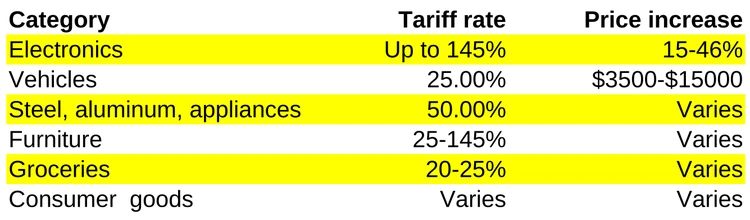
    Imports from China faced tariffs of up to 145%, leading to price hikes as high as 46% for laptops and tablets, and 26% for smartphones.

  • Automobiles and auto parts
    A 25% tariff on imported vehicles and auto parts led to price increases ranging from $3,500 to $15,000 per vehicle.

  • Steel, aluminum, construction materials and appliances
    Steel and aluminum tariffs doubled to 50% in June, raising prices for building supplies and major household appliances.


Americans faced more price increases in July as a wave of new tariffs on imported goods took hold, pushing up the cost of electronics, cars, appliances, food and more. The price hikes are among the most significant ripple effects of U.S. trade policy changes in recent years, according to economists and industry analysts.

The Yale Budget Lab estimates that U.S. tariffs could raise shortrun consumer prices by roughly 1.7% to 2.3%, depending on assumptions, and impose a household purchasing power loss ranging from about $2,300 to $3,800 annually, measured in 2024 dollars.

Where prices rose the most

Electronics
Smartphones, tablets and laptops saw some of the steepest increases, with retail prices rising 15% to 46%. The tariffs, aimed at Chinese imports, hit consumer tech especially hard.

Automobiles and auto parts
A 25% import tariff that took effect this spring translated into sticker shock for buyers of some cars and trucks. New and used vehicle prices rose by thousands of dollars, while parts and repairs became more expensive as well.

Construction materials and home appliances
Tariffs on steel and aluminum, which doubled by 50% in June, sent prices soaring for building materials. Home appliances, including refrigerators and washers, also climbed in price due to added import duties.

Furniture and household goods
Imports of furniture and kitchenware were hit with tariffs as high as 145%, resulting in price increases of 10% to 30%. Retailers reduced discounts and inventory levels as margins were squeezed.

Groceries and food items
Tariffs on products from Canada and Mexico led to higher prices on produce including avocados and tomatoes, along with other staples such as maple syrup and certain meats.

More Increases Expected in August

Many of the tariffs set to affect goods from the European Union, Canada and Mexico were scheduled to take effect Aug. 1. Experts say July's increases may represent only the beginning of a broader wave of inflation.

Some retailers and manufacturers have temporarily absorbed costs to ease the impact on consumers, but that buffer is expected to shrink in the coming weeks.

Tariff impact at a glance
Photo

Whats next?

With another round of tariffs taking effect in August, analysts expect some prices to continue rising through the fall. Bargain hunters may find fewer deals, and families already stretched by rising costs in housing and energy are likely to feel further pressure.

Lawmakers have proposed targeted relief, but no exemptions or rollbacks have been approved.


Posted: 2025-08-01 15:35:58

Get Full News Story On Consumer Affairs


Listen to this article. Speaker link opens in a new window.
Text To Speech BETA Test Version.


More News From This Category
Consumer News: What’s your favorite home improvement store? Here’s what consumers say
Thu, 14 May 2026 13:07:06 +0000

J.D. Power rates the big box stores on customer satisfaction

By Mark Huffman of ConsumerAffairs
May 14, 2026
  • Menards ranked highest in customer satisfaction among home improvement retailers in the 2026 J.D. Power study.

  • Rising prices are making shoppers more sensitive to value, even as retailers improve services and digital tools.

  • Consumers spent an average of $1,617 on home improvement purchases this year, up $278 from 2025.


Consumers say Menards is their favorite home improvement retailer, according to the newly released J.D. Power 2026 U.S. Home Improvement Retailer Satisfaction Study, which found the chain earned the highest overall customer satisfaction score among major retailers.

Menards received a score of 690 on J.D. Powers 1,000-point satisfaction scale, ahead of The Home Depot at 679 and Ace Hardware at 673. The industry average was 672.

Menards primarily serves the Midwest and parts of the northern Great Plains. The chain has stores in about 15 states, with its strongest presence in Wisconsin, Minnesota, Iowa, Illinois, Michigan, Indiana, Ohio, Nebraska, Missouri, and the Dakotas. It has also expanded into Kansas, Kentucky, West Virginia, Wyoming, and recently, Pennsylvania.

The study found that consumers appreciate improvements in product availability, digital shopping tools and expanded services such as rentals, delivery, installation assistance and rewards programs. However, those gains were offset by growing frustration over higher prices.

Although there have been meaningful gains in most operational areas, shoppers cannot ignore the rising prices, Michael Taylor, senior managing director of travel, hospitality, retail and customer service at J.D. Power, said in the report.

The average amount consumers spent at home improvement retailers climbed to $1,617 in 2026, an increase of $278 from the previous year, according to the study.

Where stores lost ground

J.D. Power said concerns about value for price paid and declining trust in retailers were the biggest drags on overall satisfaction this year. Even as companies invest more heavily in technology and delivery options, shoppers still value knowledgeable employees and in-store advice, the study found.

The research was based on responses from 2,231 customers who purchased home improvement products within the previous 12 months. The study measured satisfaction across eight categories, including customer service, product selection, digital tools, store experience and return policies.


Read More ...


Consumer News: Did you get a CP53E notice from the IRS? Here’s how to tell if it’s a scam
Thu, 14 May 2026 13:07:06 +0000

IRS warns taxpayers about fake CP53E notices targeting refund recipients

By Mark Huffman of ConsumerAffairs
May 14, 2026
  • More than 1.4 million taxpayers have received IRS CP53E notices this year, creating confusion and fueling scam fears.

  • The Taxpayer Advocate Service warns scammers are sending fake versions of the notices to steal banking and personal information.

  • Consumers should never scan QR codes or click links in suspicious IRS letters and should instead go directly to IRS.gov to verify any notice.


Scammers are very good at noticing legitimate communications that ask for sensitive information. Lately, theyre exploiting confusion over a flood of CP53E tax notices from the IRS that are being mailed this year.

The notices are legitimate IRS letters sent when the agency cannot process a taxpayers refund through direct deposit because of missing, incorrect or rejected banking information. But fraudsters are now sending convincing fake versions designed to steal financial data and personal information.

The issue has become widespread after the IRS mailed more than 1.4 million CP53E notices as part of the federal governments broader transition away from paper refund checks and toward electronic payments.

The surge in notices has left many taxpayers unsure whether the letters are real, especially because some recipients reportedly received notices despite owing taxes or not expecting refunds.

What the scam looks like

According to the Taxpayer Advocate Service and tax professionals, fake CP53E notices often include QR codes, suspicious phone numbers or links to phishing websites that ask taxpayers to verify or update bank account information.

Scammers are relying on realistic-looking documents and the publics fear of refund delays to pressure victims into acting quickly. Some fake notices even use future dates or official-sounding labels to appear authentic.

Tax experts say consumers should be especially cautious about any notice that:

  • Includes a QR code

  • Requests sensitive information by phone, email or text

  • Uses threatening or urgent language

  • Directs taxpayers to unfamiliar websites

How to verify a CP53E notice

The Taxpayer Advocate Service says the safest way to handle any IRS correspondence is to bypass links and QR codes entirely and manually type IRS.gov into a browser.

Taxpayers can then log into their IRS online account to verify whether the notice is legitimate and update banking information securely if needed.

The IRS also notes that employees cannot accept direct-deposit banking information over the phone.

Consumers who do not respond to a legitimate CP53E notice may still receive a paper refund check, although the process could take several additional weeks.

What to do if you suspect fraud

Consumers who believe they received a fake IRS notice should avoid responding and report the incident to the IRS phishing email address at phishing@irs.gov. This IRS webpage can help tell the real thing from a scam.

Anyone who has already shared financial information should immediately contact their bank and monitor accounts for suspicious activity. Experts also recommend filing reports with the Federal Trade Commission and the FBIs Internet Crime Complaint Center.


Read More ...


Consumer News: The spring housing market features slow sales and rising inventory
Thu, 14 May 2026 13:07:06 +0000

Various reports suggest buyers remain cautious

By Mark Huffman of ConsumerAffairs
May 14, 2026
  • Higher mortgage rates have cooled what many economists hoped would be a stronger spring housing rebound, leaving sales mostly flat even as more homes come onto the market.

  • Buyers are gaining slightly more leverage thanks to rising inventory and slower price growth, but affordability remains a major obstacle nationwide.

  • Economists say the 2026 housing market is increasingly regional, with parts of the Midwest and Northeast outperforming formerly red-hot Sun Belt markets.


After showing signs of renewed momentum in March, the spring housing market appears to have lost steam as higher mortgage rates and persistent affordability challenges weigh on buyers.

A new Zillow market report found that home sales were essentially flat in April compared with a year earlier, while the number of newly listed homes rose for the first time this year at a faster pace than sales.

The report suggests the traditionally busy spring selling season has become more cautious, even as buyers finally gain access to more inventory after several years of extremely tight supply.

Housing inventory is building while buyer demand reverted to a more cautious stance, Zillow said in its April analysis.

More people are trying to sell houses

According to Zillow, more than 426,000 new listings hit the market in April, up 2.1% from a year earlier. Active inventory climbed 3.7% year over year to roughly 1.3 million homes. At the same time, home sales slipped 0.4%.

The market slowdown coincided with another rise in mortgage rates. After briefly dipping near 6% earlier this year, the average 30-year fixed mortgage climbed back above 6.3%, reducing affordability for many would-be buyers.

National Association of Realtors data show existing-home sales rose only 0.2% in April to a seasonally adjusted annual pace of 4.02 million homes, well below the long-term average pace of roughly 5 million homes annually.

Prices arent falling

Despite slower sales, prices remain elevated. The median existing-home price reached a record April high of $417,700, according to NAR data cited by multiple reports.

Still, there are signs that conditions are gradually improving for buyers.

Zillow reported that monthly mortgage payments on a typical home fell 3.4% from a year ago to $1,829, helped partly by slower home-value appreciation. Typical U.S. home values increased just 0.7% year over year in April.

Homes are also staying on the market slightly longer, giving buyers more time to negotiate. Zillow found the typical home went pending in 17 days, one day longer than last year.

Bright MLS reported that pending sales in its Mid-Atlantic territory rose 5.6% from a year earlier, helped by a temporary mid-April dip in mortgage rates and increased inventory. But economists caution that the broader national market remains fragile.

Builders arent that optimistic

Builder confidence has also weakened this spring. The National Association of Home Builders/Wells Fargo Housing Market Index fell in April as builders grappled with higher material costs, uncertain demand and elevated financing costs.

Regional differences are becoming increasingly pronounced as well.Some formerly booming Sun Belt metros are now seeing price declines because of overbuilding and affordability pressures, according to recent Zillow forecasts. Meanwhile, more affordable Midwest and Northeast cities are attracting buyers and seeing stronger price gains.

Economists say the direction of the housing market for the remainder of 2026 may largely depend on mortgage rates.

If rates retreat closer to 6%, analysts believe pent-up demand could quickly revive sales activity. But if inflation and economic uncertainty keep borrowing costs elevated, the spring slowdown could extend into summer.


Read More ...


Consumer News: Urgent recall issued for MG217 eczema cream
Thu, 14 May 2026 04:07:07 +0000

The product tested positive for bacteria contamination

By Mark Huffman of ConsumerAffairs
May 13, 2026
  • Pharmacal has recalled one lot of MG217 Multi-Symptom Treatment Cream & Skin Protectant Eczema Cream after testing found contamination with Staphylococcus aureus bacteria.

  • The recalled product was sold nationwide online and in retail stores, including Amazon and H-E-B.

  • Consumers are urged to stop using the cream immediately and discard it, although no adverse events have been reported so far.


Pharmacal has issued a nationwide recall of one lot of its MG217 Multi-Symptom Treatment Cream & Skin Protectant Eczema Cream after the product tested positive for contamination with Staphylococcus aureus, the bacteria commonly associated with staph infections.

The recall affects six-ounce tubes bearing lot number 1024088 and an expiration date of November 2026, according to a notice posted by the U.S. Food and Drug Administration.

The cream, marketed for relief of eczema symptoms including itching, redness, dryness, and irritation, was sold nationwide through retail outlets and online sellers, including Amazon and H-E-B.

FDA warns of serious infections

FDA officials warned that use of contaminated topical products can lead to localized skin infections, andin some cases, more serious or life-threatening complications. People with weakened immune systems, compromised skin barriers, burns, or underlying skin disorders may face a higher risk of severe infection.

Pharmacal said it has not received any reports of adverse reactions linked to the recalled cream.

MG217 products are widely used for the treatment of psoriasis and eczema symptoms and include creams, ointments, and shampoos containing ingredients such as coal tar or colloidal oatmeal.

Consumers who purchased the recalled eczema cream should stop using it immediately and dispose of the product. The company advises anyone experiencing symptoms or complications after use to contact a healthcare provider.

Customers with questions about the recall can contact Pharmacal at 800-558-6614 or by email at aimho@pharmacalway.com.


Read More ...


Consumer News: 9 products we waste money on every single month
Wed, 13 May 2026 22:07:05 +0000

Many Americans buy these products out of habit, not necessity

By Kyle James of ConsumerAffairs
May 13, 2026
  • Convenience spending adds up fast: Small purchases like bottled water, fancy coffee, and pre-cut produce quietly drain budgets faster than most people realize.

  • Many shoppers overpay out of habit: Americans routinely spend too much on things like brand-name medicine, fast fashion, disposable razors, and trendy supplements.

  • Simple swaps can save big: Avoiding convenience markups and making smarter product choices can save shoppers hundreds of dollars every year.


Manypeople think that their budget problems come from giant mistakes like buying an expensive caror taking a lavish vacation they cant afford.

But in reality, a lot of financial stress comes from those small purchases that slowly become routine. A few extra dollars here, a convenience purchase there, then you toss something in your cart because it doesnt cost that much.

These habits then repeat week after week until they eventually eat hundreds or even thousands of dollars out of your budget every year.

Here are nine products that drain wallets far more than most people realize, along with tips to spend smarter.

1. Bottled water

A $3 bottle of water at a gas station doesnt feel expensive in the moment. But if you buy one four or five times a week, you can easily spend $500 to $700 a year on something that basically comes out of your kitchen faucet.

Convenience stores and airports especially markup bottled water because they know thirsty people dont comparison shop. And once an ice-cold bottled water becomes a habit, it becomes automatic spending.

Savings tip: Keep a reusable insulated bottle in your car at all times or buy a filtered pitcher instead of a flat of bottled water. Also, avoid "shopping thirsty"because its easy to impulse buy drinks and other snacks at the same time.

2. Pre-cut fruits and vegetables

People massively underestimate the convenience tax attached to prepared produce.

Pre-cut watermelon, sliced apples, chopped onions, shredded lettuce, and cubed pineapple often cost two to four times more than buying whole produce and spending five extra minutes prepping it yourself.

And retailers love these products because shoppers psychologically justify the markup as saving time. Sometimes youre paying an extra $5 simply because someone cut the fruit into chunks.

Savings tip: This one is pretty obviouscut the stuff up yourself. Heck, with the money saved over the course of a year, youll be able to buy yourself a couple very nice knives.

3. Single-use cleaning products

Disposable cleaning products are one of the sneakiest household expenses around.

Disinfecting wipes, Swiffer pads, paper-heavy mop systems, and disposable dusters create endless repeat purchases that quietly drain budgets month after month.

Companies intentionally design these products around refill dependency. The starter kit looks affordable. The replacement pads and cartridges are where they make the real money.

Savings tip: Microfiber cloths are reusable and often clean way better than disposable stuff. Also, concentrated cleaning solutions cost way less per use, and those generic refill pads often work perfectly fine with your Swiffer, Shark, or Bissel.

4. Fancy coffee drinks

Plain coffee isnt usually the thing draining your budget. The real killer is the daily $6-$7 custom drink loaded with syrups, cold foam, extra espresso shots, flavored toppings, and sometimes delivery fees.

A lot of people spend $200 to $400 monthly on premium coffee habits without realizing it. The purchases either feel small individually, or were afraid to total up what we spend every month.

Then add the fact that many coffee shops are masters at turning a routine into what feels more like emotional comfort spending.

Savings tip: Be sure to use coffee shop loyalty apps for freebies and an occasional discount. Also, try learning at least one copycat drink recipe at home instead of always hitting Starbucks or Dunkin.

5. Trendy health supplements

Stuff like greens powders, mushroom coffee, collagen gummies, detox drinks, hydration mixes, and influencer-backed supplements often come with huge price tags and aggressive marketing.

Some may indeed offer benefits, but many are simply expensive habits wrapped in "health" branding. And because these products are tied to self-improvement, people rarely question the spending, or they find it easy to justify.

Savings tip: Be sure to price compare, and check out the ingredient labels carefully, as many supplements contain nearly identical formulas despite huge differences in price. For example, a trendy influencer-backed collagen mix may cost three times more simply because of branding and marketing, not actual better ingredients.

6. Brand-name over-the-counter medicine

This is one of the easiest ways Americans overpay every single month.

Brand-name pain relievers, allergy medicine, antacids, and cold medicine are often chemically identical to cheaper generic versions sitting directly beside them on the shelf.

The packaging will change a little bit, but the active ingredients usually do not. Many shoppers are paying double simply because of brand familiarity.

Savings tip: Compare the active ingredients on the back of the box, not the front label, and youll find most are identical. Also, be sure to check Costco and Sams Club, as they often have incredibly low prices on generic OTC medicines.

7. Fast fashion impulse buys

Cheap clothing from online stores like SHEIN, Fashion Nova, Temu, and Boohoo feel like a bargain until it fades, shrinks, stretches, or falls apart after a few washes.

Many consumers end up repeatedly rebuying the same low-quality basics instead of investing in fewer items that last longer.

Social media trends have also accelerated impulse clothing purchases dramatically. This means many shoppers now buy outfits for specific "moments," and not for long-term use.

Savings tip: Keep in mind that cost-per-wear should matter more than the actual sticker price. Consider investing in a few high-quality basics like jeans, neutral shirts, hoodies, sneakers, and jackets. They may cost more upfront, but theyll usually fit better and last longer.

Also, dont forget about outlet stores, as they often have far better value than the ultra-cheap retailers I mentioned above.

8. Disposable razors and blade cartridges

Have you noticed how expensive razors and cartridges have become recently?

You might not have noticed if you tend to buy replacements in small increments, but over a year, shaving products can easily cost you hundreds of dollars.

Some blade systems are even intentionally designed to lock you into expensive refills making the cost fairly fixed.

Savings tip: Womens razors are often significantly more expensive than the nearly identical mens versions, a pricing strategy commonly called the pink tax. The savvy move is to buy the cheaper mens razor and ignore the more masculine packaging and color. The blades and overall performance are basically identical.

9. Phone accessories bought at checkout counters

Airport kiosks, mall carts, and drugstore checkout lines are always packed with wildly overpriced charging cables, earbuds, phone cases, and screen protectors.

Consumers often buy them in emergencies when theyre least likely to compare prices. Thats exactly why the markups are so high stores know youll pay an outrageous price.

Pro tip: Make it a habit to keep backup charging cables in your car or travel bag. Also, buy some accessories online before you urgently need them, especially inexpensive generic charging cables which are often fine for everyday use.

The bottom line

Most people dont wreck their budget with one giant purchase, but rather its the slow drain of those small convenience products.

And thats what makes these products so dangerous financially. They rarely feel expensive in the moment, but repeated over months and years, they become some of the biggest budget leaks.


Read More ...


Related Bing News Results
Here's what to buy in May 2026 | Consumer Reports
Mon, 11 May 2026 08:54:00 GMT
Memorial Day brings deals on appliances, mattresses, and grills. Consumer Reports has tips to help you choose wisely.

Consumer Reports: Ready to try digital minimalism?
Mon, 11 May 2026 08:15:00 GMT
Most of us know we spend a little too much time on our phones — but the numbers may still surprise you. A recent survey found Americans check their phones nearly 200 times a day on average and spend ...

Consumer Reports Compared Affordable Refrigerators And One Came Out On Top
Sun, 10 May 2026 09:29:00 GMT
Consumer Reports members ranked this affordable refrigerator the highest in several categories, awarding it a near-perfect predicted reliability score.

This Instant Coffee Delivers the Most Caffeine, According to Consumer Reports
Tue, 05 May 2026 10:01:00 GMT
In lab tests, some coffees topped 400 milligrams of caffeine in a 24-ounce cup — more than the FDA recommends for an entire day.

Consumer Reports: Simple steps to help slash daily screen time
Fri, 24 Apr 2026 01:25:00 GMT
Most of us know that too much scrolling on our phones isn’t great for our mental health. And now, a new approach to dialing down the digital noise is ironically trending on social media—of all places.


Blow Us A Whistle


Related Product Search/Búsqueda de productos relacionados

Amazon Logo

Visit Our New Print-On-Demand Stores On Printify and Zazzle
Printify Zazzle