Rockin Robin SongFlying The Web For News.
RobinPost Logo Amazon Prime Deals


Consumer Daily Reports

Cities in the Midwest tend to have the lowest monthly costs

By Mark Huffman Consumer News: Here are the cities where residents have the highest bills of ConsumerAffairs
September 12, 2025
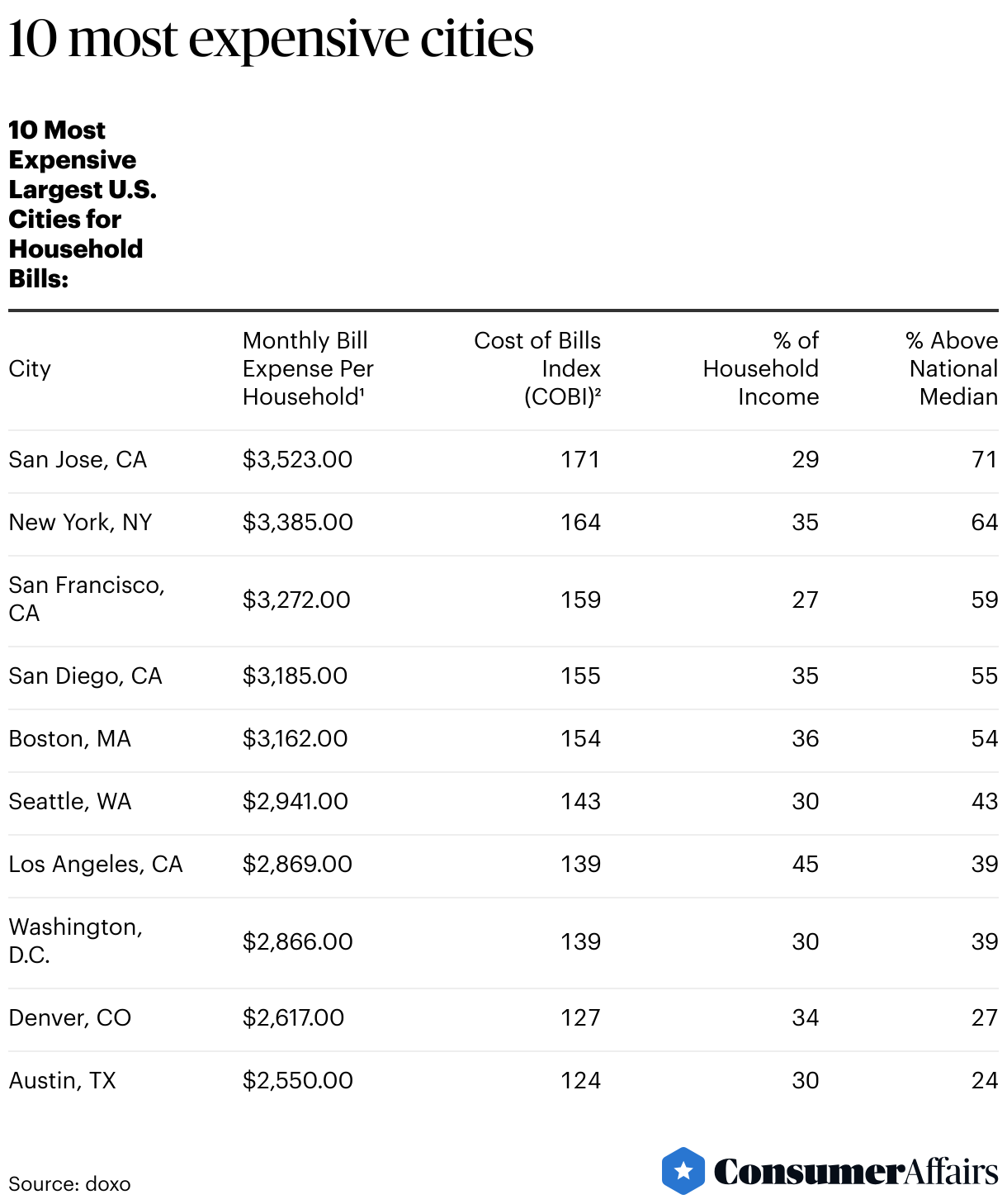
  • San Jose tops the list as the most expensive U.S. city for household bills, with residents paying a median of $3,523 per month.

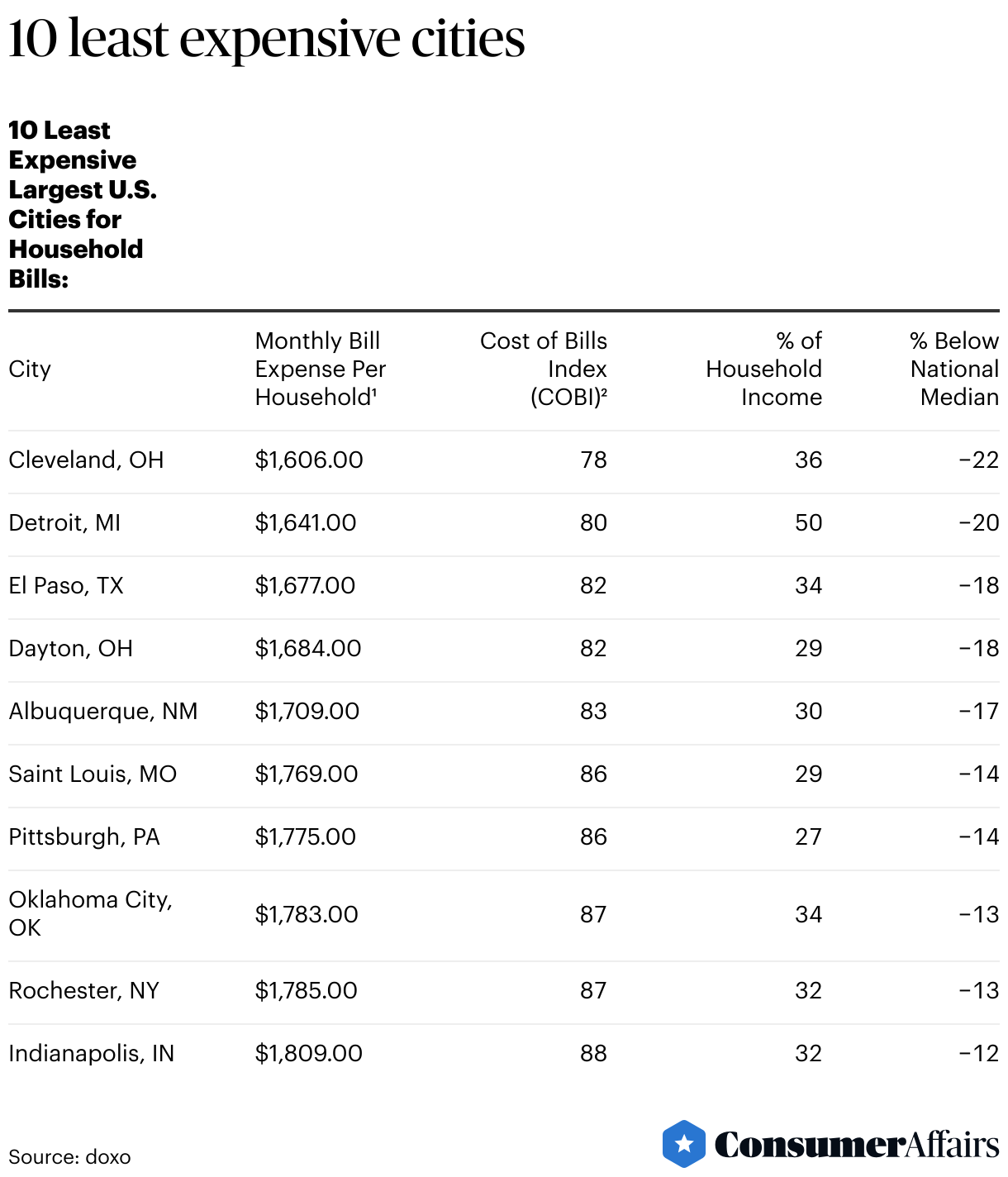
  • Cleveland ranks lowest, where households spend just $1,606 monthly22% below the national median.

  • Nationwide, bills average $2,058 per month, making up the single largest category of household expenses.


A new analysis of household spending shows that where Americans live has a dramatic impact on how much they pay in recurring bills. The doxoINSIGHTS 50 Largest U.S. Cities Household Spend Report 2025 examined actual bill payment data from millions of households, covering more than 97% of U.S. zip codes.

The findings reveal a stark contrast: residents of San Jose, Calif., face the nations steepest household costs at a median of $3,523 per month a staggering 71% above the U.S. median while households in Cleveland, Ohio, pay just $1,606 per month, the lowest among major cities.

While discussions about cost of living often focus on housing prices, doxo emphasizes that household bills are the largest recurring expense for families, exceeding mortgage or rent, insurance, utilities, internet, and even mobile phones.

Bills are the largest category of household spending, yet their impact on the cost of living is often overlooked, said Jaimie Sheridan, head of INSIGHTS at doxo. This level of transparency provides actionable insights based on actual paymentsnot estimateshelping consumers improve their financial well-being and businesses better understand their customers economic realities.

Most and least expensive cities

According to the report, California dominates the high-cost list, with San Francisco, San Diego, and Los Angeles joining San Jose as expensive when it comes to household bills. Along with Cleveland, cities such as Detroit, Dayton, Saint Louis, and Indianapolis all appear on the list of least expensive places to manage monthly expenses.

Consumer News: Here are the cities where residents have the highest bills

The report underscores how these differences can shape consumer decisions:

  • Financial health Families can benchmark their bills against local and national medians to spot savings opportunities.

  • Provider evaluation Bill-by-bill comparisons reveal where certain services may be disproportionately expensive.

  • Relocation considerations For those weighing a move, understanding how bills contribute to overall living costs provides a more realistic financial picture.

With U.S. households spending a median of $24,695 annually on bills, the study offers a rare glimpse into the true day-to-day costs of American life, beyond the price tag of housing alone.


Posted: 2025-09-12 12:31:37

Get Full News Story On Consumer Affairs


Listen to this article. Speaker link opens in a new window.
Text To Speech BETA Test Version.


More News From This Category
Consumer News: Bank of America agrees to $2.25 million settlement over ATM fees at 7-Eleven stores
Mon, 18 May 2026 16:07:08 +0000

Some consumers may receive compensation

By Mark Huffman of ConsumerAffairs
May 18, 2026
  • Bank of America has agreed to pay $2.25 million to settle allegations that customers were improperly charged ATM access fees at 7-Eleven locations.

  • Regulators said the bank failed to provide required fee disclosures before transactions were completed.

  • Eligible customers may receive refunds under the settlement agreement, which resolves claims without an admission of wrongdoing.


Regulators in several states report that Bank of America will pay $2.25 million in a settlement with consumers who say they were improperly charged ATM fees at machines located inside 7-Eleven convenience stores.

The settlement resolves claims that customers were assessed fees without receiving legally required disclosures before completing withdrawals or balance inquiries at certain ATMs operated in partnership with 7-Eleven. Regulators said consumers may not have been adequately informed that they would incur surcharges when using the machines.

Authorities alleged that the disclosure failures violated consumer protection laws designed to ensure transparency in electronic banking transactions. The issue reportedly affected transactions conducted over multiple years at ATMs in several states.

Restitution to consumers

Under the agreement, Bank of America will pay monetary penalties and provide restitution to affected customers. The bank did not admit wrongdoing as part of the settlement but agreed to improve its compliance and oversight procedures involving ATM fee notifications.

Consumer advocates say the case highlights ongoing concerns about so-called junk fees in banking and financial services. ATM surcharges, overdraft fees and other service charges have faced increasing scrutiny from regulators and lawmakers in recent years, particularly when consumers are not clearly informed in advance.

The banks response

Bank of America said it cooperated with investigators and has already taken steps to address the issue. The bank stated that transparency for customers remains a priority and that systems have been updated to ensure fee disclosures comply with applicable regulations.

Customers who believe they were improperly charged may be contacted directly regarding potential reimbursement eligibility, depending on the terms of the settlement administration process.

The settlement is the latest in a series of enforcement actions targeting financial institutions over consumer fee practices. Regulators have increasingly focused on ensuring banks provide clear disclosures and avoid charging fees that consumers may not reasonably expect.


Read More ...


Consumer News: Why some seniors are paying more at the grocery store — simply because they don’t use apps
Mon, 18 May 2026 16:07:07 +0000

Many seniors struggle with new grocery store technology

By Kyle James of ConsumerAffairs
May 18, 2026
  • More grocery stores now put their best prices behind apps and digital coupons, leaving many seniors paying higher prices at checkout.

  • For older shoppers who are not comfortable with smartphones or apps, even simple grocery deals can become frustrating and confusing.

  • Consumer advocates say many seniors are effectively paying a technology tax because they miss out on app-only discounts younger shoppers unlock easily.


For millions of Americans, saving money grocery shopping has become a digital game. You need some tech know-how to maximize your savings, and for many seniors, that shift is creating a frustrating and expensive new reality.

Older shoppers who dont own smartphones, lack reliable internet access, or simply arent comfortable navigating grocery apps, often end up paying significantly more for the exact same items sitting in the same store.

Its easy to argue that theyre being penalized simply for not being digitally connected.

The rise of the 'digital-only'grocery deal

Over the past several years, grocery chains have aggressively pushed customers toward app-based shopping and couponing.

Stores like Kroger, Safeway, Albertsons, Publix, and Target now regularly offer:

  • Digital-only coupons
  • App-exclusive discounts
  • Personalized online offers
  • Rewards programs
  • Clip before checkout savings
  • Online-only pricing

The problem is these deals often require a customer to download an app, create an account, remember a password, navigate a few menus, and even use a mobile wallet or QR code.

For younger shoppers, this feels routine and often only takes a minute to setup. For many seniors, it feels exhausting and many give up before they even try to get set up.

Seniors often face a hidden 'technology tax'

Many older Americans grew up clipping paper coupons from newspapers and simply comparing shelf prices in grocery store aisles.

Now, most stores basically require digital participation just to access advertised savings and coupons. That creates what consumer advocates increasingly describe as a technology tax, where people who are less tech savvy end up paying more.

And the gap can be substantial. For example, a box of cereal might cost $5.99, but only $2.99 with a digital coupon.

Or a frozen pizza discount might require app activation, loyalty login, coupon clipping, and then a phone-number verification at checkout.

Without all of those steps, shoppers can miss out on major discounts repeatedly throughout the store. Over the course of a year, that difference can easily add up to hundred of dollars.

Even tech-savvy shoppers get frustrated

This issue doesnt only affect seniors, as younger shoppers increasingly complain about:

  • Forgetting to clip coupons
  • Apps crashing in-store
  • Weak cell service
  • Rewards not applying correctly
  • Confusing pricing systems

But seniors often feel those frustrations more intensely because the systems werent built around their current comfort level.

They may reach checkout only to realize the sale price didnt applyor the app didnt load correctly. And for some older shoppers, the experience can become slightly humiliating and make them want to forget the whole thing.

Meanwhile, the customer behind them in line already has everything working perfectly on their phone.

Pro tip: Many grocery chains still allow shoppers to enter a phone number at checkout instead of using the full app. Seniors who are comfortable with basic loyalty programs, but not smartphone apps, should ask customer service whether digital coupons can still attach through a phone-number account.

Some states are starting to pay attention

Consumer advocates and lawmakers in several states have raised concerns that digital-only pricing may disproportionately affect:

  • Seniors
  • Low-income households
  • Rural communities
  • People without reliable internet access
  • Disabled shoppers

Some regulators have pushed for stores to offer alternative ways to access discounts, including:

  • Paper coupon options
  • In-store kiosks
  • Cashier assistance
  • Equivalent non-digital pricing

The debate is likely to grow as more retailers move toward fully digital pricing systems.

What seniors can do right now

For older shoppers feeling overwhelmed, experts recommend simplifying the process instead of trying to master every app.

Some smart and doable strategies include:

  • Sticking with one primary grocery chain.
  • Asking family members to help set up accounts.
  • Using loyalty phone numbers instead of apps when possible.
  • Shopping stores with simpler pricing systems like ALDI or Trader Joes.
  • Checking weekly ads online before going shopping.
  • Using paper lists to track those digital deals.

Some seniors also create shopping partnerships with adult children or grandchildren who preload digital coupons before grocery trips.

Pro tip: Warehouse clubs like Costco, and stores like Trader Joe's, often rely less on app-based coupon systems (or don't use themat all), which can make pricing feel simpler and less stressful for some older shoppers.

The bottom line

It used to be when you walked into the grocery store you compared prices, and then bought what was on sale or had the best value.

Now, many of the best deals are hidden behind apps, accounts, and digital hoops that not every shopper can easily navigate.

And for many seniors, that means paying more not because they shop poorly, but because the modern grocery system increasingly assumes everyone is constantly connected.


Read More ...


Consumer News: Using a single real estate agent can be costly, report says
Mon, 18 May 2026 16:07:07 +0000

Zillow argues that private listings can also leave money on the table

By Mark Huffman of ConsumerAffairs
May 18, 2026
  • Zillow says home sellers lost a combined $1.49 billion over three years when the same real estate agent represented both buyer and seller in a transaction.

  • The company also found sellers who kept listings off the Multiple Listing Service (MLS) lost another $1.36 billion collectively during the same period.

  • Researchers say the data suggests sellers generally receive lower prices when homes are marketed privately or when agents handle both sides of a deal.


It might seem obvious that if a buyer and seller share one real estate transaction, they would save money. But a new Zillow analysis suggests that, not only would you not save money, if you are the seller, you would lose money. Maybe a lot

The analysis concludes that, whats called dual agency, can mean sellers leave thousands of dollars on the table.

According to the study, sellers who used the same real estate agent as the buyer lost a combined $1.49 billion over the last three years. Zillow said these dual agency transactions consistently resulted in lower sale prices compared with deals involving separate representation for buyers and sellers.

Private listings may be costly, too

The company also reported that homes sold off the Multiple Listing Service often marketed privately or within exclusive networks generated another $1.36 billion in seller losses over the same period. Zillows analysis found privately listed homes typically sold for about 1.3% less than comparable homes listed publicly on the MLS.

Zillow argues that the financial incentives in dual agency arrangements can create conflicts of interest. When one agent represents both sides of a transaction, the brokerage may earn a larger share of the commission by keeping the deal in-house, potentially reducing motivation to negotiate aggressively on behalf of the seller.

The study found the pricing penalties associated with both dual agency and off-MLS listings appeared consistently in every year analyzed, suggesting the trend is not limited to a particular housing market cycle.

Heightened scrutiny

The findings arrive as the real estate industry continues to face scrutiny over commissions and agent compensation practices following high-profile lawsuits against the National Association of Realtors and several major brokerages. Those legal challenges accused the industry of maintaining practices that inflated commissions and limited competition.

Although recent settlement agreements were expected to increase fee transparency and encourage more negotiation, several industry analysts say commission structures have changed only modestly so far.

Consumer advocates say the new Zillow data reinforces the importance of broad market exposure and independent representation during home sales. Critics of dual agency contend that sellers may sacrifice negotiating leverage when one agent is responsible for serving both parties in a transaction.

Real estate professionals who support dual agency argue it can streamline transactions and simplify communication, though consumer groups continue to caution sellers to fully understand how representation arrangements could affect their final sale price.


Read More ...


Consumer News: Gas prices didn’t go up last week
Mon, 18 May 2026 13:07:07 +0000

But prices are at the highest level since 2022 and may not have peaked

By Mark Huffman of ConsumerAffairs
May 18, 2026
  • The national average price for regular gasoline stood at about $4.52 a gallon on Monday, May 18, according to AAA, with California topping $6 a gallon while some Southern states remained near $4.

  • Analysts say geopolitical tensions, strong global demand for U.S. fuel exports and seasonal refinery pressures are keeping prices elevated heading into summer.

  • Industry experts expect continued volatility through the summer, though forecasts for later in 2026 still point to lower prices if supply disruptions ease.


AAA, which tracks gasoline prices in all 50 states, reports the national average price of regular gas is starting the week at $4.51 a gallon, the same as the day before. Its actually a penny lower than last Monday.

But todays average price is more than $1.50 per gallon higher than the day before the start of the Iran war. Industry analysts warn that relief may be limited as the summer driving season gets underway.

Prices vary dramatically by region, with California averaging more than $6.15 a gallon, while Texas and several Gulf Coast states were still below $4.

The increase reflects a combination of geopolitical instability, seasonal refinery issues and robust international demand for U.S. energy products.

Iran war was a game-changer

Patrick De Haan, head of petroleum analysis at GasBuddy, said global supply disruptions have transformed what was expected to be a relatively calm year for fuel prices into a volatile market.

The same oil we rely on can be moved anywhere in the world, De Haan told Business Insider, noting that record U.S. exports are contributing to tighter domestic supplies.

Industry analysts say tensions affecting oil shipments through the Strait of Hormuz have intensified concerns about global crude supplies, pushing up oil and gasoline futures. Refiners are also transitioning to more expensive summer fuel blends, while maintenance and outages at some U.S. refineries have tightened gasoline inventories.

West Coast feels the most pain

The Energy Information Administrations latest fuel update showed particularly steep prices on the West Coast, where California gasoline averaged more than $7.22 a gallon in some regions. Diesel prices also remain elevated nationally, averaging about $5.64 a gallon.

Analysts warn that diesel prices could become an even larger economic problem because diesel fuels trucking, rail transportation and agriculture. MarketWatch reported that diesel prices are nearing record highs, raising concerns about broader inflation pressures as transportation costs work their way through the economy.

Despite the recent spike, some forecasters still believe prices could ease later in the year if geopolitical tensions stabilize and refinery operations normalize.

GasBuddys annual outlook released earlier this year projected a 2026 national average gasoline price below $3 a gallon, though that forecast was issued before the latest Middle East disruptions intensified.


Read More ...


Consumer News: Here are the vehicles experts say provide the best fuel economy
Mon, 18 May 2026 13:07:07 +0000

With gas prices well over $4 a gallon, fuel efficiency has never been more important

By Mark Huffman of ConsumerAffairs
May 18, 2026
  • The Toyota Prius remains the fuel economy king, delivering up to 57 mpg combined while offering sharper styling and better performance than previous generations.

  • Hybrid SUVs are gaining popularity, with models like the Hyundai Tucson Hybrid, Toyota RAV4 Hybrid and Honda CR-V Hybrid offering strong fuel savings without sacrificing space or comfort.

  • Automakers are expanding fuel-efficient options across every vehicle category, giving consumers more choices in hybrids and EVs as gas prices and vehicle costs remain high.


Over the last few weeks, gasoline prices have surged by well over $1 per gallon, meaning a fill-up is a lot more expensive now. Thats creating renewed interest in vehicles that provide superior fuel economy.

Automotive publisher Edmunds latest rankings of the most fuel-efficient vehicles on sale in America show that buyers no longer have to sacrifice comfort, technology or performance to save money at the pump.

The latest crop of fuel-sipping vehicles is dominated by hybrids, particularly Toyota models, though automakers such as Hyundai, Honda and Kia are making significant gains in efficiency and driving refinement. Edmunds evaluated vehicles using EPA combined fuel economy ratings, focusing on the most efficient trim levels available.

Prius leads the pack

Leading the pack once again is the Toyota Prius, which delivers up to 57 mpg combined in its most efficient configuration. Edmunds noted that the redesigned Prius has shed its longtime economy car image and now offers improved styling and a more engaging driving experience while remaining one of the cheapest vehicles to operate.

Other standout hybrids include the Kia Niro, rated at up to 53 mpg combined, and the Toyota Camry Hybrid, which continues to attract buyers looking for midsize sedan comfort without high fuel costs. Edmunds also highlighted the Honda Civic Hybrid and Hyundai Elantra Hybrid among the best-performing hybrid cars for 2026.

Hybrid SUVs are also becoming more competitive as consumers continue shifting away from traditional sedans. Edmunds named the 2026 Hyundai Tucson Hybrid its top gas-saving hybrid SUV, praising its balance of efficiency, performance and ride quality. The Toyota RAV4 Hybrid and Honda CR-V Hybrid remain strong contenders in the compact SUV category.

For larger families, automakers are bringing hybrid technology into three-row SUVs. The new Hyundai Palisade Hybrid delivers as much as 34 mpg combined in front-wheel-drive form while offering more than 600 miles of driving range.

EVs are getting new consideration

Electric vehicles are also becoming more efficient and practical, according to Edmunds. Models such as the Hyundai Ioniq 6, Tesla Model 3 and Lucid Air continue to post some of the highest MPGe ratings in the industry while improving charging speeds and driving range.

Industry analysts say the renewed emphasis on fuel economy is arriving as consumers face higher vehicle prices and elevated gasoline costs. Business Insider recently reported that average new-car prices have climbed above $50,000 while rising fuel costs are driving more shoppers toward hybrids and EVs.

Edmunds also advises consumers to look beyond fuel economy numbers alone when considering hybrids. Experts recommend calculating how quickly the added cost of hybrid technology will pay for itself through fuel savings. Vehicles such as the Ford Maverick Hybrid and Hyundai Santa Fe Hybrid were cited as examples with relatively short payback periods.

The growing variety of efficient vehicles means consumers now have more choices than ever, whether they want a compact commuter car, a family SUV or a fully electric vehicle. And unlike earlier generations of economy-focused vehicles, many of todays top fuel savers also rank highly for comfort, performance and technology.


Read More ...


Related Bing News Results
Consumer Reports list: What to buy in May
Thu, 14 May 2026 15:52:00 GMT
May brings a wave of deals on all sorts of products thanks to two major holidays. Consumer Reports shares how you can save big while honoring the mothers and veterans in your life. After a slower ...

This Instant Coffee Delivers the Most Caffeine, According to Consumer Reports
Tue, 05 May 2026 03:19:00 GMT
Consumer Reports analyzed caffeine levels in both instant coffees and takeout brews — and found they can vary widely. In some cases, a large cup can approach or even exceed the FDA’s 400-milligram ...

Consumer Reports: Simple steps to help slash daily screen time
Fri, 24 Apr 2026 01:25:00 GMT
Most of us know that too much scrolling on our phones isn’t great for our mental health. And now, a new approach to dialing down the digital noise is ironically trending on social media—of all places.

Consumer Reports retests protein powders, finds safer options
Wed, 18 Feb 2026 17:22:00 GMT
USES THESE SUPPLEMENTS. HERE’S MARISSA TANSINO. LAST FALL, CONSUMER REPORTS TESTED DOZENS OF PROTEIN POWDERS AND READY TO DRINK SHAKES. WHAT THE LAB FOUND RAISED RED FLAGS MORE THAN TWO THIRDS ...

Consumer Reports |Experts warn against daily use of protein supplements
Mon, 20 Oct 2025 22:57:00 GMT
Protein powders and shakes are more popular than ever, often touted as workout fuel or even meal replacements. But a new Consumer Reports investigation reveals a hidden risk: some of these supplements ...


Blow Us A Whistle


Related Product Search/Búsqueda de productos relacionados

Amazon Logo

Visit Our New Print-On-Demand Stores On Printify and Zazzle
Printify Zazzle