Rockin Robin SongFlying The Web For News.
RobinPost Logo Amazon Prime Deals


Consumer Daily Reports

Consumers are advised to dispose of them immediately

By Mark Huffman Consumer News: Costco recalls ‘dangerous’ bottles of sparkling wine of ConsumerAffairs
September 17, 2025
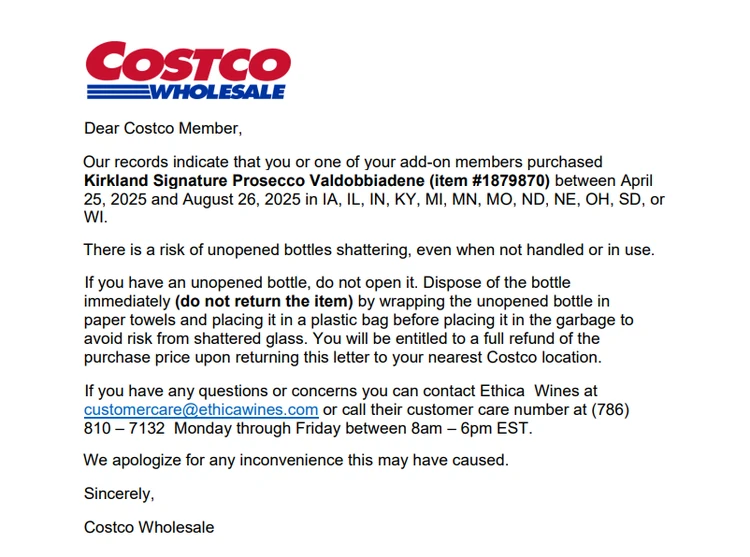
  • Recall Notice: Costco recalled Kirkland Signature Prosecco Valdobbiadene due to a risk of unopened bottles shattering, even when not in use.

  • Consumer Guidance: Customers are told not to return bottles but to safely dispose of them by wrapping in paper towels, sealing in a plastic bag, and placing in the trash.

  • Refund and Support: Affected buyers can get a full refund by showing Costcos recall letter in-store, and questions can be directed to importer Ethica Wines at (786) 810-7132.


Costco has issued a recall for one of its products that it says is so dangerous it should not be returned to the store. Instead, it should be disposed of immediately.

Kirkland Signature Prosecco Valdobbiadene, an in-house private label wine is very popular with Costco members for its quality and price. But the company has notified Costco members that there is a serious problem.

There is a risk of unopened bottles shattering, even when not in use, the company said.

Photo

The bottles were sold between April 25 and August 26 this year in Iowa, Illinois, Indiana, Kentucky, Michigan, Minnesota, Missouri, North Dakota, Nebraska, Ohio, South Dakota and Wisconsin.

If you have an unopened bottle, do not open it, the company advised. Dispose of the bottle immediately do not return it by wrapping the unopened bottle in paper towels and placing it in a plastic bag before placing it in the garbage to avoid risk from shattering glass.

Customers who received the letter from Costco are entitled to a full refund by showing the letter at a Costco store.

Costco said consumers who have questions may contract Ethica Wines, an importer Costco works with to make Kirkland brand wine, at (786) 810-7132 Monday through Friday from 8 am to 6 pm EDT.


Posted: 2025-09-17 11:18:33

Get Full News Story On Consumer Affairs


Listen to this article. Speaker link opens in a new window.
Text To Speech BETA Test Version.


More News From This Category
Consumer News: Kroger strikes $1.65 billion deal to acquire Giant Eagle
Thu, 02 Jul 2026 13:07:06 +0000

The deal is much smaller than the ill-fated Albertsons merger

By Mark Huffman of ConsumerAffairs
July 2, 2026
  • Kroger has agreed to acquire regional grocery chain Giant Eagle in a deal valued at $1.65 billion, marking its largest expansion since its failed merger with Albertsons.

  • The acquisition would give Kroger nearly 200 additional supermarkets and pharmacies across Pennsylvania, Ohio, West Virginia, Maryland and Indiana.

  • The deal faces regulatory review but is expected to close in 2027, with the companies anticipating only limited store divestitures.

Kroger is one of the largest supermarket chains in the U.S., and its about to get bigger.

The company is expanding its footprint in the Midwest and Mid-Atlantic after reaching an agreement to acquire privately held grocery chain Giant Eagle in a transaction valued at $1.65 billion.

The deal, announced this week, comes less than a year after Kroger's proposed merger with Albertsons collapsed amid legal challenges and regulatory opposition. Rather than pursuing another transformative national merger, Kroger is buying a regional chain that operates in markets adjacent to many of its existing stores.

Under the agreement, Kroger will pay approximately $1.25 billion in cash and assume about $400 million in Giant Eagle liabilities, bringing the total transaction value to $1.65 billion.

What Giant Eagle brings to the table

Giant Eagle operates 197 supermarkets and 11 standalone pharmacies across western Pennsylvania, northern Ohio, West Virginia, Maryland and Indiana. The company generates roughly $9 billion in annual sales and employs more than 30,000 people, making it one of Pennsylvania's largest private employers.

Kroger CEO Greg Foran said Giant Eagle's strong reputation for fresh foods, pharmacy services, private-label products and customer loyalty made it an attractive strategic fit.

"We evaluated the opportunity carefully, and the strategic fit is clear," Foran said in announcing the acquisition.

What Giant Eagle gets

For Giant Eagle, the transaction offers the opportunity to tap into Kroger's scale, technology and supply chain while expanding opportunities for employees.

Giant Eagle CEO Bill Artman said the combined company will be better positioned to improve quality, value and customer service while creating new growth opportunities for workers.

The acquisition also marks Kroger's return to the Pittsburgh market, which it exited in the 1980s. Giant Eagle has since become the dominant grocery chain in western Pennsylvania, although competition has been increasing with planned expansion by Wegmans and Meijer.

Unlike the proposed Albertsons merger, which would have combined two of the nation's largest supermarket operators, the Giant Eagle acquisition is considerably smaller and involves complementary geographic markets. However, Kroger and Giant Eagle said they expect to divest a limited number of stores to satisfy antitrust regulators.


Read More ...


Consumer News: Do you qualify for payment under Disney’s $50 million settlement?
Thu, 02 Jul 2026 13:07:06 +0000

Heres how to file a claim

By Mark Huffman of ConsumerAffairs
July 2, 2026
  • Millions of current and former YouTube TV and DirecTV Stream subscribers may qualify for a share of Disney's $50 million antitrust settlement.

  • The settlement covers eligible subscriptions purchased between April 1, 2019, and March 31, 2026, with claims due by Sept. 8, 2026.

  • Payments will vary based on how long customers subscribed and the total number of valid claims filed, with money expected to be distributed after final court approval.

Millions of Americans who subscribed to YouTube TV or DirecTV Stream over the past seven years could be eligible for compensation under a $50 million class-action settlement resolving allegations that Disney unlawfully drove up the price of live TV streaming services.

The settlement stems from an antitrust lawsuit accusing Disney of using its ownership of popular networksincluding ESPNto force streaming providers to carry expensive channel bundles, limiting their ability to offer lower-cost packages. Disney has denied any wrongdoing but agreed to settle the case rather than continue litigation.

Who is eligible?

Consumers may qualify if they paid for:

  • YouTube TV between April 1, 2019, and March 31, 2026, or

  • DirecTV's streaming service during the same period, including subscriptions marketed as DirecTV Stream, DirecTV Now, or AT&T TV Now.

  • Customers who subscribed to both services may include both subscriptions on a single claim.

The settlement divides claimants into two legal categories based on where they lived during the class period because state antitrust laws differ. Residents of so-called "repealer" states will share 90% of the net settlement fund, while residents of other states will divide the remaining 10%. Individual payment amounts have not yet been determined.

How much could you receive?

No fixed payment has been announced.

After attorneys' fees and administrative costs are deducted, the remaining settlement money will be distributed on a pro rata basis. That means people who subscribed for longer periods are expected to receive larger payments, although the final amount will also depend on how many valid claims are submitted. Any money left over will remain in the settlement fund rather than reverting to Disney.

How to file a claim

Eligible consumers can file a claim in one of two ways:

  • Online through the official settlement website.

  • By mail using a paper claim form.

Many eligible subscribers will receive an email or postcard containing a Unique ID and PIN that can be used to complete an online claim. Those who do not receive a notice may still submit a paper claim. No receipts are generally required, although claimants must certify the accuracy of their subscription information under penalty of perjury.

The deadline to submit a claim is Sept. 8, 2026. That is also the deadline to opt out of the settlement if consumers wish to preserve their right to sue Disney separately.

A federal judge is scheduled to consider final approval of the settlement on Jan. 14, 2027. If the agreement receives final approval and any appeals are resolved, payments will be distributed afterward.


Read More ...


Consumer News: Think your vacation photos are harmless? They could be giving scammers an advantage
Thu, 02 Jul 2026 07:07:06 +0000

Even without location tags or captions, AI can identify where many travel photos were taken

By Kristen Dalli of ConsumerAffairs
July 1, 2026
  • Your vacation photos may reveal more than you think. AI can often identify where a photo was takeneven without location tags, captions, or metadata.

  • Scammers can use those details to make phishing attacks more convincing. They may impersonate airlines, hotels, or travel companies using information tied to your trip.

  • You don't have to stop sharing your travels. Being more mindful about what you post, when you post it, and who can see it can help reduce your risk.

Before you share those beach sunsets and vacation selfies, it's worth thinking about what your photos might be revealing.

Thanks to advances in artificial intelligence, a single travel picture can contain more clues than most people realize even if you've removed the location tag and skipped the caption.

According to new research from McAfee, AI tools can often identify where a photo was taken based on the image alone, potentially giving scammers the information they need to create highly personalized phishing emails, texts, and other .

ConsumerAffairs spoke with Steve Grobman, Chief Technology Officer at McAfee, about how this technology works, why it matters, and what travelers can do to better protect their privacy online.

Vacation photos reveal a lot

Grobman explained that scammers don't need a specifics like a selfie in front of the Eiffel Tower or Times Square to know where you're traveling. They can use AI to quickly identify more subtle clues like hotel names, airline logos, restaurants, or even details in the background that reveal where you are.

Once they have that information, they can use it to make feel much more believable and targeted, he said. For example, you might receive a text claiming there's an issue with your hotel reservation, an email saying your flight has changed, or a message asking you to pay a tourist fee before you arrive. Because the scam is timed to your trip and the message includes specific details, people are much more likely to trust it.

How to spot these

One of the biggest things consumers should know is that these are designed to blend into the normal travel experience, while also taking advantage of moments when people are rushed, distracted, or on the go.

Grobman shared some of the most popular ways these take shape:

  • A fake TripAdvisor alert

  • A text from your airline saying your flight has changed

  • An email asking you to confirm your hotel reservation

  • Fake customer support numbers that appear in search results

  • QR codes that lead to malicious websites instead of legitimate services

  • Messages soliciting fake tourist or exit fees designed to steal your information

Instead of relying on obvious mistakes like bad grammar, today's are designed to blend in with the confirmations, notifications, and updates travelers receive every day, he said.

Consumers should look for signs that a message is trying to rush them into acting. Urgency is always a red flag. If a message asks you to click a link, make a payment, or share personal information right away, take a moment to verify it through the company's official app or website before responding.

Reducing your risk

If youre about to embark on a trip and are now feeling skittish about sharing your photos, Grobman has some advice to help reduce the risk of a scam.

His first piece of advice: you dont have to stop posting photos, but you may want to be more thoughtful about what you share and when.

Heres some more tips:

  • Take a quick look at your photos before you post them. Ask yourself whether they reveal more than you intended, such as a hotel name, a boarding pass, a room number, or other details that could help someone piece together where you are.

  • Consider waiting until you've returned home before posting in real time. Sharing your memories a day or two later can dramatically reduce the amount of context available to scammers while you're still traveling. Think about when you post it. Do you really need to post it while you're halfway around the world?

  • Remember that not every vacation photo needs to be public. Reviewing your privacy settings and limiting who can see your posts can go a long way toward reducing your exposure without taking away from the fun of sharing your trip.

What to do if youve been involved in one of these

If you think youve been attacked by a scammer, Grobman encourages consumers to act as quickly as possible.

He shared some additional advice for scam victims:

  • Stop interacting with the message immediately. Don't click on any additional links or reply to it. Instead, contact the company that the scammer was impersonating using its official website or app to confirm whether there really is an issue.

  • If you've already clicked a link or downloaded something, run a security scan on your device to ensure everything is safe. McAfee can help identify malicious apps or malware that may have been installed without your knowledge. If you've shared personal or financial information, contact your bank or credit card company, change any affected passwords, and monitor your accounts for suspicious activity.

  • One of the biggest misconceptions is that once you've clicked, there's nothing you can do. That's rarely the case. Acting quickly can often prevent a bad situation from becoming much worse.


Read More ...


Consumer News: Home Depot's return policy explained: Insider tips, hidden rules, and smart ways to make returns easier
Thu, 02 Jul 2026 01:07:06 +0000

The Home Depot return rules every DIYer should know

By Kyle James of ConsumerAffairs
July 1, 2026
  • Most items have 90-day returns, but not all. Major appliances get just 48 hours, and several other categories have much shorter deadlines.

  • Make returns easier. Save digital receipts, link purchases to your Home Depot account, and keep the box until you're sure everything works.

  • Know the hidden perks. The Home Depot credit card extends most eligible returns to 365 days, and trees, shrubs, and perennials carry a one-year guarantee.

Whether you're replacing a leaky faucet, remodeling your kitchen, or simply picking up supplies for a weekend DIY project, there's a good chance you'll end up buying something you don't need. Maybe you purchased too much flooring, chose the wrong light fixture, or realized that the paint color looked very different once it dried.

The good news is that Home Depot has one of the more shopper-friendly return policies among home improvement retailers. The better news? If you understand a few insider tricks, you can make returns even easier and avoid costly mistakes before they happen.

Here's everything homeowners, DIYers, and contractors should know before heading to the returns desk.

Know the standard return window

For most new merchandise, Home Depot gives shoppers 90 days to make a return.

Unlike some retailers that insist on a paper receipt, Home Depot can often locate your purchase electronically if you paid with a credit card, debit card, or linked the purchase to your Home Depot online account.

That means losing a receipt isn't always the disaster many shoppers think it is.

Pro tip: Create a free Home Depot online account before shopping. Purchases tied to your account are much easier to locate later, and you'll have a digital record if your printed receipt fades.

Not everything gets 90 days

One of the biggest misconceptions about Home Depot's return policy is that every product follows the same rules.

Some items have shorter return windows that shoppers need to be aware of. These include the following:

  • Major appliances: 48 hours

  • Gas generators, air conditioners, gas pressure washers, dehumidifiers: Seven days

  • Furniture, area rugs, gas-powered equipment, consumer electronics, and special-order merchandise: 30 days

If you're spending hundreds or thousands of dollars, don't assume you have 90 days. Instead, ask one simple question before leaving the store: "How long do I have to return this if it doesn't work for my project?"

That 10-second conversation could save you hundreds of dollars.

Pay close attention when buying appliances

The short 48-hour return window when buying major appliances messes up many shoppers.

With that said, consider the following if you're buying an appliance from Home Depot:

  • If possible, inspect it immediately upon delivery before signing off. Refuse delivery if you notice any damage.

  • Run every function within the first day or two (ice maker, washer cycles, burners, dishwasher, etc.).

  • Keep all packaging until you've confirmed the appliance works properly.

  • Report any damage or defects immediately. Don't wait until the weekend or after installation if you can avoid it.

  • If you discover a problem after 48 hours, expect to work through the manufacturer's warranty rather than returning the appliance to Home Depot.

If you accept delivery, then notice damage or defects within 48 hours, call HD Customer Solutions at 1-800-455-3869 (excluding weekends) and theyll facilitate a return truck to come get the appliance.

The Home Depot credit card comes with a hidden perk

When buying any item that comes with the standard 90-day window, paying with a Home Depot credit card gets you a very generous 365-day return window.

That can be incredibly valuable if you're remodeling your home, as projects rarely stay on schedule and contractors often get delayed. The extra return time gives you flexibility if you discover you ordered the wrong vanity, faucet, or lighting fixture weeks after making the purchase.

Don't throw away the box too soon

Many shoppers flatten the box and toss it into the recycling bin the same day they install a ceiling fan or cordless drill. That's often a mistake.

While Home Depot doesn't require original packaging for every return, having the box, manuals, hardware, and accessories usually makes the process much smoother.

If you're buying electronics, smart-home products, faucets, or expensive power tools, hold onto the packaging until you're confident everything works properly. A few weeks of extra storage can save a major headache later.

Paint requires extra planning

Having worked in the Home Depot paint department for a couple years, I can tell you that paint is one of the most misunderstood return categories. If Home Depot mixes the wrong color, they'll generally work to correct the mistake at no cost to you.

The same goes for a gallon you take home and partially use, only to decide the color isnt quite right. Most locations let you bring it back and theyll add some tint for free to try and get it right for you.

However, custom-tinted paint usually can't be returned simply because you changed your mind or the color looked different once it dried on your wall.

The smartest strategy is to spend a few dollars on a sample container first. Paint a section of the wall, view it during the day and at night, and only then commit to multiple gallons. That inexpensive sample can prevent a very costly mistake.

Plants have their own guarantees

Live plants follow different rules than lumber or hardware. Specifically, all trees, shrubs, and perennial plants carry a 365-day satisfaction guarantee.

This guarantee can provide valuable peace of mind if a newly planted tree struggles during its first season.

Pro tip: Take a picture of the plant tag before planting it. If you ever need assistance, you'll know exactly which variety you purchased. For indoor plants, put the receipt in a small Ziploc bag and tape it to the bottom of the pot so youll have it if you need it.

Save your receipts digitally

Even though Home Depot can often look up purchases electronically, saving your own digital copy is still smart.

Thermal paper receipts fade surprisingly fast, especially if they're left in a truck, toolbox, or glove compartment.

Snap a photo of every major purchase or store receipts in a folder on your phone. Future you will appreciate it.

Online purchases are often easier to return than you think

Buying online doesn't necessarily mean you'll have to ship the item back.

Most online purchases can be returned directly to your local Home Depot store, saving both shipping costs and time. That's especially convenient for bulky items that would be difficult or expensive to box up and return through the mail.

Before making a large online purchase, check whether it's eligible for in-store returns.

Buy or rent? Do the math first

Before purchasing an expensive tool, ask yourself one question:

  • How often will I realistically use it? Home Depot's Tool Rental Center offers everything from carpet cleaners and drain snakes to tile saws, floor sanders, pressure washers, demolition hammers, and concrete breakers. If you'll only use the tool once, renting is often the better financial decision. Not only will you spend less, but you also won't have to find storage space afterward.

Pro tip: Before buying any tool that costs more than $250, compare the purchase price with the rental rate. The savings can be substantial.

  • Opened tools aren't automatically disqualified. Many shoppers believe that opening a power tool means they can never return it. That's not always true. If a tool is defective or doesn't perform properly, Home Depot will often work with you under its return policy or direct you to the manufacturer's warranty program. The key is acting promptly. Using a tool for months and then trying to return it after finishing your project is unlikely to end well.

Five smart tips every Home Depot shopper should know

  1. Inspect purchases immediately. Don't wait until Day 89 to open a box. If something is missing or damaged, it's much easier to resolve early.

  2. Keep every accessory. Chargers, batteries, screws, manuals, and mounting hardware all matter. Missing pieces can complicate returns.

  3. Know when to use the warranty. Sometimes the manufacturer's warranty offers a better solution than returning the item to the store.

  4. Check seasonal purchases right away. Patio furniture, grills, snow blowers, and holiday dcor often sit in garages for months before being used. Open them while you're still within the return window.

  5. Ask about special-order items. Before ordering custom blinds, countertops, or cabinets, ask about cancellation policies, restocking fees, and return eligibility.


Read More ...


Consumer News: Digital payment fraud is on the rise: Here's how to stay safe
Wed, 01 Jul 2026 22:07:07 +0000

Criminals are using new tactics to trick people into sending money and sharing personal information

By Kristen Dalli of ConsumerAffairs
July 1, 2026
  • Scammers are increasingly targeting digital payment methods like bank transfers, debit cards, digital wallets and peer-to-peer payment apps as consumers rely less on paper checks.

  • Artificial intelligence is making fraud more convincing, with criminals using fake websites, impersonation and AI-generated voices to pressure people into sending money or sharing personal information.

  • The best defense is to slow down and verify. Experts say pausing before sending money, confirming unexpected requests through trusted sources and using security tools like multifactor authentication can help prevent fraud.

Paying bills, sending money to friends, and shopping online has never been easier. But as more consumers move their financial lives into digital spaces, scammers are finding new ways to take advantage.

While traditional fraud involving checks and deposits is becoming less common, criminals are increasingly targeting digital payment methods such as bank transfers, debit cards, digital wallets, and peer-to-peer payment apps.

Adding to the challenge, artificial intelligence is making more convincing than ever. Fraudsters can now create realistic fake websites, impersonate trusted organizations, and even use AI-generated voices and identities to gain consumers' trust. The result is a rapidly evolving fraud landscape that can catch even cautious people off guard.

To better understand these emerging threats and how consumers can protect themselves, ConsumerAffairs spoke with Jen Martin, Head of Consumer Fraud and Claims at Citizens, who shared insights on the latest fraud trends, common warning signs and the simple steps people can take to keep their money and personal information safe.

What do these look like?

Digital payment are becoming more common because money moves quickly and can be harder to recover. Martin shared the details of what these typically look like.

These often involve impersonation, she said. Fraudsters pose as a trusted source, a bank, a government agency, a retailer, or even a friend or family member, and use urgency to push consumers to act. Fraudsters are contacting consumers via text, email, phone calls and even knocking on doors at homes posing as trusted sources.

Whats changed is the level of sophistication. Were seeing more advanced, AI-driven , including fraudulent websites that closely mimic legitimate ones and highly convincing outreach designed to build trust quickly. At the same time, were seeing more synthetic and quasi-synthetic identities being used to open accounts, adding another layer of complexity to the fraud landscape.

Know how to spot these

Martin shared the top red flags that consumers should be aware of to help spot these .

The biggest red flag is urgency: any message that pressures you to act quickly or creates a sense of panic, she said.

Other common warning signs include:

  • Texts, phone calls, emails from unknown sources, even if they look legitimate (like from a bank, UPS/USPS, or government agency)

  • Requests from unknown people to move money quickly through P2P apps, wires, or other instant payment methods

  • Unexpected payment requests or last-minute changes to payment instructions, especially for small businesses

  • Messages that appear to come from a trusted source but ask for personal or financial information

If something feels even slightly off, its important to pause and verify through a trusted source. Immediately disconnect from the call, website, or conversation.

Dos and donts

If you happen to find yourself involved in one of these , here are Martins top dos and donts to make the fallout as minimal as possible.

Do:

  • Pause and verify any unexpected request using a trusted source.

  • Contact your bank immediately if something doesnt seem right.

  • Use available security tools like alerts and multifactor authentication.

  • Monitor credit reports, credit scores, bank accounts regularly for suspicious activity.

  • Use Report Spam for unknown mobile calls and texts.

  • Talk to loved ones about how to spot and what to do if you might be a victim; our elderly and student-aged family members are most targeted and the fraud schemes are different.

Dont:

  • Click on links from a text/email, especially from a merchant or delivery company.

  • Dont act under pressure or urgency.

  • Dont share personal or banking information in response to unsolicited messages.

  • Dont send money to someone you havent independently verified.

Slow down

Martin says that the most important step is to slow down.

Fraud today is designed to create urgency and bypass critical thinking, so taking a moment to verify a request can make all the difference, she said.

One of the most powerful defenses is still awareness. The more informed consumers are about how these work, the better equipped they are to protect themselves. Taking a moment to pause and verify can prevent a significant loss.


Read More ...


Related Bing News Results
NC ranks #6 in the nation for hot car deaths
Fri, 26 Jun 2026 18:11:00 GMT
On average, 37 children die each year in the U.S. after climbing into a car or being left in a car.

Consumer Reports and Yuka Test 40 Popular U.S. Foods, Find 1 in 4 Exceed Daily Safety Levels for Additives
Mon, 08 Jun 2026 11:20:00 GMT
A joint investigation by Consumer Reports and Yuka has measured the levels of eight controversial additives in 40 widely consumed packaged food products in the United States. The results show that one ...

Consumer Reports retests protein powders, finds safer options
Wed, 18 Feb 2026 17:22:00 GMT
USES THESE SUPPLEMENTS. HERE’S MARISSA TANSINO. LAST FALL, CONSUMER REPORTS TESTED DOZENS OF PROTEIN POWDERS AND READY TO DRINK SHAKES. WHAT THE LAB FOUND RAISED RED FLAGS MORE THAN TWO THIRDS ...

How Much Lead Is in Protein Powder? Consumer Reports Shares Latest Findings
Mon, 12 Jan 2026 16:00:00 GMT
Consumer Reports released new findings after testing five reader-requested chocolate protein powders for lead and other heavy metals. The nonprofit organization previously revealed in late 2025 that ...

Your Daily Protein Shake Might Be Exposing You to Lead, Consumer Reports Finds
Mon, 13 Oct 2025 17:00:00 GMT
For many people, protein powder is a staple in their kitchen pantry because of its accessibility and versatility. However, not all protein supplements are created equal, as Consumer Reports’ (CR) ...


Blow Us A Whistle


Related Product Search/Búsqueda de productos relacionados

Amazon Logo

Visit Our New Print-On-Demand Stores On Printify and Zazzle
Printify Zazzle