Rockin Robin SongFlying The Web For News.


Consumer Daily Reports

Why buying presents now feels more like pressure than pleasure

By Kristen Dalli of ConsumerAffairs
December 18, 2025

  • Holiday gifting is becoming more stressful than joyful, as rising costs, social pressure, and fear of getting it wrong fuel widespread gift anxiety.

  • Uncertainty is a major driver of that stress, with many Americans worried theyll overspend or still end up giving an unwanted gift.

  • Setting realistic budgets and clear expectations can ease the pressure, helping shoppers focus on meaning over price and avoid post-holiday regret.


For many Americans, Christmas shopping doesnt start with excitement it starts with stress.

What should be a joyful tradition of giving has quietly turned into a high-pressure exercise filled with second-guessing, budget math, and the fear of disappointing the people we care about most.

Rising living costs have made holiday spending feel heavier than ever, while social media feeds packed with picture-perfect gifts and over-the-top celebrations raise the stakes even higher.

This growing sense of gift anxiety is changing how consumers approach Christmas and prompting many to look for ways to make gifting simpler, clearer, and less emotionally charged.

ConsumerAffairs interviewed Adam Zucker, VP of Marketing at MyRegistry.com, to learn how gift anxiety shows up during the holidays and practical ways shoppers can ease the stress and bring some joy back into Christmas giving.

Feeling the pressure

Zucker broke down what consumers can expect when it comes to gift anxiety this holiday season.

Gift anxiety will typically manifest during times when emotional expectations collide with financial reality, he explained. No one wants to appear thoughtless, cheap, or out of sync in the relationship with a friend or family member.

Uncertainty can worsen the feeling of gift anxiety, and with more than half of U.S. adults expecting to receive at least one unwanted gift over the festive period, this indicates that many are spending money while quietly worrying they will get it wrong. That fear of wasted money, combined with the inevitable social comparisons and economic pressures, is what's driving so much of todays gift anxiety.

How to fight the pressure

While pressure may be mounting, it doesnt have to take over this holiday season. Zucker recommends remembering the real reason behind giving gifts.

Its so vitally important to remember that gifting at any time of the year but especially during the holidays is not a financial exchange that needs to be balanced equally, he said. The pressure to match a gift often leads to overspending and financial regret.

Set a budget you are comfortable with and stick to it, no matter what. A meaningful gift given within your means is always a better idea than adding to your debt. When expectations are clear, through a wish list or registry, the anxiety around matching value will largely disappear.


Posted: 2025-12-18 18:43:45

Get Full News Story On Consumer Affairs


Listen to this article. Speaker link opens in a new window.
Text To Speech BETA Test Version.


More News From This Category
Consumer News: Amazon Prime Day gave us a preview of Black Friday — and a warning shoppers need to hear
Thu, 15 Oct 2026 22:07:09 +0000

A big percentage-off sign doesn't prove you're getting a bargain make sure you use a price tracker

By Kyle James of ConsumerAffairs
October 15, 2026
  • Check the price history: Tools like CamelCamelCamel and Keepa can show whether a Black Friday price is actually unusually low.

  • Ignore the percentage off: A 40% off badge means a lot less if the product was selling for the same price or less a few weeks ago.

  • Don't trust your cart: An item's price can change after you add it to your Amazon cart, so check it again before buying.


Amazon's big October sale is over but it can now be used to give shoppers an important preview of Black Friday. And the biggest takeaway isn't about potential deals it's about how easily shoppers can be fooled into thinking they're getting one.

Around major Amazon sales, shoppers have noticed something very frustrating: Items sitting in their carts can change price when the sale begins and often the price will actually go up.

In one widely-shared example from a previous Prime Day, a shopper said a cart worth roughly $400 before the event jumped to about $540 once Prime Day started.

Another shopper reported seeing an $8 notebook increase to $14, only to receive a Prime Day discount that brought the price back down to around $8.

And during Amazon's October 2025 sale, a Reddit user documented a dog cargo liner priced at $35.99 before Prime Day. During the event, the displayed price was $45.99 with a 22% Prime discount, bringing the price right back to $35.99.

That doesn't necessarily prove Amazon is intentionally raising prices to manufacture discounts. Its well-known Amazon prices change constantly, and many products on its marketplace are sold by third-party sellers who set their own prices.

But it does offer an important warning as Black Friday approaches: Never judge a deal by the percentage-off. Always check the price history instead.

A price tracker can expose a not-so-great deal

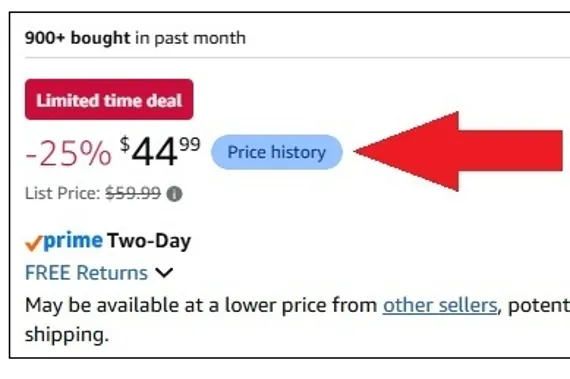
Online shopping price listing showing a limited time deal, price history button, and discount details

This may be the easiest Black Friday trick most shoppers aren't using.

Before buying something on Amazon, paste the product URL into CamelCamelCamel. The free Amazon price tracker shows a chart of the item's price history, making it much easier to see whether today's sale price is actually low compared with what it has sold for previously.

Keepa is another tool that can show price history on supported products and retailers, and its Droplist feature can watch an item for you and alert you when the price falls.

You can also find the Price History button right on the product page on Amazon (see screenshot above). Just click it and youll get the item's price history from the last month, three months, and one year.

This information can completely change how a deal looks.

Imagine a television is advertised on Black Friday like this:

  • Regular price - $699

  • BLACK FRIDAY DEAL: $499 SAVE $200

Sounds fantastic. But pull up the price history and you might discover that television sold for $479 three weeks earlier.

Suddenly that $200 savings doesn't look nearly as impressive.

Pro tip: Watch out for Black Friday-only model numbers. Some retailers sell special versions of TVs, laptops, and appliances during holiday sales. They might look nearly identical to regular models but have fewer features or sub-standard specs. Before buying, always compare the actual specs. not just the brand and screen size.

Your Amazon cart doesn't lock in the price

There's another reason to check the price history immediately before buying: Just because you add something to your Amazon cart doesn't mean you lock in its price. If the price changes before final checkout, you'll have to pay that price.

Amazon may alert you to a price change in your cart, but during a huge sale, it's easy to focus on a Prime Deal or Black Friday Deal badge rather than remembering exactly what the product cost when you first added it.

That's why simply loading your Black Friday wish list into your Amazon cart isn't enough.

Pro tip: When Black Friday finally arrives, don't go directly from your cart to checkout. Run your expensive purchases through a price tracker first. It takes less than a minute and helps you determine immediately whether you're actually getting a good deal or not.

The number that matters isn't '40% off'

There will be plenty of legitimate bargains on Black Friday and Cyber Monday.

But Prime Day offers a useful reminder that prices move constantly and a giant percentage-off badge doesn't tell you what an item was actually selling for last week.

Fortunately, you don't have to remember! You just need to remember to check a price tracker before you checkout.

Because the most important number on Black Friday isn't 40% off. It's what the product actually cost before the sale started.

Three more shopping tips worth remembering

When it comes to Black Friday shopping on Amazon, here are a few more things to keep in mind.

  1. Check the price before Black Friday week. If there's an expensive item you know you want, take a screenshot of its price now, including the date. When Black Friday arrives, you'll have your own reference point instead of relying entirely on Amazon's advertised savings.

  2. Don't let a coupon fool you. Some Amazon discounts require you to check a coupon box on the product page before adding the item to your cart. Others only apply when you use a specific promo code. Make sure the discount actually appears in your order total before clicking Buy.

  3. Check for a better deal in another color. Amazon is notorious for pricing different colors or styles of the exact same item differently. So, before buying headphones, kitchen appliances, water bottles, luggage, shoes, or clothing, click through the available colors and styles. You might find the identical item for significantly less simply by choosing a different color.


Amazon Prime Day gave us a preview of Black Friday — and a warning shoppers need to hear

Photo By CNET

Read More ...


Consumer News: The 5 worst Halloween candies for kids' teeth — and what dentists say to do instead
Thu, 15 Oct 2026 19:07:09 +0000

Fun Dip and lollipops top the list of Halloween candies hardest on teeth, but parents don't need to ban the treats

By Kyle James of ConsumerAffairs
October 15, 2026
  • Fun Dip takes the top spot: A new analysis of 30 popular Halloween candies ranks the sugary, sour powder as the toughest on teeth.

  • It's not just about sugar: Acidity, stickiness, and how long candy stays in the mouth can also increase the risk of dental problems.

  • Don't toss the trick-or-treat bag: A few simple habits, including eating candy after meals and rinsing with water, can help reduce the damage.


Halloween is almost here, which means kids everywhere are preparing for the most important annual event in candy acquisition. And parents are preparing to negotiate how much of that candy actually gets eaten.

But before you start confiscating the Reese's and Snickers, you might want to know which treats are actually the toughest on your kids' teeth.

A new October 2026 analysis from Direct Dental, a private dental clinic, examined 30 popular Halloween candies, looking at sugar content, acidity, and how long each treat typically stays in the mouth.

The results suggest some of the biggest dental troublemakers aren't necessarily the candies with the most sugar. Instead, it's often the ones that are extra sour, super sticky, or take forever to finish and thus spend the most time in your kids mouth.

Here are the 5 Halloween candies that are toughest on your teeth.

1. Fun Dip

Remember dipping that little candy stick into flavored sugar powder? Turns out, it's not exactly a dentist's dream.

Direct Dental ranked Fun Dip the worst of the 30 candies it examined, citing its high acidity and approximately 11 to 12 grams of sugar per pack.

That's roughly three teaspoons of sugar in one small treat.

2. Lollipops

The problem with the classic lollipop isn't just what's in them. It's how long kids keep the dang things in their mouths.

Some can take 15 to 30 minutes to finish, meaning teeth are exposed to sugar for an extended period of time.

And that lollipop you hand your child to buy yourself a few minutes of peace? The longer they suck on it, the longer their teeth are exposed to sugar.

3. Laffy Taffy

Sticky candy creates a different problem. Laffy Taffy can cling to teeth and get lodged in the grooves where bacteria thrive.

The analysis estimates roughly 10 grams of sugar in a piece, although amounts vary by size.

4. Caramel Apple Pops

Caramel Apple Pops combine two things dentists generally aren't crazy about: hard candy and sticky caramel.

They're slow to eat, and the caramel coating can linger on teeth.

5. Warheads

Warheads may contain less sugar per piece than some other popular treats, but their extreme sourness is the biggest concern.

The acids that are responsible for that mouth-puckering sensation can temporarily soften tooth enamel. So when kids get that exposure frequently, it can start to create some problems.

Rounding out the top 10 worst candies include some favorites like Pixy Stix, Fruit chews, Starbursts, Fruit roll-ups, and Dum Dums. Not surprisingly, these all have many of the same traits as the top five listed above.

How to let kids enjoy Halloween without the dental drama

The good news is that you don't need to be the parent who throws away your kid's entire trick-or-treat haul.

A few small changes can make a significant difference.

  • Let kids eat candy after a meal. Saliva production increases during meals, helping wash away food particles and neutralize acids. It's generally better than letting kids snack on candy continuously throughout the day.

  • Offer water afterward. A quick drink or rinse with plain water can help clear away some sugar and acids. It's especially useful after sour or sticky candy.

  • Choose chocolate over sticky or sour candy. Plain chocolate generally washes away more easily than caramel, taffy, or gummies. That doesn't make it healthy, but it can be a more tooth-friendly choice.

  • Don't rush to brush after sour candy. Acidic foods can temporarily soften enamel. The American Dental Association recommends waiting about an hour after consuming acidic foods before brushing. Keep up regular twice-daily brushing with fluoride toothpaste.

The bottom line

Simon Hubbard, director of Direct Dental, says one of the biggest mistakes parents can make is letting Halloween candy turn into weeks of constant snacking.

Every additional piece means another exposure to sugar or acid. His advice? Enjoy the treats in one sitting rather than grazing all afternoon, then rinse with water.

And perhaps most importantly: remember that Halloween is supposed to be fun.

You don't have to cancel candy. Just be a little smarter about when and how your kids eat it.

Read More ...


Consumer News: What a 194-year-old tortoise could teach us about healthy aging
Thu, 15 Oct 2026 16:07:07 +0000

Scientists studied Jonathans genes for clues to longevity and a longer, healthier life

By Kristen Dalli of ConsumerAffairs
October 15, 2026
  • Researchers studying Jonathan, a giant tortoise believed to be about 194 years old, uncovered a potential clue to his remarkable longevity.

  • The study found that genes involved in cellular energy production showed unusually low levels of a type of genetic disorder associated with aging.

  • The findings could help scientists explore ways to protect human health as we age, but more research is needed before they can be applied to people.


What if understanding how some animals live for nearly two centuries could help scientists figure out how humans might stay healthier as they grow older?

Thats one question researchers are exploring through Jonathan, a giant tortoise widely considered the worlds oldest living land animal.

Jonathan is believed to have hatched around 1832 and has lived on the island of St. Helena since 1882. Despite his extraordinary age, researchers found evidence that some of the genetic processes involved in keeping his cells functioning have remained remarkably well organized.

The study, led by researchers working with Vanderbilt Health, focused on a biological process called entropy. In simple terms, entropy describes how systems become more disordered over time. In the body, this kind of disorder can interfere with normal cellular functions and contribute to aging.

The researchers hope their findings will help scientists better understand how certain biological mechanisms might preserve health later in life.

How researchers studied Jonathans genes

The team began investigating Jonathan in 2017, when lead researcher Stephen (Wes) Clark sought permission to collect a blood sample. Because of concerns about the tortoises health, that request was denied. Instead, a veterinarian collected a small tissue sample from inside Jonathans cheek.

Scientists then analyzed his genome, which contains his DNA, and his epigenome, which includes chemical markers that influence how genes are switched on and off without changing the underlying DNA sequence.

The researchers paid particular attention to DNA methylation, a process involving chemical groups that help regulate gene activity. They examined the patterns of these markers to assess how much disorder had developed in different areas of the genome.

Their analysis revealed that gene-regulating regions associated with mitochondrial function and RNA processing had what scientists call low methylation entropy. Mitochondria are structures inside cells that help produce the energy needed for the body to function.

What the findings could mean for human health

The results suggest that Jonathan may have retained more orderly regulation of genes involved in cellular energy production than scientists might expect in an animal of his age. That organization could help preserve the efficiency of important cellular processes and potentially protect against some age-related decline.

For consumers, however, the findings are an early scientific clue, not a new anti-aging treatment. The study does not establish that people can reproduce Jonathans biology or that any particular supplement, medication, or lifestyle change will extend human life.

The researchers also emphasized the need for additional studies to validate their findings. Future work could include analyzing blood samples, which may provide a more complete picture of DNA, and investigating other long-lived species and biological pathways involved in aging.

Ultimately, Jonathans unusual biology could give scientists a new direction for studying healthspan the period of life spent in good health. Understanding why some organisms maintain cellular function for so long may eventually help researchers identify ways to support healthier aging in humans.

Read More ...


Consumer News: E-bikes linked to more serious injuries in kids than scooters
Thu, 15 Oct 2026 16:07:07 +0000

New research highlights the risks of e-bike crashes for children and teens

By Kristen Dalli of ConsumerAffairs
October 15, 2026
  • Children injured on e-bikes were nearly three times more likely to need surgery or hospitalization than those hurt on e-scooters.

  • Researchers found that pediatric injuries involving both types of devices nearly quadrupled between 2019 and 2025.

  • Speed, acceleration, and the weight of e-bikes may help explain why crashes involving these devices tend to cause more severe injuries.


Electric bikes and scooters have become increasingly common among young riders, but new research suggests the two devices may carry different risks when accidents happen.

A study from Childrens Hospital Los Angeles (CHLA) found that children injured while riding e-bikes were more likely to experience serious injuries than those involved in e-scooter accidents. The findings highlight the importance of understanding the potential dangers associated with each type of device, particularly as more young people use them.

As these devices have become more common, we are seeing more injuries, researcher Bianca Edison, MD, MS, FAAP, FAMSSM, said in a news release. We wanted to better understand what those injuries looked like and put data behind what we were seeing.

How researchers studied e-bike and scooter injuries

To examine the differences, researchers analyzed 379 injuries involving children treated at CHLA between 2019 and 2025. The team compared injuries associated with electric bikes with those involving electric scooters to understand how often riders experienced serious outcomes.

The researchers also examined changes in injury cases over time and considered whether young riders were following Californias age and helmet laws.

The total number of injuries involving both types of devices climbed from 33 cases in 2019 to 124 in 2025, nearly quadrupling over the six-year period. Although e-scooters accounted for more than three-quarters of all injuries in the study, e-bike injuries represented an increasing share of cases.

The study was designed to compare injury patterns, not establish exactly why e-bike crashes tend to result in more severe injuries.

What the findings mean for families

The differences in outcomes were notable. Nearly half of the children injured on e-bikes sustained fractures, compared with 36% of those injured on e-scooters. More than one in four e-bike riders required surgery or hospitalization, compared with one in 10 e-scooter riders.

Potentially life-threatening injuries were also more common among e-bike riders, affecting nearly 9% of that group, compared with 2.8% of e-scooter riders.

Researchers suggested that speed could be one explanation. E-bikes can travel faster and accelerate more quickly than e-scooters. They are also heavier than traditional bicycles, and riders may travel longer distances on them, increasing their exposure to traffic and other hazards.

More than half of the injured riders in both groups were violating California age or helmet laws. However, following those laws alone was not associated with less-severe injuries in this study.

For families, the findings underscore the importance of considering the specific risks of each device rather than treating e-bikes and e-scooters as interchangeable.

Preventing these injuries will require safety strategies that account for the different risks associated with each type of device, rather than a one-size-fits-all approach, Dr. Edison explains. Our hope is that these findings can lead to more proactive ways to keep young people and our communities safe.

Read More ...


Consumer News: What would a cut in Social Security benefits in 2032 look like?
Thu, 15 Oct 2026 16:07:07 +0000

Fidelity outlines three possible scenarios

By Mark Huffman of ConsumerAffairs
October 15, 2026
  • A new Fidelity Investments analysis warns that Social Security's retirement trust fund could face a shortfall in 2032, potentially reducing benefits by 22% unless Congress acts.

  • Lawmakers are considering three broad approaches to strengthen the program: changing benefits, raising payroll taxes, and bringing more workers into the system.

  • Fidelity says future retirees should prepare for possible changes by increasing savings, considering when to claim benefits, and developing other sources of retirement income.


In the same month that the government announced a 3.6% increase in Social Security benefits in 2027, Fidelity Investments is imagining what 2032 would look like, assuming the trust fund runs out of money.

A new analysis by Fidelity Investments tries to predict how the looming shortfall would affect millions of retirees, just six years from now.

Without congressional action, continuing payroll tax revenue would cover only about 78% of scheduled retirement and survivor benefits. That could mean a 22% reduction in payments, costing an average married couple approximately $10,560 a year, according to Fidelity's estimates.

The problem stems largely from demographics. Americans are living longer, while declining birth rates mean fewer workers are contributing payroll taxes to support a growing population of retirees.

Social Security isn't expected to disappear. Even if its trust fund reserves are depleted, payroll taxes would continue providing money for benefits. However, those revenues would not be sufficient to pay everyone the full amount promised under current law.

Three ways Congress could address the problem

Fidelity identifies three broad approaches lawmakers are considering to strengthen Social Security's finances. Each would affect workers and retirees differently.

1. Change who receives benefits and when

One option would be to gradually increase the full retirement age, currently 67 for people born in 1960 or later.

Some proposals would eventually raise that age to 70 for higher-income workers. Others would change how benefits are calculated, potentially reducing payments for some retirees while increasing them for others.

There are also proposals to change benefits for spouses, survivors, and dependent children.

Such changes could have significant consequences for people approaching retirement, particularly those who have planned their finances around receiving benefits at a specific age.

2. Raise Social Security payroll taxes

Another approach would require higher-income Americans to contribute more to the system.

Currently, workers pay a 6.2% Social Security payroll tax, matched by their employers. In 2026, the tax applies only to the first $184,500 in annual earnings.

Some proposals would eliminate that earnings ceiling, requiring high earners to pay Social Security taxes on all their wages.

Others would preserve the existing ceiling but resume collecting the tax on earnings above $250,000.

Another possibility would increase the combined employer-employee payroll tax rate from 12.4% to 12.6%.

These proposals could generate additional revenue without directly reducing benefits, although they would increase taxes for affected workers and employers.

3. Bring more workers into Social Security

Fidelity notes that approximately 6.3 million state and local government employees do not participate in Social Security, generally because they are covered by separate public retirement systems.

One proposal would require newly-hired state and local government employees to join Social Security, expanding the number of workers paying into the program.

However, the financial impact might be relatively modest. Fidelity cites Congressional Research Service estimates suggesting that including these workers would close only about 4% of Social Security's long-term funding shortfall.

Other proposals would expand participation by increasing the number of legally employed foreign workers contributing payroll taxes or changing certain exemptions.

What a benefit cut could mean for retirement savings

Fidelity also examined what would happen if Congress failed to act and retirees were forced to make up the difference by withdrawing more money from their savings.

The firm considered a hypothetical retired couple with a $500,000 investment portfolio and Social Security benefits reduced by $10,560 annually.

To maintain their standard of living, the couple would initially need to withdraw an additional 2.1% of their portfolio each year.

Assuming annual investment returns of 7% and inflation of 2.5%, Fidelity calculated that the couple would withdraw approximately $118,000 over 10 years just to replace their lost Social Security income.

Including the investment gains they would have missed by withdrawing that money, the total impact on their portfolio could reach approximately $161,000 over the decade.

That example is illustrative rather than a prediction. Actual results would depend on market performance, inflation, and individual spending needs.

What future retirees can do now

While Congress debates possible solutions, Fidelity recommends several steps Americans can take to reduce their exposure to a potential benefit reduction.

One is to consider delaying Social Security benefits. Under current law, waiting until age 70 instead of claiming at full retirement age can increase monthly benefits by approximately 24% for someone whose full retirement age is 67. Claiming as early as age 62 can reduce monthly payments by as much as 30%.

Delaying benefits isn't necessarily the best choice for everyone, however. Health, life expectancy, employment, and other income sources should factor into the decision.

Fidelity also encourages workers to take advantage of retirement savings opportunities, including catch-up contributions available to people age 50 and older.

In 2026, workers can contribute up to $24,500 to many employer-sponsored retirement plans, with additional catch-up contributions available for older workers.

Another option is to create additional predictable retirement income through pensions or income annuities. Annuities can provide regular payments, although they also involve costs, restrictions, and trade-offs that consumers should understand before purchasing one.

Will Congress act before 2032?

Fidelity points out that Congress has confronted Social Security funding problems before. The most significant overhaul occurred in 1983, when lawmakers approved changes that included gradually increasing the full retirement age from 65 to 67.

Historically, major changes have been phased in over many years, often protecting people already receiving benefits.

That precedent offers some reassurance, but there is no guarantee lawmakers will follow the same approach this time.

The central message from Fidelity is that Americans shouldn't assume their future Social Security benefits will necessarily match today's projections.

For people approaching retirement, planning for several possible outcomes including smaller benefits may be the best protection against an uncertain future.


What would a cut in Social Security benefits in 2032 look like?

Photo By CNET

Read More ...


Related Bing News Results
Consumer Reports wants FDA official to explain the agency's response to the Cyclospora outbreak
Wed, 14 Oct 2026 17:05:00 GMT
Consumer Reports has asked the FDA’s deputy commissioner to respond to its concerns about the agency’s response to this summer's Cyclospora outbreak linked to Taylor Farms lettuce from Mexico. In the ...
Consumer Reports Tested 7 Cottage Cheese Brands — These 2 Came Out on Top
Thu, 08 Oct 2026 05:01:00 GMT
Consumer Reports taste-tested seven cottage cheese brands, comparing their nutritional profiles, flavor, and texture. Two brands came out on top, while two others stood out for specific uses like ...
Consumer Reports investigation: Testing shows most prenatal vitamins are inaccurately labeled
Fri, 09 Oct 2026 10:41:00 GMT
Prenatal vitamins are often one of the first things people start taking when they find out they’re pregnant. They can help provide important nutrients needed during pregnancy and support a baby’s ...
Premium gas vs. regular: Consumer Reports just settled it
Thu, 08 Oct 2026 08:16:31 GMT
You've been standing at the pump, finger hovering over the 91 button, half-convinced your engine deserves the good stuff.
Consumer Reports Labels, Explained: Recommended, Top Pick, Best Brand, Best of, Smart Buy, and #1 in Brand Reliability
Tue, 10 Feb 2026 03:30:00 GMT
Consumer Reports (CR) uses several designations to help shoppers quickly identify products and services that perform well in our independent evaluations. When data is available, these designations ...

Blow Us A Whistle


RobinsPost Print On Demand Refund Policy With Printify
Printify

Related Product Search/Búsqueda de productos relacionados

Amazon Logo