Cooking tools, kids' accessories, and some food items are part of this week's recall roundup
October 16, 2026
Recall Roundup: New CPSC and FDA alerts
This roundup covers newly announced recalls and safety warnings from the Consumer Product Safety Commission and the Food and Drug Administration.
Primark recalls childrens coin purses
The recalled 101 Dalmatians faux leather coin purses contain phthalate levels above federal limits and should be returned for a refund.
- The coin purses contain higher phthalate concentrations, creating a chemical exposure risk for young children, including through ingestion.
- About 2,100 units were sold at Primark stores in the Northeast and in Florida, Maryland and Illinois from March 2026 through June 2026 for about $9.
- Consumers should stop using the coin purses immediately, keep them away from children and return them to a Primark store for a full refund.
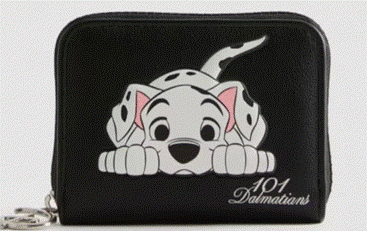
Primark US Corp., of Boston, is recalling its Primark 101 Dalmatians Faux Leather Coin Purse, Model No. 2595301. The black purse has a picture of a dalmatian and 101 Dalmatians printed on the front, with the model number on a tag attached to the zip puller. The company says the product contains phthalate levels that exceed allowable limits.
The hazard
According to the CPSC, the coin purses contain elevated concentrations of phthalates. Those chemicals can be harmful if young children are exposed to sufficient amounts, including through ingestion, and certain phthalates have been linked to developmental effects and impacts on the hormone system. No incidents or injuries had been reported at the time of the recall.
What to do
Consumers should stop using the recalled coin purses right away and keep them out of childrens reach. Primark says shoppers should return the item to a Primark store to receive a full refund in the original form of payment.
Company contact
Primark can be reached at 617-946-3236 from 8 a.m. to 5 p.m. ET Monday through Friday, or online at www.primark.com/recall or www.primark.com by clicking Recalls at the bottom of the page.
Source
Kalorik air fryer ovens burn users
CPSC is warning consumers to stop using Kalorik MAXX air fryer ovens with French doors because the doors can suddenly close on users arms while the oven is on.
- The spring-loaded French doors can suddenly shut on a consumers arms, creating a risk of serious burns.
- The warning covers Kalorik MAXX and MAXX Advance ovens sold nationwide and online from April 2020 to Jan. 8, 2024, with additional sales after June 23, 2025.
- Consumers should stop using the ovens immediately and dispose of them according to local hazardous waste procedures.
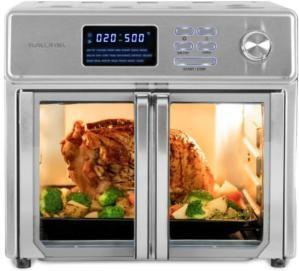
The CPSC issued a safety warning for Kalorik MAXX Air Fryer Ovens with French Doors, including MAXX and MAXX Advance models. The countertop ovens have a metal frame and spring-loaded bilateral glass doors with metal handles. Federal regulators say those doors can suddenly close on a users arms while the oven is operating.
The hazard
CPSC said its investigation found that the French doors can slam shut unexpectedly, exposing consumers to serious burn injuries while reaching into or working around a hot oven. The warning applies to products sold by Team International Group of America Inc. and Kalorik LLC from April 2020 to Jan. 8, 2024, and by The Legacy Companies LLC after June 23, 2025. The agencys notice did not list a recall remedy.
What to do
Consumers should stop using these ovens immediately. CPSC urges owners to dispose of the defective products following local hazardous waste disposal procedures rather than resell or continue using them.
Company contact
The warning directs consumers to report incidents involving Kalorik MAXX Air Fryer Ovens, or any product-related injury, to CPSC at SaferProducts.gov.
Source
Power Quick Pots pose burn risk
CPSC is warning consumers to stop using certain 6-quart Power Quick Pot pressure cookers because the lid can open while the cooker is still pressurized.
- The pressure cookers lid can open while the unit is pressurized, allowing hot contents to erupt and cause serious burns.
- The warning covers 6-quart Power Quick Pot electric pressure cookers, model Y6D-36, sold nationwide online from about July 2018 to November 2023 for $44 to $160.
- Consumers should stop using the cooker immediately, dispose of it and not sell or give away the product.
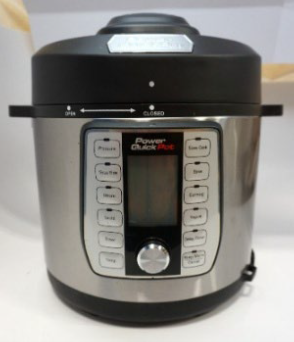
The CPSC is warning consumers to immediately stop using Tristar Products 6-Quart Power Quick Pot electric pressure cookers, model Y6D-36. The stainless-steel cookers have a black pressure lid, button controls, and a digital temperature and function display. Regulators say the lid can be opened while the contents remain under pressure.
The hazard
When a pressure cooker opens before internal pressure has safely dissipated, hot food and liquid can be expelled unexpectedly. CPSC said that failure creates a risk of serious burn injuries. The units were sold on Walmart.com, Amazon.com, Ebay.com and through other retailers nationwide over several years.
What to do
Consumers should stop using the recalled pressure cookers right away and dispose of them. CPSC also warns owners not to sell, donate or give away the hazardous product, which could put another household at risk.
Company contact
CPSC asks consumers to report any incidents involving injury or product defects at www.SaferProducts.gov.
Source
Argatroban injection recalled over particles
Par Health is recalling certain lots of Argatroban Injection after finding particulate matter that could trigger life-threatening complications if administered.
- The injectable drug may contain cellulose, polystyrene, polyethylene terephthalate, stopper material and possibly stainless steel particles.
- Affected lots were distributed nationwide to wholesalers and hospitals between Dec. 30, 2024, and May 5, 2026.
- Wholesale distributors and hospital pharmacies should stop using and distributing affected lots immediately and arrange returns through Inmar.
Par Health has announced a voluntary nationwide recall of Argatroban Injection 250 mg/2.5 mL (100 mg/mL). The affected product was distributed at the hospital and user level, with impacted lots sent nationwide to wholesalers and hospitals. The company said the recall was triggered by the presence of particulate matter in some vials.
The hazard
According to the FDA notice, the particles identified include cellulose, polystyrene, polyethylene terephthalate, stopper material and possibly stainless steel. If administered, contaminated injections have a reasonable probability of causing life-threatening adverse health consequences, including pulmonary emboli, blockages of other blood vessels that can lead to tissue death and organ damage, and inflammation of vein walls that may lead to clotting.
What to do
Par Health said wholesale distributors and hospital pharmacies with the affected lots should immediately discontinue use and stop distribution. The company is notifying accounts in writing and arranging for the return of remaining inventory through Inmar Inc.
Company contact
Consumers can contact Inmar Inc. at 1-855-648-7909. Media inquiries should be directed to Gena Holthaus, senior director of corporate brand and communications, at media.relations@parhealth.com.
Source
Pan Pepin recalls Para Bien Al Grano
Pan Pepin Inc. is recalling Para Bien Al Grano products distributed in Puerto Rico because sesame was not declared on the label.
- The product may contain undeclared sesame, posing a serious or potentially life-threatening allergy risk.
- The affected packages were distributed throughout Puerto Rico and include UPC 0 21425 01513 4 with specified sell-by and lot codes.
- Consumers with a sesame allergy or sensitivity should not consume the product and should return it for a full refund or dispose of it if returning it is not possible.
Pan Pepin Inc. has issued an allergy alert for Para Bien Al Grano due to undeclared sesame. The recalled product was distributed throughout Puerto Rico and is identified by UPC 0 21425 01513 4 and multiple affected sell-by and lot codes. People with a sesame allergy or severe sensitivity face the greatest risk.
The hazard
Sesame is a major allergen, and consuming a product that does not disclose it on the label can trigger a serious or life-threatening allergic reaction. The FDA notice lists the affected lots as Sell By Oct / 12 3B1 274, Oct / 14 3B1 277, Oct / 15 3B1 278, Oct / 17 3B1 280, Oct / 18 3B1 281, Oct / 19 3B1 282, and Oct / 21 3B1 284.
What to do
Consumers who have a sesame allergy or sensitivity should not eat the product. Pan Pepin says shoppers should return the recalled item to the place of purchase for a full refund, or discard it if a return is not possible.
Company contact
Pan Pepin Inc. can be reached at 787-403-7363 or by email at luis.santini@panpepin.com.
Source
Oliva dips recalled for sesame
Oliva LLC is recalling select Baba Ghanouj and hummus products sold in parts of Connecticut and Massachusetts because sesame was not declared.
- The dips may contain undeclared sesame, which can cause serious or life-threatening allergic reactions.
- The recall covers Riads Oliva to Go Baba Ghanouj, Spicy Baba Ghanouj, and Hummus with listed best-by dates sold in Litchfield County, Connecticut, and Great Barrington, Massachusetts.
- Consumers should return the products to the place of purchase for a full refund or replacement.
Oliva LLC has issued an allergy alert covering Riads Oliva to Go Baba Ghanouj, Spicy Baba Ghanouj, and Hummus. The recalled products were distributed to gourmet shops and farm markets in Litchfield County, Conn., and the Great Barrington, Mass., area. The company said the products contain undeclared sesame allergen.
The hazard
For people with a sesame allergy or severe sensitivity, eating these products could trigger a serious or life-threatening allergic reaction. The affected items carry best-by dates including 10/10/26 through 10/14/26, 10/10-26 through 10/14/26, and 10/12/26 through 10/18/26, according to the FDA notice.
What to do
Consumers who purchased the recalled dips should not consume them if they have a sesame allergy or sensitivity. Oliva says the products should be returned to the place of purchase for a full refund or a replacement.
Company contact
For more information, consumers can call 203-266-5558.
Source
Photo By CNET











