

Rockin Robin SongFlying The Web For News.
RobinPost Logo Amazon Prime Deals


Consumer Daily Reports

Coffee and cereal lead the increase

By Mark Huffman Consumer News: Grocery prices climb nearly 6% year over year in January of ConsumerAffairs
February 10, 2026
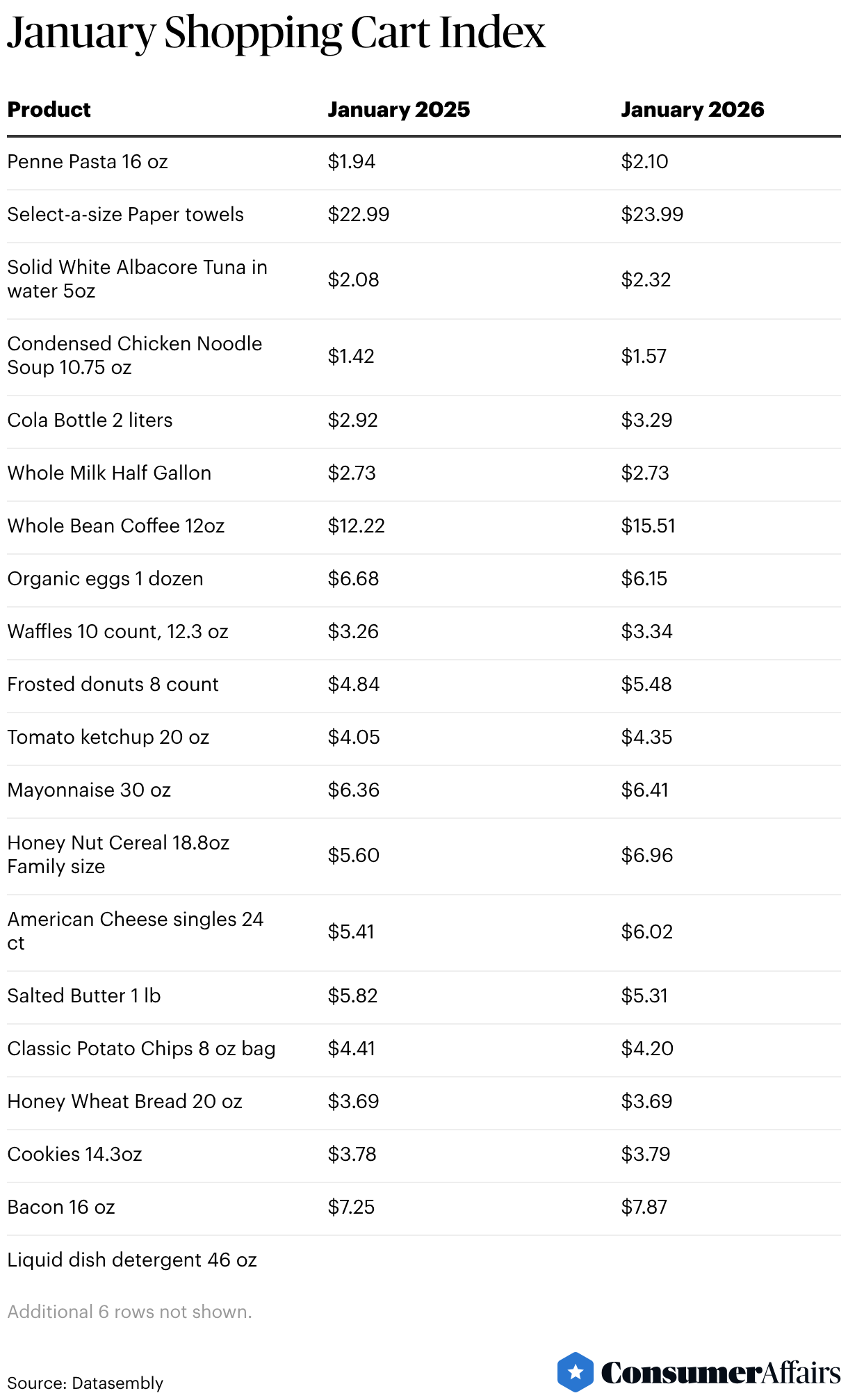
  • The ConsumerAffairs Datasembly Shopping Cart Index rose 5.9% year over year in January, increasing from $147.71 in January 2025 to $156.43 in January 2026 an $8.72 jump for the same basket of everyday items.

  • Coffee, cereal, and paper products drove much of the increase, while a handful of staples including eggs, butter, and bottled water offered modest relief.

  • Food inflation remains uneven, with sharp increases in packaged and branded goods offset by flat or declining prices in select dairy and pantry items.


The cost of a typical grocery run continued to rise in January, according to the ConsumerAffairs Datasembly Shopping Cart Index, underscoring how inflation is still shaping household budgets in uneven ways.

The index, which tracks prices for a standardized basket of 24 common grocery and household items, increased from $147.71 in January 2025 to $156.43 in January 2026, a 5.9% year-over-year increase. While that gain is smaller than the double-digit spikes consumers saw earlier in the inflation cycle, it signals that price pressures have not fully eased.

Coffee and cereal lead price gains

Some of the biggest increases came from pantry and breakfast staples. Whole bean coffee jumped 26.9%, rising from $12.22 to $15.51 the largest dollar and percentage increase in the index. Coffee prices have been pressured by weather-related supply issues and higher transportation costs.

Cereal also stood out. Honey Nut Cereal (family size) climbed 24.3%, rising from $5.60 to $6.96, while American cheese singles rose 11.3%, reaching $6.02. Branded packaged foods have been especially sensitive to higher input and marketing costs, according to retail pricing data.
Consumer News: Grocery prices climb nearly 6% year over year in January

Household essentials keep creeping up

Non-food essentials continued their slow upward march. Paper towels rose 4.3%, increasing by a dollar to $23.99, and toilet paper climbed 6.6%, reaching $12.48 for a 12-count pack. These products tend to move gradually, but their higher price points amplify the impact on monthly budgets.

Laundry detergent also edged higher, rising from $13.05 to $13.33. (Liquid dish detergent was included in the basket, but January 2026 pricing was unavailable and not factored into the year-over-year comparison.)

Some relief at the dairy case

Not every aisle saw increases. Organic eggs fell 7.9%, dropping from $6.68 to $6.15, a notable reversal after years of volatility. Salted butter declined 8.8%, and bottled spring water slipped 3.5%.

Other staples, including milk and bread, were flat year over year a welcome sign for shoppers who rely on these basics.

Inflation isnt gone its just selective

Overall, the January data suggests inflation has become more selective rather than universal. Prices for indulgences and branded packaged foods are climbing faster than staples, while some commodities are stabilizing or retreating.

For consumers, that means grocery bills may feel unpredictable not because everything is getting more expensive, but because the items people notice most often are.

As 2026 unfolds, the Datasembly Shopping Cart Index will continue to track whether these price pressures broaden again or remain concentrated in specific categories.


Posted: 2026-02-10 18:54:01

Get Full News Story On Consumer Affairs


Listen to this article. Speaker link opens in a new window.
Text To Speech BETA Test Version.


More News From This Category
Consumer News: 'Dr. AI' may not be the most reliable source of medical advice, study finds
Tue, 10 Feb 2026 20:07:06 +0000

Oxford researchers find subtle errors and oversimplification in the advice

By Mark Huffman of ConsumerAffairs
February 10, 2026
  • Researchers at Oxford University warn that popular AI chatbots can deliver medical advice that sounds confident but may be incomplete, misleading, or unsafe.

  • The study found that even when AI systems cite credible sources, they can misinterpret guidelines or fail to account for patient-specific factors.

  • Experts say the findings highlight the growing need for regulation, transparency, and human oversight as AI tools become more common in health care.


A new study from the University of Oxford is raising new concerns about the reliability of medical advice generated by artificial intelligence, warning that widely used AI platforms may inadvertently put users at risk.

The research, conducted by a multidisciplinary team of clinicians and computer scientists, examined how large language models respond to common health-related questions. According to the study, AI systems frequently produced answers that appeared authoritative and well-structured, yet contained subtle errors, oversimplifications, or advice that conflicted with established medical guidance.

One of the most troubling findings was the tendency of AI platforms to generalize. Researchers found that chatbots often failed to distinguish between symptoms that require urgent medical attention and those that can be managed at home.

In some cases, the systems offered reassurance where caution was warranted, while in others they suggested unnecessary alarm.

How useful is the advice?

Dr Adam Mahdi, senior author on the study, said that while AI is able to give medical information, people "struggle to get useful advice from it."

"People share information gradually,"he told the BBC. "They leave things out, they don't mention everything. So, in our study, when the AI listed three possible conditions, people were left to guess which of those can fit.

The study also highlighted issues with sourcing. While AI-generated responses sometimes referenced reputable organizations or clinical guidelines, the models did not always apply those sources correctly. Advice could be outdated, taken out of context, or mismatched to the users situationparticularly for people with chronic conditions, multiple medications, or atypical symptoms.

Problematic design

The researchers stressed that the problem is not malicious intent, but design. Most AI platforms are not built to practice medicine, yet they are increasingly used that way as consumers turn to chatbots for quick answers about symptoms, medications, and treatments.

Oxfords team is calling for clearer warnings to users, improved training data, and stronger collaboration between AI developers and medical professionals. The team also emphasized that AI tools should supplement, not replace, qualified health care providers.


Read More ...


Consumer News: Gas prices tick higher but remain well below last year
Tue, 10 Feb 2026 20:07:06 +0000

Seasonal trends are taking hold on the West Coast

By Mark Huffman of ConsumerAffairs
February 10, 2026
  • The nations average price of gasoline has risen 1.2 cents over the last week and stands at $2.84 per gallon, according to GasBuddy data compiled from more than 12 million individual price reports covering over 150,000 gas stations across the country.

  • The national average is up 5.4 cents from a month ago and is 24.9 cents per gallon lower than a year ago.

  • The national average price of diesel rose 2.9 cents in the last week and stands at $3.614 per gallon.


The national average price of gasoline edged slightly higher over the past week as seasonal forces, particularly on the West Coast, began to exert more influence on pump prices. While most states experienced only modest changes, California and neighboring states saw more pronounced increases as the region started its annual transition to more expensive summer gasoline blends.

Patrick De Haan, head of petroleum analysis at GasBuddy, said the broader trend points toward gradually rising prices as spring approaches.

Most states saw relatively minor fluctuations, but were now starting to see seasonal trends take hold on the West Coast, with those pressures expected to gradually push eastward in the weeks ahead, De Haan said in the GasBuddy Blog. He added that despite a slight dip in oil prices last week, strengthening seasonal demand could push the national average back above $3 per gallon for at least part of the spring.

Oil market impact

Oil markets, meanwhile, are showing signs of stabilization after weeks of volatility. Easing tensions between the U.S. and Iran have helped cap crude prices, even as they remain elevated compared with earlier months.

In early trading this week, West Texas Intermediate crude rose slightly to $63.58 per barrel, while Brent crude inched up to $68.07 per barrel. Ongoing diplomatic talks have kept prices largely confined to a narrow range between $62 and $65 per barrel.

Still, analysts caution that geopolitical risks remain a key wildcard. Giovanni Staunovo, commodities analyst at UBS, noted that markets are closely watching developments in the Middle East, as well as a series of oil market reports due this week from major energy agencies.

Those reports are expected to reflect lower U.S. oil output forecasts following recent weather-related disruptions.

Supply data from the Energy Information Administration underscore the mixed signals facing the market. U.S. crude oil inventories fell by 3.5 million barrels in the latest reporting week and remain below the seasonal average, while gasoline inventories rose and now sit above their five-year norm. Distillate supplies, which include diesel, dropped sharply and are running below average, helping explain the recent uptick in diesel prices. Refinery utilization also declined slightly, and implied gasoline demand fell by more than 600,000 barrels per day.

Price disparity

At the pump, price disparities remain wide across the country. The most common gasoline price motorists encountered last week was $2.59 per gallon, while the median price stood at $2.74. The gap between the cheapest and most expensive stations is stark, with the bottom 10% of stations averaging $2.26 per gallon and the top 10% averaging $4.14.

Oklahoma, Mississippi, and Arkansas currently boast the lowest statewide averages, while California, Hawaii, and Washington remain the most expensive. California also led the nation in weekly increases, rising 8.5 cents, while Michigan saw the largest decline, down 8.5 cents.

As spring approaches and summer driving season draws closer, analysts expect price pressures to build gradually, especially if seasonal demand strengthens and refinery or geopolitical disruptions emerge. For now, motorists are seeing relatively modest changes, but the calm may not last much longer.


Read More ...


Consumer News: Closing vents to ‘save heat’ can actually raise your energy bill
Tue, 10 Feb 2026 20:07:06 +0000

Heres what HVAC pros say to do instead

By Kyle James of ConsumerAffairs
February 10, 2026
  • When you close vents, pressure builds in the ducts, forcing your furnace to work harder and run longer.

  • That extra back pressure increases wear and tear on components, which can reduce efficiency and lead to expensive breakdowns over time.

  • Closed-off rooms can mess with airflow balance, causing the system to cycle more often just to keep the main living areas comfortable.


My wife and I are recent empty nesters, and when I got our heating bill in the mail, I started wondering if I could lower it by closing the vents in our kids old bedrooms and shutting the doors.

I mean it sounds smart, right? Shut the vents in rooms you dont use so your house stays warmer where you actually live.

So when I stumbled upon an article from The Spruce, where they interviewed a couple HVAC pros on this exact issue, I was intrigued.

Turns out this common winter trick can backfire and end up costing you more money and put extra strain on your system.

Why closing vents doesnt work in most homes

Modern HVAC systems are designed to push a set amount of air through your homes ductwork.

But the problem, according to the pros, is that when you start closing vents, the air has nowhere to go, which creates back pressure inside the system.

That pressure can:

  • Make your furnace work harder.
  • Increase wear and tear on components.
  • Lead to airflow imbalances that reduce overall efficiency.

So instead of saving energy, your system may end up running longer and be less efficient.

This ends up driving your heating costs up, not down.

The one exception: zoned systems

If your home has a true zoning system (separate thermostats and motorized dampers inside the ducts), then airflow is designed to be adjusted room by room.

But simply closing floor or wall vents by hand is not the same thing, and it doesnt give you the same energy-saving benefit.

If youre not sure whether your home has azoned system, it's smart to assume it doesnt until you verify.

Smarter ways to lower heating bills

The HVAC pros also gave some great tips for those with the goal of a warmer home with a smaller bill. Tips that wont risk doing damage to your system.

  • Use a programmable or smart thermostat: Lowering the temperature seven to 10 degrees for eight hours a day (like while sleeping or at work) can save around 8% a year on heating costs.
  • Seal drafts around windows and doors: Cold air leaks around doors and windows force your system to run longer. Weatherstripping and caulk are cheap fixes with really fast payback.
  • Upgrade insulation: Attics and crawl spaces are major heat-loss zones. Better insulation helps your home hold onto warm air.
  • Change your air filter regularly: A clogged filter restricts airflow, making your furnace work harder. Replace every one to threemonths (more often with pets).
  • Use a humidifier:Moist air feels warmer than dry air. That means you can stay comfortable at a slightly lower thermostat setting.

Read More ...


Consumer News: Dr. AI not the most reliable source of medical advice, study finds
Tue, 10 Feb 2026 14:07:06 +0000

Oxford researchers find subtle errors and oversimplification in the advice

By Mark Huffman of ConsumerAffairs
February 10, 2026
  • Researchers at Oxford University warn that popular AI chatbots can deliver medical advice that sounds confident but may be incomplete, misleading, or unsafe.

  • The study found that even when AI systems cite credible sources, they can misinterpret guidelines or fail to account for patient-specific factors.

  • Experts say the findings highlight the growing need for regulation, transparency, and human oversight as AI tools become more common in health care.


A new study from the University of Oxford is raising new concerns about the reliability of medical advice generated by artificial intelligence, warning that widely used AI platforms may inadvertently put users at risk.

The research, conducted by a multidisciplinary team of clinicians and computer scientists, examined how large language models respond to common health-related questions. According to the study, AI systems frequently produced answers that appeared authoritative and well-structured, yet contained subtle errors, oversimplifications, or advice that conflicted with established medical guidance.

One of the most troubling findings was the tendency of AI platforms to generalize. Researchers found that chatbots often failed to distinguish between symptoms that require urgent medical attention and those that can be managed at home.

In some cases, the systems offered reassurance where caution was warranted, while in others they suggested unnecessary alarm.

How useful is the advice?

Dr Adam Mahdi, senior author on the study, said that while AI is able to give medical information, people "struggle to get useful advice from it".

"People share information gradually", he told the BBC. "They leave things out, they don't mention everything. So, in our study, when the AI listed three possible conditions, people were left to guess which of those can fit.

The study also highlighted issues with sourcing. While AI-generated responses sometimes referenced reputable organizations or clinical guidelines, the models did not always apply those sources correctly. Advice could be outdated, taken out of context, or mismatched to the users situationparticularly for people with chronic conditions, multiple medications, or atypical symptoms.

Problematic design

The researchers stressed that the problem is not malicious intent, but design. Most AI platforms are not built to practice medicine, yet they are increasingly used that way as consumers turn to chatbots for quick answers about symptoms, medications, and treatments.

Oxfords team is calling for clearer warnings to users, improved training data, and stronger collaboration between AI developers and medical professionals. The team also emphasized that AI tools should supplement, not replace, qualified healthcare providers.


Read More ...


Related Bing News Results
Consumer Reports Investigates: What you need to know about toxic beauty ingredients
Tue, 10 Feb 2026 09:57:00 GMT
Consumer Reports reveals that some shampoos, deodorants, lotions or makeup may contain ingredients linked to cancer risk, hormone disruption, and other serious health problems.

Eat a protein-packed diet without powders | Consumer Reports
Mon, 09 Feb 2026 13:04:00 GMT
A Consumer Reports investigation found high levels of lead in some protein powders and shakes, raising questions about supplement safety.

7 cars Consumer Reports says are smart buys for 2026
Mon, 09 Feb 2026 12:45:34 GMT
You want a smart car purchase that balances fuel economy, safety, and long-term value — […] ...

Consumer Reports Tested 30 Store-Bought Soups — These Are the Most Nutritious
Sat, 07 Feb 2026 03:42:00 GMT
Consumer Reports tested 30 popular store-bought soups — chicken noodle, minestrone, and lentil varieties — to evaluate taste and nutrition. Lentil and minestrone soups, especially Trader Joe’s Lentil ...

Consumer Reports' top 10 vehicles for 2026 — see which cars made the list
Wed, 04 Feb 2026 14:40:11 GMT
For the first time, the top 10 cars on Consumer Reports' annual list of best new vehicles also include electric or hybrid models.


Blow Us A Whistle


Related Product Search/Búsqueda de productos relacionados

Amazon Logo

Visit Our New Print-On-Demand Stores On Printify and Zazzle
Printify Zazzle













