

Rockin Robin SongFlying The Web For News.
RobinPost Logo Amazon Prime Deals


Consumer Daily Reports

Stop browsing and start thrifting strategically

By Kyle James of ConsumerAffairs
February 19, 2026
  • Time it right. Shop MondayWednesday mornings when weekend donations hit the floor. Learn the color-tag discount cycle at stores like Goodwill and stack 50% tag days with senior, student.or military discounts.

  • Buy whats underpriced. Look for solid wood furniture, cast iron, vintage Pyrex, and quality small appliances. For resale, brands like Lululemon, Patagonia, and Levi Strauss & Co. consistently hold value.

  • Think bigger. Check the glass case, visit Goodwill Outlets (sold by the pound) and thrift in affluent neighborhoods or vacation towns for higher-end donations.


Thrift stores can feel fairly random and it often feels like all the good stuff disappeared before you walked in.

But the truth is they operate on very predictable patterns. Especially in terms of donation cycles, color-tag systems, and predictable discount days. If you understand the system, you stop browsing and you start shopping like a savvy insider.

Shop early in the week and early in the day

Weekends are prime donation time. People clean out garages, drop off bags after spring cleaning, and declutter before moving. But the best items dont usually hit the sales floor until a day or two after they get dropped off.

That makes Monday through Wednesday mornings prime hunting hours at the vast majority of thrift stores.

Shopping right when the store opens will give you first crack at all the newly processed items before theyre picked over.

Pro tip: Ask an employee when specific departments are restocked. Its been my experience that theyre always happy to give you the inside scoop. Use this info to your advantageif electronics are always re-stocked Tuesday afternoons, thats when you want to be there.

Learn the color-tag discount cycle

Most large thrift chains, including many Goodwill locations, use a rotating color-tag system.

One day each week, they pick a different colored price tag and offer all those items for an additional 50% off.

Be sure to ask at your local store what day of the week they do this, and try and shop on that day.

If you ignore the color rotation, youre leaving significant money on the table.

Heres how I play the color game at my Goodwill:

  • Identify which color is discounted this week.
  • Check items in that color across multiple departments.
  • Look for higher-end brands that slipped through the standard pricing.

Ive found that items regularly priced at $7-10 often slip through the cracks and have their price drop to $1-$2 during these color-coded events.

Know what employees consistently underprice

Considering the huge number of donated items that have to be sorted, it makes sense that employees dont have the time to research every item.

This creates a great buying opportunity for the savvy shopper.

In my experience, here are the most common underpriced categories:

  • Solid wood furniture (look for dovetail joints)
  • Cast iron cookware
  • Vintage Pyrex
  • High-end small kitchen appliances
  • Audio equipment and older speakers
  • Board games (especially sealed or complete sets)
  • Picture frames (buy for the frame, not the art)

Solid wood dressers, for example, are often priced the same as particle board pieces, but resell for significantly more.

And if youre not going to resell them, theyre much higher quality and will stand the test of time (and teenagers).

Pro tip:Besure to open boxes and check inside board games for completeness. Also, plug in small appliances and electronics if the store allows it. A 60-second inspection can mean the difference between a big score and a complete dud.

Clothing gold: Brands that hold value

If you do any reselling, you already know that not all clothing labels are created equal.

Some brands consistently resell quite well online, especially on platforms like eBay or Poshmark.

Here are a few brands that are an easy profit for resellers:

  • Arcteryx
  • Lululemon
  • Patagonia
  • Polo Ralph Lauren
  • The North Face
  • Free People
  • Levi's (especially vintage or Made in USA)
  • Vuori
  • Carhartt
  • Madewell
  • Abercerombie
  • Wrangler

Some unbranded clothing, such as vintage band tees and retro athletic wear, typically outperforms newer mall brands like American Eagle and Old Navy.

Also, be sure to scan the fabric tags, as 100% wool, cashmere, and linen often outperform synthetic blends.

Pro tip: Before buying for resale, check completed eBay listings on your phone. Sold prices tell you what people are actually paying, not the inflated price many sellers are hoping for.

Dont ignore the glass case

Those locked display cases near the register often hold the most overlooked profit potential.

In particular, look for these:

  • Jewelry
  • Video games
  • Designer handbags
  • Calculators
  • Small electronics

The prices may be higher than the on-the-rack items, but still well below their market value.

Some locations now also list premium finds on ShopGoodwill.com, where individual stores auction higher-value donations.

Pro tip: If something is priced too high in-store, check if your Goodwill runs periodic additional discounts on display-case items. Ive noticed my local store will do this once or twice per month.

Stack discounts on top of low prices
Photo

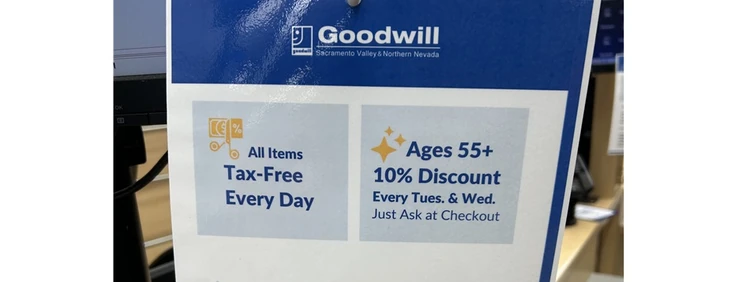
Many thrift shoppers never ask about additional discounts, which is a major mistake.

Depending on the location, you can often find these discounts (usually between 10%20% off):

  • Senior discount days
  • Military discounts
  • Student discounts
  • Teacher discounts
  • Text or email coupons
  • Loyalty rewards programs

Be sure to ask an employee, as some stores dont openly advertise these discounts.

Always ask, Do you have any discount days? Even a 10% discount compounds quickly if youre buying multiple items.

Visit the Goodwill Outlet (a.k.a. 'the bins')

If youre serious about savings or resale, you need to see if your town has a Goodwill Outlet.

Just do a Google search for YOUR TOWN Goodwill Outlet or YOUR TOWN thrift bin store.

These are often called bin stores because they dump everything into these large bins that you have to sort through.

They also sell items by the pound, instead of per piece, making them really cheap.

For example, you might pay $1 to $2 per pound for clothing, books, and household goods.

Inventory rotates constantly. Shoppers sift through large rolling bins of unsorted merchandise. Its competitive, but the margins can be substantial.

Pro tip: Wear gloves and bring your own bags. And definitely plan to arrive early, as youll have to stand in line before they open. New bins draw crowds of resellers very fast.

Add 'thrifting' to your next vacation plan

The best thrift stores youll ever visit are in vacation destinations and affluent towns and neighborhoods.

The saying one persons trash is another persons treasure has never been more accurate than in these towns.

People in wealthy areas are much more likely to donate high-quality items and brands, as they dont want to be bothered with reselling them.

For example: When you visit a ski resort town, hit up local thrift stores for awesome deals on snow gear, ski equipment, and expensive winter brands.

The same goes for areas with many expensive golf courses. You just might find your next set of clubs for pennies on the dollar, just because someone needed the next greatest set of clubs and donated their old ones.


Posted: 2026-02-19 22:17:27

Get Full News Story On Consumer Affairs


Listen to this article. Speaker link opens in a new window.
Text To Speech BETA Test Version.


More News From This Category
Consumer News: Taking a long trip? Here’s how to avoid back pain
Tue, 30 Jun 2026 13:07:07 +0000

About 26% of U.S. adults report having an aching back

By Mark Huffman of ConsumerAffairs
June 30, 2026
  • Orthopedic specialists say long hours in planes, trains and cars can aggravate back pain, but planning ahead can help prevent painful flare-ups.

  • Poor lumbar support, prolonged sitting and lifting heavy luggage are among the biggest travel-related risks for the spine, according to Hackensack Meridian Health physicians.

  • Doctors recommend preparing before a trip with stretching, packing light, frequent movement and supportive seating to reduce strain during peak travel season.

Its been said that sitting is the new smoking, since prolonged time in a chair can lead to several different health-related issues.

Unfortunately, prolonged sitting cant be avoided on long trips, but doctors say a little planning can make a big difference. As millions of Americans take to the roads, rails and skies this summer, orthopedic specialists warn that long hours spent sitting can turn a vacation into a painful experience for travelers with back problems.

About 26% of U.S. adults report having back pain at any given time, and nearly one in 12 people worldwide lives with chronic low back pain. For many of them, extended travel can worsen symptoms, but spine specialists say taking preventive steps before and during a trip can significantly reduce the risk of flare-ups.

Hard on the spine

"Travel can place unexpected stress on the spine," said Dr. Dante Implicito, regional chair of orthopedic surgery at Hackensack Meridian Health.

He said that long periods of sitting, lifting luggage, sleeping in unfamiliar beds and disruptions to normal routines can all contribute to episodes of low back pain or sciatica.

One of the biggest culprits is prolonged sitting. Airplane, train and car seats often provide little lumbar support, causing the spine's natural curve to flatten. That places added strain on muscles and ligaments. Remaining in the same position for hours also reduces circulation, leading to muscle stiffness and fatigue that can make the spine more susceptible to pain.

Doctors say prevention should begin before travelers leave home.

"Spine care and preventive measures should start long before a scheduled trip," said Dr. Marc Levine, chair of orthopedics at Jersey Shore University Medical Center.

Before you leave

Orthopedic specialists recommend maintaining regular exercise and stretching routines in the days leading up to a trip, especially exercises that strengthen the core and improve flexibility. Travelers should also pack strategically, placing heavier items in rolling luggage rather than shoulder bags whenever possible.

People with chronic back conditions should pack any medications they may need and consider bringing portable lumbar cushions or neck pillows to improve support during long periods of sitting.

Once underway, movement becomes critical.

Experts advise standing up and walking every 30 to 60 minutes during flights or train rides when it's safe to do so. Drivers should schedule regular rest stops to stretch and walk around before continuing their trip. Even simple movements, such as shoulder rolls, ankle circles and gentle spinal stretches while seated, can help reduce stiffness.

Maintaining good posture is equally important. Doctors recommend sitting with both feet flat on the floor, shoulders relaxed and the lower back supported. Travelers should avoid slouching or leaning forward for extended periods while using phones or laptops.

Hydration also plays a role. Drinking plenty of water helps maintain muscle function, while limiting alcohol can reduce dehydration that may contribute to stiffness.

Know when to seek medical care

Most travel-related back discomfort improves after returning to normal activity. However, doctors advise seeking prompt medical attention if pain is severe, lasts several days after returning home, or is accompanied by numbness, weakness, loss of bowel or bladder control, or pain radiating down the legs, which could signal a more serious spinal condition.

For travelers with chronic back pain, experts say the goal isn't to avoid vacations, but to travel smarter.

With a little preparation and regular movement, they say most people can enjoy their trips without bringing home an unwanted souvenir: a painful back.


Read More ...


Consumer News: Medicare launches coverage of GLP-1 weight-loss drugs
Tue, 30 Jun 2026 13:07:07 +0000

Three name-brand drugs are covered starting July 1

By Mark Huffman of ConsumerAffairs
June 30, 2026
  • Medicare begins covering certain GLP-1 weight-loss drugs on July 1 through a new temporary pilot program called the Medicare GLP-1 Bridge.

  • Eligible beneficiaries will pay a flat $50 monthly copayment for approved medications including Wegovy, Zepbound and Foundayo.

  • The demonstration, scheduled to run through the end of 2027, marks the first time Medicare has broadly provided coverage for obesity medications prescribed specifically for weight loss.

Beginning Wednesday, millions of Medicare beneficiaries will have access to popular GLP-1 weight-loss medications under a new federal demonstration program that dramatically reduces the cost of the drugs for eligible seniors.

The Centers for Medicare & Medicaid Services (CMS) is launching the Medicare GLP-1 Bridge, a temporary pilot program that will provide qualifying Medicare Part D beneficiaries with certain GLP-1 medications for a flat $50 monthly copayment through Dec. 31, 2027.

The initiative represents a significant shift in Medicare policy. Until now, Medicare generally covered GLP-1 drugs such as Wegovy and Zepbound only when prescribed for conditions such as Type 2 diabetes or certain cardiovascular diseasesnot for obesity alone, because federal law excludes coverage of drugs used solely for weight loss.

CMS Administrator Dr. Mehmet Oz called the medications "a major medical advancement" when announcing the program, saying too many older Americans have been unable to afford them because of their high cost.

Who qualifies

The new program is available to eligible Medicare beneficiaries enrolled in Part D prescription drug coverage who meet specific medical criteria and obtain prior authorization.

According to CMS, the program covers three medications:

  • Wegovy (injectable and oral forms)

  • Zepbound (KwikPen formulation)

  • Foundayo (oral tablet)

The medications are intended for patients who meet body mass index (BMI) requirements and other clinical eligibility standards established by CMS.

A temporary demonstration

Unlike traditional Medicare drug coverage, the GLP-1 Bridge operates outside the normal Part D benefit. CMS is using a centralized system to process prior authorizations, pharmacy claims and payments, allowing beneficiaries to access the medications regardless of which Part D plan they have.

The agency says the demonstration is designed to test a new approach to expanding access to obesity treatments while gathering data on costs, utilization and health outcomes before considering longer-term policy changes.

GLP-1 medications have become some of the most sought-after prescription drugs in recent years because clinical trials have shown they can produce substantial weight loss while also improving health outcomes for many patients with obesity.

However, physicians caution that older adults require careful monitoring. Side effects can include gastrointestinal problems, and experts warn that seniors may face increased risks of muscle loss, frailty and malnutrition if treatment is not paired with adequate nutrition and physical activity.

Healthcare providers also emphasize that the medications are most effective when combined with lifestyle changes, including improved diet and regular exercise.


Read More ...


Consumer News: American consumers are being bombarded with
Tue, 30 Jun 2026 13:07:07 +0000

A new survey finds that victims rarely report the crime

By Mark Huffman of ConsumerAffairs
June 30, 2026
  • A new Gallup/Stop Alliance survey finds that one in 10 U.S. adults said someone in their household lost money or gave scammers access to a financial account in 2025.

  • Nearly half of affected households reported losses exceeding $500, yet only a small minority reported the crime to law enforcement or federal authorities.

  • The findings suggest Americans overwhelmingly believe government and private companies need to do more to stop before they reach consumers.

Americans are facing an onslaught of increasingly sophisticated , but most victims never report the crimes to law enforcement, according to a new survey from Gallup and the Stop Alliance.

The nationwide survey found that about one in 10 U.S. adults said they or another member of their household were tricked by scammers in 2025 into losing money or giving criminals access to a financial account. Nearly half of those households reported losing more than $500.

The findings paint a picture of a country inundated by fraud attempts while lacking confidence that reporting will make a difference.

According to the survey, many victims chose not to contact authorities because they doubted they would recover their money or were unsure where to report the crime. Only a small share reported to local police or federal agencies, although more than half notified their bank or financial institution.

Just part of modern life

The Gallup findings mirror those of a separate Associated Press-NORC poll, which found that scam attempts have become a routine part of daily life for many Americans. More than half of adults said they receive suspicious texts, emails, phone calls or online messages every day, while older Americans reported the highest rates of daily scam attempts.

The survey also found that scam losses are widespread. About half of the households that fell victim reported losing between $125 and $2,000, and roughly one in 10 adults said they had been scammed multiple times.

No confidence

Despite the prevalence of fraud, Americans expressed little confidence that enough is being done to combat it. According to the Gallup survey, about 80% of respondents believe the federal government is not doing enough to protect consumers from . Many also said banks, telecommunications companies, technology firms and social media platforms should play a larger role in preventing fraudulent communications from reaching consumers.

The Stop Alliance, a nonprofit that advocates public-private cooperation to combat financial fraud, says prevention should become the primary focus. The organization argues that stopping scam calls, texts and online messages before consumers ever see them would be more effective than relying on victims to recover losses afterward.


Read More ...


Consumer News: Organic moringa supplements recalled nationwide over possible Salmonella contamination
Tue, 30 Jun 2026 13:07:07 +0000

A tainted supply chain triggered the recall

By Mark Huffman of ConsumerAffairs
June 30, 2026
  • Total Nutrition Inc. has recalled two organic moringa supplements after a supplier warned of possible Salmonella contamination in the raw ingredient.

  • The recall affects one lot each of TNVitamins 100% Organic Moringa 1,200 mg Capsules and 100% Organic Moringa Powder sold nationwide.

  • No illnesses have been reported, but consumers are urged to stop using the products immediately and dispose of them.

Total Nutrition Inc. is recalling two organic moringa dietary supplements after a supplier initiated a recall of the raw moringa ingredient because of potential Salmonella contamination.

The Deer Park, New York-based company said the recall involves:

  • TNVitamins 100% Organic Moringa 1,200 mg Capsules (90-count bottles), Product No. AB9917, Lot 2800, expiration February 2028

  • TNVitamins 100% Organic Moringa Powder (96-gram jars), Product No. AB9904, Lot 2782, expiration May 2028 (U.S. Food and Drug Administration)

The affected lot numbers appear on the bottom of the container and near the barcode. Products with different lot numbers are not included in the recall.

The company said the recall was prompted by a supplier's notification that the raw organic moringa ingredient may have been exposed to Salmonella, a bacterium that can cause serious and sometimes fatal infections, particularly in young children, older adults and people with weakened immune systems.

Healthy people infected with Salmonella commonly experience fever, diarrhea, nausea, vomiting and abdominal pain. In rare cases, the infection can spread into the bloodstream and lead to more severe illnesses.

What to do

Total Nutrition said no illnesses have been reported in connection with the recalled products.

Consumers who purchased the affected supplements should not consume them and should dispose of the products immediately. The company has established a recall information page and refund process for affected customers.

The recall comes amid broader federal scrutiny of moringa-containing dietary supplements following multiple recalls earlier this year tied to potential Salmonella contamination in the supply chain.


Read More ...


Consumer News: Are we protecting our kids too much? Some experts think so
Tue, 30 Jun 2026 13:07:07 +0000

The case for letting kids take more age-appropriate risks

By Kyle James of ConsumerAffairs
June 29, 2026
  • Some experts say parents are overprotecting kids: Shielding children from every setback may limit resilience and independence.

  • Challenges help children grow: Age-appropriate risks and occasional failure can build confidence and problem-solving skills.

  • Step back when it's safe: Let kids solve problems, handle disappointment, and earn more independence over time.

For years, parents have been told that their job is to keep children safe.

Don't let them climb too high. Don't let them get dirty. Don't let them walk alone. Don't let them fail. Don't let them get hurt.

But some experts argue that modern parents may have swung too far in the other direction, creating a generation of kids who have fewer opportunities to build resilience, confidence, and independence.

That's the central argument behind a recent essay in The Free Press, by Charlotte Grinberg, MD, which suggests that many parents are spending so much energy trying to eliminate every risk that they may be unintentionally limiting valuable childhood experiences.

Why experts are concerned

Dr. Grinbergs argument is that children learn through experience. They learn by climbing, falling, solving problems, making mistakes, navigating disagreements with friends, and figuring things out without constant adult intervention.

Yet many childhood activities that were common a generation ago have become increasingly rare. Walking to a friend's house alone, riding bikes around the neighborhood, playing unsupervised at the park, or simply spending hours outdoors without adults hovering nearby are far less common than they once were.

Some child development experts worry that excessive protection can limit opportunities for kids to develop confidence and independence.

When adults constantly step in to solve problems, children may miss opportunities to practice problem-solving on their own.

The hidden cost of overprotection

Dr. Grinberg argues that parenting should focus on preparing children for independent adulthood rather than shielding them from every possible risk.

That means kids need opportunities to practice making decisions, managing disappointment, handling conflict, and recovering from mistakes before they leave home.

A child who never experiences failure may struggle more when they encounter it in college, at work, or in relationships.

Likewise, a child who is shielded from every uncomfortable situation may have a harder time developing the confidence needed to handle challenges independently.

The key is allowing age-appropriate risks while maintaining reasonable safety boundaries.

Tips for parents who want to raise confident, capable kids

Finding the right balance between protecting children and preparing them for adulthood isn't always easy. But experts say parents can help build resilience by giving kids opportunities to solve problems, make decisions, and learn from manageable mistakes.

  • Ask yourself whether it's actually dangerousor simply uncomfortable. Every scraped knee, awkward conversation, or disappointing outcome doesn't require a parent's intervention. If the situation isn't putting your child in real danger, consider whether stepping back might give them a chance to build confidence and independence.

  • Resist the urge to solve every problem. When children run into challenges with homework, friendships, teachers, or everyday responsibilities, encourage them to work through the issue before stepping in. Knowing a parent is available for guidance is important, but learning how to solve problems on their own is an essential life skill.

  • Prepare children for the world instead of trying to remove every obstacle. Life will always include setbacks, disagreements, and uncertainty. Rather than trying to eliminate every challenge, focus on teaching children how to think critically, ask questions, adapt, and recover when things don't go as planned.

  • Give kids more freedom as they earn it. Independence doesn't have to happen all at once. As children demonstrate responsibility whether that's walking to a friend's house, managing their own schedule, handling money, or communicating with teachers gradually give them more opportunities to make decisions on their own. Small steps today can build the confidence they'll need as adults.

  • Let them experience disappointment. Not making the team, getting a lower grade than expected, or losing a competition can be valuable learning experiences. Children build resilience by working through setbacks, not by avoiding them.


Read More ...


Related Bing News Results
Consumer Reports: Hot-car deaths remain a deadly risk for children
Fri, 26 Jun 2026 18:11:00 GMT
Hot-car deaths can happen in mild weather, and Consumer Reports says a back-seat check can save a child’s life.

Consumer Reports and Yuka Test 40 Popular U.S. Foods, Find 1 in 4 Exceed Daily Safety Levels for Additives
Mon, 08 Jun 2026 11:20:00 GMT
A joint investigation by Consumer Reports and Yuka has measured the levels of eight controversial additives in 40 widely consumed packaged food products in the United States. The results show that one ...

Consumer Reports retests protein powders, finds safer options
Wed, 18 Feb 2026 17:22:00 GMT
USES THESE SUPPLEMENTS. HERE’S MARISSA TANSINO. LAST FALL, CONSUMER REPORTS TESTED DOZENS OF PROTEIN POWDERS AND READY TO DRINK SHAKES. WHAT THE LAB FOUND RAISED RED FLAGS MORE THAN TWO THIRDS ...

How Much Lead Is in Protein Powder? Consumer Reports Shares Latest Findings
Mon, 12 Jan 2026 16:00:00 GMT
Consumer Reports released new findings after testing five reader-requested chocolate protein powders for lead and other heavy metals. The nonprofit organization previously revealed in late 2025 that ...

Your Daily Protein Shake Might Be Exposing You to Lead, Consumer Reports Finds
Mon, 13 Oct 2025 17:00:00 GMT
For many people, protein powder is a staple in their kitchen pantry because of its accessibility and versatility. However, not all protein supplements are created equal, as Consumer Reports’ (CR) ...


Blow Us A Whistle


Related Product Search/Búsqueda de productos relacionados

Amazon Logo

Visit Our New Print-On-Demand Stores On Printify and Zazzle
Printify Zazzle













