


The hidden math under Amazon prices
-
Bigger isnt always cheaper. On Amazon, larger packs can cost more per unit than smaller ones. Different sellers price each size separately, and prices fluctuate constantly.
-
Check the price per unit. Always look at the cost per ounce, count, or item under the main price and click every size option. The default Best Choice isnt always the best deal.
-
Dont overspend upfront. Even if bulk is slightly cheaper per unit, spending $50 instead of $17 only makes sense if youll actually use it.
We all assume buying in bulk saves money, but sometimes, if youre not paying attention, it will actually cost you money.
Specifically, on Amazon, the bigger pack isnt always the best deal. And sometimes its actually significantly more expensive per unit than a smaller option. If youre not checking the price per unit line under the product price, you could be overspending without even realizing it.
Lets look at a real example
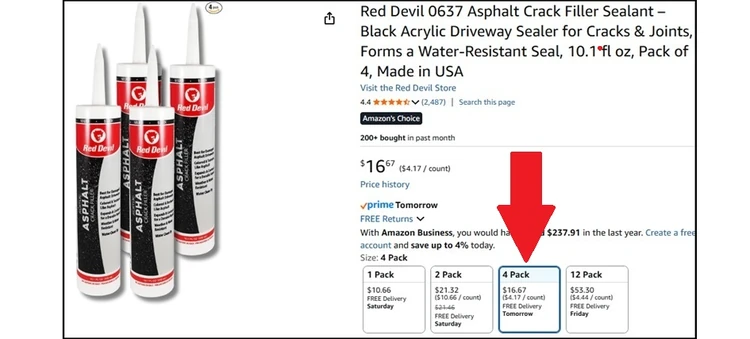
I recently noticed some cracks in my asphalt driveway and went on Amazon to buy some crack filler.
I quickly spotted the Red Devil Asphalt Crack Filler, clicked on it, and noticed it came in four different pack-quantities.
Much to my surprise, the pricing of the multiple sizes was crazy:
- 1 Pack $10.66
- 2 Pack $21.32($10.66each)
- 4 Pack $16.67($4.17each)
- 12 Pack $53.30($4.44each)
At first glance, most shoppers would assume the 12-pack is automatically the best value without looking at the per-unit price.
But in actuality, the per-unit price is lowerfor the four-pack compared to the 12-pack.
Also, I'd be spending $53upfront, instead of $16, and Id never actually use or need 12 tubes of crack filler.
This is not a one-off. In many Amazon listings (paper towels, shampoo, vitamins, pantry staples), the smaller pack is actually cheaper per unit than the larger option.
This happens often because pricing fluctuates constantly as Amazon allows third-party sellers to set their prices, and they adjust prices based on current demand.
In other words, the default size Amazon highlights isnt always the smartest buy.
Why this happens on Amazon
Amazons pricing isnt static like your local grocery store shelf.
Each size variation can be:
- Sold by different sellers
- Discounted differently
- Eligible (or not eligible) for Subscribe & Save
- Adjusted by Amazons algorithm in real time
Thats why the four-pack might be heavily discounted, while the two-pack quietly sits at full price.
If youre not scanning through each quantity option, youre only seeing part of the picture.
Smart tips to avoid thisAmazon trap
1. Click every size option
Dont trust the default selection or what Amazon might call the best choice.Tap through each quantity to compare the price-per-unit.
2. Check Subscribe & Save carefully
Sometimes the discount only applies to certain sizes. Other times, the base price is inflated on larger packs so the discount looks better than it is.
3. Dont tie up cash unnecessarily
Instead of tying up your money in bulk packs that you might not actually use, keep your money in your bank account earning interest.
Even if the 12-pack is a few cents cheaper per unit, spending over $50 upfront makes zero sense if the four-pack meets your needs.
4. Recheck before reordering
If you shop on Amazon often, youve probably noticed that their prices fluctuate daily.
When you go to reorder a product, be aware that the cheapest option last month may not be cheapest today.
5. Watch for third-party sellers
Third-party sellers on Amazon can, and do, price "pack sizes"differently. Youll notice this the most often with home improvement products, cleaning supplies, snacks, and pantry staples.
The bottom line for smart shoppers is that bulk doesnt automatically mean bargain, especially when shopping on Amazon.
Always take the extra 10 seconds to check the unit price. Its one of the easiest ways to avoid overspending and keep more money in your pocket.
Posted: 2026-02-25 17:31:59








