

Rockin Robin SongFlying The Web For News.
RobinPost Logo Amazon Prime Deals


Consumer Daily Reports

The hidden couponing system most Sams shoppers miss

By Kyle James of ConsumerAffairs
April 22, 2026
  • Couponing at Sams Club is all about strategy (not clipping),using Instant Savings, knowing the timing, and tracking prices to know when deals are actually worth it.

  • Smart shoppers stack savings by combining Instant Savings with rebates from apps like Ibotta and even vendor checks to push prices lower.

  • The biggest savings come from discipline: only buying true bulk deals, using the app to plan ahead, and avoiding impulse purchases that cancel out discounts.


Couponing at Sams Club doesnt look anything like traditional grocery store couponing.

You cant use stacks of paper manufacturer coupons and there are no extreme coupon hauls. And thats exactly why most shoppers assume theres nothing to game, but thats not entirely true.

The savings at Sams are baked into the pricing, promotions, and timing. And if you dont understand how it works, youll overspend without realizing it.

1. Master Instant Savings at Sams (this is your foundation)

Instant Savings are the closest thing Sams Club has to actual coupons and theyre definitely where most of your savings will come from.

These are pre-loaded discounts for specific items that:

  • Automatically apply at checkout
  • Rotate products every few weeks
  • Often range from $3 to $20+ off bulk items

Theyre heavily promoted in-store, and the products with a discount have a yellow shelf tag with the words Instant Savings in bold letters. Theyre hard to miss.

You can also find them on their website, their app, and in their monthly savings book. Before you head to Sams, I highly recommend downloading their appand checking out the current items with Instant Savings.

With that said, many shoppers dont realize that not every Instant Savings deal is a stock-up deal.

How experienced shoppers approach this:

  1. They track price cycles:Many staple items like detergent, paper towels, and snacksgo on sale on a predictable cycle (typically every six to 10 weeks.)
  2. They dont buy just because its on sale:If something is discounted but still higher than previous sale prices, theyll wait unless they absolutely need the product right now.
  3. They buy in volume only when it makes sense:The biggest savings come from buying at the lowest price point per-unit, not just any discount that looks like it could be a deal.

Pro tip: I like to keep a running note in my phone of good prices for the items I buy the most often. Then over time, Ill know instantly whether something is worth stocking up on or not.

2. Stack savings with Ibotta rebates (this is where real value happens)
Photo

This is the most overlooked part of Sams Club shopping.

Even though traditional coupons arent accepted, you can still use a cashback rebate app like Ibotta to save money at Sams.

Aside from their Instant Savings, Sams Club rarely discounts items, but when you use Ibotta rebates, you can easily push prices significantly lower than traditional grocery stores.

How to earn cash back in-store with Ibotta:

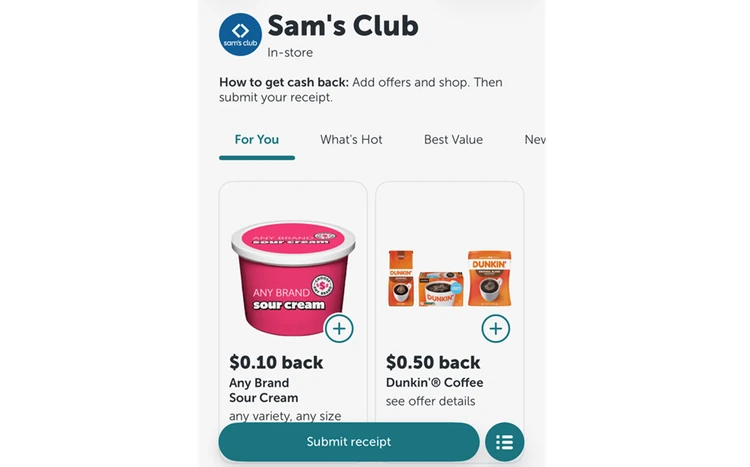
  1. Find Sams Club in the Ibotta app:Search for Sams Club in the Ibotta app and select the in-store option.
  2. Add your offers:Browse available deals and tap (+) to add them to your list before shopping.
  3. Shop like normal:Buy the items in-store and check out as you usually would.
  4. Upload your receipt:Submit your paper Sam's receipt through the app after your purchase.
  5. Get your cash back:Cash back is typically credited to your Ibotta account within 72 hours.

Important: Scan & Go purchases at Sams are not eligible for cash back with Ibotta. You must submit a paper receipt to get your rebate.

Pro tip: Build a quick habit of always scanning Ibotta before you head to Sams (or while youre in the aisle). It takes less than a minute and can save you a surprising amount over the course of a year.

3. Sams accepts 'vendor checks'
Photo

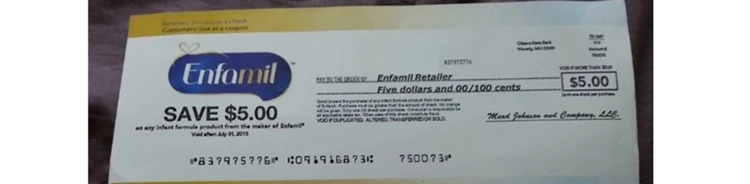
Vendor checks are similar to manufacturer coupons in that the maker of the product creates them, but they actually look like check, not a coupon.

And unlike manufacturer coupons, Sams Club absolutely accepts them.

Brands where youll see these include:

  • Enfamil
  • Similac
  • Gerber
  • Purina

Youll often receive them in the mail, or when you get home from the hospital with a new baby, or when you adopt a new puppy or dog from a shelter.

Examples include:

  • Save $5 off any Enfamil product
  • Save $30 off any infant formula over $30 from Similac
  • Save $10 off any dog food from Purina

Also, keep in mind that vendor checks cannot be used with Scan & Go, as they need to be ran through the check reader at a checkout register.

4. Know when bulk pricing actually works (this is where most people fail)

Im not afraid to say itbuying in bulk doesnt automatically save you money.

Sams Club feels cheaper because of the volume aspect, but the math doesnt always support it.

When bulk works:

  • You know youll use the product consistently.
  • The unit price is clearly lower.
  • Its a non-perishable item.

When it doesnt:

  • You dont finish it before it expires.
  • Its not discounted via Instant Savings or Ibotta.
  • Its simply a nice-to-have purchase and not a necessity.

Smart shoppers always checkthe following:

  • Price per ounce/unit
  • Competing store sales
  • Household consumption rate

Pro tip: If its not on sale and not a staple, its probably smart to skip it. Most overspending at Sams Club happens when you let your guard down and start deviating from your shopping list.

5. Use the Sams app like a couponing tool

The Sams Club app is one of the most powerful and underused tools for saving money.

Inside the app, you can:

  • Browse Instant Savings before you shop
  • Scan items in-store to verify pricing
  • Access online-only deals
  • Create lists so you can track your most-shopped products

How smart shoppers use the app

  • They pre-plan their trip and their meals. They check deals before entering the store so they know exactly whats worth buying.
  • They price-check everything: Sometimes the shelf tag doesnt reflect the latest discount. Youd be surprised how often this happens.
  • They use Scan & Go: This avoids checkout lanes, as you can finish your transaction right from any aisle in the store.This also helps you avoid last-minute impulse buys, as they tend to put those towards the front of the store near checkout.

Pro tip: Treat the app like your digital coupon binder. If its not in your favorites list, dont buy it.


Posted: 2026-04-22 21:25:19

Get Full News Story On Consumer Affairs


Listen to this article. Speaker link opens in a new window.
Text To Speech BETA Test Version.


More News From This Category
Consumer News: FBI warns Microsoft users about a sophisticated phishing scam
Tue, 26 May 2026 13:07:07 +0000

Cybercriminals are using fake Microsoft login requests to bypass multi-factor security

By Mark Huffman of ConsumerAffairs
May 26, 2026
  • The FBI warned on May 21 that cybercriminals are increasingly targeting Microsoft 365 users with sophisticated phishing .

  • The scam uses a tool called Kali365 to steal account access tokens and bypass multi-factor authentication protections.

  • Officials say the attacks rely on fake Microsoft login requests and social engineering tactics designed to trick users into handing over access.


The FBI is warning Microsoft users to be on alert after identifying a fast-growing phishing campaign that allows scammers to bypass common account security protections and gain access to sensitive information.

In a public service alert, the FBI said cybercriminals are using a phishing-as-a-service platform called Kali365 to target Microsoft 365 accounts. The tool enables attackers to steal OAuth access tokens, giving them persistent access to accounts without needing passwords or repeatedly triggering multi-factor authentication (MFA).

According to the FBI, the service first appeared in April and is being distributed through Telegram channels. The agency said the platform lowers the barrier for cybercrime by offering automated phishing templates, AI-generated scam emails, and dashboards that track victims in real time.

It starts with an email

The typically begin with an email that appears to come from a trusted cloud service or document-sharing platform. Victims are instructed to visit a legitimate Microsoft verification page and enter a device code supplied in the email. Once the code is entered, attackers can capture authentication tokens and gain access to services such as Outlook, Teams, and OneDrive.

Because the attacks exploit Microsofts legitimate authentication workflow, they can be difficult for users and security systems to detect. Cybersecurity experts say the method is especially dangerous because it bypasses MFA protections that many users rely on to secure their accounts.

The potential damage

The FBI warned that compromised accounts can expose sensitive business information, personal data, and financial records. Attackers may also use stolen access to launch additional phishing attacks from legitimate accounts, making future appear more credible.

Microsoft recently reported a separate sophisticated phishing campaign that targeted more than 35,000 users across 13,000 organizations in 26 countries, with most victims located in the United States. Researchers said attackers used polished corporate-style emails and fake internal communications to trick recipients into surrendering credentials and authentication tokens.

Federal authorities are urging users to avoid clicking links in unsolicited emails, verify login requests independently, and never enter device codes unless they initiated the request themselves. The FBI also recommends enabling phishing-resistant MFA methods, monitoring account activity, and reporting suspicious messages to the FBIs Internet Crime Complaint Center.

The warning reflects a broader trend toward increasingly sophisticated phishing operations that rely more on social engineering than traditional malware. Security researchers say these are becoming more convincing through the use of AI-generated messages, professional-looking templates, and legitimate cloud infrastructure.


Read More ...


Consumer News: Beverages recalled due to Salmonella risk
Tue, 26 May 2026 13:07:07 +0000

SKS Copack reports that a supplier warned of a tainted ingredient

By Mark Huffman of ConsumerAffairs
May 26, 2026
  • SKS Copack has recalled dozens of specialty beverage powders because they may be contaminated with Salmonella.

  • The affected products were sold under brands including Angel Specialty Products, Royal Gold, Boba Time, Fanale, and Denda in 25 states.

  • Consumers are urged not to consume the recalled products and may return them for a full refund.


SKS Copack, a California-based beverage manufacturer, is recalling a wide range of specialty beverage powders after a supplier warned that an ingredient may be contaminated with Salmonella, according to the Food and Drug Administration (FDA).

The Cerritos, Calif., company said the recall affects powdered beverage mixes sold under several brands, including Angel Specialty Products, Royal Gold, Boba Time, Fanale, and Denda. The products were distributed through cafes, restaurants, and direct online sales in 25 states, including California, Texas, Florida, Illinois, New York, and Virginia.

The recall was initiated after SKS Copack received notice from supplier California Dairies Inc. that a lot of low-heat nonfat dry milk powder tested positive for Salmonella during routine testing.

No illnesses had been reported as of the FDA announcement.

Salmonella can cause serious and sometimes fatal infections, particularly in young children, older adults, and people with weakened immune systems. Symptoms can include fever, diarrhea, nausea, vomiting, and abdominal pain. In rare cases, the infection can spread into the bloodstream and cause more severe complications.

What to do

Among the recalled products are matcha green tea powder, taro drink mix, horchata mix, milk tea powder, vanilla smoothie base, cappuccino mixes, yogurt powder, and ice cream mix. Affected lot codes and best-by dates are listed on the FDA recall notice.

Consumers are advised to stop using the recalled products immediately and return them to the place of purchase for a refund. SKS Copack said it has halted distribution of the affected products and is cooperating with the FDA during the investigation.

Consumers with questions can contact SKS Copack at (562) 404-8158 weekdays between 8 a.m. and 4 p.m. Pacific time.


Read More ...


Consumer News: It’s likely to cost more to stay cool this summer
Tue, 26 May 2026 13:07:07 +0000

Here are some ways to keep those bills in check

By Mark Huffman of ConsumerAffairs
May 26, 2026
  • U.S. households are expected to pay an average of $778 for summer cooling this year, up 8.5% from 2025 and nearly 37% higher than in 2020.

  • Southern states are projected to see the steepest increases, with cooling bills in the South Atlantic region rising more than 13%.

  • NEADA says one in six households is already behind on utility bills, with total energy debt reaching about $25 billion.


Now that we are at the unofficial start of summer, its time to start thinking about how to tame air conditioningbills, because electric utility rates are climbing.

The National Energy Assistance Directors Association (NEADA) projects the average household will spend about $778 on electricity for home cooling during the summer months, an increase of 8.5% from last years estimated $717. The organization said cooling costs are now nearly 37% higher than they were in 2020.

Families are squeezed from both directions, said Mark Wolfe, executive director of NEADA. They are paying more for electricity, and they need more of it to stay safe during increasingly hot summers.

The report attributes the increase to two primary factors: electricity prices continuing to rise faster than inflation and higher summer temperatures driving greater air-conditioning use. NEADA said households are not only paying more per kilowatt-hour but are also consuming more electricity because air conditioners are running longer and more frequently.

Southern households may feel the most pain

The largest increases are expected in Southern states, where air-conditioning use is widespread and summer temperatures are typically highest. NEADA projects cooling costs in the South Atlantic region will rise by more than $100, or about 13.5%, this summer. The West South Central region is expected to see an 11.5% increase, while the East South Central region could face an 8.5% jump.

Midwestern households are expected to experience smaller increases of roughly 4.8%, while New England and Mid-Atlantic states are projected to see increases ranging from about 6.7% to 7.8%.

NEADA said the rising costs come as many consumers are already struggling to keep up with utility payments. The organization estimates that one in six U.S. households is behind on energy bills, with total utility debt reaching approximately $25 billion.

Cutting electric bills without sacrificing comfort

Consumers can lower summer cooling costs without sacrificing comfort by combining low-cost home improvements, smarter thermostat use, and changes in daily habits. Energy experts say even small adjustments can add up during periods of extreme heat.

Here are some of the most effective strategies:

  • Raise the thermostat slightly: The Department of Energy (DOE) recommends setting the thermostat to 78 degrees when people are home and awake. Raising the temperature by even one to twodegrees can noticeably reduce electricity use while remaining comfortable for most households. Programmable and smart thermostats can automatically adjust temperatures when no one is home, helping avoid unnecessary cooling.
  • Use ceiling fans correctly: Ceiling fans can make a room feel about fourdegrees cooler by improving air circulation. Fans use far less electricity than air conditioning, allowing consumers to raise thermostat settings without losing comfort. During summer, ceiling fans should rotate counterclockwise to push cool air downward.
  • Block sunlight during the hottest hours: Sunlight streaming through windows can dramatically increase indoor temperatures. Closing blinds, curtains, or shades during the afternoon can reduce heat gain, especially on south- and west-facing windows. Blackout curtains and reflective window films can further cut cooling demands.
  • Avoid heat-producing appliances during peak heat: Ovens, clothes dryers, and dishwashers generate additional indoor heat. Running them in the evening or early morning can help keep homes cooler. Outdoor grilling and microwave cooking also reduce heat buildup indoors.
  • Seal air leaks: Cool air escaping through gaps around doors, windows, and ductwork forces air conditioners to work harder. Weatherstripping and caulking are relatively inexpensive improvements that can improve efficiency immediately. Adding insulation in attics can also help maintain indoor temperatures.
  • Maintain the air conditioner: Dirty filters and clogged outdoor units reduce efficiency. Experts recommend replacing HVAC filters every one to three months during heavy-use periods. Keeping outdoor condenser units free of debris and scheduling annual maintenance can improve performance and lower operating costs.

Reducing cooling costs should never come at the expense of health and safety. Older adults, young children, and people with medical conditions are especially vulnerable to heat-related illness.

On extremely hot days, consumers should stay hydrated, use fans carefully, and seek cooling centers or public air-conditioned spaces if home cooling is inadequate.


Read More ...


Consumer News: Consumer sentiment hit an all-time low in May
Tue, 26 May 2026 13:07:07 +0000

Consumers worry about the rising cost of living

By Mark Huffman of ConsumerAffairs
May 26, 2026
  • The University of Michigans consumer sentiment index fell to 44.8 in May, the lowest reading since the survey began in 1952.

  • Rising gasoline prices and fears of persistent inflation were major drivers behind the sharp decline in confidence.

  • Lower-income Americans and consumers without college degrees reported the steepest deterioration in sentiment.


Americans are feeling more pessimistic about the economy than at any point in more than seven decades, according to the University of Michigans latest Survey of Consumers.

The universitys closely watched Index of Consumer Sentiment dropped to 44.8 in May, down from 49.8 in April and below the preliminary May reading of 48.2. The latest figure marks the lowest level recorded since the survey began in 1952.

The survey found that concerns about the rising cost of living continue to dominate consumers outlook. According to the report, 57% of respondents spontaneously mentioned that high prices were hurting their personal finances, up from 50% a month earlier.

The cost of living continues to be a first-order concern, with 57% of consumers spontaneously mentioning that high prices were eroding their personal finances, up from 50% last month, said survey director Joanne Hsu in commentary accompanying the report.

Lower-income consumers and those without college degrees posted particularly strong sentiment declines; these groups are more sensitive to increases in the cost of gas and other essentials.

Pain at the pump

Higher gasoline prices appeared to be a key factor behind the worsening mood. The survey noted that many consumers cited rising fuel costs and fears that inflation could spread beyond energy prices into other parts of the economy.

The report also showed growing anxiety about inflation expectations. Consumers now expect inflation to run at 4.8% over the next year, up slightly from 4.7% in April. Long-run inflation expectations climbed to 3.9%, well above the range seen throughout 2024.

Lower-income households and consumers without college degrees experienced some of the sharpest declines in confidence, reflecting the disproportionate impact of rising costs for essentials such as gasoline and groceries.

Political and demographic differences

The survey also revealed widening political and demographic differences. Sentiment among independents and Republicans fell to the lowest levels of the current administration, while Democratic sentiment was largely unchanged from April.

Economists say the record-low reading highlights the growing disconnect between how consumers feel and how the economy is performing. While sentiment has deteriorated sharply, consumer spending and employment data have remained relatively resilient in recent months.

Heres the concern: Analysts warn that if consumers eventually pull back on spending, the overall economy could weaken. Consumer spending accounts for roughly two-thirds of U.S. economic activity.


Read More ...


Consumer News: World Cup are getting smarter — Here’s what fans need to watch for
Fri, 22 May 2026 22:07:08 +0000

From fake visas to bogus crypto coins, scammers are using AI and official-looking branding to target excited soccer fans

By Kristen Dalli of ConsumerAffairs
May 22, 2026

  • Cybersecurity researchers warn that World Cup 2026 scammers are using AI-generated images, fake websites, and official-looking branding to make harder to detect than ever before.

  • Fans are being targeted through fake World Cup visas, bogus LEGO and Panini collectible stores, and fraudulent crypto coins designed to steal money, personal data, and digital wallet access.

  • Experts say consumers should avoid clicking links from ads or social media, double-check website URLs, and be wary of high-pressure sales tactics, countdown timers, and deals that seem too good to be true.


As excitement builds for the 2026 FIFA World Cup, cybersecurity experts are warning that scammers are already gearing up.

While fake ticket sales have long been a concern surrounding major sporting events, researchers at Malwarebytes say criminals are now using far more sophisticated tactics to target fans money, personal information, and even cryptocurrency wallets.

ConsumerAffairs spoke with Shahak Shalev, Global Head of Scam and AI Research at Malwarebytes, who explained that scammers are creating convincing fake websites, AI-generated images, and official-looking branding tied to the World Cup to trick consumers into letting their guard down.

The range from bogus travel visas and fake collectible stores to fraudulent crypto tokens and unregulated betting platforms all designed to capitalize on the hype surrounding one of the worlds biggest sporting events.

The are getting harder to spot

Shalev explained that the most current World Cup arent as easy for consumers to spot.

Previously, consumers would see more obvious red flags like typos, awkward phrasing or pixelated imagery, he said. AI has helped scammers step up their game.

Today, AI-generated images, text, and cloned websites are making , including these new examples from the World Cup, significantly harder to spot. Year-round, cybercriminals are leveraging AI tools to generate deepfakes, storefronts and advertisements that mimic legitimate companies flawlessly. Scammers leverage cultural moments and seasons to target consumers in new ways.

Some other signs to look out for:

  • High-pressure tactics

  • Fake inventory counters

  • Unrealistic deals

  • Malicious ads

  • Complex site redirects that send users to a different domain than the one they clicked

Integrating with popular brands, big events

These can take many forms, and scammers have gotten creative at incorporating popular brands and working around major events, like the World Cup, to start their schemes.

Shalev broke down three of the most popular geared towards the World Cup right now the fake World Cup Visa scam, LEGO and Panini , and World Cup crypto .

World Cup Visa Scam

Heres how it works:

  • Sites like "WC2026 Visa" are charging a fake $270 fee under the guise of an expedited tournament entry document.

  • The reality is that there is no special tournament visa.

  • The US government has confirmed that visitors must use standard B1/B2 visas or the Visa Waiver Program with an ESTA authorization.

Beyond the $270 financial loss, the long-term risks are serious, Shalev said. By filling out these forms, fans hand over personal data like their full name, passport numbers, date of birth, travel logistics, and payment information. This gives cybercriminals the information to use for their own gain or package and sell for additional identity fraud activities.

LEGO and Panini

LEGO announced a partnership with FIFA in late 2025, so that part of the scam is legitimate and what can confuse unassuming consumers.

However, where things get dicey is that scammers take advantage of consumers looking for collectible jerseys, trophies, and other World Cup memorabilia. Scammers exploit this by spinning up targeted storefronts that pretend to sell these niche products.

These sites often use quiz-funnel to secure contact info or hide subscription billing flows disguised as shipping fees. Fans click on sponsored ads or social links looking for a hard-to-find item, only to have their credit card harvested by a site that will vanish shortly after the tournament ends.

Similarly, Panini is the international distributor for stickers, trading cards, and other sports memorabilia. Scammers create websites that are lookalike versions of the legitimate Panini site, often with countdowns to inventory running out and other urgency tactics. If consumers order items from these sites, not only is there risk that they may never come, but their information is also stored for future .

Crypto

While FIFA has a real digital ecosystem (FIFA Collect, Right-to-Buy NFTs), it is strictly documented on FIFA-controlled domains, not third-party community token sites, Shalev said.

The first red flag is the claim itself. If a token claims to be an official community coin or product of FIFA, stop right there. Once a fan engages, they either receive nothing, receive something they cant sell, or sign a transaction that gives the operator access to their entire digital wallet.

Protect your identity and your money

Shalev shared his top tips to help consumers protect their identities and their money during the height of these World Cup :

  • Go direct, and check URLs: Never click a link from an ad, text, or email. Look closely at the website address. Type FIFA.com or LEGO.com directly into your browser and avoid URLs like "official-worldcup-tickets.com.

  • Ignore the clock: If a site has a countdown timer or says "only 100 left" to pressure you into buying, its likely a scam.

  • Watch out for Facebook groups: Facebook groups have been a hotbed for scammers. There is no reason to buy from Facebook groups, as they are very hard to authenticate.

  • Use a guard: Use free tools like Malwarebytes Scam Guard or Browser Guard to help you verify sites and offers in real time.

  • If youve been scammed: If you realize youve been compromised, do not wait. If you shared financial details, alert your bank immediately. If you shared personal data, drop an immediate credit/fraud alert on your profile and report the incident straight to the authorities.


Read More ...


Related Bing News Results
Toyota, Subaru, Honda top Consumer Reports list of most reliable new cars
Sat, 02 May 2026 22:54:00 GMT
Consumer Reports uses data to compile an annual list of the most reliable new car brands. Some brands on the list are obvious while others are moving up reliability rankings. Reliability is a huge ...

Consumer Reports: Simple steps to help slash daily screen time
Fri, 24 Apr 2026 01:25:00 GMT
Most of us know that too much scrolling on our phones isn’t great for our mental health. And now, a new approach to dialing down the digital noise is ironically trending on social media—of all places.

Consumer Reports retests protein powders, finds safer options
Wed, 18 Feb 2026 17:22:00 GMT
USES THESE SUPPLEMENTS. HERE’S MARISSA TANSINO. LAST FALL, CONSUMER REPORTS TESTED DOZENS OF PROTEIN POWDERS AND READY TO DRINK SHAKES. WHAT THE LAB FOUND RAISED RED FLAGS MORE THAN TWO THIRDS ...

How Much Lead Is in Protein Powder? Consumer Reports Shares Latest Findings
Mon, 12 Jan 2026 16:00:00 GMT
Consumer Reports released new findings after testing five reader-requested chocolate protein powders for lead and other heavy metals. The nonprofit organization previously revealed in late 2025 that ...

Consumer Reports |Experts warn against daily use of protein supplements
Mon, 20 Oct 2025 22:57:00 GMT
Protein powders and shakes are more popular than ever, often touted as workout fuel or even meal replacements. But a new Consumer Reports investigation reveals a hidden risk: some of these supplements ...


Blow Us A Whistle


Related Product Search/Búsqueda de productos relacionados

Amazon Logo

Visit Our New Print-On-Demand Stores On Printify and Zazzle
Printify Zazzle





