

Rockin Robin SongFlying The Web For News.
RobinPost Logo Amazon Prime Deals


Consumer Daily Reports

Sponsored search results are creating confusion for many

By Kyle James of ConsumerAffairs
May 21, 2026
  • Many drivers searching Google for DMV services are accidentally landing on third-party websites that charge extra fees for renewals and paperwork help.

  • The confusion happens because sponsored search results often appear above the official DMV website and look surprisingly official.

  • Experts recommend skipping sponsored results, looking for .gov websites, and checking carefully for any added processing fees.


In the digital age, it makes total sense that millions of Americans would go online and renew their vehicle registrations, replace licenses, and even deal with DMV paperwork.

But in doing so, many drivers go to Google and search phrases like:

  • DMV registration renewal
  • Renew license plates
  • Vehicle registration online

and theyre ending up on third-party service websites instead of their actual state DMV website.

These companies are not necessarily pretending to be the DMV or operating illegally. Most even clearly disclose they are third-party services that help process registration paperwork for a fee.

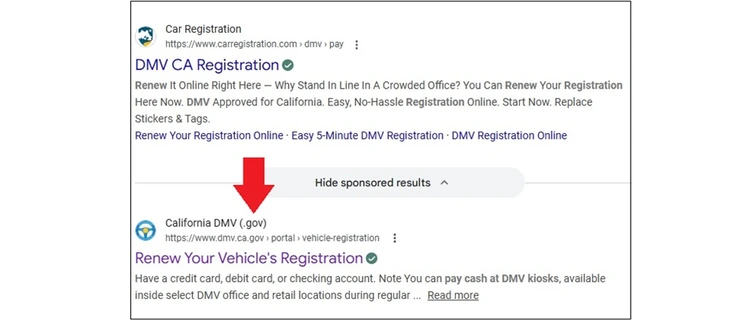
The problem is that many consumers do not realize that when they click on it. Especially because the sites typically appear as a sponsored Google result above the official DMV listing.

Why people get confused
Photo

To many drivers, especially less tech-savvy consumers, the sites can look andfeel extremely similar to government websites.

They often include:

  • DMV-related wording
  • Professional-looking layouts
  • Registration and renewal tools
  • State references
  • Official-sounding language

And because people naturally trust the first result they see, many assume they are already on the official DMV website.

That confusion can become expensive.

Where the extra fees show up

Many third-party DMV service sites charge:

  • Processing fees
  • Convenience charges
  • Service markups
  • Expedited handling fees

In some situations, consumers may pay $20 to $80 more than they would directly through their state DMV.

Sometimes the extra cost may be worth it for people who want annual renewal help, faster service, help with paperwork, or need registration assistance.

But many drivers only realize afterward that they paid extra for something they could have done directly through the DMV for less.

Why seniors are especially vulnerable

Older Americans are often more likely to get caught up in the confusion of this.

They tend to be more likely to:

  • Click the first Google result
  • Miss the small Sponsored label
  • Assume professional sites are official
  • Feel overwhelmed by online government websites

On smartphones, the confusion gets even worse becauseURLs are much harder to see, and sponsored ads blend in very easily.

For many consumers, especially seniors, the difference between a government website and a private processing company is not very obvious at all.

Googles role in the confusion

Part of the issue is how modern search results work.

Sponsored ads now closely resemble regular search listings. The only real distinction is usually a small Sponsored or Sponsored result label many users barely notice.

That means a paid third-party registration service can appear above the actual DMV website simply because it purchased the ad placement.

And many consumers incorrectly interpret top result as an official result.

How to avoid unnecessary DMV fees online

Consumer experts recommend slowing down anytime you are dealing with government services, registration renewals, taxes, passports, and drivers licenses.

A few simple habits can save you money and reduce the confusion considerably.

Look for .gov

Official DMV websites almost always use .gov at the end of the web address.

If the website ends in:

  • .com
  • .org
  • vehicle services
  • registration processing

it is likely a private third-party company.

Again, that does not automatically mean the company is dishonest. It simply means additional fees will usually apply to your purchase.

Skip sponsored results when possible

Whenever you do this type of business online, know that there will be sponsored ads at the top of search results hoping youll click on them. The safest move is to get in the habit of immediately scrolling past the sponsored ads and finding your actual state DMV website.

Also, consider bookmarking your state DMV website once you find it so you never have to search for it again and run the risk of clicking on the wrong link.

Always read checkout screens carefully

Before paying, look closely for:

  • Processing fees
  • Convenience charges
  • Service markups
  • Subscription offers

Some consumers do not realize the total cost difference until the final payment screen.

Avoid a lot of future headaches by getting in the habit of slowing down and taking a minute to make sure the website youre on is the site you think.


Posted: 2026-05-21 21:18:22

Get Full News Story On Consumer Affairs


More News From This Category
Consumer News: Living near gas stations may raise childhood cancer risk, new study finds
Thu, 21 May 2026 22:07:09 +0000

Researchers say distance from fuel pumps could play a bigger role in health than previously thought

By Kristen Dalli of ConsumerAffairs
May 21, 2026
  • A new Canadian study found higher rates of childhood leukemia among children living close to gas stations.

  • Researchers focused on exposure to benzene, a known carcinogen found in gasoline fumes.

  • The study suggests vapor-control systems and buffer zones could help reduce potential risks.


A new study is raising fresh questions about how living near gas stations may affect childrens health.

Researchers from Canada found that children born close to gas stations appeared to face a higher risk of developing leukemia, with the risk increasing the closer they lived to fuel pumps. The findings add to growing concerns about long-term exposure to air pollutants tied to gasoline and vehicle emissions.

Research suggests that only 5 to 10% of childhood cancers are attributable solely to genetics, while the rest are due to other factors, particularly environmental ones, researcher Stphane Buteau said in a news release.

The study

The study, published in the journal Environmental Pollution, followed more than 824,000 children born in Quebec, Canada.

Researchers looked at where children lived at birth and compared that information with later childhood cancer diagnoses. They specifically examined whether there were gas stations within 250 meters about 820 feet of a childs home.

The researchers focused on gas stations because gasoline releases benzene, a chemical already linked to leukemia and other health concerns in adults. Benzene can enter the air during fuel storage, refueling, and fuel deliveries by tanker trucks.

In the absence of residential history, postal codes at birth were used to estimate exposure during the prenatal and early-life periodstimes of heightened susceptibility to environmental hazards, said Buteau,.

What the study found

According to the study, children living within 250 meters of a gas station had a higher risk of childhood leukemia, and the risk appeared highest for those living within 100 meters, or roughly 328 feet.

The study also found an interesting difference in Montreal, where local rules require vapor recovery systems at gas stations to reduce emissions during fueling. In that city, the connection between nearby gas stations and cancer risk appeared weaker, suggesting pollution-control measures may help lower exposure levels.

Researchers cautioned that the study does have limitations. For example, they used postal codes at birth rather than tracking where families lived over time. The findings also do not prove that gas stations directly cause cancer. Instead, the study identifies an association that researchers say deserves further investigation.

What these findings mean for consumers

For consumers, the study highlights how environmental factors may play a role in health risks, particularly for children.

Researchers suggested that cities could consider creating buffer zones between gas stations and places where children spend time, such as homes, schools, and daycares. They also pointed to vapor recovery systems as a relatively simple way to reduce emissions.

Such measures are simple and not costly to implement, and they would deliver major health benefits and help reduce inequalities in exposure levels, Buteau said.


Read More ...


Consumer News: Target expands next-day delivery services
Thu, 21 May 2026 22:07:09 +0000

The change comes as shoppers increasingly expect faster, cheaper shipping

By Kristen Dalli of ConsumerAffairs
May 21, 2026
  • Target is expanding next-day delivery service to more areas across the U.S., covering millions of additional shoppers.

  • The retailer says most items sold in stores are now eligible for next-day shipping, including groceries, household basics, and electronics.

  • Consumers may be able to get free next-day delivery depending on order size, memberships, or payment methods.


Target is making a bigger push into fast shipping, expanding its next-day delivery service across the United States as retailers race to meet growing consumer demand for convenience.

The company says the move will allow more shoppers to receive orders the very next day on hundreds of thousands of eligible items, from pantry staples to clothing and home goods.

The expansion comes as major retailers continue competing with services like Amazon Prime and Walmart delivery, where speed has become one of the biggest selling points for online shopping.

This spring, 60% of the U.S. population will have access to quicker, easier shopping as Target expands next-day delivery of online orders to more markets, the company said in a statement. Guests in more than 50 top U.S. metro areas will be able to get their purchases delivered next day in many cases for free.

Whats changing?

According to Target, most items available for shipping now qualify for next-day delivery, representing roughly 85% of products sold in Target stores. Customers can check whether an item is eligible directly on the product page or during checkout.

The company says next-day delivery is free on orders over $35, and Target Circle 360 members or shoppers using a Target Circle Card can qualify for no-minimum delivery perks.

The expansion is tied to Targets larger investment in supply chain and fulfillment operations. Over the last few years, the retailer has added sortation centers, expanded last-mile delivery networks, and turned many stores into mini fulfillment hubs to move online orders faster.

Company executives have said these efforts are designed to help Target compete more aggressively in the growing delivery market while also improving efficiency behind the scenes.

What this means for consumers

For consumers, the changes could make online shopping feel much more like an on-demand service. Faster shipping can be especially useful for last-minute needs like household essentials, birthday gifts, school supplies, or forgotten groceries. But shoppers may still want to pay attention to delivery minimums, membership fees, and item eligibility before assuming every purchase qualifies for free next-day arrival.

Consumers should also remember that next day can depend on order timing and inventory availability in their region. Retailers often require purchases to be placed before a certain cutoff time, and some products may ship separately. Comparing membership perks between retailers could also help shoppers decide which service offers the best value based on how often they order online.


Read More ...


Consumer News: Keeping the weight off could help protect your brain as you age
Thu, 21 May 2026 22:07:08 +0000

New research suggests long-term weight management may slow cognitive decline in older adults

By Kristen Dalli of ConsumerAffairs
May 21, 2026
  • A new University of Georgia study found that higher BMI over time was linked to faster cognitive decline in adults over 50.

  • Researchers tracked more than 8,200 people for 24 years and found the strongest effects in adults over 65.

  • The study suggests that managing weight may help slow declines in memory, focus, and problem-solving skills.


As people get older, some degree of memory loss and slower thinking is considered a normal part of aging. But new research from the University of Georgia suggests that long-term weight gain could speed up that process more than previously thought.

According to the study, adults with higher body mass index (BMI) over time experienced faster declines in memory, executive functioning, and overall cognitive health compared to people with lower BMI levels.

Researchers say the findings highlight an important connection between physical and brain health, especially as the population ages. The study was published in the Journal of Neurology and focused on adults over the age of 50.

We found that if people managed their weight, they could significantly lower their rate of cognitive decline in just two years, researcher Suhang Song said in a news release. That makes BMI one of the most easily modifiable risk factors when it comes to aging well.

The study

The research team analyzed data from more than 8,200 participants who were followed for 24 years as part of a large national health study, the Health and Retirement Study (1996-2020).

Rather than looking at weight at a single moment in time, researchers tracked BMI trends over many years to better understand long-term effects on the brain.

Additionally, the researchers measured cognition using a standardized composite score of memory and executive function.

The findings

They found that every increase in BMI was associated with faster declines in areas tied to memory, concentration, planning, emotional regulation, and decision-making.

The link between weight and cognitive decline appeared strongest around year eight of the study, and the impact was most noticeable among adults older than 65. Researchers noted that obesity may affect the brain through several possible pathways, including inflammation, insulin resistance, and reduced blood flow. These changes may contribute to conditions like cognitive impairment and dementia over time.

Still, the researchers emphasized that the findings are not meant to be discouraging. In fact, they noted that weight management may be one of the more changeable risk factors tied to brain aging.

For consumers, the takeaway is less about chasing a perfect number on the scale and more about understanding how overall health habits may influence brain health later in life.

The study does not prove that weight directly causes dementia, but it does suggest that maintaining a stable, healthy weight over time could play a role in supporting cognitive function as people age. Researchers also pointed out that dementia rates are expected to rise sharply in the coming decades, making preventive lifestyle factors increasingly important.

There are no cures for dementia, Song said, which is why it is critical to identify and address any modifiable risk factors we can find to prevent it.


Read More ...


Consumer News: Grocery stores are replacing paper price tags with digital ones — and shoppers are uneasy
Thu, 21 May 2026 19:07:34 +0000

Digital price tags have arrived and theyre not going away

By Kyle James of ConsumerAffairs
May 21, 2026
  • Walmart, Kroger, and Whole Foods Market are replacing paper shelf tags with digital price labels that update instantly.

  • Retailers say the labels improve efficiency, but many shoppers worry they could eventually lead to grocery surge pricing.

  • Experts recommend checking shelf prices closely, reviewing receipts, and photographing expensive item prices before checkout.


Have you been to a store recently and noticed the tiny digital screens where the shelf price sticker used to be? Well, youre not alone, and theyre starting to cause a lot of concern among shoppers.

Stores like Whole Foods Market, Kroger, and Walmart have started rolling out digital shelf labels across their U.S. stores.

The technology allows stores to instantly change prices electronically without employees manually swapping paper tags.

Retailers, of course, say the move is all about efficiency and reducing the number of staffing hours needed to update price stickers. But many consumers and lawmakers are worried it could eventually open the door to surge pricing for groceries and other goods.

Why shoppers are nervous

Consumers are already keenly aware that airlines, hotels, Uber, and concert tickets use dynamic pricing systems where they raise prices when demand spikes.

Now many shoppers are smartly wondering if grocery and big-box stores will eventually start doing the same thing.

Some lawmakers, including Sen. Elizabeth Warren, have publicly raised concerns that digital shelf labels could someday allow stores to increase prices based on:

  • Time of day
  • Weather
  • Holidays
  • Demand spikes
  • Emergencies

That could theoretically mean bottled water prices rise before a heat wave or snacks jump in price before a major sporting event.

And with grocery prices already consuming a larger portion of household budgets than they have in decades, shoppers are paying close attention.

What grocery chains are saying

So far, the major retailers rolling out digital labels strongly deny they are using surge pricing or plan to start.

Whole Foods, for example, said the technology is designed to:

  • Simplify price-tag updates
  • Reduce paper waste
  • Improve customer experience

Walmart said price changes are still reviewed by employees and are usually updated outside shopping hours so prices stay stable during the day.

Kroger also denied claims that the labels would be used for dynamic pricing at their Fred Meyer stores.

Instead, companies say the labels mainly help stores:

  • Correct pricing faster
  • Launch promotions more efficiently
  • Reduce labor costs
  • Keep shelf prices more accurate

The good news for shoppers

At the moment, theres little evidence U.S. grocery stores are actively changing prices throughout the day based on demand.

In fact, digital labels can sometimes benefit shoppers because stores can quickly markdown products nearing expiration instead of throwing them away.

Still, experts say the technology clearly creates the ability for real-time pricing if retailers ever decide to move in that direction.

That alone makes many shoppers uncomfortable.

How shoppers can protect themselves

Even if surge pricing never becomes widespread, digital pricing makes it more important than ever to pay attention while shopping.

A few smart habits:

  • Double-check prices at checkout.
  • Review your receipt before leaving.
  • Use grocery apps to compare prices.
  • Take photos of shelf prices for expensive items.
  • Watch weekly sales carefully.

Pro tip: If an item rings up higher than the shelf price, many states have consumer pricing laws that may require the store to honor the lower advertised price.

The bottom line

Digital shelf labels are likely the new norm and youll start seeing them at more grocery stores because they absolutely save retailers a lot of time and money.

But the bigger question still to be answered is whether stores continue using the technology for efficiency only, or whether grocery prices will start fluctuating prices often based on a bunch of external factors.


Read More ...


Related Bing News Results
Consumer Reports' Top-Rated Place To Buy Appliances Isn't Lowe's Or Home Depot
Mon, 18 May 2026 10:00:00 GMT
Home Depot and Lowe's may come to mind when you start shopping for appliances. However, this retailer is ranked higher by Consumer Reports in some key areas.

Consumer Reports: Simple steps to help slash daily screen time
Fri, 24 Apr 2026 01:25:00 GMT
Most of us know that too much scrolling on our phones isn’t great for our mental health. And now, a new approach to dialing down the digital noise is ironically trending on social media—of all places.

Consumer Reports retests protein powders, finds safer options
Wed, 18 Feb 2026 17:22:00 GMT
USES THESE SUPPLEMENTS. HERE’S MARISSA TANSINO. LAST FALL, CONSUMER REPORTS TESTED DOZENS OF PROTEIN POWDERS AND READY TO DRINK SHAKES. WHAT THE LAB FOUND RAISED RED FLAGS MORE THAN TWO THIRDS ...

How Much Lead Is in Protein Powder? Consumer Reports Shares Latest Findings
Mon, 12 Jan 2026 16:00:00 GMT
Consumer Reports released new findings after testing five reader-requested chocolate protein powders for lead and other heavy metals. The nonprofit organization previously revealed in late 2025 that ...

Consumer Reports |Experts warn against daily use of protein supplements
Mon, 20 Oct 2025 22:57:00 GMT
Protein powders and shakes are more popular than ever, often touted as workout fuel or even meal replacements. But a new Consumer Reports investigation reveals a hidden risk: some of these supplements ...


Blow Us A Whistle


Related Product Search/Búsqueda de productos relacionados

Amazon Logo

Visit Our New Print-On-Demand Stores On Printify and Zazzle
Printify Zazzle





