Rockin Robin SongFlying The Web For News.


Consumer Daily Reports

A new analysis shows pharmacy deserts are making it harder for some consumers to access medications

By Kristen Dalli of ConsumerAffairs
July 24, 2026
  • More Americans are searching for online prescription refills as pharmacy access becomes more limited, with searches up 440% since 2022.

  • A new Tebra analysis found millions of households live in pharmacy deserts, where getting to a local pharmacy can be difficult.

  • Experts say online prescription services can help fill access gaps, but consumers should use licensed, reputable providers and not view them as a replacement for quality healthcare.


Picking up a prescription has long been a routine part of healthcare, but for many Americans, it's becoming less convenient than it used to be.

As pharmacies close or become harder to reach, some communities are finding themselves in what's known as a "pharmacy desert" areas where access to prescription medications is limited. That shift is prompting more consumers to look for digital alternatives, from online prescription refills to virtual pharmacy services.

A new analysis from Tebra examines where pharmacy access is most limited across the country and how those challenges are changing the way people manage their medications. ConsumerAffairs spoke with Kyle Ryan, Chief Product & Technology Officer at Tebra, who explained how digital healthcare tools are helping fill some of the gaps, while also highlighting why they aren't a complete replacement for in-person pharmacy care.

Key findings

To better understand where pharmacy access is most limited and how consumers are responding, Tebra analyzed data from all 50 states to create a Pharmacy Desert and Digital Demand Index.

The ranking combined three factors: the share of census tracts classified as pharmacy deserts (40%), the number of federally designated medically underserved areas per 100,000 residents (40%), and online healthcare search activity (20%). The search analysis included five prescription-related terms, such as "online pharmacy" and "prescription refill online," using search data from 2025 through 2026 and U.S. Census population estimates.

Some key findings from the survey include:

  • Searches for "prescription refill online" have increased 440% since 2022, making it the fastest-growing search term in the category.

  • Alaska had the highest share of pharmacy deserts, with more than half (51.41%) of its census tracts lacking adequate pharmacy access.

  • Texas had the largest number of affected households at more than 2.8 million.

  • Washington ranked first in overall online pharmacy search demand, suggesting residents are increasingly seeking digital healthcare options.

  • Wyoming led the nation in searches for "prescription refill online," highlighting how limited local pharmacy access may be driving consumers to look for online alternatives.

A 440% rise in searches for prescription refill online shows that people are looking for backup options when the nearest pharmacy is too far away, too busy, or no longer available, Ryan said. The findings illustrate that access problems and online behavior do not always reflect each other.

The risks

While many consumers are turning to digital pharmacies out of necessity, Ryan warns that there are some risks involved with doing so.

One significant risk is assuming that an online prescription tool works like any other online checkout, he said. Medication is different because a safe refill depends on prescription verification, dosage accuracy, drug-interaction checks, privacy protections, and access to a licensed clinician or pharmacist when consumer questions arise.

Consumers should be careful with websites that promise unusually cheap medication, skip medical review, or make it difficult to identify who is dispensing the prescription. Online refills can be incredibly useful, but they should still feel like healthcare and not a shortcut around healthcare.

What are the long-term solutions?

Ultimately, Ryan says that the long-term goal should be to increase access to pharmacy services to areas that need it most.

The long-term answer cannot be just telling consumers to go online, because online access still depends on broadband, delivery reliability, insurance coverage, and comfort using digital health tools, Ryan said.

Instead, a better solution is redundancy: safe mail-order pharmacy options, telehealth-enabled refills, mobile pharmacy services, local clinic partnerships, and better support for rural and independent pharmacies. For consumers in pharmacy deserts, the goal should be having more than one reliable path to essential medication before a refill becomes urgent. That is especially important in large states like Texas, where the study found 2.8 million households in pharmacy deserts, making this a scale problem as much as an access problem.


Posted: 2026-07-24 14:03:13

Get Full News Story On Consumer Affairs


More News From This Category
Consumer News: This Amazon Prime email almost fooled me — 5 clues that exposed the scam
Thu, 24 Sep 2026 22:07:14 +0000

The fake renewal notice looked remarkably real, right down to the Prime Video branding and a personal verification key

By Kyle James of ConsumerAffairs
September 24, 2026
  • It looks like Amazon: The email uses Prime Video branding, current shows, and a polished membership-renewal notice that could easily pass for the real thing at a glance.

  • The sender gives it away: The message says it's from Prime Support, but the actual email address has nothing to do with Amazon.

  • Don't use the button: If you're worried about your Prime membership, go directly to Amazon's website or app rather than clicking a link in an unexpected email.


I've seen my share of scam emails, and I'll admit a recent one made me look twice.

An email that landed in my inbox this week appeared to come from Amazon Prime Video and warned me that my membership had expired. It looked surprisingly legitimate.

The email had the Prime Video logo, images of popular shows, professional-looking graphics, and even a four-digit Personal Verification Key that I was supposed to enter to confirm an exclusive renewal offer.

There was just one problem. Actually, there were several.

Amazon has previously warned about membership-renewal in which criminals impersonate legitimate companies and try to convince consumers to provide credit card information. Amazon says email remained the most common way U.S. customers reported encountering Amazon impersonation in 2025.

Here's what gave this one away.

1. Look beyond the sender's name

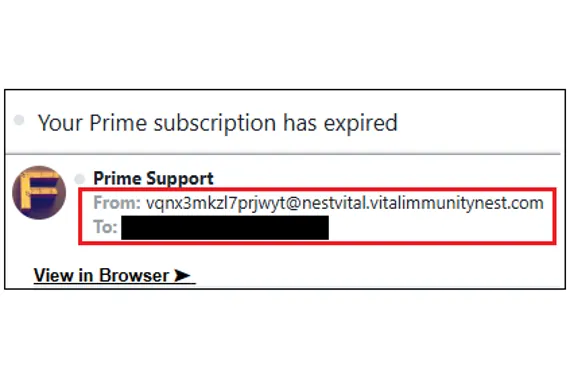
Email notification showing a Prime subscription expired message with sender and recipient details

At first glance, the email appeared to come from Prime Support.

But clicking on the sender information revealed the actual email address: vqn3xmkzl7prjwyt@nestvital.vitalimmunitynest.com

Not to sound overly obvious here, but that's a pretty big clue that Amazon didn't send it.

Amazon specifically recommends checking the actual sender rather than trusting the display name. Legitimate Amazon emails use an Amazon email domain.

2. Apparently, my membership expired in the future

Prime Video membership renewal email with verification key and popular show banners at the top

This was my favorite clue.

The email told me: Your Prime subscription expired September 25, 2026.

I received the email on September 21.

Unless Amazon has figured out time travel, my membership couldn't have expired two days from now.

It's a good reminder to slow down and actually read suspicious emails instead of reacting to the big red warning telling you something has gone wrong.

3. Amazon apparently forgot my name

Despite supposedly knowing enough about my account to know when my membership expires, the email begins simply:

Dear Member,

That doesn't automatically make an email fraudulent, but combined with the bizarre sender address and impossible expiration date, it's another reason to be suspicious.

4. The verification key makes it feel official

One of the smartest parts of this scam is the prominent four-digit Personal Verification Key.

Mine was 8426.

It creates the impression that the offer was generated specifically for my account and gives you another reason to interact with the message.

But Amazon warns that impersonation commonly use account problems and urgent requests to get consumers to hand over account or payment information.

5. Don't click anything including View in Browser

This is where the email got me and where I made a mistake.

At the top of the email was a seemingly harmless View in Browser link. I clicked it, thinking I'd get a better look at the message or maybe it would take me to the Amazon website.

Don't do that.

View in Browser is still a link controlled by whoever sent the email. Clicking it can take you away from the relative safety of your inbox and onto a website controlled by scammers. At a minimum, clicking a unique link may also confirm that your email address is active and that someone is engaging with the message.

The same rule applies to the big blue CONFIRM button farther down the email. I didn't click that one.

If an email claims there's a problem with your Prime membership, don't use any link in the message to investigate. Even one that looks as innocuous as View in Browser.

Instead, open the Amazon app or type Amazon's web address into your browser yourself and check your account there.

These tricks aren't limited to Amazon

Scammers impersonate retailers, banks, and other familiar companies.

Heres the playbook when an unexpected email lands in your inbox:

  • Check the real sender address: Don't trust the display name. Expand the sender information and look at the actual email address.

  • Don't trust the branding: Logos, product photos, and professional-looking graphics are easy for scammers to copy.

  • Watch for urgency: Expiring memberships, suspicious purchases, refunds, and delivery problems are common ways to get you to act quickly.

  • Don't click any links: Even harmless-looking links like View in Browser, Track Package, or Get Refund can lead somewhere you don't want to go.

  • Verify it yourself: Open the company's app or type its website into your browser and check your account there.

And Amazon isn't the only big-name scammers impersonate. FTC data found Best Buy and Geek Squad generated the most impersonation reports in 2023, followed by Amazon and PayPal.

The logos, graphics, and formatting may look 100% perfect. But its the small details where scammers often slip up and show their cards.


This Amazon Prime email almost fooled me — 5 clues that exposed the scam

Photo By CNET

Read More ...


Consumer News: Check your Kroger receipt: Inspectors found hundreds of pricing errors
Thu, 24 Sep 2026 19:07:15 +0000

Government inspection records reviewed by a consumer advocacy group found some items ringing up higher than their shelf prices

By Kyle James of ConsumerAffairs
September 24, 2026
  • Government inspectors documented 644 incorrect prices in 389 inspections of Kroger stores across nine Ohio jurisdictions from 2022 through mid-2026.

  • Pricing errors favored Kroger nearly three times as often as shoppers, according to a new analysis of the inspection records.

  • One inspection found an 18-count carton of eggs marked at $3.99 ringing up at $6.19 after a digital coupon failed to apply.


You might want to start paying closer attention to the screen when you're checking out at Kroger.

A new report based on government inspection records found pricing errors at more than one-third of the 101 Ohio Kroger stores examined, with mistakes much more likely to cost shoppers money than save them some.

The Center for Responsible Food Business (CRFB), a nonprofit advocacy group that has been critical of Kroger, obtained government pricing inspection records through public-records requests.

The records covered 389 inspections at 101 Kroger stores across nine Ohio jurisdictions between 2022 and mid-2026. Of those stores, 36 had at least one inspection in which overcharging was found, according to the report. Overall, 58 of the 389 inspections failed.

Inspectors documented 644 incorrect prices, with errors favoring Kroger nearly three times as often as shoppers. When shoppers were overcharged, the errors averaged more than 20% above the advertised shelf price.

$3.99 eggs rang up for $6.19

Some of the individual discrepancies were significant. During one Butler County inspection, an 18-count carton of Kroger eggs displayed at $3.99 rang up for $6.19, a difference of $2.20, or about 55%.

The inspector attributed the problem to a digital coupon that didn't apply properly.

Another big price discrepancy in the report had to do with fresh raspberries. An inspector found raspberries advertised for $1.47, but they were ringing up for $3.49 when a weekly digital deal failed to apply.

Interestingly, not every incorrect price hurt shoppers. But according to the report, government records showed 474 overcharges compared with 170 undercharges.

The findings don't necessarily mean Kroger stores nationwide have the same pricing problems. The government inspection data examined in the report came from Ohio, Kroger's home state.

The CRFB also operates a campaign called Kroger Hurts Families and has been publicly critical of the grocer. Its report includes consumer complaints submitted to the organization that weren't necessarily independently verified.

The government inspection records, however, provide a separate source of evidence for the pricing discrepancies.

Kroger has pushed back against the group's broader allegations and said store employees are empowered to address pricing concerns when shoppers bring them to their attention.

What Kroger shoppers can do

The easiest protection, which might also be the simplest, is to take a close look at your receipt before you toss it in the garbage.

Pay particular attention to those sale items, digital coupons, and products where the shelf price was significantly lower than you expected.

If you're buying an item because of a particularly good advertised deal, consider taking a quick photo of the shelf tag with your phone. That gives you something to show customer service if the price rings up differently.

Also, check that your digital coupons actually came off your bill before leaving the store. Clipping a coupon in an app doesn't necessarily mean the discount was successfully applied at checkout.

For larger grocery orders, watching every price flash across the checkout screen isn't something we can realistically do. Instead, focus on the items where you know you should be receiving a sale or digital-coupon price.

And if something doesn't match, don't assume a dollar or two isn't worth mentioning.

A $2 overcharge may not seem significant by itself. But if you're buying groceries every week and don't notice repeated pricing mistakes, those small discrepancies can add up quickly.

The latest inspection data provides one more reason to make checking your receipt part of your grocery-shopping routine.

Read More ...


Consumer News: Amway agrees to $225 million settlement over sales and earnings claims
Thu, 24 Sep 2026 16:07:14 +0000

Former participants are likely to receive compensation

By Mark Huffman of ConsumerAffairs
September 24, 2026
  • Amway and two affiliated training groups have agreed to pay $225 million to resolve allegations that they misled people about the money they could earn selling Amway products.

  • The FTC says nearly all the money will go to participants who lost money, but it has not yet announced how payments will be made.

  • Amway disputes the allegations and says the settlement allows it to move forward.


Amway and two affiliated training groups have agreed to pay $225 million to settle allegations that they used misleading earnings claims and pressured recruits to buy products they were unlikely to sell.

The Federal Trade Commission (FTC) and the state of Washington brought the case against Amway, World Wide Group and Leadership Team Development. The FTC calls the proposed payment its largest monetary recovery in a case against a multilevel marketing company. Nearly all of it is intended for Amway participants recruited by the two groups who lost money, according to the agency. A federal judge must approve the settlement before it takes effect.

Amway calls its sellers Independent Business Owners, or IBOs. In their complaint, regulators allege that recruits were told they could earn substantial income, replace a full-time job, or retire early. Yet most IBOs who joined the two training groups after 2020 spent more on Amway products and training than they received from Amway, the complaint says.

Regulators also allege that the groups urged IBOs to buy products every month whether they could resell them or wanted them for personal use. The complaint says participants were instructed to report sales they had not made, creating a misleading picture of customer demand. These are allegations resolved by the proposed settlement, not findings by a court.

Terms of the settlement

Under the proposed order, IBOs would have to sell at least 70% of the products they buy from Amway each month to other people. Recruiters would receive substantially less compensation when people they recruit buy products without reselling them. Amway would have to send receipts to customers, submit its sales records to regular independent audits, and terminate IBOs who fake sales or teach others to do so. The training groups and other approved providers could not charge new IBOs for training or services during their first year.

In a statement on its website, Amway said, We fundamentally disagree with the agencies characterization of our business. It also rejected the agencies assertion that its sales data is inaccurate and said settling lets it focus on customers, IBOs, and employees.

The FTC said it will provide details about its payment program later. Former participants do not yet have instructions for seeking a payment.


Amway agrees to $225 million settlement over sales and earnings claims

Photo By CNET

Read More ...


Consumer News: A compound in berries may help muscle cells burn fat
Thu, 24 Sep 2026 16:07:13 +0000

A new study found that pterostilbene helped reduce fat buildup in mouse muscle cells, but more research is needed

By Kristen Dalli of ConsumerAffairs
September 24, 2026
  • A compound found naturally in blueberries, grapes, and other berries reduced fat buildup in cultured mouse muscle cells.

  • Researchers found that pterostilbene appeared to help muscle cells break down stored fat rather than simply preventing fat from entering the cells.

  • The findings are an early step and don't show that eating berries or taking pterostilbene supplements will produce the same effects in people.


Fat doesn't only accumulate under the skin. It can also build up inside skeletal muscle cells, where it may interfere with how those cells use fats and glucose. This type of fat accumulation can be associated with reduced metabolic flexibility and insulin resistance.

Researchers at Shinshu University in Japan wanted to see whether naturally occurring compounds found in foods could help address this problem. Their focus was pterostilbene, a polyphenol found in blueberries, grapes, and other berries.

The researchers were particularly interested in a protein called PPAR, which plays an important role in how cells process fatty acids. When PPAR is active, it helps promote the breakdown of fatty acids and can limit the buildup of lipids inside cells.

How the study worked

The researchers screened a collection of food-derived compounds using cultured C2C12 mouse skeletal muscle cells. They looked for compounds that could reduce fat accumulation without disrupting the cells' normal growth and development.

Pterostilbene produced the strongest reduction in fat buildup among the compounds tested. The researchers then ran additional experiments to figure out how it was working.

They found that the compound didn't appear to reduce fat by stopping fatty acids from entering the muscle cells. Instead, treated cells released more glycerol, which is a sign that stored fat was being broken down.

The researchers also found increased activity in genes involved in fatty acid oxidation, suggesting that the cells were better able to process stored fat for energy.

What the results could mean for consumers

The researchers found that pterostilbene increased the amount of PPAR protein inside the muscle cells. Rather than directly activating the protein, pterostilbene appeared to protect it from being broken down. That left more PPAR available to promote processes involved in fat metabolism.

The findings could eventually help researchers explore food-based approaches for addressing excess fat accumulation in muscle. However, there's an important catch: this was a laboratory study involving cultured mouse muscle cells, not a study of people.

That means the research doesn't establish that eating blueberries, grapes, or other foods containing pterostilbene will cause the same changes in human muscle. It also doesn't show that pterostilbene can prevent or treat obesity, type 2 diabetes, or other metabolic conditions.

More research, including studies in living organisms and eventually humans, will be needed to determine whether the effects hold up outside the laboratory and to assess the compound's effectiveness and safety.

"Our findings establish a scientific framework for developing functional foods and nutritional supplements that target muscle fat metabolism, researcher Dr. Takakazu Mitani said in a news release. However, beyond the potential of pterostilbene itself, this work provides an experimental framework for identifying other natural compounds that can stabilize the PPAR protein.

Read More ...


Consumer News: ALDI is cutting prices on fall grocery favorites
Thu, 24 Sep 2026 16:07:13 +0000

The grocery chain is investing $86 million in savings through early November

By Kristen Dalli of ConsumerAffairs
September 24, 2026
  • ALDI says shoppers will see an estimated $86 million in additional savings this fall.

  • Price cuts include seasonal produce, chicken, coffee, nuts, and other everyday items.

  • The reductions begin Sept. 23 and are scheduled to last through at least Nov. 3.


As shoppers settle into fall routines, ALDI is making another round of price cuts on groceries. The supermarket chain announced that it is investing an estimated $86 million in savings on products shoppers commonly reach for this time of year.

The latest reductions are being added to ALDI's existing low-price strategy. According to the company, nearly one-third of its everyday in-store assortment is now priced lower than it was last year.

The new savings are focused on a mix of seasonal foods, organic options, and lean proteins, giving shoppers more opportunities to spend less on items they may already be planning to buy.

At ALDI, value is a year-round promise, not a promotion, Scott Patton, ALDI Chief Commercial Officer, said in a news release.

Customers trust us to help them make the most of their grocery budget, and we never stop looking for ways to run our business more efficiently so we can pass along savings. As shoppers head into fall routines and healthier habits, we're making additional investments to lower prices on our better-for-you favorites, building on the value customers already see throughout our stores.

Which products are getting cheaper?

The price reductions cover a range of fall favorites, including Autumncrisp grapes, Bartlett pears, Brussels sprouts, butternut and spaghetti squash, fresh herbs, garlic, French beans, apples, and potatoes.

A couple of reductions stand out. Honeycrisp apples are now $1.99 per pound, which ALDI says is 35% less than last year and the lowest everyday price it has offered on the apples in more than five years.

Kirkwood chicken breast family packs are also dropping to $1.99 per pound, the lowest everyday price ALDI says it has offered since 2022.

The new cuts build on hundreds of products that were already priced below their 2025 prices, including ground and organic whole bean coffee, mixed nuts and dried fruit, paper towels, protein shakes, and chocolate.

What this means for shoppers

For ALDI customers, the biggest takeaway is that the lower prices aren't limited to one type of grocery. The company says the fall reductions cover everything from fresh produce to protein and pantry staples.

The additional savings are scheduled to remain in effect from Sept. 23 through at least Nov. 3 at ALDI stores nationwide. However, the company notes that actual prices and product availability can vary by store.

ALDI estimates the fall price investments will save shoppers $86 million based on its internal analysis of projected sales and pricing during that period. Online and delivery prices may also be different from in-store prices.

Read More ...


Related Bing News Results
Consumer Reports investigates PFAs in baby products
Wed, 23 Sep 2026 06:51:00 GMT
Caring for a new baby comes with plenty of decisions, and choosing safe everyday products shouldn’t have to add more stress. With growing concern about chemicals like PFAS, many parents may be ...

Consumer Reports' highest-rated non-dairy milk is almost as nutritious as cow's milk
Sun, 20 Sep 2026 11:00:00 GMT
Plant-based milks have become increasingly popular in recent years, but according to Consumer Reports this brand is the closest one to dairy nutritionally.

Consumer Reports tested baby food for microplastics for the first time. Every puree had them
Thu, 17 Sep 2026 03:00:00 GMT
The good news: Levels of some contaminants are improving, though heavy metals and phthalates still turned up in some products.

New study finds many prenatal vitamins fail to meet label accuracy
Mon, 14 Sep 2026 03:16:53 GMT
A Consumer Reports study of 17 prenatal vitamins found that most failed to meet label accuracy standards despite containing no harmful levels of contaminants.

Consumer Reports: Most prenatal vitamins inaccurately labeled
Fri, 11 Sep 2026 08:57:00 GMT
Prenatal vitamins are often one of the first things people start taking when they find out they’re pregnant. They can help provide important nutrients needed during pregnancy and support a baby’s ...


Blow Us A Whistle


RobinsPost Print On Demand Refund Policy With Printify
Printify

Related Product Search/Búsqueda de productos relacionados

Amazon Logo