Commemoration Special
As communities gather this Sunday, December 7th, to remember, we look back at a single morning that reshaped a nation, examine the causes and consequences of the attack, and reflect on how Hawai‘i and the world carried forward the work of healing and reconciliation.
A Morning That Changed the World
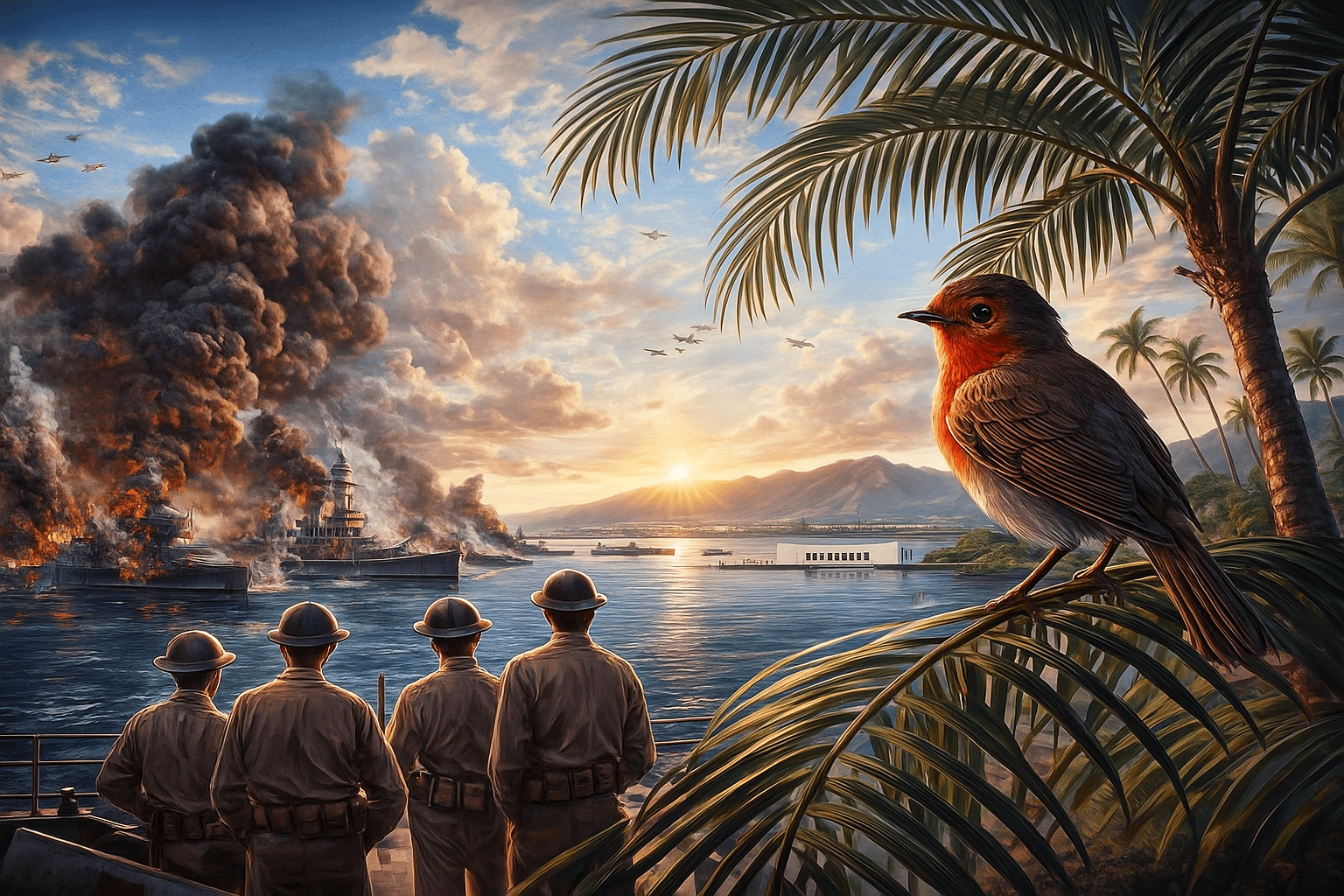
On a clear morning that remains etched into the pages of history, aircraft appeared over Pearl Harbor and the United States Pacific Fleet was struck in a surprise assault. In fewer than two hours, battleships burned, aircraft were destroyed on the ground, and more than 2,400 American service members and civilians lost their lives. The attack thrust the United States into the global conflict of World War II and set in motion a series of events that would transform both the Pacific and the world.
Why the Bombing Took Place
The assault was rooted in a tense and deteriorating relationship between the United States and Imperial Japan. As Japan extended its military reach across East Asia and the Pacific, the United States applied economic pressure most prominently through resource sanctions and an oil embargo aimed at limiting further expansion. Japanese leaders, confronting a perceived strategic emergency and resource shortages, chose a sudden, decisive strike intended to neutralize American naval power and secure room to maneuver in the region.
Strategically intended to buy time and space for Japan’s ambitions, the attack instead hardened American resolve and unified a nation around the urgent work of war and, later, reconstruction.
The Path to Resolution
Contrary to its aim, the attack on Pearl Harbor galvanized the United States. The nation entered World War II, and across four arduous years, the conflict in the Pacific saw intense campaigns from Midway and Guadalcanal to Iwo Jima and Okinawa. The war’s end in 1945 brought devastation and complicated moral reckonings. It was a difficult process toward global peace.
Postwar diplomacy, economic cooperation, and cultural exchange transformed relations between former enemies. The modern alliance between the United States and Japan stands as a testament to the possibility of reconciliation and shared security forged from the ashes of conflict.
The Emotional Toll on Hawai‘i
For residents of Hawai‘i, the attack carried immediate physical danger and lasting emotional weight. Civilians watched explosions from shorelines and neighborhoods; families were separated, and lives were upended. Wartime measures blackouts, curfews, and military rule in some places, altered daily life. The islands’ culturally diverse communities shouldered loss alongside existing struggles caused by colonization and economic change.
"We remember not only the ships and the strategies, but the people who lived through that day, their grief, their courage, their small acts of kindness that held neighborhoods together."
Even as grief ran deep, local responses were shaped by solidarity: neighbors volunteering, hospitals stretched to capacity and supported by donations, and communities holding one another through fear. The aloha spirit, compassion expressed through action, became a quiet form of resistance and resilience.
How We Should Remember and How to Move Forward
Remembrance is an active practice. Ceremonies at memorials such as the USS Arizona invite reflection on individual sacrifice, while classrooms and families carry lessons about the broader causes and consequences of conflict.
Ways to honor the day:
- Visit or virtually observe memorial services and moments of silence to acknowledge those lost.
- Learn and teach the fuller history, politics, military, and human aspects so that memory resists simplification.
- Support veterans, first responders, and families who continue to feel the long-term effects of war.
- Commit to constructive civic engagement that reduces misunderstanding and prevents escalation.
Remembering Pearl Harbor is not an exercise in nostalgia. It is a civic act that asks us to hold the past clearly to understand why tragedy occurred, to grieve for those who suffered, and to use that memory to inform an ethic of prevention and care. It asks communities and nations to choose reconciliation over recrimination, partnership over isolation.
A Future Rooted in Memory
As ceremonies conclude this Sunday and the quiet returns to shores and streets, the challenge is simple and profound: to let memory be a source of moral clarity. We honor those who were lost by telling their stories accurately and compassionately. We honor survivors and descendants by listening and supporting healing. And we honor the future by working together, across differences, to make a world where such losses are far less likely to happen again.
May the memory of that morning and the resilience that followed guide us toward a more peaceful tomorrow.