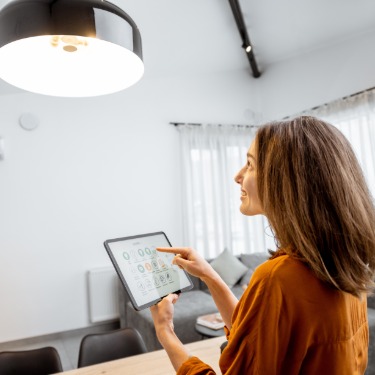
Lighting controls have moved well beyond the familiar toggle switch, yet more technology doesn’t automatically make a home easier to use. Before upgrading home lighting controls, homeowners should look at how each room functions and where better control would solve an everyday frustration.
A dining room may need smooth dimming, while a hallway could benefit from automatic lighting after dark. Starting with those needs keeps the project focused on comfort rather than filling the walls with features nobody uses.
Start With the Rooms That Need Better Control
Walking through the home at different times of day can reveal where the current lighting falls short. Perhaps the kitchen feels overly bright after dinner, or someone regularly leaves the basement lights on.
Those observations can guide the upgrade more effectively than starting with a specific brand. A dimmer may solve one problem, while an occupancy sensor may make more sense elsewhere.
Rooms with several entrances deserve extra attention. A lighting plan should preserve convenient wall control wherever someone naturally enters or leaves the space.
Match the Control to the Room
Lighting controls solve different problems, so room-by-room selection is worthwhile.
Dimmers work well where brightness changes throughout the day. Dining rooms are an obvious candidate, though living rooms and bedrooms can benefit too. A good dimmer lets the homeowner lower light levels without sacrificing normal switch operation.
Occupancy sensors automatically turn lighting on when they detect someone in the space and switch it off after the room stays empty for a set period. That behavior can suit closets or utility spaces where people tend to enter briefly.
Vacancy sensors work differently. Someone turns the lights on manually, and the sensor handles shutoff after the room empties. That can work well when homeowners want automatic shutoff without lights activating every time someone walks past.
The most sophisticated control isn’t necessarily the best choice. The control that disappears into the household routine usually proves more useful.
Pay Attention to Daylight
Rooms with generous windows rarely need the same amount of electric light throughout the day. Morning sun may provide plenty of illumination, while the room needs more artificial light later.
Daylight sensors respond to those changes. Understanding how daylight sensing responds to a room helps explain why sensor placement matters. The control measures available light and can adjust connected fixtures when natural light rises or falls.
Placement deserves careful planning. A sensor that receives direct sunlight may read the room differently than one positioned near where people spend their time.
Window orientation matters as well. A bright south-facing room may give a daylight sensor plenty to work with, while an interior hallway gains little from the feature.
Check Fixture and Dimmer Compatibility
Replacing a traditional switch with a dimmer sounds straightforward until the fixtures start flickering.
LED lamps and fixtures need compatible dimming controls. A poor match may create flicker or prevent the lights from dimming smoothly across the expected range.
Manufacturers commonly publish compatibility information, and an electrician can help match the existing fixtures to an appropriate control. Homeowners replacing lighting fixtures at the same time have greater freedom because they can select the fixture and control together.
Low-voltage lighting may bring other control requirements. Decorative fixtures with integrated LEDs can also have manufacturer-specific recommendations.
Checking those details before ordering controls saves frustration once installation starts.
Look Behind the Existing Switch
The wall plate can hide another important consideration: wiring.
Some smart controls need a neutral conductor at the switch location. Older electrical layouts may not provide one in every box, which can narrow the available products or require extra electrical work.
Multiway lighting creates another question. If two wall locations control the same fixture, the selected system needs compatible controls for that arrangement.
An electrician can inspect these conditions before the homeowner commits to a particular product line. That visit can also reveal crowded boxes or older components that affect installation.
Questions Worth Answering Before Buying
A short review can keep the project focused:
- Which rooms need dimming or automatic shutoff?
- Will the existing fixtures work with the new controls?
- Can wall switches still operate normally without an app?
- Does the existing wiring support the selected system?
These questions also make product comparisons easier because homeowners can ignore features that don't fit the house.
Don't Make the Phone the Only Light Switch
App control sounds convenient until someone wants to walk into a room and turn on the lights.
A well-planned system should preserve intuitive wall controls. Guests shouldn't need instructions, and homeowners shouldn't have to find a phone before using a room.
Internet outages deserve consideration too. Some smart lighting products retain local wall control when connectivity drops, while certain connected features may become unavailable.
Voice commands can complement physical controls when homeowners enjoy them. They shouldn't make ordinary switch operation feel secondary.
Long-term usability matters as well. Lighting controls may stay in place through several phone upgrades, which makes straightforward manual operation worth preserving.
Consider Energy Savings Room by Room
Sensors can reduce unnecessary lighting use by dimming fixtures or turning them off in empty spaces. The size of that benefit depends heavily on how people use the room.
Research from the U.S. Department of Energy found a wide range of lighting energy savings from occupancy sensors across different commercial room types. The figures range from about 10% in some open offices to much higher levels in spaces with intermittent occupancy.
Those commercial findings shouldn't be taken as a promise of residential savings. They do show why usage patterns matter. A sensor has more opportunity to reduce waste in a room where lights regularly stay on after people leave.
A heavily used kitchen may tell a different story because the lights remain useful for much of the day.
Decide How Much Automation the Home Needs
Whole-home lighting systems can coordinate several rooms, while stand-alone dimmers or sensors keep control local.
A homeowner renovating several connected spaces may appreciate coordinated scenes or schedules. Someone updating a single room may find that a conventional dimmer solves the problem with far less complexity.
Either choice can work well when it fits the household.
Future maintenance deserves a place in that decision. Connected products may depend on software support or a particular ecosystem. Conventional controls generally ask less from the homeowner after installation.
Make the Upgrade Feel Invisible
An upgrade to home lighting controls works best when homeowners barely notice the technology during everyday use. The room has the right amount of light when someone needs it.
That result starts with matching controls to real habits and checking compatibility before installation. It also means resisting features that sound impressive but complicate ordinary tasks.
Good lighting control should make the house easier to live in. If family members have to explain the new switches every time someone visits, the system may be doing more than the home ever asked of it.
Bio: Casey is a passionate copyeditor highly motivated to provide compelling SEO content. Her expertise spans technical, consumer, and lifestyle industries with an emphasis on readability and detail.