


A home device that promises better memory, calmer evenings, or more engagement can be hard to ignore when dementia has changed a family’s daily life. That is why red light therapy for dementia patients has become a subject of growing interest. It is also an area where hopeful marketing often moves faster than clinical evidence.
Red and near-infrared light are being studied for possible effects on brain cells, circulation, inflammation, sleep, and mood. The research is worth watching, but it does not yet establish light therapy as a proven treatment for Alzheimer’s disease, vascular dementia, Lewy body dementia, or other causes of cognitive decline. Families considering it need clear expectations, medical guidance, and a careful way to judge any claimed benefit.
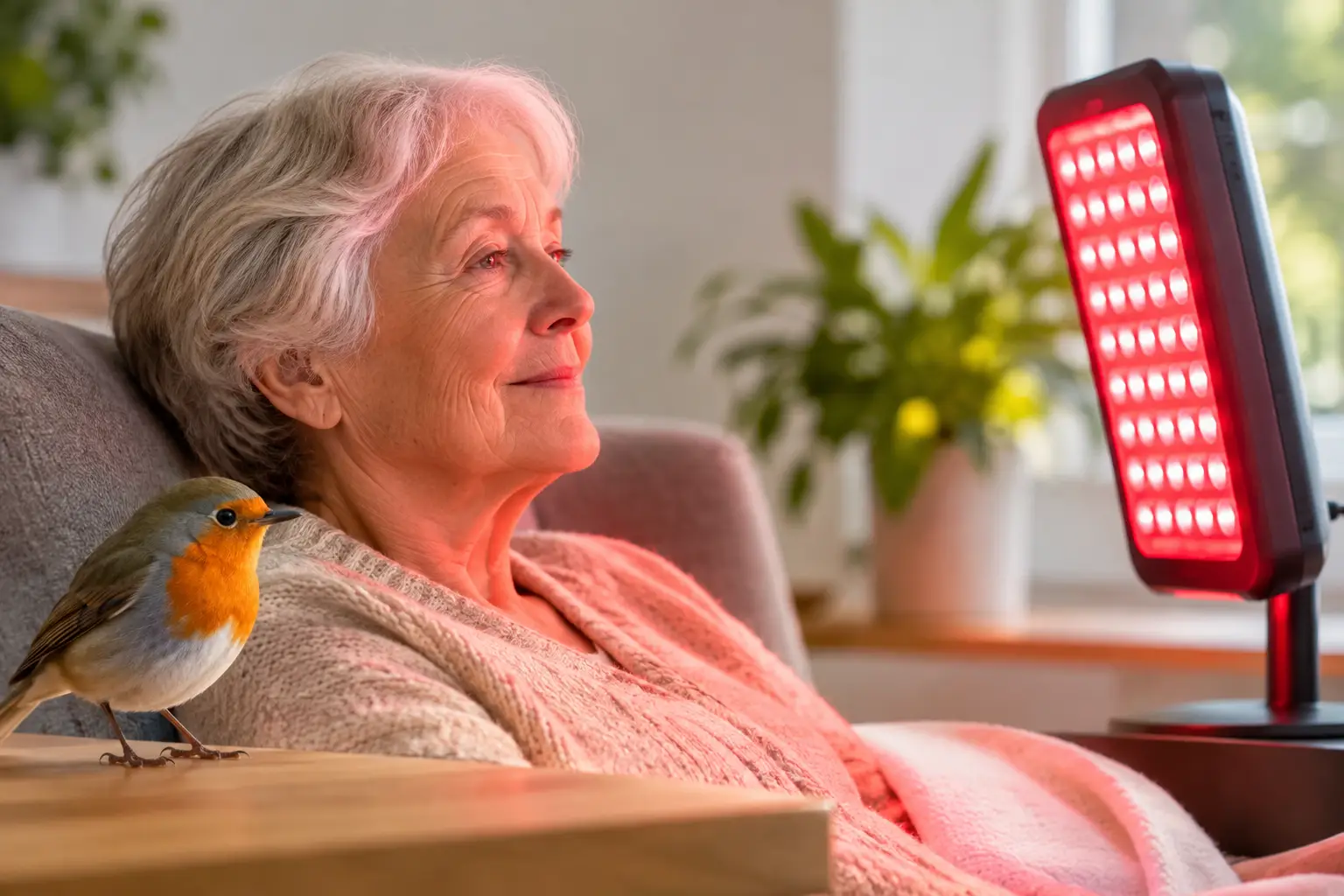
What red light therapy is
Red light therapy, also called photobiomodulation, uses particular wavelengths of visible red light and invisible near-infrared light. Unlike ultraviolet light, it is not intended to tan the skin or cause a sunburn. Depending on the system, light may be delivered through a panel, helmet-like device, headset, nasal device, or a clinical setup that targets a specific part of the body.
The theory is that certain wavelengths can be absorbed by mitochondria, the structures that help cells produce energy. Researchers are exploring whether that response could influence inflammation, blood flow, oxidative stress, or cell signaling. In dementia research, the goal is generally not to reverse established brain damage with light, but to see whether treatment might support brain function or improve symptoms in some people.
That distinction matters. Dementia is not one condition with one pathway. It describes a set of symptoms caused by different diseases and injuries to the brain. A therapy that appears promising in a small study of mild cognitive impairment may not have the same effect for a person with advanced Alzheimer’s disease or dementia following multiple strokes.
Red light therapy for dementia patients: what studies suggest
Early studies of transcranial photobiomodulation, meaning light applied to the head, have reported signals that deserve further study. Some small trials and case reports have described changes in attention, executive function, sleep, mood, agitation, or caregiver observations. Researchers have also investigated light delivered through the nose or used alongside other forms of stimulation.
However, these findings come with major limits. Many studies have involved few participants, short treatment periods, different device settings, and different ways of measuring outcomes. Some did not have the kind of large, blinded comparison group needed to separate a real treatment effect from expectation, day-to-day variation, or the extra attention participants receive during a study.
There is also no widely accepted protocol. Researchers vary the wavelength, power, treatment time, frequency, placement of devices, and total number of sessions. A consumer device that uses the words “red light” may not match the device or dosage used in a study. Two products can look similar online while delivering very different amounts of energy.
For now, the most accurate position is measured: red light therapy is an investigational option for dementia-related symptoms, not a replacement for diagnosis, prescribed medications, cognitive support, or a broader care plan. Larger, well-designed clinical trials are needed to determine who may benefit, which settings are appropriate, and whether any gains last.
Why families are paying attention
The appeal is understandable. Dementia care often involves difficult trade-offs. Medicines may offer limited symptom relief, can cause side effects, and do not work the same way for every person. Non-drug approaches that appear low risk can feel especially attractive when someone is struggling with sleep disruption, anxiety, low mood, social withdrawal, or reduced attention.
Light-based treatments also fit into a wider public conversation about brain health, wearable technology, and care at home. But “noninvasive” does not automatically mean effective, appropriate, or harmless. A device may be physically comfortable while still creating financial pressure, false hope, or a distraction from care needs that have stronger evidence behind them.
A family may decide that a carefully supervised trial is reasonable, particularly if a clinician is aware and expectations are modest. Another family may decide the cost and uncertainty are not justified. Both decisions can be sensible when they are based on reliable information rather than a dramatic testimonial.
Safety questions to ask before trying a device
In published research, red and near-infrared light therapy has generally been described as well tolerated, with reported issues such as temporary headache, eye discomfort, fatigue, skin warmth, or sleep changes. Yet safety data in older adults with multiple medical conditions and advanced dementia remain limited.
Before buying or using a device, discuss it with the person’s physician, neurologist, geriatrician, or other clinician involved in their care. That conversation is particularly useful when the person has a seizure disorder, severe headaches, eye disease, a history of skin cancer, or sensitivity to light. It is also important to review medications. Some medicines can increase photosensitivity, and an individual’s medical history may change the risk calculation.
Eye protection and device instructions deserve close attention. Never assume a product is safe to use near the eyes simply because it is sold directly to consumers. A bright-light device used for circadian rhythm treatment is also different from a red or near-infrared device marketed for photobiomodulation. The terms are sometimes used loosely in advertising, but the intended use and safety considerations may differ.
Be cautious with claims that a device can “treat dementia,” “clear plaques,” or replace medical care. In the United States, a product’s regulatory status, intended use, and marketing language matter. Families should ask whether the device has been evaluated for the specific purpose being advertised, rather than treating a broad wellness label as proof of benefit for dementia.
A practical way to evaluate claims
The best starting point is a specific goal. “Improve dementia” is too broad to measure. A more useful goal might be fewer nighttime awakenings, more participation in conversation, less late-day distress, or better ability to follow a familiar routine. The goal should reflect the person’s stage of dementia and what matters most to them and their caregiver.
If a clinician supports a trial, keep conditions as consistent as possible. Continue prescribed treatment unless the medical team advises otherwise, avoid starting several new interventions at once, and use a simple record of the target symptom. Caregivers can note sleep patterns, mood changes, alertness, headaches, and any discomfort over a defined period.
Four questions can help separate useful information from marketing language:
- What exact device, wavelength, dose, and schedule are being recommended?
- Has that approach been studied in people with a similar diagnosis and stage of dementia?
- What outcome should improve, and how soon would it be reasonable to assess it?
- What would count as a reason to stop, such as discomfort, worsening sleep, agitation, or no meaningful change?
A reputable provider should be able to answer these questions without promising a cure. Be especially skeptical of before-and-after stories with no medical history, no details about other treatments, and no way to know whether changes persisted.
Do not overlook supports with stronger evidence
Interest in technology should not crowd out the basics that often make the biggest difference in daily life. Regular physical activity suited to the person’s abilities, predictable routines, meaningful social contact, hearing and vision support, treatment for pain or depression, and attention to sleep can all affect function and quality of life.
For some people, a medication review is one of the most useful next steps. Drugs with sedating or anticholinergic effects can worsen confusion in certain patients. New agitation, hallucinations, sudden decline, or altered sleep can also signal infection, dehydration, medication effects, constipation, or another medical problem that needs prompt evaluation rather than a new wellness device.
Caregivers deserve support as well. A treatment that adds complicated setup, cost, or conflict may not be a practical fit, even if it appears promising on paper. The best plan is one the person with dementia can tolerate and the household can sustain.
Research into red light therapy for dementia patients may eventually clarify where it belongs in care. Until then, families are best served by curiosity paired with caution: bring the question to a trusted clinician, set a realistic goal, and keep the person’s comfort, safety, and everyday dignity at the center of every decision.