Carwash businesses in the Central U.S. have been busier than usual this week after residents across several states awoke Saturday morning to strange, dusty patterns on their vehicles.
Shopping center parking lots were filled with cars and trucks with the same pattern, convincing drivers it wasnt just something falling out of trees in their yards. TV station meteorologists were quick to offer an explanation.
Mike Goldberg, a meteorologist at CBS 6 in Richmond, Va., said massive dust storms in Texas and New Mexico were responsible. The dust was lifted high into the atmosphere and was brought to earth by a gentle overnight rain shower. The raindrops were filled with dirt and dust from the storms that traveled across the country in the jet stream.
"We are far from alone - this occurred from the central U.S. all the way to the Mid-Atlantic," Goldberg said on the stations website.
Meterorologists say the dirty rain fell over a wide swatch of the country, starting in Missouri and traveling as far as the Atlantic Coast. Besides sending vehicles to the car wash, health officials say the fine dust and dirt particles can cause problems for people with respiratory issues.
Sign up below for The Daily Consumer, our newsletter on the latest consumer news, including recalls, scams, lawsuits and more.
Learn the four Target savings layers Circle offers, manufacturer coupons, gift card promos, and the 5% Circle Card discount can all stack if used correctly.
Combine store and manufacturer coupons You can stack one Target store coupon with one manufacturer coupon on the same item to drop the price fast.
Add rebate apps for extra savings After checkout, scan your receipt with apps like Ibotta or Fetch to earn cashback or points on top of Target discounts.
Using coupons strategically to save money at Target is all about stacking the right discounts. Behind Targets clean red aesthetic lies one of the most stackable savings systems in retail.
The catch? Its layered. And if you dont understand the layers, youll never unlock the real savings.
Heres how Target couponing actually works and how you can turn it into a repeatable system.
First: understand the 4 discount layers at Target
Before you clip anything, you need to understand how Target structures their discounts.
The key to saving big is stacking these different types of discounts in your order. Not by trying to double up the same type of discounts, as that wont work.
Most Target shoppers will only use one savings layer and call it a day. However, the serious savings comes from stacking two to fourat once.
Pro tip: Target coupons and offers refresh every Sunday between midnight and 2 a.m. central time. So, if youre shopping on a Friday or Saturday and not liking any of the deals that youre seeing, wait until Sunday morning and check again.
Target Circle: the engine behind most savings
Target Circle is their completely free loyalty program that lives inside the Target app. If youre not using it, youre overpaying, so youll want to create a free account today.
Inside Circle, youll find the following:
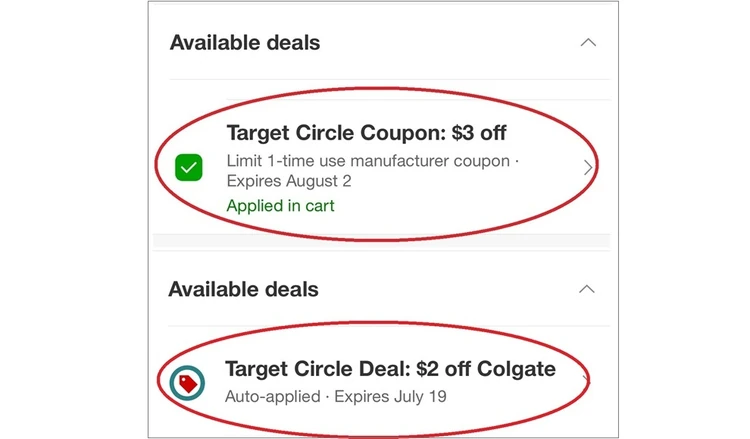
Target Circle coupons (these are auto-applied)
Manufacturer digital coupons (you must click the boxto add them)
Category-wide discounts (like 15% off beauty)
Gift card promos (like $5 gift card when you spend $30 on beauty products)
Personalized Bonus offers
Heres where people get confused:Some Circle offers are store coupons created by Target, and some are manufacturer coupons created by the company that made the product.
Why this matters:
You CAN stack a store coupon with a manufacturer coupon.
You CANNOT stack two manufacturer coupons on the same item.
The app will tell you exactly what type of coupon youre dealing with.
Pro tip: Ive found that the best way to familiarize yourself with the different deals on the Target app and website is to search for the product you want to buy, then tap Target Circle Deals.
This will quickly filter your search results for everything with a Circle discount attached. This will give you a good feel for the types of deals you can expect.
How stacking actually works (with a real breakdown)
Lets walk through a realistic example.
Lets say youre buying laundry detergent and its priced at $14.99.
Then in the app, you find:
$3 Target Circle store coupon
$3 manufacturer coupon
Spend $40 on household items, get $10 gift card promo
Then if you have a Circle Card, that takes another 5% off that $8.99.
Lastly, if this item helps you reach a $40 threshold in household goods, you also trigger a $10 gift card, which effectively reduces your net cost even further.
The cashier will hand you the $10 gift card when in-store, or it will show up in your Target account via their app if you order online.
So, in actuality, that $14.99 detergent will end up costing you closer to $6$7 after factoring in the gift card.
How to actually redeem the coupons
Okay, so you have a few items in your cart, all with Circle offers attached to them, and youre ready to complete your purchase. Youre probably asking yourself, Now what?
When shopping in-store, all you need to do is presentthe Wallet barcode, in the Target app, and the employee will scan it. Thats how their system knows whichsaved Circle offers to apply to your purchase.
When shopping online, you'll need to add any manufacturer coupons orbonus offers that you find before youcheckout. All other Circle discounts, including those free gift card deals, will automatically apply. The discounts will then show in your online order summary, be sure they are all there before you pay.
Pro tip: When I walk into Target, I like to set a reminder on my phone to pull up the Target app and barcode to be scanned at checkout. Because if you forget, they wont retroactively apply your discounts.
Now lets bring Ibotta and Fetch into the mix
Now that you have a good grasp of stacking Circle offers at Target, lets take your savings game to the next level.
Ive personally used Ibotta for years to scan my Target receipts and earn cashback on my in-store purchases. Earnings that you can withdraw to your bank, PayPal account, or via gift cards.
But the whole idea of strategically finding Target Circle Deals that also had Ibotta offers attached to them seemed daunting, and if Im being honest, more effort than it was worth.
But when I set out to find practical ways to make the app work in conjunction with Target offers, I was genuinely surprised at how easy it was to stack my savings.
Heres what I discovered:
1.Ibotta and Target Circle offers often coincide
I was surprised at how many items on the Target app had Circle coupons attached to them as well as Ibotta cashback. Big brands like Purina, Glade, Colgate, Tide, and Brawny to name a few.
2. Search Ibotta by category
Ibotta does a great job of breaking up Target products by category, so you can quickly search the app to see whats available.
When you find a cashback offer you want to use, you need to tap the + sign next to it so the cashback offer gets added to your Ibotta account.
Then when you upload your Target receipt, the cashback gets added to your account within a couple of days.
3. Be open to different brands
The Ibotta and Target Circle mashup works best if youre not stuck on a certain brand and youre willing to buy the brand with the best deal. Obviously, this wont work for everyone, as your dog might need a particular food, or your skin may need a particular laundry detergent.
But for stuff like paper products, trash bags, pastas and rice, cleaning supplies, and even canned vegetables, Ibotta is great as you can easily go off-brand without noticing much difference and save in the process.
Double dipping is easy. At first, I was concerned that if my Target receipt showed that I used a coupon on the item, Ibotta wouldn't accept it.
But thats definitely not the case, as Ibotta accepted my receipt without an issue on multiple items that had a Target coupon attached to it.
Now the Fetch app
The Fetch app is different from Ibotta, as it uses a point-based system where you earn points for scanning grocery receipts and buying specific products.
You then redeem your points for free gift cards at hundreds of different retailers and restaurants.
Heres what you need to know:
1. Offers are lacking when compared to Ibotta
Fetch is a great little companion app to Ibotta but I wouldn't spend a lot of time looking for offers before you go shopping.
They just dont have the quantity of offers to make it worth your while. Instead, focus your time on Ibotta and Target Circle offers.
2. Snap a picture of all receipts
Ive gotten in the habit of submitting all of my Target receipts to Fetch, as you never know what products you bought will trigger a nice little points bonus.
Theyll even occasionally give you points for buying generic products, like bananas and milk.
3. Beware of spending minimums
Some of the better offers on Fetch come with fine print, like having to spend $20 on a specific brand to unlock the bonus points.
Its annoying, and thats why I dont chase Fetch offers. I just scan my Target receipts like clockwork and let the surprise points stack up quietly in the background.
A large U.S. clinical trial found that risk-based breast cancer screening where screening frequency is tailored to each womans individual risk is just as safe as yearly mammograms for catching advanced cancers.
Women were grouped using genetics, lifestyle, and clinical factors; those at highest risk got more intensive screening, while lower-risk women had less frequent imaging.
Most women preferred risk-based screening when given the choice, and the approach led to fewer mammograms overall without increasing dangerous late-stage cancers.
For decades, routine breast cancer screening in the U.S. has largely meant annual mammograms starting in middle age a one-size-fits-all approach based mostly on age.
But what if screening could be smarter?
Thats exactly what researchers set out to test in the WISDOM trial, a large study coordinated by the University of California, San Francisco (UCSF) that asked a simple question: Can we use individual risk profiles to decide who needs what kind of screening?
Published in JAMA and presented at a major cancer symposium, the trial enrolled tens of thousands of women ages 4074 and compared traditional yearly mammograms with a personalized plan driven by each womans unique risk factors including genetics, breast density, lifestyle, and other health details.
These findings should transform clinical guidelines for breast cancer screening and alter clinical practice, Laura J. Esserman, M.D., MBA, director of the UCSF Breast Care Center, said in a news release. The personalized approach begins with risk assessment, incorporating genetic, biological, and lifestyle factors, which can then guide effective prevention strategies.
How the study worked
Instead of automatically giving everyone a mammogram every year, researchers built risk scores that placed participants into different screening pathways.
Women in the highest risk group based on things like genetic predisposition or very high calculated risk were advised to get imaging every six months, switching between mammograms and MRI.
Those with elevated risk still got annual mammograms plus counseling on ways to lower their risk. Most women fell into the average risk category and were recommended to have mammograms every two years. At the lowest end, women with especially low estimated risk were told they could safely delay screening until later often up to age 50 unless their calculated risk rose.
This design also offered tools for personalized risk reduction, like diet and exercise guidance or conversations about medications that may lower cancer risk. Women who chose not to be assigned randomly could pick their own screening approach in an observational group and most picked the risk-based route.
What the results showed
After about five years of following more than 28,000 women, the core finding was that the risk-based screening plan was as safe as traditional annual mammography.
Researchers looked especially at the number of advanced cancers (stage IIB or higher) detected and found that the risk-based group did not have more of these serious cases in fact, the rate was slightly lower across the study period, meeting the trials main goal of noninferiority.
Interestingly, women in the risk-based strategy had fewer mammograms overall but similar rates of biopsies and cancer detection meaning the personalized approach didnt miss cancers or lead to more invasive follow-ups even with less frequent imaging for many.
Whats more, when given the choice, a large majority of participants opted for the risk-based strategy, showing that many people appreciate tailoring screening to their specific profile.
Sorbitol, a common sugar alcohol used in zero-calorie foods and found naturally in some fruits, isnt just a passive sweetener it can be converted inside the body into compounds that stress the liver.
In experiments with zebrafish, sorbitol formed in the gut moves to the liver and becomes a fructose derivative, which fuels fat buildup linked to liver disease.
Friendly gut bacteria normally break down sorbitol, but high levels or an imbalance of microbes may allow more sorbitol to reach the liver.
Sorbitol has long been marketed and often enjoyed as a healthier option for people trying to cut calories or manage blood sugar. Its a sugar alcohol that adds sweetness without the glycemic spike of table sugar, popping up in sugar-free candies, gums, and many diet goodies.
But recent research out of Washington University in St. Louis is prompting scientists and consumers alike to rethink that assumption.
The work suggests that sorbitol may not be quite as biologically innocent as its packaging implies especially when it comes to how the liver handles it.
The study
To understand how sorbitol behaves inside the body, the research team used zebrafish a species scientists often study because many of its metabolic processes work in ways similar to humans. The goal was to follow sorbitol step by step and see where it goes after its produced or consumed.
The researchers focused on the gut and the liver, two organs that play major roles in processing sugars. Using advanced lab tools that let them track tiny molecules, they discovered that cells in the intestine can actually turn glucose into sorbitol. That means sorbitol isnt just something we eat it can also be made inside the body.
In simple terms, the study followed sorbitols journey through the body and found that whether it stays in the gut or reaches the liver may depend heavily on the health of the gut microbiome.
What the results mean and dont mean
The researchers discovered that when sorbitol remains in the gut, certain bacteria can break it down before it causes problems. But when those helpful microbes are reduced or overwhelmed, more sorbitol is able to travel from the intestine to the liver.
Once it reaches the liver, sorbitol doesnt just pass through harmlessly. The liver converts it into a compound related to fructose. Unlike glucose, which the body uses widely for energy, fructose is processed almost entirely in the liver. That process can trigger the production of fat inside liver cells.
In the zebrafish studied, this chain reaction sorbitol moving from the gut to the liver and then being converted was linked to fat buildup in the liver, a hallmark of steatotic liver disease.
The findings suggest that sorbitol may contribute to liver fat accumulation under certain conditions, particularly when the gut microbiome isnt able to effectively break it down first.
While the study was conducted in zebrafish and more research is needed to understand how this translates to humans, the results highlight how a sweetener often considered a safer alternative can still have meaningful effects inside the body.
This tip works especially well with layered drinks like the Ube Coconut Macchiato.
Order a grande and ask for an empty tall cup on the side. Or better yet, instead of asking for a tall cup, order a free water and theyll hook you up with a cup full of ice that you can use for splitting.
Then you can split the drink into two smaller servings. Its not perfect, but it stretches one premium drink into two lighter ones. This is especially helpful with the super-rich flavors like the ube and coconut.
Recreate it at home for 7080% less
While these drinks might look complex, they really arent. You can easily make them at home and save a ton of money.
At-home Ube Coconut Macchiato
Brew strong coffee or espresso
Mix coconut milk with a spoonful of ube powder or ube jam
Add vanilla syrup
Pour over ice and top with coffee
Estimated cost: $1.50$2 per drink.
At-home Lavender Cream Chai
Use chai concentrate
Add milk of choice
Make cold foam with heavy cream + lavender syrup
Pour over ice
Estimated cost: About $1 per drink.
Search TikTok or Instagram for Starbucks ube copycat or lavender chai copycat and youll find dozens of step-by-step videos from creators who break it down in under 60 seconds.
The FDA has issued 30 warning letters to telehealth companies over misleading claims about compounded GLP-1 drugs.
Regulators say some companies implied their compounded products were equivalent to FDA-approved medications or obscured where the drugs were made.
The action is part of a broader crackdown on misleading direct-to-consumer pharmaceutical advertising launched last September.
The U.S. Food and Drug Administration (FDA) has issued warning letters to 30 telehealth companies for making false or misleading claims about compounded GLP-1 drugs promoted on their websites.
The agency said the companies marketed compounded versions of GLP-1 medications in ways that suggested the products were the same as FDA-approved drugs or failed to clearly disclose where the medications were produced.
Its a new era. We are paying close attention to misleading claims being made by telehealth and pharma companies across all media platformsand taking swift action, said FDA Commissioner Dr. Marty Makary.
Makary said compounded drugs can play an important role in addressing shortages or meeting specific patient needs, but warned that compounders should not attempt to bypass the FDAs drug approval process.
Second wave of actions
The warning letters mark the second wave of enforcement actions targeting telehealth companies since the FDA launched a broader effort last September to police misleading direct-to-consumer pharmaceutical advertising.
Over the past six months, the agency said it has sent thousands of warning letters to pharmaceutical and telehealth companies directing them to remove misleading advertisements more than were sent during the entire previous decade.
According to the FDA, the most common violations involved claims that compounded GLP-1 products were the same as FDA-approved medications. Other companies promoted drugs using their own brand names or trademarks without clarifying that a separate pharmacy actually compounded the medications.
The FDA emphasized that compounded drugs are not FDA-approved, meaning the agency does not review them for safety, effectiveness or quality before they are sold. The agency also noted that compounded drugs are not equivalent to generic drugs, which must undergo FDA review and approval.
The warning letters require the companies to correct the violations and remove misleading claims from their marketing materials. Failure to comply could result in further regulatory action, the agency said.
Related Bing News Results Some baby formula brands contain heavy metals, Consumer Reports says Wed, 04 Mar 2026 06:56:54 GMT Tests of dozens of baby formulas by Consumer Reports found that nearly half contained potentially dangerous chemicals. Consumer Reports tests caffeine levels in popular coffee brands Wed, 04 Mar 2026 06:14:00 GMT Consumer Reports examined caffeine levels in various coffee brands, revealing significant differences and emphasizing the importance of moderation. Trader Joe's Daily Facial Sunscreen SPF 40 Wed, 25 Feb 2026 05:13:00 GMT We've tested and reviewed products since 1936. Read CR's review of the Trader Joe's Daily Facial Sunscreen SPF 40 sunscreen to find out if it's worth it. Consumer Reports retests protein powders, finds safer options Wed, 18 Feb 2026 17:22:00 GMT Researchers have tested more popular brands, including five reader-requested chocolate protein powders from Clean Simple Eats, Equate, Premier Protein, Ritual and Truvani. CR Investigates: Toxic beauty ingredients Tue, 17 Feb 2026 17:52:00 GMT Most of us don’t think twice about shampoo, deodorant, or lotion. Now, Consumer Reports reveals that some of those products may contain ingredients linked to cancer risk, hormone disruption, and other ...



 of ConsumerAffairs