A new study conducted by researchers from the Washington University School of Medicine identified an experimental drug that could be effective at preventing the onset of Alzheimers symptoms.
The drug, gantenerumab, works by lowering the amyloid levels in the brain. Amyloid is a protein in the brain that, when elevated, has been linked with Alzheimers. This study showed that targeting the protein directly with this drug was effective at delaying Alzheimers-related symptoms.
I am highly optimistic now, as this could be the first clinical evidence of what will become preventions for people at risk for Alzheimers disease, senior author Randall J. Bateman, MD, said in a news release. One day soon, we may be delaying the onset of Alzheimers disease for millions.
A look at the study
Researchers at Washington State University School of Medicine have been working on the Knight Family Dominantly Inherited Alzheimer Network-Trials Unit (DIAN-TU) since 2012. The ongoing trial was designed to evaluate drugs similar to gantenerumab that work to specifically target the amyloid protein.
All of the participants enrolled in the study had genetic mutations that contribute to increased levels of amyloid. None of the participants had displayed any symptoms related to Alzheimer's or cognitive decline, but based on their genetics, they were predisposed to develop the condition within 10 to 15 years.
While the DIAN-TU study has been ongoing for several years, these most recent results focus on the outcomes of 22 participants who have been taking gantenerumab for an average of eight years.
The results
The researchers observed positive cognitive health outcomes for the study participants taking gantenerumab.
At the start of the study, all of the participants were all but 100% guaranteed to develop Alzheimer's symptoms. After taking the drug for nearly a decade, the risk of developing symptoms was cut in half.
Based on these findings, the researchers believe that targeting the amyloid protein decades before Alzheimers symptoms show up could be an effective way to prevent cognitive decline.
It currently remains a question how long these preventative efforts will continue to protect participants from developing Alzheimers symptoms. However, the researchers are continuing their work to get a better understanding of this.
Everyone in this study was destined to develop Alzheimers disease and some of them havent yet, Dr. Bateman said.
We dont yet know how long they will remain symptom-free maybe a few years or maybe decades. In order to give them the best opportunity to stay cognitively normal, we have continued treatment with another anti-amyloid antibody in hopes they will never develop symptoms at all. What we do know is that its possible at least to delay the onset of the symptoms of Alzheimers disease and give people more years of healthy life.
Time it right. Shop MondayWednesday mornings when weekend donations hit the floor. Learn the color-tag discount cycle at stores like Goodwill and stack 50% tag days with senior, student.or military discounts.
Buy whats underpriced. Look for solid wood furniture, cast iron, vintage Pyrex, and quality small appliances. For resale, brands like Lululemon, Patagonia, and Levi Strauss & Co. consistently hold value.
Think bigger. Check the glass case, visit Goodwill Outlets (sold by the pound) and thrift in affluent neighborhoods or vacation towns for higher-end donations.
Thrift stores can feel fairly random and it often feels like all the good stuff disappeared before you walked in.
But the truth is they operate on very predictable patterns. Especially in terms of donation cycles, color-tag systems, and predictable discount days. If you understand the system, you stop browsing and you start shopping like a savvy insider.
Shop early in the week and early in the day
Weekends are prime donation time. People clean out garages, drop off bags after spring cleaning, and declutter before moving. But the best items dont usually hit the sales floor until a day or two after they get dropped off.
That makes Monday through Wednesday mornings prime hunting hours at the vast majority of thrift stores.
Shopping right when the store opens will give you first crack at all the newly processed items before theyre picked over.
Pro tip: Ask an employee when specific departments are restocked. Its been my experience that theyre always happy to give you the inside scoop. Use this info to your advantageif electronics are always re-stocked Tuesday afternoons, thats when you want to be there.
Learn the color-tag discount cycle
Most large thrift chains, including many Goodwill locations, use a rotating color-tag system.
One day each week, they pick a different colored price tag and offer all those items for an additional 50% off.
Be sure to ask at your local store what day of the week they do this, and try and shop on that day.
If you ignore the color rotation, youre leaving significant money on the table.
Heres how I play the color game at my Goodwill:
Identify which color is discounted this week.
Check items in that color across multiple departments.
Look for higher-end brands that slipped through the standard pricing.
Ive found that items regularly priced at $7-10 often slip through the cracks and have their price drop to $1-$2 during these color-coded events.
Know what employees consistently underprice
Considering the huge number of donated items that have to be sorted, it makes sense that employees dont have the time to research every item.
This creates a great buying opportunity for the savvy shopper.
In my experience, here are the most common underpriced categories:
Solid wood furniture (look for dovetail joints)
Cast iron cookware
Vintage Pyrex
High-end small kitchen appliances
Audio equipment and older speakers
Board games (especially sealed or complete sets)
Picture frames (buy for the frame, not the art)
Solid wood dressers, for example, are often priced the same as particle board pieces, but resell for significantly more.
And if youre not going to resell them, theyre much higher quality and will stand the test of time (and teenagers).
Pro tip:Besure to open boxes and check inside board games for completeness. Also, plug in small appliances and electronics if the store allows it. A 60-second inspection can mean the difference between a big score and a complete dud.
Clothing gold: Brands that hold value
If you do any reselling, you already know that not all clothing labels are created equal.
Some brands consistently resell quite well online, especially on platforms like eBay or Poshmark.
Some unbranded clothing, such as vintage band tees and retro athletic wear, typically outperforms newer mall brands like American Eagle and Old Navy.
Also, be sure to scan the fabric tags, as 100% wool, cashmere, and linen often outperform synthetic blends.
Pro tip: Before buying for resale, check completed eBay listings on your phone. Sold prices tell you what people are actually paying, not the inflated price many sellers are hoping for.
Dont ignore the glass case
Those locked display cases near the register often hold the most overlooked profit potential.
In particular, look for these:
Jewelry
Video games
Designer handbags
Calculators
Small electronics
The prices may be higher than the on-the-rack items, but still well below their market value.
Some locations now also list premium finds on ShopGoodwill.com, where individual stores auction higher-value donations.
Pro tip: If something is priced too high in-store, check if your Goodwill runs periodic additional discounts on display-case items. Ive noticed my local store will do this once or twice per month.
Stack discounts on top of low prices
Many thrift shoppers never ask about additional discounts, which is a major mistake.
Depending on the location, you can often find these discounts (usually between 10%20% off):
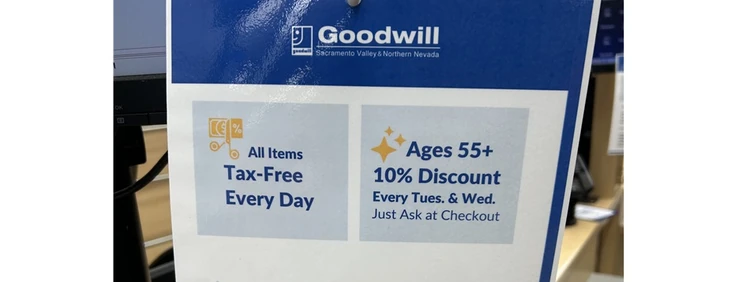
Senior discount days
Military discounts
Student discounts
Teacher discounts
Text or email coupons
Loyalty rewards programs
Be sure to ask an employee, as some stores dont openly advertise these discounts.
Always ask, Do you have any discount days? Even a 10% discount compounds quickly if youre buying multiple items.
Visit the Goodwill Outlet (a.k.a. 'the bins')
If youre serious about savings or resale, you need to see if your town has a Goodwill Outlet.
Just do a Google search for YOUR TOWN Goodwill Outlet or YOUR TOWN thrift bin store.
These are often called bin stores because they dump everything into these large bins that you have to sort through.
They also sell items by the pound, instead of per piece, making them really cheap.
For example, you might pay $1 to $2 per pound for clothing, books, and household goods.
Inventory rotates constantly. Shoppers sift through large rolling bins of unsorted merchandise. Its competitive, but the margins can be substantial.
Pro tip: Wear gloves and bring your own bags. And definitely plan to arrive early, as youll have to stand in line before they open. New bins draw crowds of resellers very fast.
Add 'thrifting' to your next vacation plan
The best thrift stores youll ever visit are in vacation destinations and affluent towns and neighborhoods.
The saying one persons trash is another persons treasure has never been more accurate than in these towns.
People in wealthy areas are much more likely to donate high-quality items and brands, as they dont want to be bothered with reselling them.
For example: When you visit a ski resort town, hit up local thrift stores for awesome deals on snow gear, ski equipment, and expensive winter brands.
The same goes for areas with many expensive golf courses. You just might find your next set of clubs for pennies on the dollar, just because someone needed the next greatest set of clubs and donated their old ones.
A new peer-reviewed study found that about 71% of U.S. baby and toddler foods sold in major grocery stores are classified as ultra-processed.
Ultra-processed products tend to contain more added sugars, sodium, and industrial additives like flavor enhancers and thickeners than less-processed foods.
These findings highlight how common highly-processed commercial foods have become for infants, raising questions about nutrition and labeling transparency.
When youre shopping for baby food whether jars, pouches, or snacks youre likely focused on nutrition: veggies, fruits, maybe a little protein. But a recent scientific study published in Nutrients shows that the majority of those products are what researchers call ultra-processed foods (or UPFs).
That term might sound a bit technical, but it simply refers to foods formulated with industrial ingredients and additives that go well beyond basic pureed produce. Instead of mostly whole ingredients, these products often contain flavoring agents, thickening agents, emulsifiers and even artificial colors.
This level of processing isnt just an academic label it shapes what ends up in your cart and on your babys plate, especially at a stage when taste preferences and dietary habits are being formed.
The study
To figure out just how processed baby foods really are, scientists took a deep look at the ingredient lists and composition of 651 different infant and toddler foods sold in the top 10 grocery retailers in the U.S. in 2023.
Heres what they did:
Collected product data from real store shelves and online listings.
Identified ingredients using standardized food classification systems.
Applied the NOVA system, a widely used framework that categorizes foods according to how processed they are from unprocessed or minimally processed to highly or ultra-processed.
Compared nutrient levels, like sugar and sodium, between ultra-processed and less-processed products.
The researchers also counted how many processed ingredients each item contained and noted which types of additives were most common.
The results
The headline result is clear: about 71% of the products examined were classified as ultra-processed. That means most baby and toddler foods on store shelves rely heavily on industrial ingredients and additives.
Digging deeper, the study showed that:
Additives were everywhere. Flavor enhancers, thickeners, emulsifiers and colors appeared frequently and some products had more than 50 distinct ingredients listed.
Sugar and sodium levels were higher in ultra-processed items compared with less-processed counterparts, and added sugars were found only in the ultra-processed group.
Energy density was also higher among ultra-processed foods meaning more calories packed into the same amount of food.
These patterns held true across many categories, from fruit-based snacks to savory meals even ones that might seem like straightforward nutrition choices.
In other words, if you peel back the labels and really look at whats in that squeeze pouch or jar, most baby foods on the market are a blend of industrial ingredients, flavors and additives rather than simple purees of fruits and vegetables. Which is exactly why more parents and health experts are paying closer attention to whats inside those familiar packages.
What parents should know
The study doesnt suggest that every jar or pouch is bad, but it does show how common ultra-processed options have become in the baby food aisle. For parents, that makes ingredient labels especially important.
Ultra-processed foods are typically identified not just by what they contain fruits, vegetables or grains but by added components like flavorings, thickeners, emulsifiers and added sugars.
Because infants and toddlers are still developing taste preferences, researchers note that early exposure to sweeter or more energy-dense foods may shape what children prefer later on. The findings may prompt some families to look more closely at product labels, compare ingredient lists, or consider less-processed options when available.
In short, the study highlights transparency: understanding how foods are made not just how theyre marketed can help parents make informed choices in a grocery aisle thats increasingly dominated by highly formulated products.
Vehicle problems after three years of ownership rose to 204 problems per 100 vehicles (PP100), the highest level since the studys 2022 redesign.
Infotainment systems and mobile phone integration issues remain the biggest trouble spots, with Android Auto and Apple CarPlay connectivity topping the list for a third straight year.
Premium vehicles saw a sharp increase in reported problems, widening the dependability gap with mass market brands.
Americans are keeping their vehicles longer, meaning dependability is a very important factor in the choice of a make and model. Unfortunately, long-term vehicle dependability has slipped again, as software glitches and technology frustrations weigh heavily on owners, according to the newly released J.D. Power 2026 U.S. Vehicle Dependability StudySM (VDS).
The study, which measures problems experienced by original owners of three-year-old vehicles, found an industry average of 204 problems per 100 vehicles (PP100), up two points from 2025.
In the VDS, a lower score indicates higher quality. This years tally marks the highest problem level recorded since J.D. Power redesigned the study in 2022 and continues a three-year trend of declining dependability.
Technology troubles dominate
Infotainment systems remain the most problematic category, with 56.7 PP100, followed by vehicle exterior issues at 27.5 PP100. Mobile phone integration problems account for four of the top five industry complaints, underscoring how central smartphone connectivity has become to the driving experience.
Android Auto and Apple CarPlay connectivity issues top the list for the third consecutive year at 8.9 PP100. Other frequent trouble spots include built-in Bluetooth systems (5.5 PP100), wireless charging pads (5.1 PP100), and automaker mobile app connectivity (4.7 PP100). Together, these issues account for 24.2 PP100nearly half of all infotainment-related complaints.
As owners hold onto their vehicles longer, the long-term ownership experience matters more than ever, said Jason Norton, director of auto benchmarking at J.D. Power.
He noted that while over-the-air software updates and new technologies are designed to improve vehicles over time, many owners report little benefit after updates are installed. Norton said clearer communication and better owner education could help automakers ensure customers understand the intended improvements.
OTA updates offer limited relief
Software updates are now a routine part of vehicle ownership, with 40% of owners reporting they received at least one update in the past year. However, only 27% said the update improved their vehicle, while 58% noticed no meaningful change.
More than 63% of updates were delivered over the air (OTA). Vehicles receiving OTA updates saw a nearly 14% increase in reported problems this year, equal to 2.5 PP100, suggesting that software fixes may not always translate into improved owner satisfaction.
After two years of relative stability, the premium segment saw a significant increase in problems, rising eight PP100 to 217. Thats the highest level for premium vehicles since the studys redesign. The performance gap between premium and mass market brands widened to 17 PP100, with premium brands underperforming in seven of nine categories.
Premium vehicles lagged most notably in features, controls and displays, as well as driving experience. Only powertrain and seat-related issues were less problematic among premium brands.
Electrified vehicles show higher problem counts
Electrified vehicles continue to present more long-term challenges than their gas-powered counterparts.
Plug-in hybrid electric vehicles (PHEVs) recorded the highest problem rate of any powertrain type at 281 PP100, a year-over-year increase of 39 PP100. Battery electric vehicles (BEVs) and hybrids also saw increases, both rising 14 PP100 to 237 and 213 PP100, respectively.
In contrast, gas-powered vehicles improved slightly, dropping two PP100 to 198, making them the least problematic powertrain type in the study.
Among premium brands, Lexus ranked highest in dependability for the fourth consecutive year with a score of 151 PP100. Cadillac (175 PP100) placed second, followed by Porsche (182 PP100).
In the mass market segment, Buick led for the second straight year at 160 PP100. MINI ranked second at 168 PP100, and Chevrolet placed third at 178 PP100.
Toyota Motor Corporation earned the most model-level awards, with eight vehicles recognized, including the top overall model, the Lexus IS. Other award winners include the Lexus UX, Lexus GX, Toyota Corolla, Toyota Camry, Toyota Tacoma, Toyota Sienna, and Toyota 4Runner. General Motors received four model-level awards for the Buick Enclave, Cadillac XT6, Chevrolet Equinox, and Chevrolet Tahoe.
Scammers are using AI chatbots posing as trusted assistants to sell fake cryptocurrencies.
A fraudulent Google Coin presale site featured a chatbot claiming to be Googles Gemini AI, complete with branding and detailed investment projections.
Google does not have a cryptocurrency, but the convincing AI-driven pitch is designed to pressure victims into sending irreversible crypto payments.
A new cryptocurrency scam is leveraging artificial intelligence in a way that marks a troubling evolution in online fraud: custom-built chatbots that impersonate legitimate AI assistants to persuade victims to invest in worthless tokens.
Cybersecurity firm Malwarebytes recently uncovered a live Google Coin presale website featuring a chatbot that introduced itself as Gemini your AI assistant for the Google Coin platform. The bot used Gemini-style branding, including a sparkle icon and a green Online status indicator, creating the impression that it was an official Google product.
It wasnt.
AI as the closer
The chatbot didnt just greet visitors it acted as a full-fledged sales representative.
When asked, Will I get rich if I buy 100 coins, the bot provided specific financial projections. A $395 investment at the supposed presale price of $3.95 per token would allegedly be worth $2,755 at a future listing price of $27.55 approximately 7x growth, according to the chatbot. It then invited users to ask how to participate.
This kind of personalized, back-and-forth engagement once required human scammers operating through Telegram or WhatsApp chats. Now, AI can automate the entire pitch, responding instantly with tailored answers designed to build trust and overcome skepticism.
A persona that never breaks
What stood out most in Malwarebytes analysis was how tightly controlled the chatbots persona appeared to be.
The bot consistently claimed to be the official helper for the Google Coin platform. Yet it refused to provide any verifiable company information no registered entity, regulator, license number, audit firm, or official email address.
When confronted with concerns, it redirected users to vague claims about transparency and security. It would not acknowledge any possibility that the project could be a scam. More difficult questions were reportedly referred to an unnamed manager, suggesting a human operator might step in when needed.
Unlike some AI systems that can be pushed off-script, this bot repeatedly looped back to the same selling points: a detailed 2026 roadmap, military-grade encryption, AI integration, and a growing community of investors.
Whoever built it effectively locked the chatbot into a conversion script with a single goal getting victims to send cryptocurrency.
A polished fake
The chatbot sat atop a professionally designed scam site that mimicked Googles branding, complete with the G logo, sleek navigation menus, and a presale dashboard.
The site claimed to be in Stage 5 of 5, with more than 9.9 million tokens sold and a looming February 18 listing date classic urgency tactics. It also displayed logos from major companies, including OpenAI, Google, Binance, Coinbase, Squarespace, and SpaceX, under a Trusted By Industry banner. None of those companies are connected to the project.
Clicking Buy brought users to a wallet dashboard showing balances for a fictional Google token on a made-up Google-Chain, alongside Bitcoin and Ethereum. Buyers could select any number of tokens, triggering a Bitcoin payment request to a specific wallet address.
A tiered bonus system offered additional tokens for larger purchases, with bonuses ranging from 5% at 100 tokens up to 30% at 100,000 tokens a classic upsell strategy to encourage bigger, irreversible payments.
There is no legitimate exchange listing. The token has no real-world value. And once cryptocurrency is sent, it cannot be recovered.
AI scales the scam
Scammers have long relied on social engineering: build trust, create urgency, overcome doubt, and close the deal. Traditionally, that required teams of human operators, limiting how many potential victims they could handle at once.
AI chatbots eliminate that bottleneck.
A single operation can now deploy a chatbot capable of engaging hundreds of visitors simultaneously, 24 hours a day. The messaging is consistent, polished, and authoritative. The bot can impersonate a trusted AI brand, respond with customized financial projections,and escalate only the most promising leads to human closers.
The broader trend is already visible. According to Chainalysis, roughly 60% of funds flowing into crypto scam wallets are tied to scammers using AI tools. AI-powered infrastructure is quickly becoming standard in crypto fraud operations.
The chatbot is just one component of that toolkit but it may be the most persuasive, because it creates the illusion of an interactive relationship between the victim and a trusted brand.
Investment on the rise
The timing is significant. According to the Federal Trade Commissions Consumer Sentinel data, U.S. consumers reported losing $5.7 billion to investment in 2024 more than any other type of fraud and a 24% increase from the previous year.
Cryptocurrency remains the second-most common payment method used in , largely because transactions are fast and irreversible. When combined with AI capable of delivering a convincing sales pitch at scale, the fraud model becomes even more powerful.
How to spot AI-driven crypto
Malwarebytes warns that AI chatbots on scam sites are likely to become more common. Consumers should be wary of:
Impersonation of known AI brands. A chatbot calling itself Gemini, ChatGPT, or Copilot on a third-party crypto site is almost certainly not affiliated with those companies.
Evasion of due diligence questions. Legitimate operations can provide verifiable information about their legal entity, regulatory oversight, and registration. Scam bots tend to avoid or deflect those questions.
Specific return projections. No legitimate investment product guarantees a future price. Promises that a $395 investment will become $2,755 are red flags.
High-pressure urgency. Claims about final presale stages, imminent listings, or limited-time bonuses are designed to push quick decisions.
How to protect yourself
Google does not have a cryptocurrency, has not launched a presale, and is not using Gemini as a sales assistant on third-party crypto sites.
Consumer advocates recommend:
Verifying claims on a companys official website.
Not relying on chatbot branding as proof of legitimacy.
Never sending cryptocurrency based on projected returns.
Searching a project name along with scam or review before investing.
Using web protection tools such as Malwarebytes Browser Guard to block known and suspected scam sites.
Anyone who has already sent funds should report the incident to local law enforcement, the FTC at reportfraud.ftc.gov and the FBIs Internet Crime Complaint Center at ic3.gov.
As AI tools become more accessible, scammers are adapting quickly. The face of online fraud may now look like a friendly chatbot but the outcome remains the same.
Wait to book. Expedia says international travelers can save about $190 by booking 1530 days out instead of six months early.
Timing pays. Book on Monday. Fly Thursday (international) or Friday (domestic) for the lowest fares. Tuesday is the least crowded day to travel.
September saves. Its the cheapest month for international trips about 26% less than December.
If youve ever felt like airfare pricing is random, youre not alone. But according to new data from Expedia, its not random, its just misunderstood.
The companys annual Air Hacks report analyzes millions of real flight bookings to uncover patterns in pricing, booking timing, and travel days. And some of the findings flip common travel advice on its head.
Heres what consumers should know before booking their next trip.
The 'book super early'rule isnt always true
Many travelers assume the earlier you book, the better the deal. But Expedias data suggests theres a sweet spot.
Booking too far in advance can actually mean paying more. Instead, if you can stomach waiting until closer to departure, youll typically get better pricing for many routes.
Expedia recommends booking just a few weeks to a couple of months before departure, depending on the route.
International travelers can save an average of $190 by booking 15 to 30 days ahead instead of locking in fares six months in advance. Even booking 31 to 45 days out can yield average savings of $185.
The sweet spot is often closer to departure than many travelers think.
Translation: Dont panic-book six months out unless youre traveling in a peak holiday season.
Book on a Monday, fly on a Friday
If youre booking a flight, aim for Monday. Data shows its consistently one of the better days to lock in lower fares.
When it comes to the day you actually fly, timing matters even more.
For international trips, Thursday is the cheapest day to fly and about 8% less than Saturday, which is the most expensive.
In the biggest surprise to me, Friday is the cheapest day to depart for domestic travel, saving up to 7% compared to flying on Monday.
On a $600 ticket, that difference could mean keeping $40 to $50 in your pocket.
September is the cheapest month to travel
If you have the flexibility, September is the most budget-friendly month for international travel. Fares are about 26% lower than in December, translating to average savings of around $160.
The obvious tradeoff is that kids are back in school and summer travel demand drops big-timewhich is exactly why airfare gets cheaper.
January is also one of the least busy months to fly, while August is typically the most crowded and expensive.
Fly on Tuesday to avoid the chaos
If youre trying to avoid packed airports and long security lines, Tuesday is the least busy day to fly. Friday is the busiest day, which is why Im surprised Expedia says its the cheapest.
Some of the calmest individual travel dates in 2026 are projected to be April 8, June 10, November 25, and December 10. Peak congestion is expected around June 24, August 1 and 15, and October 10.
The rise of the 24-hour 'micro-cation'
Short trips are gaining serious traction in 2026 according to Expedia.
So-called micro-cations are 24-hour getaway trips which started as a TikTok trend but are quickly going mainstream. About a quarter of Millennials and Gen Z travelers say they plan to fly somewhere for just a day.
Some of the more popular quick-stay destinations include New York City, Chicago, and Washington, D.C. all cities with frequent flights and dense, walkable attractions that make short stays practical.
Related Bing News Results Consumer Reports retests protein powders, finds safer options Wed, 18 Feb 2026 20:22:00 GMT Researchers have tested more popular brands, including five reader-requested chocolate protein powders from Clean Simple Eats, Equate, Premier Protein, Ritual and Truvani. Consumer Reports investigates toxic beauty ingredients Tue, 17 Feb 2026 17:52:00 GMT Consumer Reports uncovers hidden risks in daily cosmetics, urging consumers to read labels and avoid harmful chemicals like phthalates and formaldehyde. 7 cars Consumer Reports says are smart buys for 2026 Mon, 09 Feb 2026 12:45:34 GMT You want a smart car purchase that balances fuel economy, safety, and long-term value — […] ... Consumer Reports' top 10 vehicles for 2026 — see which cars made the list Wed, 04 Feb 2026 14:40:11 GMT For the first time, the top 10 cars on Consumer Reports' annual list of best new vehicles also include electric or hybrid models. Consumer Reports tests more protein powders for lead Mon, 26 Jan 2026 15:41:00 GMT DENVER — Last fall, Consumer Reports tested dozens of protein powders and ready-to-drink shakes. What the lab found raised red flags: more than two-thirds contained more lead in one serving than CR’s ...