Rockin Robin SongFlying The Web For News.
RobinPost Logo Amazon Prime Deals


Consumer Daily Reports

A new Medicare program caps the cost of expensive drugs

By Mark Huffman Consumer News: Here’s how cancer patients on Medicare can save money on treatments of ConsumerAffairs
April 28, 2025

Key takeaways

  • Medicare Part D reforms under the Inflation Reduction Act now cap annual out-of-pocket drug costs at $2,000, offering significant relief from previous expenses that could exceed $10,000 for cancer patients.

  • The new Medicare Prescription Payment Plan (MPPP) allows patients to spread their $2,000 maximum into affordable monthly payments, but early enrollment is crucial to maximize benefits.

  • Awareness and timely enrollment in the MPPP are essential, as researchers emphasize that without proactive participation, many patients may continue to face financial barriers to critical cancer treatments.


Cancer treatments are very expensive, even for seniors on Medicare. But a new study from the University of Pennsylvanias Perelman School of Medicine found a new Medicare program that began this year could dramatically ease the financial burden faced by cancer patients needing expensive oral medications if they take full advantage of it.

Under the Inflation Reduction Act, annual out-of-pocket drug costs for Medicare Part D beneficiaries will be capped at $2,000, a sweeping change from the current reality where patients often face bills exceeding $10,000. However, researchers warn that without awareness of the newly introduced Medicare Prescription Payment Plan, patients may still struggle with the timing of those costs.

Until now, Medicares structure left patients facing heavy financial exposure. In 2023, patients paid a $505 deductible, 25% coinsurance until reaching a high threshold, and then 5% of drug costs indefinitely. This meant drugs like enzalutamide for prostate cancer could cost a patient over $11,000 a year, and combination regimens like dabrafenib/trametinib for melanoma and thyroid cancers could soar above $20,000 annually.

Even worse, a large portion of these payments was front-loaded into the early months of the year, leading to devastating upfront costs. Prior research by the Penn team found that 42% of patients abandoned treatment due to these early-year expenses a dangerous interruption that could allow cancers to grow or return.

Time is of the essence

The Medicare Prescription Payment Plan offers a simple but powerful solution: allowing patients to divide their annual $2,000 out-of-pocket maximum into monthly installments. Patients who enrolled in January 2025, for example, would pay about $167 per month.

High out-of-pocket costs often put these critical medicines out of reach and can lead to patients abandoning treatment, study lead author Jalpa Doshi said in a press release. The annual out-of-pocket maximum and MPPP together make it possible for Medicare Part D beneficiaries to greatly reduce these costs, on an annual and monthly basis.

However, Doshi emphasized that timing is critical. Patients must enroll early in the year to fully benefit from spreading out payments. Oncology providers, she said, must proactively inform patients about the MPPP and encourage early enrollment to prevent lapses in critical treatment.

More affordable treatments

The new cost-sharing caps under the IRA paired with monthly payment options through the MPPP represent an unprecedented opportunity to make lifesaving oral cancer drugs more affordable and accessible for Medicare beneficiaries, researchers said. Yet the success of these reforms hinges on awareness and enrollment.

Sign up below for The Daily Consumer, our newsletter on the latest consumer news, including recalls, scams, lawsuits and more.


Posted: 2025-04-28 12:09:05

Get Full News Story On Consumer Affairs


Listen to this article. Speaker link opens in a new window.
Text To Speech BETA Test Version.


More News From This Category
Consumer News: Why checking a store’s app before you shop can save you hundreds
Fri, 24 Apr 2026 01:07:07 +0000

Why the best price isnt always in front of you

By Kyle James of ConsumerAffairs
April 23, 2026
  • Many big-box retailers like Home Depot and Best Buy offer online-only deals that arent shown in-store, making it easy to overpay if you dont check.

  • Big-ticket items are often priced lower online or stored in warehouses, meaning the best deals arent always on the sales floor and employees dont even know about them.

  • Smart shoppers check the app/online before buying, compare prices in-store, and use online pricing for pickup or price matching.


For years, shoppers were trained to trust what they saw on the shelf.

If a refrigerator was labeled $1,299 in-store, that was the price. If a TV had a tag, that was the deal.

But thats no longer how retail works.

Today, many of the best deals are happening inside store apps and online listings. And if youre not checking before you shop, you could be paying significantly more than you need to.

The real-world example most shoppers miss

Photo

Lets start with something simple, and expensive: major appliances.

I was recently talking with my mom about how she needed to buy a new refrigerator for a rental house. She told me, Did you know the Home Depot website has deals on refrigerators that you cant find if you walk into the store? Being the bargain hunter that I am, I was immediately intrigued.

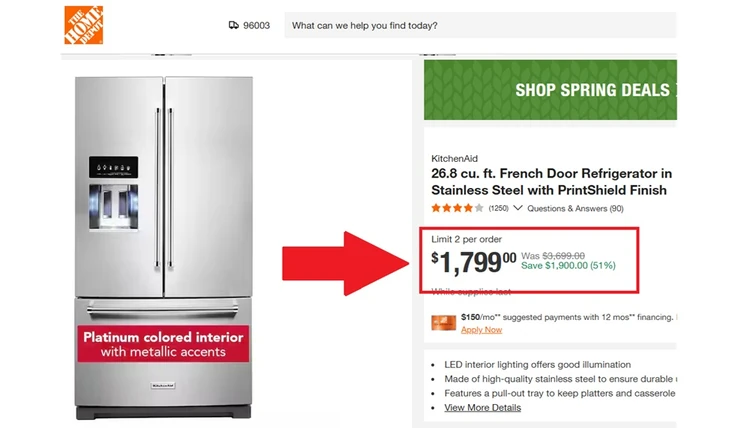
She explained that she had gone into the Home Depot and didnt notice any good deals on refrigerators. Later, on a whim, she decided to check the Home Depot website and found a 26.8 KitchenAid French Door fridge for just $1,799, regularly $3,699. As you can see by the screenshot above, thats a whopping 51% off.

So she wrote down the model number and headed back to the Home Depot, thinking the deal might be too good to be true and they probably wouldnt have it available.

An employee put the model number into the computer and said, Yep, we have a couple available at that price in our warehouse, where do you want it delivered?

If she hadnt done the extra research online, she never would have known the deal existed. There are often no signs in-store pointing out deals like this. No obvious indication that a better deal exists beyond what sits on the sales floor.

And when youre talking about big-ticket items like refrigerators, TVs, dishwashers, or ovens, the savings can easily reach into the thousands, like it did for my mom.

This isnt just a Home Depot thing

This pricing gap is happening across multiple major retailers and big-box stores, and in many different product categories as well.

At Lowes, similar situations pop up regularly. Tools, outdoor equipment, and appliances may carry in-store pricing that doesnt reflect online promotions, bundle discounts, or limited-time app deals.

For example:

  • A power tool set might be listed at full price on the shelf, while another similar set might be cheaper but only found on their website.
  • The app may include a bundled accessory or discount that you cant find in-store.

At Best Buy, the gap can be even more dynamic.

Electronics pricing changes fast, and Best Buy frequently runs:

  • App-exclusive deals
  • Flash sales
  • Member pricing
  • Online-only discounts

A TV you see in-store might look like a solid deal, but checking the app could reveal:

  • A lower online price
  • A bundle with accessories
  • Or a limited-time discount not shown in-store

Other stores where this often works includeTarget, Sams Club, IKEA, Walmart, and even Costco.

The takeaway is that what you see in-store, versus whats on the app/website, is not always in sync and it turns out theyre not meant to be.

Why many retailers are doing this

Many retailers are intentionally moving deals into their digital platforms for a few key reasons:

1. They want you using their app

Apps allow retailers to:

  • Send notifications
  • Track your shopping behavior
  • Promote personalized deals

And they know that once you download the app and start using it, youre much more likely to return to the store.

2. They can change pricing faster

Updating in-store price tags takes up a lot of time and labor. While updating pricing on a website, or app, can be done in seconds.

That means retailers can:

  • Run short-term promotions
  • Adjust prices based on inventory
  • Test different pricing strategies

3. They can target specific shoppers

Not every deal is meant for everyone.

Some discounts are:

  • Location-based
  • Time-sensitive
  • Or tied to digital engagement

4. It reduces reliance on in-store staff

Instead of training employees to explain every deal, retailers let the app do the work.

That puts the responsibility on you, the shopper, to seek out the deals online before you head to the actual store.

Why most people never notice

Even though these deals are widely available, most shoppers completely miss them.

That comes down to habit, as most people:

  • Walk into a store with a general idea of what they want
  • Look at the price tag
  • Make a decision based on whats in front of them

Many shoppers rarely:

  • Open the stores app
  • Cross-check pricing
  • Compare online listings

They are also assumingthat: If it were cheaper, theyd tell me.

But thats no longer how retail works, especially at many big-box stores where not all inventory is on the sales floor,but in a regional warehouse somewhere.

In fact, the system now rewards shoppers who take an extra step to look online and quietly penalizes those who dont.

What smart shoppers do differently

The difference between paying full price and getting the best deal often comes down to a simple habit shift.

Heres how experienced shoppers approach it:

1. They check the app before leaving home.

Before heading to stores like Home Depot, Lowes, or Best Buy, they search the item they plan to buy.

Specifically, theyre looking for:

  • Lower online pricing
  • Active promotions and deals that dont exist in-store
  • Bundle offers

This takes less than a minute in most case, but it sets a baseline. Now they know what the item should cost.

2. They use the app inside the store.

Once theyre in-store, they dont rely solely on shelf price tags.

Instead, they:

  • Scan barcodes
  • Search product names
  • Compare listings in real time

This often reveals:

  • Hidden discounts
  • Pricing discrepancies
  • Availability at nearby locations

3. They look for online only deals.

This is where some of the biggest savings are hidden.

Many retailers label deals as:

  • Online only
  • App exclusive

But heres the trick most people miss: You can usually buy the item in the app and choose in-store pickup while standing in the store.

Same product. Lower price. No extra effort.

4. They ask for price matches.

If they find a lower price in the stores app, they dont simply ignore it.

Instead, they:

  • Show the lower price at checkout.
  • Ask if it can be matched on the spot.

In many cases, retailers will absolutely honor their own online pricing.


Read More ...


Consumer News: The ‘heat or eat’ reality: Why 1 in 5 Americans are skipping meals to stay warm
Thu, 23 Apr 2026 19:07:06 +0000

Rising energy costs are forcing many households to cut back on food, risk safety, or fall behind on bills

By Kristen Dalli of ConsumerAffairs
April 23, 2026

  • Nearly one in five lower-income Americans are skipping meals or cutting back on groceries just to afford heating and electricity during colder months.

  • Many households are making risky trade-offs, with some turning to unsafe heating methods or falling behind on rent and other essential bills.

  • Most dont know help is available, with 74% unaware of where to find emergency energy assistance programs like LIHEAP.


When temperatures drop, most people expect higher heating bills but for millions of Americans, the impact goes far beyond a seasonal expense. Its a daily balancing act between staying warm and covering basic needs.

New data from Payless Power highlights just how tough those choices have become, especially for lower-income households.

From skipping meals to using potentially unsafe heating methods, many families are making difficult and sometimes dangerous trade-offs just to get through the winter. ConsumerAffairs spoke with CEO Brandon Young who shed light on whats driving this growing heat or eat crisis and what it means for consumers trying to keep up.

Making sacrifices

Young explained that the "heat or eat" dilemma has existed as long as energy costs have been a burden on tight budgets. However, rising electricity prices and unpredictable cold-weather events have made it more acute.

Our survey found that 19% of lower-income Americans have skipped meals or cut back on groceries to afford their heating or electricity bills during cold months, he said. That's nearly one in five people making a direct choice between food and heat.

When you zoom out, 60% of lower-income Americans made some kind of financial sacrifice to cover winter energy costs.

Strategies for saving

Young says there are a few ways to make a real difference without spending much money.

  • Lowering your thermostat. Even a few degrees while you sleep or when you're out, which is the most common thing people already do, but its for good reason. Our survey found 34% of lower-income Americans use this as their main way to manage winter bills.

  • Sealing drafts around doors and windows. It sounds basic, but 19% of lower-income Americans told us their homes are poorly insulated and lose heat fast, even small fixes like weatherstripping or a door sweep make a noticeable difference.

  • Unplug things you're not using, use rugs on bare floors, and keep curtains closed at night to hold heat in.

Resources for assistance

If youre struggling to keep up with your energy bills, youre certainly not alone. But do you know the resources that exist to help make the month-to-month expenses a bit easier?

The survey revealed that 74% of lower-income Americans don't know where to access emergency energy assistance, including the primary federal program designed specifically to help them. Additionally, 52% have never heard of LIHEAP at all, and 22% have heard of it but don't know how it works or where to apply.

Young shared the key resources:

  • LIHEAP (Low Income Home Energy Assistance Program): The main federal heating and cooling assistance program. Eligibility is based on income and household size. Find your local agency and apply at liheap.org/directory, or call 1-866-674-6327.

  • 211: Dial 2-1-1 or visit 211.org to be connected to local energy assistance, food banks, and other emergency support programs in your area.

  • Your utility provider directly: Many utilities have their own hardship or low-income assistance programs separate from LIHEAP. Call the number on your bill and ask specifically about payment assistance, payment plans, or cold-weather disconnection protections.

  • Community Action Agencies: These local nonprofits administer LIHEAP in most states and often hold additional emergency funds. Search at communityactionpartnership.com.

  • The Salvation Army and Catholic Charities both operate utility assistance programs funded independently from federal sources in many communities.

Issues persist with AC

As the warmer weather heats up, many consumers are starting to put on the air conditioning. Young explained that the survey focused specifically on cold snaps and winter heating costs; however, the underlying financial pressure is absolutely a year-round reality for lower-income households.

The same dynamics that drive winter trade-offs, tight budgets, rising energy costs, poorly insulated homes, apply equally in summer, he said. Our data showed that 19% of lower-income Americans live in homes that are poorly insulated and lose heat quickly in winter and those same homes tend to trap heat in summer, forcing air conditioning systems to work harder and driving bills higher.

LIHEAP does include a cooling assistance component for summer months, and the awareness gap we documented for winter assistance almost certainly extends to summer as well. Energy insecurity doesn't take a season off; it's a year-round challenge for households already managing tight budgets.


Read More ...


Consumer News: What are Americans really keeping in storage units?
Thu, 23 Apr 2026 19:07:06 +0000

From hidden cash to side hustles, storage units are becoming private extensions of everyday life

By Kristen Dalli of ConsumerAffairs
April 23, 2026
  • Nearly six in 10 Americans say theyve used a storage unit to hide something private and many are using the space for more than just storage.

  • Storage units are doubling as flexible spaces for side hustles, small businesses, and even personal escapes from daily stress.

  • With valuable items like cash and documents being stored, choosing the right unit features and using the space intentionally matters more than ever.


Whats really inside Americas storage units? It turns out, a lot more than old furniture and holiday decorations.

A new survey from SpareFoot reveals that these spaces are increasingly being used to stash personal items, keep secrets, and even carve out a little breathing room from everyday life. In fact, nearly six in 10 Americans say theyve used a storage unit to hide something private.

But the story goes deeper than secrecy. For some, storage units double as quiet escapes from crowded homes or stressful routines. Others are using them to run small businesses or side hustles, turning a simple rental into a source of extra income.

ConsumerAffairs spoke with Kathryn Kennedy, General Manager, Storable, who explained that as housing costs rise and personal space shrinks, these units are evolving into something more personal a place to store not just belongings, but parts of life people arent ready to share.

Flexible spaces

Sparefoot surveyed 1,000 adults across the U.S. who either currently rent storage space or have previously rented storage space. According to Kennedy, the survey found that these spaces are less about storage, and more about flexibility.

Our research found that one in three adults are using a storage unit to generate income, and the most common types of businesses are resellers, like eBay or Etsy shops, she said.

Landscaping or photography businesses were also more common.Theres a small but growing portion of people using their units as small workshops or content generation studios, such as building/repairing goods and filming social media content. It speaks to the creative nature of many adults in todays economy, and figuring out low cost workspaces outside their home.

A place to escape to

In addition to side hustles and building businesses, many storage unit-renters are using the space to escape.

The survey showed that more than one in three people have used their unit as a way to step away from daily life, whether thats to get privacy, decompress, or just have a quiet place to think/reflect.

One in 10 people specifically said they use their unit to escape work stress or family pressures, and thats pretty understandable when a lot of homes have little to no personal space, especially if you have kids, Kennedy said. In that sense, your storage unit is a controlled environment where you can reset without any interruptions.

Protect your assets

With many consumers leaving important items in their storage unit, knowing the level of safety and protection of your specific unit is paramount.

One of the biggest misconceptions is that all storage units offer the same level of protection, but in reality, the right fit depends a lot on what youre storing, Kennedy said. The data shows that a significant share of renters are keeping cash (36%) and sensitive documents (28%) in their units, which raises the stakes when it comes to choosing features like climate control, surveillance, gated access, and individual unit alarms.

"Not every facility is built for high-value or sensitive items, so its important for consumers to be intentional rather than just going with whats most convenient.

Make the most of your storage unit

If you have a storage, or youre thinking of renting one, think about how you can make the most of the space especially given the cost.

Treat your unit as a functional space, not just a catch-all, Kennedy said. People who get the most value are using their units intentionally, whether thats organizing inventory for resale, creating small workspaces, or rotating items in and out vs letting them ideal indefinitely. Considering how many are already merging storage with side hustles or strategic use, theres 100% an opportunity to offset costs by making the space more productive.

You can even consolidate, downsize unit size, or regularly take stock of whats inside, all of these things can make a noticeable difference.


Read More ...


Consumer News: The ‘fake invite’ scam that tricks you through people you trust
Thu, 23 Apr 2026 19:07:06 +0000

How to spot a fake invitation before its too late

By Kyle James of ConsumerAffairs
April 23, 2026
  • Scammers hijack accounts and send fake invites that look real, tricking you into logging in and handing over your email and password.

  • Once you click, they can take over your account, access your contacts, and spread the scam to your friends often before you realize it.

  • Protect yourself by not clicking right away, verifying invites directly with the sender, and never entering login info through email links.


A recent column from The Washington Post highlights a fast-growing scam that feels harmless at first, but can quickly spiral into identity theft.

It often starts with a simple party initiation sent to your email or Facebook account.

Maybe it says, Youre invited! or Shhh its a surprise! and it usually comes from someone you know or a name you recognize. But behind the scenes, its part of a larger scheme where scammers hijack accounts, impersonate people, and take advantage of peoples trust.

By the time victims realize whats happening, their email or social media accounts may already be compromised, and their friends could be next.

How the scam actually works

A hacker first gains access to someones email or social account.

Then they send out invitations or messages that look legitimate. Theyre often done through platforms that mimic real services like Paperless Post or Punchbowl. The invite design will typically look identical to real invite platforms, making the scam tricky to identify.

Once you click the invitation:

  • Youre taken to a fake login page.
  • Youre asked to enter your email and password.
  • Your credentials are captured instantly.

From there, scammers can:

  • Take over your account.
  • Access your contacts.
  • Send more fake invites from your account.
  • Attempt identity theft or financial fraud.

The worrisome part is that the damage can spread quickly. Once one account is compromised, it can easily trigger dozens more.

Red flags you shouldnt ignore

Even convincing leave clues if you know what to look for:

  • The invite comes from a personal email address, not the actual platform.
  • Youre asked to log-in just to view an invitation.
  • The message is vague (no date, time, or importantdetails).
  • Afriend sends something that feels out of character for them.

A good rule-of thumb to rememberis if anything feels slightly off, assume it is until proven otherwise.

How to protect yourself (and your contacts)

This is one of those where a few simple habits can make a big difference.

  1. Dont click immediately:Even if it looks real, pause for a moment. Most rely on quick reactions.
  2. Verify outside the message:Text or call the person who sent the invite. A quick check can stop the scam cold.
  3. Never log in through a link:If you need to check an invite, go directly to the official website instead of clicking on the email link.
  4. Turn on two-factor authentication:This adds a second layer of protection even if your password is stolen.
  5. Watch for duplicate accounts:If you get a new friend request from someone you already know, it could be a cloned profile.
  6. Act fast if something feels off:If you clicked, or entered information, you should do the following:
    • Change your password immediately.
    • Enable 2-factor authentication if available.
    • Alert your contacts.

Read More ...


Consumer News: How much do you trust AI to recommend product purchases?
Thu, 23 Apr 2026 16:07:06 +0000

A new survey finds a lot of skepticism

By Mark Huffman of ConsumerAffairs
April 23, 2026
  • Only 2% of consumers say they would buy from an AI-recommended brand without researching it first

  • Nearly all shoppers (98%) take extra stepslike reading reviews or searching onlinebefore making a purchase

  • The findings highlight a major trust gap as AI becomes more embedded in shopping


As artificial intelligence becomes a bigger part of how people discover products and brands, a new survey suggests it is far from replacing traditional research habits.

Just 2% of U.S. consumers say they would purchase from an unfamiliar brand based solely on an AI recommendation, according to a new study from Idea Grove. By contrast, 98% of respondents said they verify the brand through other sources before making a decision.

The findings point to a clear divide between how consumers use AI and how much they trust it.

AI helps shoppers find options, but doesnt close the deal

AI tools like chatbots and recommendation engines are increasingly shaping the early stages of the buying journey, helping consumers discover new brands and narrow choices.

But the survey shows that most shoppers still rely on traditional signalssuch as online reviews, search results, media coverage, and a companys websiteto confirm whether a brand is credible.

AI is accelerating discovery, but its not replacing decision-making, the report suggests.

That pattern is consistent with broader research showing consumers use AI as a research assistant rather than a final authority. Many shoppers turn to AI for comparisons or suggestions, then verify information elsewhere before completing a purchase.

Trust remains the biggest hurdle

The reluctance to rely solely on AI recommendations underscores ongoing concerns about trust, accuracy, and transparency.

Consumers appear to treat AI suggestions as a starting point, not a guarantee of quality. Instead, they seek out familiar trust markers that predate AI, such as customer reviews and independent validation.

This skepticism is not new, but it is becoming more significant as brands invest heavily in trying to appear in AI-generated recommendations.

Implications for brands and consumers

For businesses, the message is clear: being recommended by AI tools may boost visibility, but it wont automatically translate into sales.

Companies still need to build credibility through strong online reputations, clear information, and positive customer feedback.

For consumers, the trend reinforces the importance of verification in an AI-driven marketplace. Even as technology streamlines shopping, the responsibility for making informed decisions largely remains with the buyer.


Read More ...


Related Bing News Results
Consumer Reports investigation: Energy drinks risky for teens
Thu, 23 Apr 2026 17:56:00 GMT
Energy drinks are colorful, sweet, and hugely popular with teens. Now, an important warning for parents.

Consumer Reports explores digital minimalism
Wed, 22 Apr 2026 17:38:00 GMT
A survey shows Americans spend over four hours daily on their phones, with nearly half feeling addicted, as experts highlight the impact on mental health and suggest ways to cut back.

Consumer Reports analysis of multiple at-home hair dyes and hair chalk found issues with all of them
Sat, 18 Apr 2026 05:00:00 GMT
It can be fun to switch up your personal aesthetic with hair dye. However, a Consumer Reports analysis of several at-home hair dyes found issues with each one.

Consumer Reports: What’s really inside energy drinks?
Fri, 17 Apr 2026 11:12:00 GMT
Energy drinks are all the rage, colorful, sweet, and hugely popular with teens. Now, an important warning for parents: a new Consumer Reports investigation finds what’s inside those drinks may be ...

Consumer Reports: How much caffeine is really in your coffee?
Mon, 13 Apr 2026 22:20:00 GMT
That morning cup of coffee feels routine, right? But the caffeine kick might not be. Consumer Reports tested popular coffees and found that caffeine can vary a lot.


Blow Us A Whistle


Related Product Search/Búsqueda de productos relacionados

Amazon Logo

Visit Our New Print-On-Demand Stores On Printify and Zazzle
Printify Zazzle