Rockin Robin SongFlying The Web For News.
RobinPost Logo Amazon Prime Deals


Consumer Daily Reports

PFAS, microplastics, arsenic - there's a steady stream of contaminants

By James R. Hood of ConsumerAffairs
May 19, 2025

Arguments pro and con about flouride are suddenly everywhere. Florida banned flouride in public drinking water last week, based on fears that the chemical can harm children's intellectual development. But public health officials and dentists argue that not adding flouride can harm children'steeth, opening the door to other health problems.

"Fluoride supplements have been shown to be effective at reducing tooth decay and are one method for maintaining oral health when utilized daily in compliance with the proper dose," the American Dental Association said in a recent statement.

Meanwhile in Texas, Attorney General Ken Paxton is threatening to sue toothpaste companies, saying that theyflavor their products and deceptively market them in ways that encourage kids to ingest fluoride toothpaste."

So, leaving aside for a moment all the politically inspired blather about fluoride, let's ask a simple question: What's the best way to provide the purest water supply for yourself and your family, with or without fluoride?

Germs, metals, chemicals

Obviously, the first consideration is bacteria. Drinking water that is infested with germs can cause serious illness and even death. But assuming you're on a public water supply, chlorine and other chemicals are added to the water to kill any potentially harmful bacteria.

So the next consideration is harmful chemicals, including heavy metals and the PFAS family of "forever chemicals" and the microplastics that are being found just about everywhere imaginable. Recent tests have found these chemicals present in a surprisingly high percentage of samples from municipal water.

Add to that, the American Chemical Society found in a recent study thatconsumers who drink bottled water could be consuming tens of thousands more microplastic particles when compared withthose who dont.

Individuals who meet their recommended water intake through only bottled sources may be ingesting an additional 90,000 microplastics annually, compared to 4,000 microplastics for those who consume only tap water, their study concluded.

Then there's the issue of taste.While chlorine is considered safe and protects against bacteria infestation,it doesn't taste very good. Neither do some of the other chemicals commonly added to municipal water supplies. One simple way to deal with that is to buy bottled water but that has its faults as well.

Bottled water not necessarily safer

Bottled water tastes better than municipal water because the chlorine has been removed. That doesn't make it healthier, it just makes it taste better. And while some bottled water claims to come from fresh mountain springs, most of it comes straight from the tap and is then filtered to remove the chlorine.

Even if your favorite brand really does come from a spring, that doesn't do anything for its health qualities.Spring water can, and often is, contaminated by agricultural fertilizers, runoff from feedlots and other less than healthy sources.

There's also the plastic problem. Harmful chemicals can leach from the plastic bottles used to store water, especially if it's stored for a long time or exposed to sunlight and high temperatures.

Between an estimated 10% and 78% of bottled water samples contain contaminants, including microplastics, often classified as hormone disruptors, and various other substances including phthalates (used to make plastics more durable) and bisphenol A (BPA) according toresearchersfrom Weill Cornell Medicine.

So what's the solution to finding clean water water that's free of bacteria, heavy metals, PFAS and microplastics? For most people, it's a reverse osmosis system, one of the few affordable and easily maintained methods.

Counter-top or under the sink
Photo

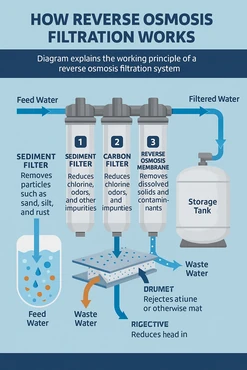
Areverse osmosis (RO) system uses pressure to force water through a semi-permeable membrane, removing contaminants and leaving clean, filtered water on the other side. Affordable home filters are now readily available, either as counter-top or under-the-sink models.

While it's true that reverse osmosis uses a lot of water in the process of producing clean water, it's unlikely it will run up your water bill enough to make it more expensive than bottled water. It may also filterout some beneficial minerals, most notably magnesium. A simple supplement can replace it if you truly become deficient; talk to your doctor or nutritionist about this.

High-quality counter-top units are available for $150 to $400. Under-sink units require professional installation, which runs the cost up somewhat. But both should be more cost-effective than regularly buying bottled water, which is also a major source of environmental waste.

There's also the matter of taste. Besides the chlorine, tap water often just doesn't taste very good. It may be cloudy and even foul-smelling, causing most consumers to look around for their water bottle. An RO system solves that problem. It produces water thatlooks good and tastes good, even if you leave it sitting on the counter overnight.

A fewfinal tips: If you go to the trouble of running your water through an RO filter, be sure to store it safely, preferably in glass or stainless steel, not plastic.

If you have older people in your family, they may reap even more benefits from an RO system. Kidney function declines with age and filtered water can help keep kidneys healthy by filtering out harmful contaminants.

And, although it may sound odd, there are also water filters for your shower head. The chlorine in tap water tends to throw off chlorine gas when it's hot, as it is in a shower. This can cause throat and skin irritation. It doesn't require an RO system, just a simple carbon filter to eliminate the chlorine.

, , , ,


Posted: 2025-05-19 00:01:00

Get Full News Story On Consumer Affairs


Listen to this article. Speaker link opens in a new window.
Text To Speech BETA Test Version.


More News From This Category
Consumer News: FTC sues to halt alleged deceptive health insurance scheme
Wed, 29 Apr 2026 13:07:07 +0000

The agency says products were not even insurance policies

By Mark Huffman of ConsumerAffairs
April 29, 2026
  • FTC alleges a nationwide telemarketing scheme deceived consumers into buying fake or inadequate health insurance plans

  • A federal court has temporarily halted the operation and frozen its activities

  • Regulators say victims paid millions for coverage that often failed to deliver promised benefits


The Federal Trade Commission has filed a lawsuit to stop what it describes as a widespread and deceptive health care scheme that allegedly duped consumers into purchasing inadequate insurance products while posing as legitimate providers.

According to the FTC, a U.S. District Court in Florida has already issued a temporary restraining order halting the operation, which regulators say impersonated government agencies and well-known insurance companies to sell bogus health plans nationwide.

The agency alleges that, since at least early 2023, six defendants operated a telemarketing scheme targeting people seeking comprehensive health coverage. Sales agents allegedly told consumers they were buying state-issued PPO plans with low or no deductibles and full coverageclaims the FTC says were false.

Not insurance

In many cases, the products sold were not insurance at all. Instead, they consisted of limited medical discount plans or supplemental products with capped payouts, and in some instances excluded major services like hospital care.

The FTC also alleges the scheme targeted people who already had insurance, falsely warning them their existing coverage would be canceled unless they made immediate payments.

Consumers reportedly paid hundreds of dollars per monthamounting to thousands annuallyfor plans that did not provide the promised coverage. Many only discovered the limitations when attempting to use the plans, leaving some facing unexpected medical bills or delaying care altogether.

Deceptive telemarketing practices

In addition to misrepresenting the nature of the products, the complaint alleges the defendants used deceptive telemarketing practices, charged consumers without proper consent, and failed to clearly disclose terms related to recurring payments and cancellations.

The FTC claims the operation violated multiple laws, including the FTC Act, the Telemarketing Sales Rule, and the Gramm-Leach-Bliley Act. The agency is seeking financial relief for affected consumers as the case proceeds in federal court.

FTC Chairman Andrew Ferguson said the case demonstrates the agencys focus on combating practices that inflate healthcare costs and mislead consumers. Regulators indicated they will continue pursuing enforcement actions against similar schemes targeting vulnerable consumers in the health insurance market.


Read More ...


Consumer News: Gallup poll finds Americans increasingly worried about affordability
Wed, 29 Apr 2026 13:07:07 +0000

Housing, energy and healthcare are major pain points

By Mark Huffman of ConsumerAffairs
April 29, 2026
  • Affordability concerns dominate Americans financial worries, with rising costs for essentials like housing, healthcare and energy topping the list.

  • A growing share of Americans say their personal financial situation is getting worse, reaching levels not seen in decades.

  • Inflation remains the leading financial problem for families, though concern has broadened to a wider range of everyday expenses.


A new Gallup poll shows that affordability from groceries to housing and healthcare continues to overshadow all other financial concerns for Americans, revealing persistent economic anxiety despite cooling inflation.

The survey, part of Gallups annual Economy and Personal Finance poll, found that the cost of living remains the most frequently cited financial problem facing U.S. households. Rising expenses tied to housing, healthcare and energy are among the leading pressures driving concern.

While inflation has eased from its peak in recent years, it still ranks as the top financial issue for many Americans, continuing a trend that has held for several consecutive years.

Financial outlook worsens

The poll also highlights a deepening sense of financial pessimism. A record share of Americans report that their personal financial situation is deteriorating, reflecting lingering strain from years of elevated prices and cost-of-living increases.

Recent reporting on the same Gallup data indicates that more than half of Americans now say their finances are getting worse the highest level recorded in over two decades marking the fifth straight year in which negative assessments outnumber positive ones.

Although inflation remains central, the nature of Americans concerns has gone deeper. Costs tied to housing including rent and homeownership have climbed to new highs as a share of financial worries, while healthcare and energy expenses continue to weigh heavily on household budgets.

This shift suggests that Americans are no longer focused solely on inflation as a headline economic indicator but are grappling with a wider affordability challenge affecting multiple aspects of daily life.

Implications for economy and policy

The findings point to a disconnect between macroeconomic indicators and personal financial experiences. Even as inflation moderates and economic growth remains steady, many households continue to feel squeezed by high prices for essential goods and services.

That ongoing strain is likely to carry political implications as well, with affordability emerging as a central issue for policymakers and voters alike.

Overall, the Gallup data paints a clear picture: for many Americans, the economic story is no longer just about inflation its about whether everyday life is becoming unaffordable.


Read More ...


Consumer News: Lawmakers push for federal sports betting safeguards
Wed, 29 Apr 2026 13:07:07 +0000

Legislation would establish federal oversight of the fast-growing industgry

By Mark Huffman of ConsumerAffairs
April 29, 2026
  • Federal lawmakers are pushing new national standards to curb what they call predatory online sports betting practices.

  • The proposed SAFE Bet Act would impose limits on marketing, AI targeting, and other industry tactics tied to addiction risks.

  • Supporters argue the rapid growth of mobile betting has created a public health crisis, especially among young people.


Online sports betting has taken off in the last decade, raising concerns that many bettors are in over their heads. Sen. Richard Blumenthal (D-Conn.) and Rep. Paul Tonko (D-N.Y.) are renewing their push for sweeping federal oversight of the online sports betting industry, warning that aggressive marketing and data-driven targeting have fueled a growing addiction crisis.

Speaking at a public health conference in Boston last week, the lawmakers said they plan to advance the Supporting Affordability and Fairness with Every Bet (SAFE Bet) Act, legislation aimed at establishing nationwide consumer protections while still allowing legal wagering.

The event, hosted by Northeastern Universitys Public Health Advocacy Institute, brought together policymakers, researchers and addiction experts to examine the rapid expansion of online gambling. Participants highlighted what they described as the failure of the industrys responsible gaming model to adequately protect consumers.

Massive growth

The size of the online sports betting industry depends on how you define it (online-only vs. total sports betting), but the latest data show it is already a massive global market and growing fast.

For example:

Global online sports betting market: about $85 billion in 2025, up from roughly $75 billion in 2024. Its expected to reach around $163 billion by 2030.

The entire global sports betting market (online + retail) is estimated at roughly $110$115 billion in 2025. In the U.S. alone, legal sports betting generated about $16.96 billion in revenue in 2025. Thats massive growth, considering that just a few years ago, gambling was illegal in most states.

Public health emergency

Blumenthal framed the issue as a mounting public health emergency driven by technology and sophisticated marketing tools. We are facing a perfect storm of addiction, he said, pointing to real-time data tracking and personalized promotions that target vulnerable users, particularly young people.

Tonko drew parallels to the tobacco industry, arguing that sports betting companies use similar tactics to maximize profits. Without federal guardrails, he said, the industry will continue prioritizing growth over consumer safety.

The SAFE Bet Act would require states that allow sports betting to meet minimum federal standards governing advertising, affordability measures and the use of artificial intelligence in targeting customers. These provisions are designed to reduce addictive features and limit practices critics say exploit problem gamblers.

The legislative push comes amid continued growth in sports wagering across the U.S. Since the Supreme Court cleared the way for legalization in 2018, the market has expanded rapidly, with most betting now taking place online.


Read More ...


Consumer News: Google is trying to reinvent video search
Wed, 29 Apr 2026 07:07:06 +0000

Ask YouTube is currently in testing mode

By Mark Huffman of ConsumerAffairs
April 28, 2026
  • Google is reportedly testing a new feature called Ask YouTube, aimed at making video search more conversational and AI-driven.

  • The tool allows users to ask natural-language questions and receive curated clips or answers pulled directly from YouTube content.

  • The experiment signals Googles broader push to integrate generative AI across its search and media platforms.


You might not think of it this way, but YouTube is actually a search engine as well as a video platform. People use it not just for entertainment but also to perform tasks such as changing the oil in a lawnmower.

Google may be making the process easier for users. The company said it is experimenting with a new feature called Ask YouTube, a move that could fundamentally change how users discover and interact with video content on the platform. The feature is currently available to adult Premium users.

The test, which appears to be part of the companys ongoing push into generative AI, allows users to pose questions in plain language and receive tailored responses drawn from YouTube videos.

Interpreting user intent

Rather than relying on traditional keyword searches, Ask YouTube is designed to interpret user intent more deeply. For example, instead of typing how to fix a leaky faucet, users could ask a question like, Whats the easiest way to stop a faucet from dripping overnight? The system would then surface relevant clips or summarize insights from multiple videos, effectively turning YouTube into a more interactive knowledge tool.

Early indications suggest the feature may combine video search with AI-generated summaries, highlighting key moments within clips or stitching together information from different creators. This could significantly reduce the time users spend scrubbing through videos to find specific answers.

The test aligns with Googles broader strategy of embedding AI into its core products, including Search, Maps, and Workspace. By enhancing YouTube with conversational capabilities, the company said it is positioning the platform not just as an entertainment hub, but as a direct competitor in the growing field of AI-powered information retrieval.

Questions for content creators

However, the approach also raises questions. Content creators may be concerned about how their material is used or summarized, particularly if users can get answers without watching full videos. There are also potential challenges around accuracy, context, and attribution issues that have surfaced across many generative AI applications.

Ask YouTube appears to be in limited testing, with no official timeline for a broader rollout. Still, the feature suggests a clear trend: the future of search whether text or video is becoming increasingly conversational, personalized, and AI-driven.


Read More ...


Consumer News: Taylor Swift files to trademark her voice
Wed, 29 Apr 2026 07:07:06 +0000

The singer is taking a proactive move to prevent deepfake rip-offs

By Mark Huffman of ConsumerAffairs
April 28, 2026
  • Taylor Swift has reportedly filed new trademark applications covering both her likeness and her voice.

  • The move is widely seen as a preemptive strike against the growing threat of AI-generated deepfakes.

  • Legal experts say the filings could set a precedent for how celebrities protect their identity in the age of generative AI.


If you are a famous person, people without fame increasingly try to cash in by using AI to rip off your likeness even your voice. Taylor Swift is taking an aggressive step to protect her identity in the digital age, filing trademark applications that extend beyond her image to include her voice, an increasingly valuable and vulnerable asset in an era of rapidly advancing artificial intelligence.

According to filings submitted to the U.S. Patent and Trademark Office, the global pop star is seeking expanded protections that would give her greater control over how her likeness and vocal identity are used commercially. While celebrities have long trademarked their names and images, Swifts attempt to formally secure rights over her voice signals a new frontier in intellectual property law.

The move comes amid a surge in AI-generated deepfake content, including songs that mimic the voices of well-known artists. In recent years, viral tracks using AI-generated versions of major performers including Swift have circulated widely online, raising concerns about consent, compensation, and reputational harm.

Entertainment industry unease

Legal analysts say Swifts filing reflects growing unease within the entertainment industry. According to legal analysts, voices are becoming just as recognizable and monetizable asfaces. If courts uphold these kinds of protections, they sayit could fundamentally reshape how identity rights are enforced.

Swift has been particularly proactive in managing her intellectual property. Her ongoing efforts to re-record her early albums to regain control over her master recordings have already positioned her as a leading figure in artist rights. This latest legal maneuver appears to extend that strategy into emerging technological territory.

Whos next?

The implications could reach far beyond the music industry. Actors, influencers, and even public figures in politics and media are facing similar challenges as AI tools make it easier to replicate voices and appearances with minimal effort.

Tech companies, meanwhile, are under increasing pressure to address misuse. Some platforms have begun implementing watermarking and detection tools for synthetic media, but enforcement remains inconsistent.

For Swift, the trademark filings are as much about prevention as enforcement. By formally staking a legal claim to her voice, she may be better positioned to challenge unauthorized uses before they spread widely.

Whether the filings will be approved and how broadly they will be interpreted remains to be seen. But one thing is clear: as artificial intelligence blurs the line between real and replica, the battle over who owns a persons identity is just beginning.


Read More ...


Related Bing News Results
Consumer Reports investigation: Energy drinks risky for teens
Wed, 29 Apr 2026 06:54:00 GMT
Energy drinks are colorful, sweet, and hugely popular with teens. But they come with an important warning for parents. A new Consumer Reports investigation finds what’s inside those drinks may be more ...

What's inside those popular energy drinks teens consume
Mon, 27 Apr 2026 10:14:00 GMT
Consumer Reports says many drinks double the daily caffeine limit recommendation ...

consumer reports
Thu, 23 Apr 2026 03:11:00 GMT
Eken Group has issued a firmware update to resolve major security issues with its doorbell cameras that were uncovered by Consumer Reports. The cameras are sold under the brands Eken, Tuck, Fishbot, ...

Consumer Reports explores digital minimalism
Wed, 22 Apr 2026 17:38:00 GMT
A survey shows Americans spend over four hours daily on their phones, with nearly half feeling addicted, as experts highlight the impact on mental health and suggest ways to cut back.

Consumer Reports analysis of multiple at-home hair dyes and hair chalk found issues with all of them
Sat, 18 Apr 2026 05:00:00 GMT
It can be fun to switch up your personal aesthetic with hair dye. However, a Consumer Reports analysis of several at-home hair dyes found issues with each one.


Blow Us A Whistle


Related Product Search/Búsqueda de productos relacionados

Amazon Logo

Visit Our New Print-On-Demand Stores On Printify and Zazzle
Printify Zazzle