The FDA reported recalls of several popular acne treatments after benzene, a known carcinogen, was found in products containing benzoyl peroxide (BPO).
Valisure, an independent lab, first raised the alarm, showing benzene contamination can result from BPO breakdown, especially under heat.
Experts warn that benzenes cumulative exposure from various sources, including skincare, poses a significant long-term public health risk.
Back in March, the U.S. Food and Drug Administration announced the voluntary recall of several widely used acne treatments after they were found to contain benzene, a chemical linked to cancer. The recall decision followed months of investigation spurred by findings from Valisure, an independent testing laboratory known for uncovering safety concerns in consumer health products.
ConsumerAffairs originally reported the recall on March 19. Following the recall, the health agency determined that the public should be told more about the potential risks.
Valisure, based in New Haven, Conn., tested a wide range of over-the-counter and prescription acne medications containing benzoyl peroxide (BPO)an active ingredient commonly used to treat acne by killing bacteria and reducing inflammation. Alarmingly, Valisure discovered that many BPO products degrade into benzene over time, especially when stored in warm conditions.
Exceeding benzene limits
Their testing revealed that some products exceeded the FDAs conditional benzene limit of 2 parts per million (ppm), with one sample reaching as high as 35 ppm. The results, published in Environmental Health Perspectives and later reinforced by a follow-up study in the Journal of Investigative Dermatology, triggered concern from the medical community and prompted an FDA response.
The FDA recall included six acne products:
La Roche-Posay Effaclar Duo Dual Action Acne Treatment
Walgreens Acne Control Cleanser
Proactiv Emergency Blemish Relief Cream (5% BPO)
Proactiv Skin Smoothing Exfoliator
SLMD Benzoyl Peroxide Acne Lotion
Walgreens Tinted Acne Treatment Cream
Victory for patient safety
Dr. Christopher Bunick, associate professor of dermatology at Yale and a co-author of both studies, emphasized that no level of benzene is acceptable in products like acne medications. "There shouldnt be any carcinogens in any of our acne products, Bunick asserted. The recall is a victory for patient safety.
Benzene, a volatile chemical found in cigarette smoke, car exhaust, and industrial emissions, is already omnipresent in daily life. Its all the benzene exposure throughout all of society that adds cumulative risk, Bunick said. And the last place consumers need additional risk is in an acne product.
Though benzene contamination has previously been identified in sunscreens, hand sanitizers, and dry shampoos, this new research shows that in acne products, the benzene isn't from manufacturing errorsits the result of BPO itself breaking down under heat or over time.
While the FDAs own testing identified fewer contaminated products than Valisures, experts caution that the time lag between Valisure's petition and the agency's investigation may have allowed companies to quietly reformulate or recall tainted batches. The FDA has issued guidance to manufacturers to reformulate certain drug products, especially those using gelling agents linked to benzene formation.
Shop early and often: Ross Dress for Less turns over inventory quickly, so weekday mornings, especially Monday and Tuesday, give you the best shot at fresh deals.
Dont shop by size alone: The best finds are often misplaced, so check nearby racks and dig past the front.
Target high-value sections: Shoes and accessories usually offer the biggest discounts grab them before theyre gone.
Shopping at Ross Dress for Less can either feel like a goldmineor a complete waste of time.
Some people walk out with $200 worth of name-brand gear for $60. Others leave frustrated after digging through messy racks for 45 minutes. The difference isnt luck. Its strategy.
Ross operates very differently than traditional retail. If you understand how their pricing, inventory, and markdown system actually works, you can consistently find deals most shoppers miss.
First: How Ross pricing actually works (this explains a lot)
Ross isnt running sales like a normal store does.
Instead, the store is built on more of an opportunistic buying model. The products you find on their shelves and racks are typically one of the following:
Excess inventory from big brands
Cancelled orders from department stores
Past-season merchandise
Overproduction directly from manufacturers
Thats why youll regularly see:
Top brands like Nike, Calvin Klein, Michael Kors, etc.
Consistent pricing 20%60% below department store pricing
But the key difference is that Ross will rarely, if ever, restock the same item.
They tend to buy small batches, sell them fast, and move on.
Thats why youll notice:
Inventory is constantly changing
Sizes are very inconsistent
Deals disappear quickly
Once you understand that, your entire approach should change.
The #1 mindset shift: Ross is not a storeits a system
Most people lose money at Ross because they:
Go in looking for something specific
Get frustrated
Then impulse-buy something else
Thats backwards. Instead, Ross rewards:
Flexibility
Patience
Repetition
Think of it this way, youre not necessarily shopping for super-specific items at Ross, but instead you win by looking for the best values.
The best days and times to shop Ross
Most people lose money at Ross because they walk in looking for something specific, get frustrated, then often impulse-buy something else.
Instead, you have to be flexible, patient, and learn to time your purchases.
Specifically, the best time to shop is right after new inventory hits the shelves. Ross receives shipments multiple times per week and most stocking happens in the morning.
From having talked to many Ross employees over the years, weekday mornings, particularly early in the week (on a Monday or Tuesday)is the best time to shop.
This is because a lot of restocking happens on Mondays, as stores try to replenish from weekend sales. Many stores also do their new clearance markdowns on Monday and Tuesday when the store is less crowded.
So, if at all possible, hit your local Ross on Monday, a couple hours after opening, through Tuesday, and youll be able to shop fresh inventory (and deals) before they get picked over.
Pro tip: If you leave this article only remembering one thing, it should be shop Ross more often, not for longer. Instead of one long trip, savvy Ross shoppers make quick, frequent visits, and look for new inventory and fresh clearance markdowns.
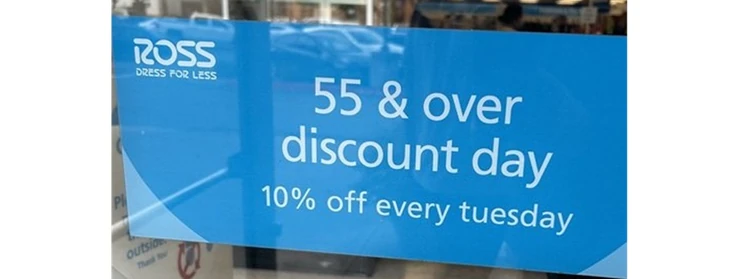
Aged 55 or older? Gotta shop on a Tuesday
Not only will you get first dibs on new inventory on a Tuesday, but if youre 55 or older, youll also save an additional 10% off everything you buy.
There's also no sign-up required to get their senior discount. All you need to do is flash your ID at check-out, and Ross will happily give you an extra 10% off.
Where the best deals are hiding inside the store
Ross isnt built for easy shopping. Its built to move inventory fast. Stuff comes in, stuff goes out, and nobodys carefully organizing it in between. That chaos? Thats where the savings live if you know how to work it.
1. The wrong-size racks (this is where the gold is)
People grab a medium, hold it up to look at it, decide its not right for them and often toss it wherever theyre standing. Very rarely does someone walk it back to the right rack.
So now youve got:
Smalls hiding in larges
Premium brands mixed into random sections
Clearance-level deals sitting in plain sight just in the wrong spot
If youre only shopping your exact size rack, youre missing a huge chunk of inventory.
What to do instead:
Always scan the rack one size upand one size downfrom your actual size.
Check racks right next to your section (especially those endcaps).
Look for higher-quality fabrics or brands first, then check for your size.
From shopping at Ross over the years, Ive found that a lot of my best finds felt more like mistakes. Because they are.
Pro tip: Buy now, decide later. Because the good stuff at Ross disappears quickly, when you find a good deal, buy it and decide at home. Ross has a generous 30-day return window which gives you plenty of time to try it on at home when youre not rushed.
2. The back of racks (where patience pays off)
Most Ross shoppers shop like this: Quick glance grab whats in front move on
That means the front of every rack gets picked over fast. Whats left behind or shoved back?
Usually, the better stuff that just didnt catch someones eye in twoseconds.
Youll find:
Name brands pushed behind generic items
Nicer pieces hidden behind loud or outdated styles
Out-of-season gems that people overlooked
If youre willing to actually dig, you instantly have less competition.
Simple rule: Dont trust the first fiveitems on any rack. Thats just what everyone else already rejected or skimmed.
Instead, try this:
Slide hangers over and scan everything
Look for quality (stitching, fabric, weight) instead of just style
Take twoextra minutes per rack
This is the difference between Ross is picked over and Ross is amazing.
3. Shoes and accessories (highest ROI in the whole store)
If you only have 1015 minutes, skip the clothing entirely and go here.
Ross quietly crushes it in:
Athletic shoes
Brand-name sneakers
Handbags and backpacks
Why this section matters more:
Clothing discounts are nice, but shoes and accessories often have the biggest price gaps vs retail.
Youll regularly see:
$80$120 sneakers marked down to $30$50
Recognizable brands that people specifically search for
Items that hold resale value if you know what youre looking at
This is why resellers camp-out in this section.
How to shop it smarter:
Check multiple sizes (people try on and ditch boxes everywhere)
Look for slight box damage price is the same, product isnt
Scan quickly for known brands before digging deeper
Even if you dont resell, this is where youll feel the biggest wow, thats cheap moments.
Pro tip: Learn your stores patterns by talking to employees. Every Ross location is slightly different. So, by starting up a friendly conversation, youll learn your stores exact restock schedule, clearance markdowndays, and the best days to shop.
To find out whether your specific vehicle is included in a recall, you can check by VIN or license plate on NHTSA's recall lookup page: NHTSA.gov/recalls.
If your vehicle has an unrepaired recall, contact your local dealership to schedule a repair recall remedies are provided at no cost.
Dating is getting more expensive and its changing behavior: Most singles say rising costs are leading them to go on fewer dates and think more carefully before making plans.
Low-cost dates are no longer a turnoff: Simple ideas like coffee, walks, or staying in are increasingly seen as thoughtful even a green flag.
Overspending can actually hurt your chances: Many singles view flashy spending or bragging about money as a red flag, with authenticity mattering more than price.
Dinner, drinks, maybe a movie dating used to feel pretty straightforward. But lately, romance has come with a price tag thats harder to ignore. As inflation pushes up the cost of everything from meals out to gas, more singles are rethinking how and even whether they date at all.
New research from DealSeek highlights just how much things have shifted. A majority of singles say dating has gotten more expensive in the past year, and many are going on fewer dates or opting for lower-cost alternatives instead. Whats emerging is a new kind of dating culture one where budgeting, financial transparency, and even couponing are becoming part of the equation.
ConsumerAffairs spoke with Hailey Neff, Creative Strategist on behalf of DealSeek who explained that these financial pressures are quietly rewriting the rules of attraction, expectations, and what it means to make a connection.
How do finances impact dating?
Neff explained that the biggest shift in the dating scene is how often people are going out.
A lot of singles are doing the math now, she said. In our study, 71% said dating has gotten more expensive, and 40% said theyre going on fewer dates because of it.
So its not just noticing higher prices, its actually changing behavior. Dating feels a bit less casual than it used to. Even deciding whether to go on a date can feel like a budget choice.
Low-cost dating options
If youre on the dating scene, you can still pull out all the stops without breaking the bank.
About half of singles said suggesting a low-cost date is actually a green flag, and even things like using coupons are viewed positively by a lot of people now, Neff said. Thats a big shift from the old idea that you have to spend to impress. It really comes down to the thought behind the plan more than the price.
Here are some ideas for lower-cost date options:
Coffee or a walk. These are still some of the easiest first dates because its low effort in a good way.
Lean into things like local events, galleries, or outdoor plans. About 37% said theyve suggested free options like parks or community events just to keep costs down.
Stay in instead of going out. Staying in is more common than people might expect. Cooking together or doing something simple at home can feel more natural than a big night out.
Most people think the expectation is higher than it actually is, Neff said. The majority want to keep a first date under $100, and more than half prefer under $75.
At the same time, trying too hard financially can backfire. Around 61% see overspending as a red flag, and nearly 8 in 10 say bragging about money is a turnoff. Its less about cutting corners and more about being real about it. A simple plan that feels considered usually lands better.
The USPS is warning about a rise in QR code , including mystery packages designed to trick people into scanning malicious codes.
Scammers are placing fake QR codes in everyday placeslike parking meters, emails, and public signswhere people are used to scanning without thinking.
Experts say the best defense is to slow down: check where the code came from, preview the link, and never enter personal or payment information unless youre sure its legitimate.
QR codes have quietly become part of everyday life used for everything from restaurant menus to package tracking. But now, that convenience is being turned against consumers.
The U.S. Postal Service (USPS) is warning about a surge in mystery packages arriving at homes with QR codes inside, designed to lure people into scanning them. Its just one example of how scammers are evolving, placing malicious codes on everything from parking meters to emails that look legitimate.
ConsumerAffairs spoke with Sharat Potharaju, CEO & Co-Founder, Uniqode, to break down why QR-based have become so widespread, how these are evolving, and outline exactly what consumers need to do to protect themselves before scanning.
What do these look like?
Potharaju explained that one of the biggest challenges with QR is that they usually look like normal QR experiences at first glance which is also why theyre so effective.
They can appear on a public parking meter with a prompt to pay, on a restaurant menu that looks like it came from the business, or on a missed package note with a message asking you to fix a vague problem, he said. But theyre also showing up in emails, text messages, public signage, event posters, and other places where people have grown used to scanning.
Some warning signs to look for:
If a QR code is on a sticker placed over another code, thats a clear risk.
If it comes in an unexpected text or email and tells you to act quickly, thats another.
Any QR code that opens an unfamiliar URL or uses a misspelled domain is suspicious.
After the click-through, if youre taken to a page that immediately asks for sensitive information, thats a good moment to stop.
Ultimately, the simplest rule is to pause before tapping through, Potharaju said. They should ask themselves: Where am I scanning? Wheres this supposed to take me? Would this company really need this information from me?
Familiarity powers the
One of the reasons that these types of have become so popular is because theyre based around something thats very familiar to consumers.
Potharaju said that a recent Uniqode report found that 70% of consumers now scan QR codes at least once a month, 71% describe them as genuinely helpful in daily life, and 83% are now willing to share data after a scan.
That kind of adoption is great for legitimate businesses. But it creates a big opportunity for bad actors too, he said. The more common a behavior becomes, the easier it is for scammers to hide inside it.
This isnt a case of QR codes suddenly becoming unsafe. Its more that scammers follow consumer behavior. Email, text messages, and social platforms have all gone through the same pattern. QR codes are now going through it too.
Know how to protect yourself
With these gaining ground, knowing how to protect yourself is key.
Here are some of Potharajus best tips:
Before scanning, the first question to ask is where the code came from. If its on a sign, menu, meter, package, or flyer, double-check whether it looks original or if something was stuck on afterward. And if it came by text or email, dont assume its safe just because the sender name looks familiar.
If you do scan, pause at the link preview. The domain should look familiar and match the company or service you thought you were scanning for. If it looks strange, is spelled slightly wrong, or doesnt match the context, stop there.
Avoid entering payment details, passwords, or personal information from a QR landing page unless the source is clear. If youre in doubt, use the companys app or type the website in yourself.
Its usually not the act of scanning itself, but what comes next, Potharaju said. If someone shares a password, payment information, or even worse, a Social Security number, through the wrong page, that information is out there. Then the risk can become fraudulent charges, account access, identity theft, or more targeted later. This can go on for quite some time too.
Thats why slowing down and checking where the page is taking you is so important.
Cinco de Mayo is stacked with cheap margaritas and food deals at spots like Chuy's, Chilis, and BJ's Brewhouse.
The best freebies are app-based, like free chips and guac at Chipotle, 75 tacos at Jack in the Box, and a $1 nugget deal at Taco Bell.
Local restaurants often beat chains with better taco prices, drink specials, and events so dont skip them.
Cinco de Mayo (May 5) has quietly become one of the best days of the year to score discounted food and drinks.
And in 2026, it lands on a Tuesday, which basically means Taco Tuesday on steroids.
Heres where to find the best offers this year.
Baja Fresh
Club Baja Rewards members get $5.55 off your $20+ order on May 4and 5
Use code CINCO5 and you must order from their website to use the code.
BJs Brewhouse
This Cinco de Mayo, BJ's Restaurant & Brewhouse is serving up $6 Brewhouse margaritas during two happy hour windows: from 37 p.m. and again from 9 p.m. until close.
Chilis
Chilis is offering its Tequila Classic Marg for only $5 for the holiday.
A new classic marg, this crowd pleaser is made with Cuervo Tradicional Blanco, triple sec, Chilis house-made sour, and garnished with a lime wedge.
Chipotle
Get free chips and guac (or queso) with any entre purchase.
Use code CINCO26 in the app or online.
This is one of the easiest freebies just order digitally.
Chuys
From May 1-5th, Chuy's is rolling out a lineup of festive deals on drinks and apps, including:
This deal is exclusively for rewards members. If youre not a member, sign up ahead of time its completely free to join.
Ruby Tuesday
On May 5only, you can score a burger (or sandwich) and fries for just $5.99.
Plus, you can get a Ruby-Rita with Hornitos Reposado tequila for just $6, as well as a bucket of Dos Equis lager for just $16.
Taco Bell
Taco Bell is celebrating Cinco de Mayo with a limited-time deal: the first 30,000 rewards members to claim it in the Taco Bell app can score a five-piece order of Diablo Dusted Crispy Chicken Nuggets for just $1.
The offer drops May 5 at 2 p.m. PT (5 p.m. ET), so timing matters.
7-Eleven
7Rewards and Speedy Rewards members can take $3 off select beers, including Modelo Especial, Coronita Extra, and Pacifico.
Local restaurants (dont skip these)
While national chains get all the attention on May 5th, dont ignore your local spots, as they often have:
Cheaper tacos
Better drink specials
Live music and events
Also, in many cities, restaurants and food trucks are offering:
Street taco deals
Family-friendly events
Food + entertainment combos
Translation: your best overall deal might actually be to dine local.
Related Bing News Results Kitchen Appliances: How to make them last longer Mon, 04 May 2026 10:57:00 GMT Consumer Reports has a tool that helps you figure out if it's worth it to repair them or replace them ... Consumer Reports: The truth about fish oil pills Mon, 04 May 2026 10:45:00 GMT Fish oil is one of the most popular supplements in the country. Adults take them regularly, trying to get some of the same heart-healthy nutrients found in fish, like salmon. But exclusive new testing ... Consumer Reports investigation: Energy drinks risky for teens Wed, 29 Apr 2026 06:54:00 GMT Energy drinks are colorful, sweet, and hugely popular with teens. But they come with an important warning for parents. A new Consumer Reports investigation finds what’s inside those drinks may be more ... consumer reports Thu, 23 Apr 2026 03:11:00 GMT Eken Group has issued a firmware update to resolve major security issues with its doorbell cameras that were uncovered by Consumer Reports. The cameras are sold under the brands Eken, Tuck, Fishbot, ... Consumer Reports explores digital minimalism Wed, 22 Apr 2026 17:38:00 GMT A survey shows Americans spend over four hours daily on their phones, with nearly half feeling addicted, as experts highlight the impact on mental health and suggest ways to cut back.



 of ConsumerAffairs