Rockin Robin SongFlying The Web For News.
RobinPost Logo Amazon Prime Deals


Consumer Daily Reports

20% increased stroke risk and 29% higher chance of acute coronary syndrome

By James R. Hood of ConsumerAffairs
June 18, 2025

  • Major global review finds cannabis users face up to 100% higher risk of cardiovascular death.

  • Study shows 20% increased stroke risk and 29% higher chance of acute coronary syndrome.

  • Experts urge public health reforms and tobacco-style regulation of cannabis products.

Photo

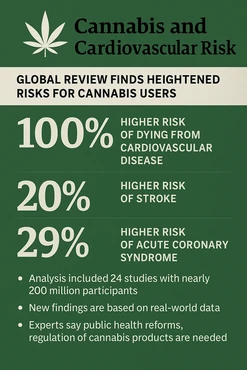
A sweeping international review of nearly 200 million individuals has revealed that cannabis use may significantly elevate the risk of life-threatening cardiovascular issues, including a doubling of the risk of death from heart disease and a 20% increased risk of stroke. The findings, published in the journal Heart, represent one of the largest and most comprehensive syntheses of real-world data on the subject to date.

The research was led by a team from the University of Toulouse in France, who sought to clarify the scale of cannabis-related cardiovascular risks amid a sharp rise in global use and changing legal frameworks. Though earlier studies had raised alarms about potential heart-related side effects, the researchers said previous data lacked clarity on just how serious the consequences might be.

Data from 24 studies

To deepen the understanding of cannabis's cardiovascular impact, the Toulouse team reviewed 24 large-scale observational studies published between 2016 and 2023. Together, these studies covered nearly 200 million participants, including 17 cross-sectional studies, six cohort studies, and one case-control study.

Most participants were aged 19 to 59, and where demographic data was recorded, cannabis users were found to be predominantly male and younger than non-users.

The pooled analysis found:

  • A 29% increased risk of acute coronary syndrome (e.g., heart attacks).

  • A 20% increased risk of stroke.

  • A 100% (doubling) of the risk of death from cardiovascular disease.

Research limitations,calls for caution

Despite the alarming results, the study authors acknowledged notable limitations. Many of the included studies had a moderate to high risk of bias, often due to imprecise cannabis exposure measurement and missing data. Furthermore, as most of the data came from observational studies, the researchers stopped short of claiming a definitive causal link.

Still, they argued the findings were meaningful and urgent: "The findings outlined by this meta analysis should enhance the general awareness of the potential of cannabis to cause cardiovascular harm," the authors said.

Experts: Treat cannabis like tobacco

In an accompanying editorial, Prof. Stanton Glantz and Dr. Lynn Silver of the University of California, San Francisco, warned that the assumptions of cannabiss cardiovascular safety are now deeply challenged.

They noted the modern cannabis market has shifted toward high-potency concentrates, synthetic cannabinoids, and diverse edibles, all of which may compound cardiovascular risks. The editorial urged public health authorities to adopt tobacco-style policies: warning labels, marketing restrictions, and limits on secondhand exposure.

"Effective product warnings and education on risks must be developed, required, and implemented," Glantz and Silver wrote. "Cardiovascular and other health risks must be considered in the regulation of allowable product and marketing design."

They concluded that cannabis should not be criminalised, but rather regulated with vigorous public health protections"not unlike tobacco."

A wake-up call

With cannabis use now increasingly mainstream and legally sanctioned in many regions, researchers and public health experts say these findings demand immediate attention. As more people turn to cannabis for recreational or medicinal purposes, a clearer understanding of the long-term cardiovascular effects is vital.

The new study delivers a powerful warning: as cannabis products become more accessible and potent, so too may the unseen dangers to the heart.


Posted: 2025-06-18 14:57:30

Get Full News Story On Consumer Affairs


Listen to this article. Speaker link opens in a new window.
Text To Speech BETA Test Version.


More News From This Category
Consumer News: Homeowners insurance rates are projected to rise again in 2026
Wed, 18 Mar 2026 19:07:07 +0000

New Insurify data reveals where costs are climbing fastest, whats driving the increases, and how homeowners can stay ahead

By Kristen Dalli of ConsumerAffairs
March 18, 2026
  • Homeowners insurance costs are rising again nationwide, with premiums expected to increase in 2026 though some states will see much steeper hikes than others.

  • Extreme weather and costly natural disasters are the biggest drivers behind higher rates, with risks varying by region.

  • Homeowners may be able to lower their premiums by shopping around but cutting coverage could leave you financially exposed.


If it feels like everything tied to homeownership is getting more expensive lately, youre not imagining it and homeowners insurance is a big part of that trend.

A new report from Insurify shows that premiums are continuing to climb nationwide, adding yet another layer of cost for homeowners already dealing with high mortgage rates and maintenance expenses.

The increases arent happening in a vacuum. From extreme weather to rising construction costs, several forces are pushing insurance prices higher and, according to Insurifys projections, those pressures arent easing anytime soon.

ConsumerAffairs spoke with Insurifys Senior Economic Analyst, Matt Brannon, to break down whats behind the spike and what it means for homeowners right now.

Key findings from the report

Insurifys latest data paints a clear picture: homeowners insurance costs are rising across the board, though some areas are being hit harder than others.

  • A nationwide increase is on the way: The average cost of homeowners insurance is expected to rise about 4% in 2026, bringing the typical annual premium to around $3,057.

  • Some states will see much sharper spikes: Premiums are projected to jump 10% or more in several states, including Georgia, New Mexico, Nebraska, and California.

  • California is facing major increases: Insurify predicts that California premiums will rise 16% in 2026, the largest estimated hike in any state.

  • Prices are lowering in some states: Rates are projected to drop in five states by 0% to 2%: Hawaii, Massachusetts, Maine, Louisiana, and Rhode Island.

Why are prices rising?

Brannon explained that extreme weather and natural disasters are two of the primary reasons for higher homeowners insurance premiums.

Broadly, severe weather is an answer, Brannon said. But the type of severe weather that is raising insurance premiums varies from state to state.

Brannon broke it down:

  • The southeast: Wind is often the most costly weather threat. The region is a hotspot for hurricanes and lately has seen increased tornado activity as well.

  • The Midwest: Hail was the main driver of losses in 2024. And the high cost of hail claims has caused insurers to move away from insuring the replacement value of a roof and instead now factor in depreciation, often lowering the payout in the event of a claim.

  • The West: Insurers in California and surrounding states may raise rates to offset wildfire losses. In terms of insured losses, the Palisades and Eaton fires are now the first and second-most expensive fires on record globally (1900 to present).

These increasingly expensive claims events have caused home insurance premiums to significantly outpace inflation, Brannon said.

Can you lower your monthly premium?

One tactic that some homeowners adopt to lower their monthly premium is to reduce their coverage. However, Brannon says this is a risky move.

The worst-case scenario becomes more likely, a situation in which your home is rendered uninhabitable and your policy doesnt fully cover the damage, leaving you still responsible for your mortgage payments, he said. It should be a last-resort option, as there are better alternatives.

What are those better alternatives?

  • Compare prices: Too many homeowners treat their insurance coverage like their mortgage just paying it and moving on without appreciating the difference in pricing between insurers. Comparison websites allow homeowners to input how much coverage they need and find out what different insurance companies would charge them. Insurers are constantly changing rates, so comparing prices twice a year can yield significant savings.

  • Location-based mitigation programs: In California, at-risk homeowners can earn an insurance discount if they make fireproofing upgrades to their home and pass an inspection. In Florida, homeowners can obtain matching grants of up to $10,000 for wind-mitigating upgrades, and insurers are required to provide discounts to homeowners who make certain adjustments.


Read More ...


Consumer News: Inflation is surging at the wholesale level: Are consumer prices next?
Wed, 18 Mar 2026 19:07:07 +0000

In February, the Producer Price Index rose at the fastest level in months

By Mark Huffman of ConsumerAffairs
March 18, 2026
  • Wholesale inflation accelerated in February, with the Producer Price Index (PPI) rising 0.7%, the fastest monthly gain in months.

  • Goods prices surged 1.1%, driven by sharp increases in food and energy, including a nearly 49% spike in vegetable prices.

  • Core producer prices (excluding food, energy, and trade services) climbed 0.5% for the 10th straight month, signaling persistent underlying inflation.


Economists keep an eye on wholesale prices, because they eventually affect the prices consumers pay. The trend is not good.

Wholesale prices picked up momentum in February, reflecting broad-based increases across goods and services, according to new data from the U.S. Bureau of Labor Statistics.

The Producer Price Index (PPI) for final demand rose 0.7% for the month on a seasonally-adjusted basis, following gains of 0.5% in January and 0.4% in December. On a year-over-year basis, producer prices increased 3.4%, matching the largest annual gain recorded since February 2025.

The February increase was driven by both goods and services, though goods prices showed the strongest acceleration. Prices for final demand goods climbed 1.1% the largest jump since August 2023 while services advanced 0.5%.

The biggest drivers

Food and energy played a major role in the goods increase. Food prices surged 2.4%, accounting for roughly 40% of the overall rise in goods. Energy prices also rose sharply, up 2.3%.

A standout contributor was a dramatic 48.9% spike in prices for fresh and dry vegetables, which alone accounted for more than one-fifth of the overall increase in goods. Other notable increases included diesel fuel, gasoline, jet fuel, chicken eggs, and tobacco products. In contrast, prices for jewelry fell 4.0%, while home heating oil and soft drinks also declined.

On the services side, the 0.5% increase marked the third consecutive monthly gain. Much of the rise came from services excluding trade, transportation, and warehousing, which climbed 0.6%.

Trade services and transportation and warehousing services also posted gains of 0.4% and 0.5%, respectively.

Within services, a sharp 5.7% increase in traveler accommodation prices was a key driver, accounting for about one-fifth of the overall services advance. Prices also rose for food and alcohol wholesaling, financial services such as securities brokerage and investment advice, and inpatient care. However, some sectors saw declines, including a 4.5% drop in retail margins for apparel and accessories, as well as decreases in airline passenger services and gaming receipts.

Meanwhile, core producer prices which exclude food, energy, and trade services rose 0.5% in February. This marked the tenth consecutive monthly increase, pushing the 12-month gain to 3.5%.

The steady climb in core prices suggests that underlying inflation pressures remain persistent, even as some categories show volatility.


Read More ...


Consumer News: CDC probes E. coli outbreak linked to raw cheddar cheese
Wed, 18 Mar 2026 19:07:07 +0000

Seven cases have been confirmed in three states so far

By Mark Huffman of ConsumerAffairs
March 18, 2026
  • Federal and state officials are investigating a multistate E. coli outbreak linked to raw cheddar cheese.

  • Seven cases across three states have been reported, with two hospitalizations and no deaths.

  • Health officials say Raw Farm brand raw cheddar cheese is the likely source and advise consumers to avoid it.


U.S. health officials are investigating a multistate outbreak of E. coli infections that may be tied to raw cheddar cheese produced by Raw Farm, LLC, according to the U.S. Centers for Disease Control and Prevention (CDC).

The CDC, working alongside the U.S. Food and Drug Administration (FDA) and state health agencies, has identified seven confirmed cases of E. coli O157:H7 infection across three states. Two people have been hospitalized, but no deaths have been reported.

Illnesses linked to the outbreak began as early as September 1, 2025, with the most recent case reported on February 13, 2026. Officials caution that the true number of infections is likely higher, since many people recover without seeking medical care or undergoing testing.

Reporting delays also mean additional cases may still be identified.

Young children among those affected

Preliminary demographic data show that the outbreak has disproportionately affected very young individuals. The median age of those infected is just 3 years old, with patients ranging in age from 1 to 28. About 71% of reported cases are male.

Among patients with available racial data, most are white, while a smaller portion are African American. The majority of those infected are non-Hispanic.

Raw cheddar cheese identified as likely source

Investigators are focusing on Raw Farm brand raw cheddar cheese as the likely source of contamination. Of the three patients interviewed so far, all reported consuming the product in the week before becoming ill.

Laboratory analysis supports this link. Using whole genome sequencing, scientists found that bacterial samples from infected individuals are closely related genetically, indicating a common source of exposure.

The CDCs PulseNet system, which tracks DNA fingerprints of foodborne bacteria nationwide, played a key role in identifying the outbreak.

Health officials urge caution

While the investigation continues, public health officials are advising consumers to avoid eating Raw Farm raw cheddar cheese.

Consider not eating affected raw cheddar cheese produced by Raw Farm, LLC, while this investigation is ongoing, the CDC said.

E. coli O157:H7 can cause severe illness, including stomach cramps, diarrhea (often bloody), and vomiting. Young children, older adults, and people with weakened immune systems are at higher risk for serious complications.


Read More ...


Consumer News: AI boom could make your next phone and laptop more expensive
Wed, 18 Mar 2026 19:07:06 +0000

Why waiting to upgrade could end up costing you

By Kyle James of ConsumerAffairs
March 18, 2026
  • AI is driving up costs: Tech companies are buying up memory chips, leaving fewer for phones and laptops.

  • Prices likely rising into 2026: Shortages wont ease quickly, so expect higher device prices.

  • Buy smart now: Shop earlier, consider last years models, and track prices to avoid overpaying.


The rapid rise of artificial intelligence isnt just changing tech, its also starting to hit your wallet. A new Bloomberg analysis shows that surging demand for AI is creating a major shortage of memory chips, a key component inside of our smartphones, laptops, and gaming consoles.

Right now, tech giants like Amazon, Google, Microsoft, and Meta are pouring hundreds of billions into AI data centers. These systems require massive amounts of memory, including high-speed chips designed specifically for AI workloads. The problem? There simply arent enough to go around.

Thats pushing everyday consumer devices to the back of the line.

And this isnt a quick fix. Building new chip factories takes years, and manufacturers are being cautious about expanding too fast. This means the supply shortage, and subsequent higher prices, could stick around all of 2026 and beyond.

What consumers can do now

  • Buy sooner rather than later: Prices are likely to rise in the coming months. If youve been thinking about replacing an old phone or laptop, now would be a good time to start researching and price comparing your various options.
  • Skip the latest model: Last years devices can often be bought at a steep discount, typically in the 30-40% off range. Unless youre looking for specific features, they are nearly identical in terms of performance for the average user.
  • Track prices before you buy: Use price tracking tools like CamelCamelCamel or Keepa to spot price spikes on laptops and tablets so you dont get fooled by fake sales. Theres a good chance rising chip costs will translate to sales that arent always real deals anymore.
  • Prioritize RAM and storage over brand-new models: With memory costs rising quickly, its smart to figure out now how much RAM youll potentially need and lock in higher RAM now. Not only will you extend your devices lifespan, but youll avoid a costly upgrade later.
  • Time your purchase around major sales windows: Back-to-school sales, Amazon Prime events, and Black Friday deals may be your best shot to offset AI-driven price increases before they fully hit store shelves.

Read More ...


Consumer News: Want to handle stress better? Start with your routine
Wed, 18 Mar 2026 19:07:06 +0000

Researchers connect everyday habits to stronger emotional flexibility

By Kristen Dalli of ConsumerAffairs
March 18, 2026

  • Regular breakfast, sleep, and exercise habits are linked to better stress resilience.

  • Psychological flexibility plays a key role in how people respond to stress.

  • Small, consistent lifestyle choices not extremes were associated with stronger outcomes.


Managing stress often feels complicated, but new research suggests some of the most effective tools may already be part of your daily routine.

A study from Binghamton University looked at how habits like eating breakfast, getting enough sleep, and exercising might influence how well people handle stress.

Rather than focusing on stress itself, researchers zeroed in on something called psychological flexibilitythe ability to pause, process emotions, and adapt to challenges. This trait helps people avoid getting stuck in stressful moments and instead respond more thoughtfully. According to the findings, everyday behaviors may help strengthen that flexibility, which in turn supports resilience.

You might know someone who stays cool under pressure, researcher Lina Begdache said in a news release. The kind of person who misses a flight and, instead of panicking, calmly adapts to the situation. This person may still feel stressed, but theyre better able to manage it through psychological flexibility.

People may say that these are resilient people, but they also have whats called psychological flexibility. Theyre able to change the way they think about the situation and then use brain resources to handle the stress.

The study

To explore this connection, researchers surveyed roughly 400 college students about their eating habits, sleep patterns, exercise routines, and supplement use. The survey was anonymous and designed to capture a broad snapshot of participants lifestyles and mental well-being.

The study specifically examined how these lifestyle factors related to psychological flexibility and resilience. Researchers then analyzed how different habits like how often someone ate breakfast or how much they slept were associated with participants ability to adapt to stress.

Importantly, the study didnt test a single intervention or controlled experiment. Instead, it identified patterns and relationships between daily behaviors and mental health traits, offering insight into how these factors may work together in real life.

What the researchers found

The results point to a clear pattern: consistent, healthy habits were associated with greater psychological flexibility and, in turn, better resilience to stress.

For example, eating breakfast at least five times per week was linked to higher resilience through its connection to psychological flexibility. Getting fewer than six hours of sleep was associated with lower flexibility and resilience, while regular exercise even as little as 20 minutes showed a positive relationship with both.

The study also found that certain habits tended to cluster together. Lower psychological flexibility was associated with patterns like insufficient sleep and frequent fast-food consumption. On the flip side, healthier routines appeared to reinforce one another, contributing to stronger adaptive responses to stress.

When were under stress, we feel like we fuse with the stress. We live the stress. But psychological flexibility is like stepping back and thinking, I feel this because of that. What can I do? Identifying your emotions sometimes helps you find the solution for these emotions, said Begdache.


Read More ...


Related Bing News Results
Consumer Reports’ top 10 vehicles of 2026 all have EV or hybrid options for the first time. How to find great value in an ever-more-expensive market
Tue, 17 Mar 2026 14:00:00 GMT
If you stack federal and state incentives, your next ride could be an amazing deal — with lower maintenance and fuel costs.

Consumer Reports investigates: Toxic ingredients in beauty products
Mon, 09 Mar 2026 21:01:00 GMT
Most of us don’t think twice about shampoo, deodorant, or lotion. Now, Consumer Reports reveals that some of those products may contain ingredients linked to cancer risk, hormone disruption, and other ...

Consumer Reports tests lead levels in popular chocolate protein powders
Fri, 30 Jan 2026 14:09:00 GMT
Last fall, Consumer Reports tested dozens of protein powders and ready-to-drink shakes. What the lab found raised red flags: more than two-thirds contained more lead in one serving than CR’s ...

Consumer Reports finds five popular protein powders meet lead safety thresholds
Fri, 30 Jan 2026 13:58:00 GMT
TODAY. THIS IS DESPITE PRESIDENT TRUMP’S NEW NOMINEE FOR THE FEDERAL RESERVE CHAIR LAST YEAR, A CONSUMER REPORTS INVESTIGATION FOUND CONCERNING LEVELS OF LEAD IN SOME POPULAR PROTEIN POWDERS. THIS ...

Consumer Reports investigates more protein powders
Fri, 16 Jan 2026 01:32:00 GMT
Last fall, Consumer Reports tested dozens of protein powders and ready-to-drink shakes. What the lab found raised red flags: more than two-thirds contained more lead in one serving than CR’s ...


Blow Us A Whistle


Related Product Search/Búsqueda de productos relacionados

Amazon Logo

Visit Our New Print-On-Demand Stores On Printify and Zazzle
Printify Zazzle