Rockin Robin SongFlying The Web For News.
RobinPost Logo Amazon Prime Deals


Consumer Daily Reports

Residential electricity rates are rising as utilities try to keep up with demand from data centers as well as climate change and aging equipment

By James R. Hood of ConsumerAffairs
August 1, 2025
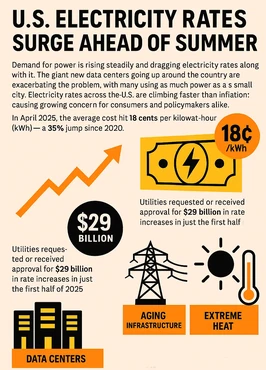
  • Residential electricity prices hit 18/kWh on average in April 2025a 35% increase over five years.

  • Utilities requested or received approval for $29 billion in rate increases in just the first half of 2025.

  • Data centers, aging infrastructure, extreme heat, and regulatory changes are fueling rising costs nationwide.

Photo

Demand for poweris rising steadily and dragging electricity rates along with it. The giant new data centers going up around the country are exacerbating the problem, with many using as much power as a small city. Electricity rates across the U.S. are climbing faster than inflation, causing growing concern for consumers and policymakers alike. In April 2025, the average cost hit 18 cents per kilowatt-hour (kWh)a 35% jump since 2020, and the trend shows no signs of tapering off.

According to the most recent data from the Consumer Price Index, under the Trump administration, electricity prices are up nearly 5 percent from the start of the year and up by almost a full percentage point in June 2025. Prices are expected to climb even further, with the average electric bill in the U.S. during this years air conditioning season projected to hit record highs.

The U.S. Energy Information Administration forecasts continued rate hikes: retail electricity prices are expected to rise 2% in 2025 and surge 13% from 2022 through 2025.EIA also projects increases of up to 18% regionally in 20252026, driven by infrastructure upgrades and rising natural gas costs.

Several factors are fueling the upward pressure:

  • Exploding power needs from AI-driven data centers and tech infrastructure, which could absorb up to 9% of all generation by 2030.

  • Aging grid infrastructure, with many utilities investing heavily in upgradescosts that are passed directly to customers.

  • Severe summer heat waves, which surged peak demand and prompted emergency policy responses by grid operators.

Record rate requests and consumer strain

In the first half of 2025, utilities demanded or secured $29 billion in rate hikes, more than double the amount requested during the same period in 2024. The second quarter alone saw $9billion in requests affecting around 40 million customers, particularly in the South and West, according toPowerLines.

PJM Interconnectionserving 13 states including Virginia, Ohio, and Pennsylvaniawarned that wholesale capacity costs rose sharply in auctions, potentially upping monthly electric bills by 5% for 67 million customers.

  • Minnesota leads its region with February 2025 average rates of 14.62/kWh, while Pacific, Mid-Atlantic, and New England residents are bracing for higher-than-average increases (U.S. Energy Information Administration).

  • Utilities in states like California and Pennsylvania face public outcry as emergency rate hikes take effect in response to wildfires and infrastructure liabilities.

The policy divide

Policy shifts are reshaping the energy landscape. The Trump administration's "Big Beautiful Bill" rolled back many incentives for renewables, potentially slowing clean energy deployment and raising long-term costs by $40$300 per household annually by 2030.Meanwhile, states like Virginia and Ohio are pushing backproposing new tariffs that would make Big Tech and data center operators shoulder more of the infrastructure burden to shield residential users from rate hikes.

Pressure is also coming from Democrats in Congress.Senator Elizabeth Warren (D-Mass.) and several colleagues wrote to Trump last month, calling for changes in White House Policy.The Administration must reverse its path of increased energy prices and instead work to cut energy costs for American families,wrote the lawmakers.

Despite Donald Trumps campaign promise to cut the price of energy and electricity in half, consumers are facing higher electricity prices than when President Biden left office, the lawmakers said.

At the same time, the Trump Administration is cutting programs that help families afford higher electricity costs and lower their energy usage, all while utility CEOs receive massive payouts, Warren said. A combination of the Administrations regulatory decisions, the impacts of tariffs, and the Administrations reversal of key energy investments is driving up energy bills for Americans around the country.

The lawmakers cited key examples of Trump administration actions which have exacerbated the energy cost crisis, including:

  • The Presidents Big Beautiful Bill makes cuts to existing clean energy and manufacturing tax credits that will lead to the estimated loss of 1.6 million jobs and elimination of $980 billion in GDP growth. The final law will result in an estimated $280 increase in average American household energy costs per year over the next decade.
  • President Trumps efforts to sell more gas overseas risk creating a domestic price surge due to draining domestic supplies.
  • The Trump Administration is forcing states to keep defunct, unwanted, and unneeded coal plants open in several states, foisting tens of millions of dollars of new maintenance and retention costs onto consumers in 15 states.
  • President Trumps tariffs policy is increasing costs for building materials for transmission lines and electrical equipment, and virtually every other segment of the supply chain, imposing additional costs on consumers.
  • The Administration has proposed entirely eliminating funding for the Low-Income Home Energy Assistance Program (LIHEAP) after firing the entirety of the programs staff, which provides $4 billion in assistance to approximately 6 million low-income families who rely on this funding to pay their utility bills.
  • The Energy Department is in the process of rolling back energy efficiency and water conservation standards, which save households close to $600 annually on water and gas bills.

What consumers can do

Amid rising rates, consumers are feeling the squeeze. According to PowerLines, 75% are worried about their utility bills, 80% feel powerless, and two-thirds say higher bills are causing financial stress. Some states are taking actionthough 33 states lack protections against utility shut-offs during summer heatwaves.

That doesn't leave much room for consumers to maneuver, although a new study from Stanford University finds that most U.S. households could reduce their electricity costs and endure power outages by installing rooftop solar panels and battery packs, according to a new Stanford University study, though people may need to buy the equipment by Dec. 31 to cash in on current incentives and rebates.

With electricity rates now rising in most states, shaving utility bills can help people quite a bit, but the ability to ride out local or regional blackouts is becoming very important to many families, said the studys senior author,Ram Rajagopal, associate professor of civil and environmental engineering and of electrical engineering at Stanford. Thats because U.S. electricity infrastructure is old and getting replaced slowly, while the extreme weather events like hurricanes and heat waves that cause blackouts are becoming more frequent, intense, and longer lasting.


Posted: 2025-08-01 18:42:26

Get Full News Story On Consumer Affairs


Listen to this article. Speaker link opens in a new window.
Text To Speech BETA Test Version.


More News From This Category
Consumer News: Urgent recall issued for MG217 eczema cream
Thu, 14 May 2026 04:07:07 +0000

The product tested positive for bacteria contamination

By Mark Huffman of ConsumerAffairs
May 13, 2026
  • Pharmacal has recalled one lot of MG217 Multi-Symptom Treatment Cream & Skin Protectant Eczema Cream after testing found contamination with Staphylococcus aureus bacteria.

  • The recalled product was sold nationwide online and in retail stores, including Amazon and H-E-B.

  • Consumers are urged to stop using the cream immediately and discard it, although no adverse events have been reported so far.


Pharmacal has issued a nationwide recall of one lot of its MG217 Multi-Symptom Treatment Cream & Skin Protectant Eczema Cream after the product tested positive for contamination with Staphylococcus aureus, the bacteria commonly associated with staph infections.

The recall affects six-ounce tubes bearing lot number 1024088 and an expiration date of November 2026, according to a notice posted by the U.S. Food and Drug Administration.

The cream, marketed for relief of eczema symptoms including itching, redness, dryness, and irritation, was sold nationwide through retail outlets and online sellers, including Amazon and H-E-B.

FDA warns of serious infections

FDA officials warned that use of contaminated topical products can lead to localized skin infections, andin some cases, more serious or life-threatening complications. People with weakened immune systems, compromised skin barriers, burns, or underlying skin disorders may face a higher risk of severe infection.

Pharmacal said it has not received any reports of adverse reactions linked to the recalled cream.

MG217 products are widely used for the treatment of psoriasis and eczema symptoms and include creams, ointments, and shampoos containing ingredients such as coal tar or colloidal oatmeal.

Consumers who purchased the recalled eczema cream should stop using it immediately and dispose of the product. The company advises anyone experiencing symptoms or complications after use to contact a healthcare provider.

Customers with questions about the recall can contact Pharmacal at 800-558-6614 or by email at aimho@pharmacalway.com.


Read More ...


Consumer News: 9 products we waste money on every single month
Wed, 13 May 2026 22:07:05 +0000

Many Americans buy these products out of habit, not necessity

By Kyle James of ConsumerAffairs
May 13, 2026
  • Convenience spending adds up fast: Small purchases like bottled water, fancy coffee, and pre-cut produce quietly drain budgets faster than most people realize.

  • Many shoppers overpay out of habit: Americans routinely spend too much on things like brand-name medicine, fast fashion, disposable razors, and trendy supplements.

  • Simple swaps can save big: Avoiding convenience markups and making smarter product choices can save shoppers hundreds of dollars every year.


Manypeople think that their budget problems come from giant mistakes like buying an expensive caror taking a lavish vacation they cant afford.

But in reality, a lot of financial stress comes from those small purchases that slowly become routine. A few extra dollars here, a convenience purchase there, then you toss something in your cart because it doesnt cost that much.

These habits then repeat week after week until they eventually eat hundreds or even thousands of dollars out of your budget every year.

Here are nine products that drain wallets far more than most people realize, along with tips to spend smarter.

1. Bottled water

A $3 bottle of water at a gas station doesnt feel expensive in the moment. But if you buy one four or five times a week, you can easily spend $500 to $700 a year on something that basically comes out of your kitchen faucet.

Convenience stores and airports especially markup bottled water because they know thirsty people dont comparison shop. And once an ice-cold bottled water becomes a habit, it becomes automatic spending.

Savings tip: Keep a reusable insulated bottle in your car at all times or buy a filtered pitcher instead of a flat of bottled water. Also, avoid "shopping thirsty"because its easy to impulse buy drinks and other snacks at the same time.

2. Pre-cut fruits and vegetables

People massively underestimate the convenience tax attached to prepared produce.

Pre-cut watermelon, sliced apples, chopped onions, shredded lettuce, and cubed pineapple often cost two to four times more than buying whole produce and spending five extra minutes prepping it yourself.

And retailers love these products because shoppers psychologically justify the markup as saving time. Sometimes youre paying an extra $5 simply because someone cut the fruit into chunks.

Savings tip: This one is pretty obviouscut the stuff up yourself. Heck, with the money saved over the course of a year, youll be able to buy yourself a couple very nice knives.

3. Single-use cleaning products

Disposable cleaning products are one of the sneakiest household expenses around.

Disinfecting wipes, Swiffer pads, paper-heavy mop systems, and disposable dusters create endless repeat purchases that quietly drain budgets month after month.

Companies intentionally design these products around refill dependency. The starter kit looks affordable. The replacement pads and cartridges are where they make the real money.

Savings tip: Microfiber cloths are reusable and often clean way better than disposable stuff. Also, concentrated cleaning solutions cost way less per use, and those generic refill pads often work perfectly fine with your Swiffer, Shark, or Bissel.

4. Fancy coffee drinks

Plain coffee isnt usually the thing draining your budget. The real killer is the daily $6-$7 custom drink loaded with syrups, cold foam, extra espresso shots, flavored toppings, and sometimes delivery fees.

A lot of people spend $200 to $400 monthly on premium coffee habits without realizing it. The purchases either feel small individually, or were afraid to total up what we spend every month.

Then add the fact that many coffee shops are masters at turning a routine into what feels more like emotional comfort spending.

Savings tip: Be sure to use coffee shop loyalty apps for freebies and an occasional discount. Also, try learning at least one copycat drink recipe at home instead of always hitting Starbucks or Dunkin.

5. Trendy health supplements

Stuff like greens powders, mushroom coffee, collagen gummies, detox drinks, hydration mixes, and influencer-backed supplements often come with huge price tags and aggressive marketing.

Some may indeed offer benefits, but many are simply expensive habits wrapped in "health" branding. And because these products are tied to self-improvement, people rarely question the spending, or they find it easy to justify.

Savings tip: Be sure to price compare, and check out the ingredient labels carefully, as many supplements contain nearly identical formulas despite huge differences in price. For example, a trendy influencer-backed collagen mix may cost three times more simply because of branding and marketing, not actual better ingredients.

6. Brand-name over-the-counter medicine

This is one of the easiest ways Americans overpay every single month.

Brand-name pain relievers, allergy medicine, antacids, and cold medicine are often chemically identical to cheaper generic versions sitting directly beside them on the shelf.

The packaging will change a little bit, but the active ingredients usually do not. Many shoppers are paying double simply because of brand familiarity.

Savings tip: Compare the active ingredients on the back of the box, not the front label, and youll find most are identical. Also, be sure to check Costco and Sams Club, as they often have incredibly low prices on generic OTC medicines.

7. Fast fashion impulse buys

Cheap clothing from online stores like SHEIN, Fashion Nova, Temu, and Boohoo feel like a bargain until it fades, shrinks, stretches, or falls apart after a few washes.

Many consumers end up repeatedly rebuying the same low-quality basics instead of investing in fewer items that last longer.

Social media trends have also accelerated impulse clothing purchases dramatically. This means many shoppers now buy outfits for specific "moments," and not for long-term use.

Savings tip: Keep in mind that cost-per-wear should matter more than the actual sticker price. Consider investing in a few high-quality basics like jeans, neutral shirts, hoodies, sneakers, and jackets. They may cost more upfront, but theyll usually fit better and last longer.

Also, dont forget about outlet stores, as they often have far better value than the ultra-cheap retailers I mentioned above.

8. Disposable razors and blade cartridges

Have you noticed how expensive razors and cartridges have become recently?

You might not have noticed if you tend to buy replacements in small increments, but over a year, shaving products can easily cost you hundreds of dollars.

Some blade systems are even intentionally designed to lock you into expensive refills making the cost fairly fixed.

Savings tip: Womens razors are often significantly more expensive than the nearly identical mens versions, a pricing strategy commonly called the pink tax. The savvy move is to buy the cheaper mens razor and ignore the more masculine packaging and color. The blades and overall performance are basically identical.

9. Phone accessories bought at checkout counters

Airport kiosks, mall carts, and drugstore checkout lines are always packed with wildly overpriced charging cables, earbuds, phone cases, and screen protectors.

Consumers often buy them in emergencies when theyre least likely to compare prices. Thats exactly why the markups are so high stores know youll pay an outrageous price.

Pro tip: Make it a habit to keep backup charging cables in your car or travel bag. Also, buy some accessories online before you urgently need them, especially inexpensive generic charging cables which are often fine for everyday use.

The bottom line

Most people dont wreck their budget with one giant purchase, but rather its the slow drain of those small convenience products.

And thats what makes these products so dangerous financially. They rarely feel expensive in the moment, but repeated over months and years, they become some of the biggest budget leaks.


Read More ...


Consumer News: Looking at dessert videos might actually help some dieters resist temptation, study finds
Wed, 13 May 2026 19:07:07 +0000

New research suggests scrolling through food content may satisfy cravings more than expected

By Kristen Dalli of ConsumerAffairs
May 13, 2026
  • Researchers found that people dieting spent more time viewing indulgent food content online than non-dieters.

  • In one experiment, dieters who watched dessert videos later ate less chocolate when given the chance.

  • Scientists say the effect may be linked to cross-modal satiation, where visual exposure helps reduce the urge to eat.


Scrolling through videos of gooey brownies, cheesy pizza, and oversized burgers is often blamed for making unhealthy cravings worse. But a new study from researchers at the University of Bristol suggests the opposite may sometimes be true especially for people actively trying to diet.

The study found that dieters may use digital food content almost like a substitute for actually eating the food itself. Instead of triggering overeating, viewing indulgent foods online appeared to help some participants manage cravings and exercise more restraint later on.

It may sound counterintuitive, but our findings show that people, particularly those trying to control their diet, can use visual food content as a self-regulation tool, researcher Dr. Esther Kang said in a news release. Engaging with food imagery may help satisfy cravings without actual consumption.

In todays digital environment, where food content is highly accessible, this type of visual engagement may offer a simple and non-invasive way to support dietary goals.

The study

The research, published in the journal Computers in Human Behavior, involved three separate experiments with a total of 840 participants between the ages of 19 and 77. The work was conducted by researchers from the University of Bristol and the University at Buffalo School of Management.

In one experiment, participants watched short social media-style videos featuring both high-calorie and low-calorie chocolate desserts. Afterward, participants were presented with a bowl of real chocolates.

Another experiment compared reactions to unhealthy foods like pizza, burgers, and fries against healthier foods such as salads, yogurt, and smoothies.

The results

Researchers found that people who identified as dieters spent about 30% more time viewing the indulgent desserts compared to non-dieters. Then, despite showing greater interest in the dessert videos, the dieting group ended up eating less chocolate than the non-dieters.

In the second trial, dieters gravitated more toward the unhealthy food imagery, spending roughly 50% longer engaging with it than non-dieters.

We refer to this process as cross-modal satiation, researcher Dr. Arun Lakshmanan said in the news release. People can partially satisfy their desire to eat by consuming food visually rather than physically. This helps explain why engaging with food content on social media does not always translate into increased consumption.

An appetite management strategy?

The authors emphasized that the findings do not mean food videos can replace eating altogether or serve as a guaranteed weight-loss tool. Instead, they suggest that digital food content may affect people differently than previously assumed and could potentially become part of future appetite-management strategies.

Researchers also noted that food-related media is now deeply embedded in daily life through social media platforms, making these kinds of visual experiences more accessible than ever. According to the study, that accessibility could offer some people a simple and free way to help manage cravings without actual food consumption.

Weight loss is a huge business, Dr. Kang said. Our study results suggest there may be a vast array of free online material which could assist people who are trying to resist their unhealthy cravings and steer clear of such treats.

While were of course not claiming imagery could wholly replace the desire to eat chocolate or other indulgent foods, they could perhaps help people who are watching their calorie intake to reduce or avoid overindulgence."


Read More ...


Consumer News: Move faster, live healthier? Study says exercise intensity may matter more than you think
Wed, 13 May 2026 19:07:07 +0000

Even short bursts of vigorous movement could help lower the risk of major diseases and early death

By Kristen Dalli of ConsumerAffairs
May 13, 2026
  • A new study found that people who included more vigorous activity in their routines had lower risks of several major diseases.

  • Researchers tracked more than 96,000 adults using wrist accelerometers to measure both activity volume and intensity.

  • Even just a few minutes of activity that leaves you slightly out of breath was linked to meaningful health benefits.


When it comes to exercise, most people focus on one thing: how long theyre active. But new research suggests another factor may be just as important how hard youre working while you move.

A study published in the European Society of Cardiologys journal, the European Heart Journal, found that people who regularly included vigorous activity in their daily lives had lower risks of developing several major diseases and a lower overall risk of death.

Researchers say vigorous activity doesnt necessarily mean training for a marathon or spending hours at the gym. In the study, it referred to movement intense enough to leave someone slightly out of breath. That could include things like climbing stairs quickly, brisk walking, or running to catch a bus.

The findings also suggest that intensity may matter differently depending on the condition. For inflammatory diseases like arthritis and psoriasis, the intensity of exercise appeared especially important. For conditions such as diabetes and liver disease, both the amount of movement and the intensity seemed to play a role.

Vigorous physical activity appears to trigger specific responses in the body that lower-intensity activity cannot fully replicate, researcher Minxue Shen said in a news release. During vigorous physical activity the kind that makes you feel out of breath your body responds in powerful ways. Your heart pumps more efficiently, your blood vessels become more flexible, and your body improves its ability to use oxygen.

Vigorous activity also appears to reduce inflammation. This may help explain why we saw strong associations with inflammatory conditions such as psoriasis and arthritis. It may also stimulate chemicals in the brain that help keep brain cells healthy, which could help explain the lower risk of dementia.

How the study worked

The research team analyzed data from 96,408 adults participating in the U.K. Biobank study. Rather than asking participants to estimate how much they exercised, researchers used wrist-worn accelerometers to objectively track movement over a seven-day period.

That approach allowed scientists to capture not only formal workouts, but also short bursts of movement throughout the day that people might otherwise forget or overlook. Researchers then calculated two things: each persons total amount of physical activity and the percentage of that activity considered vigorous.

Participants were followed for roughly seven years. During that time, researchers monitored whether they developed any of eight major health conditions, including cardiovascular disease, irregular heartbeat, type 2 diabetes, inflammatory diseases, liver disease, chronic respiratory disease, chronic kidney disease, and dementia. They also tracked deaths from any cause.

The goal was to better understand whether exercise intensity offered benefits beyond simply being active overall. Researchers specifically wanted to know whether two people with similar activity levels might experience different health outcomes depending on how vigorously they exercised.

What researchers found

People who spent a greater share of their activity time doing vigorous movement consistently had lower risks across all eight diseases studied.

Compared with participants who did no vigorous activity, those with the highest proportion of intense movement had a 63% lower risk of dementia, a 60% lower risk of type 2 diabetes, and a 46% lower risk of death from any cause.

Importantly, the benefits showed up even when the total amount of vigorous activity was relatively small. Researchers noted that as little as 15 to 20 minutes of vigorous movement spread throughout a week was associated with measurable health benefits.

Our findings suggest that making some of your physical activity vigorous can provide substantial health benefits, Professor Shen said. This doesn't require going to the gym. Adding short bursts of activity that make you slightly breathless into daily life, like taking the stairs quickly, walking fast between errands or playing actively with children, can make a real difference.

The authors say vigorous exercise may trigger biological responses that lighter activity does not fully produce, including improved cardiovascular function, better oxygen use, and lower inflammation levels.

At the same time, researchers cautioned that vigorous activity may not be appropriate for everyone, particularly older adults or people with certain medical conditions. They emphasized that any increase in movement can still be beneficial and that exercise should be tailored to the individual.


Read More ...


Consumer News: Study finds drinking 2–3 cups of coffee a day may help lower dementia risk
Wed, 13 May 2026 19:07:07 +0000

Your daily coffee habit may be doing more than waking you up

By Kyle James of ConsumerAffairs
May 13, 2026
  • A new long-term study found that drinking two to threecups of caffeinated coffee daily was linked to a lower risk of dementia.

  • Researchers say caffeine and antioxidants in coffee may help protect brain health as people age.

  • Experts say moderate coffee intake may help brain health, but not to neglect the most important factors which include exercise, sleep, and a healthy diet.


Coffee lovers just got another reason to pour themselves a second cup every morning.

A new study from researchers affiliated with Harvard University, Mass General Brigham, and the Broad Institute found that drinking two to three cups of caffeinated coffee per day was linked to a lower risk of dementia and slower cognitive decline.

The study, published in JAMA, followed more than 130,000 people for up to 43 years, making it one of the larger long-term studies to examine the connection between caffeine and brain health.

Researchers found that participants with the highest intake of caffeinated coffee had an 18% lower risk of developing dementia compared to people who drank little or no caffeinated coffee.

Tea drinkers also saw similar cognitive benefits.

Interestingly, decaf coffee doesnt do anything to help with your brain health. Its the caffeine itself that may actually play an important role.

The 'sweet spot'appears to be moderate coffee intake

The strongest benefits appeared among people who drank:

  • Two to three cups of caffeinated coffee daily
  • Or one to two cups of tea daily

Researchers emphasized that more is not necessarily better, but they also did not find evidence that heavy caffeine intake harmed cognitive health in the study.

Thats important because many people still worry that coffee may negatively impact long-term health.

Why researchers think coffee may help

Coffee and tea contain compounds called polyphenols, along with caffeine. Researchers believe that both of these may help:

  • Reduce inflammation
  • Lower cellular damage
  • Protect brain function as people age

Scientists say these compounds may help slow some of the biological processes associated with cognitive decline and dementia.

Still, researchers cautioned that coffee is not a magic bullet. The studys lead authors stressed that the protective effect was relatively modest and should be viewed as one piece of a much larger brain-health puzzle.

What this means for everyday coffee drinkers

For most healthy adults, moderate coffee consumption is already considered safe by medical experts.

This new research suggests your daily coffee habit may potentially offer some long-term cognitive benefits in addition to the energy boost many people already rely on.

That said, experts still recommend focusing on the bigger lifestyle factors that are strongly tied to brain health, including:

  • Regular exercise
  • Good sleep
  • Blood pressure control
  • Healthy diet
  • Social interaction
  • Managing diabetes and cholesterol

Smart coffee habits to keep in mind

If you want the potential benefits without turning your coffee into a dessert, experts recommend:

  • Going lighter on sugar-heavy creamers
  • Watching oversized caf drinks packed with calories
  • Avoiding too much caffeine late in the day as it could affect your sleep
  • Staying hydrated

Many specialty coffee drinks can contain 400800 calories and have huge amounts of sugar, which can offset the overall health benefits.

The bottom line

The study adds to the growing evidence that moderate caffeinated coffee consumption may support long-term brain health.

And while researchers say coffee alone will not prevent dementia, two to three daily cups may eventually become part of a broader conversation around healthy aging.


Read More ...


Related Bing News Results
Here's what to buy in May 2026 | Consumer Reports
Mon, 11 May 2026 08:54:00 GMT
Memorial Day brings deals on appliances, mattresses, and grills. Consumer Reports has tips to help you choose wisely.

Consumer Reports: Ready to try digital minimalism?
Mon, 11 May 2026 08:15:00 GMT
Most of us know we spend a little too much time on our phones — but the numbers may still surprise you. A recent survey found Americans check their phones nearly 200 times a day on average and spend ...

Consumer Reports Compared Affordable Refrigerators And One Came Out On Top
Sun, 10 May 2026 09:29:00 GMT
Consumer Reports members ranked this affordable refrigerator the highest in several categories, awarding it a near-perfect predicted reliability score.

This Instant Coffee Delivers the Most Caffeine, According to Consumer Reports
Tue, 05 May 2026 10:01:00 GMT
In lab tests, some coffees topped 400 milligrams of caffeine in a 24-ounce cup — more than the FDA recommends for an entire day.

Consumer Reports: Simple steps to help slash daily screen time
Fri, 24 Apr 2026 01:25:00 GMT
Most of us know that too much scrolling on our phones isn’t great for our mental health. And now, a new approach to dialing down the digital noise is ironically trending on social media—of all places.


Blow Us A Whistle


Related Product Search/Búsqueda de productos relacionados

Amazon Logo

Visit Our New Print-On-Demand Stores On Printify and Zazzle
Printify Zazzle