Rockin Robin SongFlying The Web For News.
RobinPost Logo Amazon Prime Deals


Consumer Daily Reports

Make Amazon notify you only when you're saving money

By Kyle James of ConsumerAffairs
December 4, 2025
  • Rufus in the Amazon app can trackthe price of anyitemand can even 'Auto Buy' for you if youre a Prime member

  • Turn on Amazon app notifications, open the product page, tap Ask Rufus, set your target price or % drop, and wait for the alert

  • Use alerts to pre-stalk big sales, restock household staples at a good price, and slow down impulse buys


Imagine telling Amazon, Notify me when this TV drops below $499, and then going back to your life. Well, thats basically what Rufus price alerts do and they can save you time and money.

Rufus is Amazons AI shopping assistant built into the app and website. It can show price history, set price alerts, and even auto-buy something for you once it hits your target price.

Below is a step-by-step guide that you can use to start setting price alerts on Amazon and only buy when the price is right.

First, make sure youre familiar with Rufus (and notifications on)

The first thing you need to do is get familiar with Rufus and where youll access the AI tool on the Amazon app and website.

Where Rufus lives:

  • In the Amazon app (iOS/Android), look for a little Rufus logo with colorful chat bubbles or the Ask Rufus button. Youll find both on individual product pages as well as near the bottom of the screen.
  • Also, on Amazon.com, you can find Rufus near the search bar at the top or on individual product pages. But you CANNOT set price alerts on the website, only via the Amazon app.

Turn on notifications first (or this whole thing is pointless):

  • Open the Amazon app Account Settings Notifications.
  • Also, make sure app notifications are allowed for Amazon in your phone settings and that shopping/price notifications are enabled in the app.
  • If notifications are off, Rufus can track the price, but youll never see the alert.

To make price alerts happen, you dont need a special subscription beyond a basic Amazon account. But if you want to use the Auto Buy feature, youll need to be a Prime member.

Method #1 Manually set your price alert
Photo

This is the tap it and go manual method that many of you will probably use.

  1. Open the Amazon app.
  2. Go to the exact product page you care about and make sure youve selected the right size/color/configuration first, because alerts are tied to that specific product version.
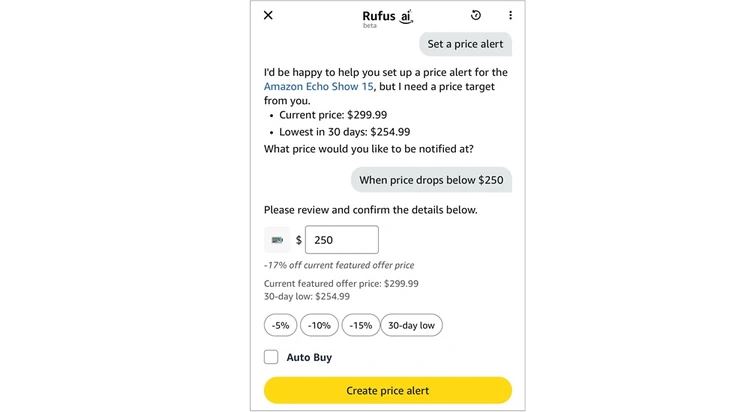
  3. There currently is not a Set price alert buttonon the product page. You actually need to open Rufus first and type Set price alert.
  4. Rufus will then show you the current price of the product as well as the 30-day lowest price.
  5. Youll then be asked What price would you like to be notified at? You just type the price you want to pay.
  6. Rufus will then pull up a price alert review and give you a couple other alert options that you can choose if you like.
  7. At this point, you can also select Auto Buy if youre a Prime member. When youcheck the Auto Buy box, Amazon will actually buy the item for you once it reaches your pre-selected price point.
  8. Last, tap Create price alert and youre done.

Once thats set, Rufus will check every 30 minutes for price changes and send you a notification when it hits your target.

Pro tip: When using Auto Buy, Amazon automatically places the order using your default payment method and default shipping address. And dont worry, youll get notified that the order has been placed and you have a 24-hour cancellation window to change your mind. Also, be aware that auto-buy requests stay active for up to six months or until you cancel them.

Method #2 Just ask Rufus to set the alert

You can also talk to Rufus directly via your phone to set up your price alert.

Heres how to make it happen:

  1. Open the product page in the Amazon app.
  2. Tap the Rufus icon / Ask Rufus button.
  3. Tap the microphone icon and say something like:
    • Set a price alert for this if it drops below $500.
    • Let me know if this falls 15%.
    • Set a price alert at $16.99 and auto-buy it when it hits that price.
  4. Rufus will then confirm the item, your target price or percentage-off, and whether you want Auto Buy.

Behind the scenes, talking to Rufus does the same thing as manually typingSet price alert, it just feels a little more tech-savvy.

How to actually find your price alerts
Photo

As is the case withmany features on Amazon, they dont always make things easy to find.

As a matter of fact, when using their website (not the app), they make it impossible to find the price alerts that youve previously set up.

Heres exactly how to find your price alerts:

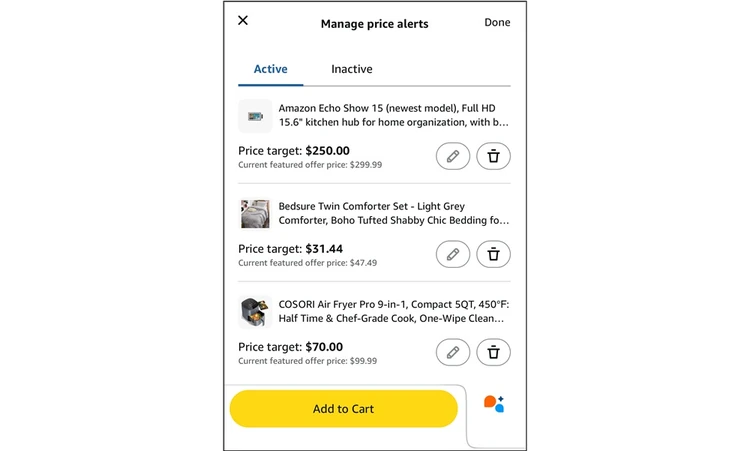
  • On the Amazon app, tap the three horizontal lines (menu) at the bottom, then Account, then in the Orders section tap on Your Price Alerts, then Manage Price Alerts.
  • Even easier when using the app, you can simply tap Rufus and say Manage my price alerts and youll get instant access to them.
  • On the website, youre out-of-luck. As of right now, you can only access your price alerts via the Amazon app. I verified this with an Amazon rep after a lengthy phone call. Hopefully theyll fix this in the near future.

Once you find your price alerts, you can tweak them how you want or cancel them altogether. This is also the spot where you can turn Auto Buy on or off.

Smart ways to actually use Rufus alerts

Here a few of my favorite ways to use these price alerts to save money in real-life:

Pre-sale stalking:

Before big shopping days like Prime Day / Black Friday / Cyber Monday, set price alerts on your maybe or wish items. Then let Rufus do the tracking instead of you refreshing your cart 40 times.

Stock-up strategy:

For stuff my family buys over and over (things like detergent, pet food, razor refills), I like to set a reasonable price target and then let Auto Buy do the work for me whenever the price is right. It saves me a lot of time and I know Im always getting a deal.

Impulse-control hack:

If you train yourself to only buy when Rufus hits your target price, youve basically turned every I want it now purchase into Ill wait for a real discount. Think of this as a built-in cooling-off period and it often keeps your impulses purchases under wraps.


Posted: 2025-12-04 02:15:33

Get Full News Story On Consumer Affairs


Listen to this article. Speaker link opens in a new window.
Text To Speech BETA Test Version.


More News From This Category
Consumer News: Home prices are still rising, but not everywhere
Thu, 30 Apr 2026 13:07:07 +0000

Nationwide, prices rose 0.1% in March

By Mark Huffman of ConsumerAffairs
April 30, 2026
  • U.S. home prices rose just 0.1% in March, marking the third straight month of minimal gains.

  • Annual price growth slowed to about 1.7%1.9%, the weakest on record dating back to 2012.

  • Prices declined in 13 major metro areas, with the biggest drops in Texas markets.


Are home prices going up or going down? It all depends.

In some markets where prices surged during the pandemic, prices are now falling. But in some other markets, where demand has remained steady, home prices are still rising.

So, when you hear that home prices rose 0.1% in March, thats the national average of the top housing markets taken together.

In a new analysis, real estate brokerage Redfin reports that March prices were up roughly 1.7% from a year earlierthe slowest year-over-year growth since Redfin began tracking the data in 2012.

Demand pressures weigh on prices

The sluggish growth reflects softer demand, as many prospective buyers have stepped back from the market. Elevated mortgage ratesrising from about 6% to 6.4% in Marchcombined with economic uncertainty, have reduced affordability and dampened buyer activity.

Redfin economists say these pressures are putting a lid on price growth, contributing to what they describe as an early-stage reset in the housing market.

Supply constraints prevent price declines

Despite weaker demand, home prices have not fallen nationally, largely because inventory remains constrained. Some homeowners are opting not to sell into a softer market, limiting the number of new listings and helping support prices.

There are still more sellers than buyers overall, but the gap has narrowed as both sides hesitate amid uncertain conditions.

Regional disparities widen

While the national trend shows slight growth, local markets are diverging. Prices fell month over month in 13 of the largest U.S. metro areas, with the steepest declines in Fort Worth and Austin, Texas.

At the same time, some markets posted notable gains, including Pittsburgh, West Palm Beach, and San Francisco, highlighting uneven conditions across the country.

Market reset underway

The latest data suggests the housing market is transitioning away from the rapid price growth seen during the pandemic era toward a more balanced environment.

Slower price increases could eventually improve affordability and draw some buyers back, but for now, high borrowing costs and economic uncertainty continue to restrain activity, keeping home price growth near historic lows.


Read More ...


Consumer News: Infant formula gets a clean bill of health after a government study
Thu, 30 Apr 2026 13:07:07 +0000

Fears of contamination and chemicals may have been unfounded

By Mark Huffman of ConsumerAffairs
April 30, 2026
  • FDA tested more than 300 infant formula samples in its largest-ever safety study

  • Vast majority showed undetectable or very low levels of contaminants

  • Agency plans continued testing and potential new limits for chemicals in formula


The U.S. Food and Drug Administration (FDA) on Wednesday released results from what it called the largest and most comprehensive testing of infant formula ever conducted in the United States, finding that most products meet high safety standards despite trace levels of contaminants.

The agency analyzed more than 300 samples of infant formula sold nationwide, generating over 120,000 data points as part of a sweeping review of chemical contaminants. The testing screened for heavy metals such as lead, mercury, cadmium and arsenic, as well as pesticides, PFAS forever chemicals, and phthalates.

According to the FDA, the overwhelming majority of samples contained either undetectable or very low levels of contaminants, reinforcing that the U.S. infant formula supply is safe for consumers. In many cases, contaminant levels were below federal drinking water standards.

Meet high safety standards

Health and Human Services Secretary Robert F. Kennedy Jr. said the findings show most products meet high safety standards, while emphasizing that even small exposures remain important for infants.

The testing effort is part of the FDAs broader Operation Stork Speed initiative and its Closer to Zero program, both aimed at reducing contaminants in foods consumed by infants and young children. The initiative was launched amid heightened scrutiny of infant formula safety following past recalls and reports of contaminants.

Work continues

Despite the reassuring results, the FDA said it plans to continue working with manufacturers to further reduce contaminant levels and may establish formal limits for certain chemicals in infant formula. The agency also intends to expand ongoing surveillance, including testing newer products entering the market.

Experts say the findings provide reassurance for parents but also show the need for continued oversight. Some have called on regulators to set clear national standards for contaminants in infant formula to ensure consistent safety benchmarks going forward.

The FDA said it will release additional data from follow-up surveys as part of its commitment to transparency.


Read More ...


Consumer News: Amazon’s return policy explained: What you can send back — and how to avoid costly mistakes
Thu, 30 Apr 2026 01:07:07 +0000

The fine print most Amazon shoppers miss

By Kyle James of ConsumerAffairs
April 29, 2026
  • Most items come with a 30-day return window, but the exact rules can vary depending on the product category and whether its sold by Amazon or a third-party seller.

  • Returns arent always free you may pay shipping or see deductions if youre returning something you simply dont want, especially with third-party sellers.

  • Start your return early and keep all packaging and accessories to avoid delays, extra fees, or reduced refunds once the item is inspected.


Shopping with Amazon is convenient, but returns can get a little confusing.

Between different return windows, seller rules, and occasional fees, its not always as simple as free returns, no questions asked. But once you understand how their system works, returning items (and avoiding unnecessary costs) becomes much easier.

Heres a full breakdown of Amazons return policy, along with some practical tips to make it work in your favor.

The basics: Most items have a 30-day return window

For the majority of items sold and fulfilled by Amazon, you have 30 days after delivery to return them.

That includes:

  • Electronics
  • Clothing and shoes
  • Household items
  • Most third-party seller items (but not all more on that below)

Refunds are typically issued to your original payment method once the item is received and processed.

Start your return as soon as you know something isnt right. You dont need to ship it back immediately, but by initiating the return, it locks in your eligibility and you dont have to worry about missing the return window.

Pro tip: Dont ignore Amazons extended holiday return policy. Every year, items purchased between November 1 and December 31 can be returned through January 31 of the following year. This makes it much easier to shop early for the holidays, since gift recipients still have plenty of time to return or exchange items after the season ends.

Not everything follows the same rules

This is where many Amazon shoppers get tripped up.

Some items have different return windows or restrictions, including:

  • Apple products: 15 days
  • Amazon Haul items: 15 days
  • Digital content (books/music): Seven days (if not used/downloaded)
  • Amazon Renewed:
    • 90 days (standard)
    • 365 days (Premium condition)
  • Wedding registry gifts: 180 days
  • Baby registry items: 365 days
  • Holiday purchases: Extended (often until late January)

Non-returnable items include:

  • Gift cards
  • Downloadable software
  • Perishable groceries
  • Some personal care items
  • Live plants, insects, or hazardous materials

Always check the Return Policy section on the product page before buying.

Pro tip: If youre buying a gift or something seasonal, double-check the return window, as it may be shorter than you expect.

Third-party sellers: Read the fine print

Its important to keep in mind that not everything on Amazon is sold by Amazon itself.

Items sold by third-party sellers may have:

  • Different return policies
  • Restocking fees
  • Buyer-paid return shipping

Most sellers follow Amazons general guidelines, but theyre allowed some flexibility.

Action step: Look for Sold by and Fulfilled by on the product page. When you see Fulfilled by Amazon you know that returns will be easier.

Are Amazon returns really free?

Often returns are completely free with Amazon, but not always.

Free returns typically apply when:

  • The item is defective
  • The wrong item was sent
  • The item arrived damaged

But if youre returning something because you changed your mind, it didnt fit, or you no longer want it, youll typically have to pay return shipping or see a small deduction from your refund.

When selecting a return reason, always be accurate, but also understand that some reasons may trigger fees.

How to return an item (step-by-step)

  1. Go to Your Orders
  2. Select the item and click Return or Replace
  3. Choose a return reason
  4. Select your refund method
  5. Choose how youll send it back

Youll then get:

  • A QR code (no box or label needed at some locations)
  • Or a printable return label

Return options: More convenient than ever

Amazon has expanded their return drop-off options significantly.

When you initiate your return, youll be told what your options are in your area.

You can return items at:

  • The UPS Store
  • FedEx Office
  • Kohl's
  • Staples
  • Whole Foods Market
  • Other grocery stores in your area (I have a Save Mart in my town that now takes Amazon returns via a kiosk.)

Many of these locations:

  • Pack the item for you
  • Dont require a box
  • Accept QR codes

Pro tip: Choose the no box, no label option whenever possible, as its the fastest and easiest.

Watch out for restocking fees

In some cases, Amazon may charge a restocking fee, especially if:

  • The item is returned used or damaged
  • Parts or packaging are missing
  • You return it outside the policy guidelines

Action step: Its very smart to keep original packaging and accessories until youre sure youre keeping the item.

Return-less refunds: When you keep the item

Sometimes Amazon will tell you to keep the item and they'll still refund you your money.

These return-less refunds usually happens when:

  • The item is low-cost
  • Return shipping would cost more than the item
  • Theres a quality issue

Youll be told to keep it, donate it, or to discard the item. Ive also had it happen on items that contain liquids or are health related. In most cases, Amazon doesnt want them back, as theyd have to throw them away.

This isnt something you can request, so its not worth trying to game the system to try and get free stuff. But rather, its automatically determined by Amazons internal system.

Common mistakes that cost you money

Even experienced shoppers make these mistakes when it comes to Amazons return policy:

  • Waiting too long:If you miss the return window, you may be stuck with the item.

Pro tip: Ive found that if you start a live chat and apologize that you're late on your return, theyll typically make an exception and let you return the item. This is especially the case if the item is still brand new and youre only seven to 14 days past the 30-day window.

  • Throwing away packaging too soon:Missing boxes or parts can potentially reduce your refund.
  • Not checking seller policies:Those third-party returns can be stricter, so make sure whos fulfilling your order before youcomplete checkout.

You definitely can abuse their policy

If youre returning a large percentage of what you buy, Amazon is going to notice. At some point, they can flag your account and temporarily block you from making additional returns.

The same goes for starting returns and never actually sending the item back. Do it enough times, and it can raise red flags.

Behind the scenes, Amazon tracks something called your concessions limit. I was told this is essentially a threshold amount they assign based on your return and refund history. It could be a $500 threshold, or it could be closer to $1,000 Amazon keeps the actual amount close to their vest.

I was also told they have employees that review accounts and sets these limits for users who they think are pushing the policy too far. If you go over that limit, your account can get labeled for concession abuse.

In plain terms, that means if Amazon sees a pattern of frequent refunds, credits, or return-related requests, theyre not going to keep approving them.

Once youre flagged, future returns can be denied altogether, even if the request would normally qualify.

The good news is that you wont be blindsided. Amazon typically sends a warning email first before taking any action, which gives you a chance to course-correct.

How to avoid returns in the first place

The easiest way to win at returns is to avoid them altogether.

Before buying:

  • Read reviews carefully (especially recent reviews, as those tell you what the current version is like).
  • Always check sizing charts and product dimensions when available.
  • Be sure to look at any customer photos and videos that come from legit buyers.
  • Avoid too good to be true listings. Always trust your gut, if the deal seems to good to be true, it probably is.

What to do if your return is denied

If your return is rejected or your refund seems incorrect:

  1. Contact Amazon customer service
  2. Provide photos or documentation
  3. Escalate if needed

Amazon is generally customer-friendly, but you need to be sure to follow up.


Read More ...


Consumer News: Grocers caught overcharging for meat — here’s how to protect yourself
Wed, 29 Apr 2026 19:07:07 +0000

What to do when your steak costs more than it should

By Kyle James of ConsumerAffairs
April 29, 2026
  • Watch the unit price closely: Dont rely on the total, instead compare price per pound across similar meat packages to spot inconsistencies or red flags quickly.

  • Double-check weight when unsure: Use in-store scales (or compare similar packages) to catch obvious mismatches between labeled and actual weight.

  • Speak up and keep receipts: If something seems off, ask staff to reweigh it and request a refund.


A new investigation out of Canada found major grocery chains overcharging customers for underweight meat. The issue is that some packages appear to be priced with the packaging included in the weight, meaning shoppers are paying for plastic, not just food.

While this report focused on Canadian stores, the takeaway is just as relevant for U.S. shoppers. The fact of the matter is that pricing errors happen, and they can add up quickly, especially as food costs continue to rise.

In some cases, overcharges ranged from a few percentage points to nearly 17%. That might not sound like much, but on higher-priced items like meat, it can mean paying an extra dollar or more per package every time you shop.

Heres how to protect yourself and avoid overpaying.

Why this matters for U.S. shoppers

In both Canada and the U.S., grocery stores are required to price items based on net weight. This means the food only, not the packaging. But errors can still happen at multiple points in the process, from suppliers to in-store labeling.

If youve bought steak recently, you already know meat is one of the most expensive items in your cart. So even small discrepancies can hit your budget harder than you might think.

3 simple ways to avoid overpaying for meat

1. Check the price per poundnot just the total. Always look at the unit price (price per pound or per ounce). If something feels off, like a small package costing more than expected, youd be wise to pause and take a closer look.

Pro tip: Compare similar packages. If two packs look about the same size but clearly have different weights or prices on the tag, thats a red flag.

2. Use the in-store scale when possible

Many grocery stores (especially in the produce section) have scales customers can use. If youre unsure, quickly weigh your package, especially when buying more expensive cuts like rib-eye, filet mignon, and NY strip.

You dont need to be exact, but just by checking whether the number is noticeably off can help you catch issues.

3. Speak up and get a refund if needed

If you think youve been overcharged:

  • Bring it up to customer service
  • Politely ask them to reweigh the item
  • Request a refund or price adjustment

Most stores will correct the issue quickly, and some may even offer a refund bonus depending on local pricing accuracy laws.

Pro tip: Its smart to keep your receipt until youve checked your purchases at home, especially for higher-cost items like meat.

A smart shopper habit that pays off

One of the most effective habits is to spot-check your groceries occasionally.

You dont need to weigh everything, but checking once in a while:

  • Keeps stores accountable
  • Helps you spot patterns
  • Protects your budget over time

Read More ...


Consumer News: How electric vehicles could reshape household energy bills
Wed, 29 Apr 2026 19:07:06 +0000

New research shows EV adoption may lower fuel prices and strengthen U.S. energy security

By Kristen Dalli of ConsumerAffairs
April 29, 2026
  • Widespread EV adoption could cut U.S. household energy costs by more than 6% by 2035.

  • Reduced gasoline demand may lower prices at the pump even for non-EV drivers.

  • The shift could also reduce oil imports and boost U.S. energy exports.


Electric vehicles (EVs) are often framed as a personal choice one that benefits drivers willing to invest in newer technology. But new research suggests the ripple effects could extend far beyond individual car owners.

According to a study from Georgia Tech, putting more EVs on the road could actually lower energy costs across the board, including for people who still drive gas-powered cars.

The reasoning is fairly straightforward: when more drivers switch to electricity, demand for gasoline drops. That reduced demand can push down fuel prices, meaning even households without EVs may see savings. At the same time, the study points to broader national impacts, including improved energy security and shifts in how the U.S. participates in global energy markets.

Proponents of eliminating fuel efficiency standards and other EV-boosting policies often frame regulatory approaches as consumer-unfriendly, but our analysis shows that such policies have many long-term benefits, both for consumers and for the nations energy security, researcher Niraj K. Palsule said in a news release.

How researchers modeled the impact

To understand these potential effects, researchers used a version of the National Energy Modeling System a tool designed to simulate how energy is produced, consumed, and priced over time. Their version was tailored to better capture how different parts of the energy system interact with each other.

The study compared multiple policy scenarios between 2022 and 2035. One scenario assumed fewer incentives for EV adoption and weaker fuel efficiency standards. Another modeled a more moderate path forward, incorporating a mix of federal and state-level policies aimed at increasing EV use.

By running these side-by-side simulations, researchers were able to estimate how changes in vehicle technology and policy could influence fuel demand, electricity prices, and overall household energy spending over time.

What the study found

The results point to measurable, if gradual, economic benefits. By 2035, widespread EV adoption could reduce overall household energy bills by more than 6%, including over 4% savings on gasoline alone.

Lower demand for oil plays a key role here. The study estimates oil imports could fall by about 7%, while exports could increase by nearly 4%, shifting the U.S. further toward being a net energy exporter.

Interestingly, the savings arent limited to higher-income households or EV owners. Lower-income households many of whom may still rely on gas-powered cars could see slightly larger percentage savings on energy costs.

There are also secondary effects. As EV adoption grows, advances in battery technology could make energy storage cheaper and more efficient. That, in turn, may help stabilize or even slightly reduce electricity prices, offsetting concerns about increased demand on the grid.

Overall, the study suggests that the economic impact of EVs isnt just about what happens in your driveway its about how shifts in demand reshape the entire energy system.


Read More ...


Related Bing News Results
Consumer Reports investigation: Home hair dye kits
Wed, 29 Apr 2026 17:04:00 GMT
Consumer Reports investigation: Home hair dye kits ...

Consumer Reports investigation: Energy drinks risky for teens
Wed, 29 Apr 2026 10:01:00 GMT
Energy drinks are colorful, sweet, and hugely popular with teens. But they come with an important warning for parents. A new Consumer Reports investigation finds what’s inside those drinks may be more ...

What's inside those popular energy drinks teens consume
Mon, 27 Apr 2026 10:14:00 GMT
Consumer Reports says many drinks double the daily caffeine limit recommendation ...

consumer reports
Thu, 23 Apr 2026 03:11:00 GMT
Eken Group has issued a firmware update to resolve major security issues with its doorbell cameras that were uncovered by Consumer Reports. The cameras are sold under the brands Eken, Tuck, Fishbot, ...

Consumer Reports explores digital minimalism
Wed, 22 Apr 2026 17:38:00 GMT
A survey shows Americans spend over four hours daily on their phones, with nearly half feeling addicted, as experts highlight the impact on mental health and suggest ways to cut back.


Blow Us A Whistle


Related Product Search/Búsqueda de productos relacionados

Amazon Logo

Visit Our New Print-On-Demand Stores On Printify and Zazzle
Printify Zazzle