Every June 11, Hawaii shifts into celebration mode for king kamehameha day, a state holiday that blends history, ceremony, and public pride in a way few observances do. You might see flower-covered statues, floral parades, hula performances, and crowds gathering not just for a day off, but for a living tribute to the ruler credited with uniting the Hawaiian Islands.
For many readers outside Hawaii, the holiday can look festive first and historical second. But the order really runs the other way. The color, music, and pageantry matter because they carry memory. King Kamehameha Day is not simply about a famous monarch from the past. It is about how Hawaii publicly remembers political leadership, cultural identity, and the formation of a kingdom whose legacy still shapes civic life today.
What is King Kamehameha Day?
King Kamehameha Day is a Hawaii state holiday observed annually on June 11 in honor of King Kamehameha I, also known as Kamehameha the Great. He is widely recognized as the leader who united the Hawaiian Islands into one royal kingdom in the late 18th and early 19th centuries.
The holiday dates back to the 19th century. It was established by King Kamehameha V in 1871 to honor his grandfather's achievements and preserve his legacy for future generations. That timing matters. Even then, Hawaii's leaders understood that public remembrance needed more than textbooks or court records. It needed a day people could see, attend, and pass down.
Today, the observance remains one of Hawaii's most recognizable annual celebrations. It carries official state status, but it also has a strong community rhythm. Schools, civic groups, cultural practitioners, local businesses, and visitors all interact with it in different ways.
Why King Kamehameha Day still matters
The most basic answer is historical. Kamehameha I changed the political structure of the islands through warfare, diplomacy, and strategic alliances, creating a unified Hawaiian Kingdom. That alone would justify major historical recognition.
But the holiday continues to matter because it speaks to more than political victory. In Hawaii, public history is closely tied to place, ancestry, language, and ceremony. Honoring Kamehameha is also a way of recognizing Native Hawaiian heritage and the continuing visibility of Hawaiian culture in public life.
There is also a modern layer to the holiday. For residents, it can be a source of pride and continuity. For visitors, it can be an entry point into Hawaiian history that goes beyond postcard imagery. For educators and news audiences, it is a reminder that state holidays often reveal what a place values most.
That said, the meaning is not identical for everyone. Some approach the day primarily as a cultural celebration. Others focus on the monarchy, Hawaiian sovereignty, or the broader history of colonization and political change. Those perspectives can overlap, but they are not interchangeable. A useful way to understand the holiday is to see it as ceremonial on the surface and deeply layered underneath.
How King Kamehameha Day is celebrated
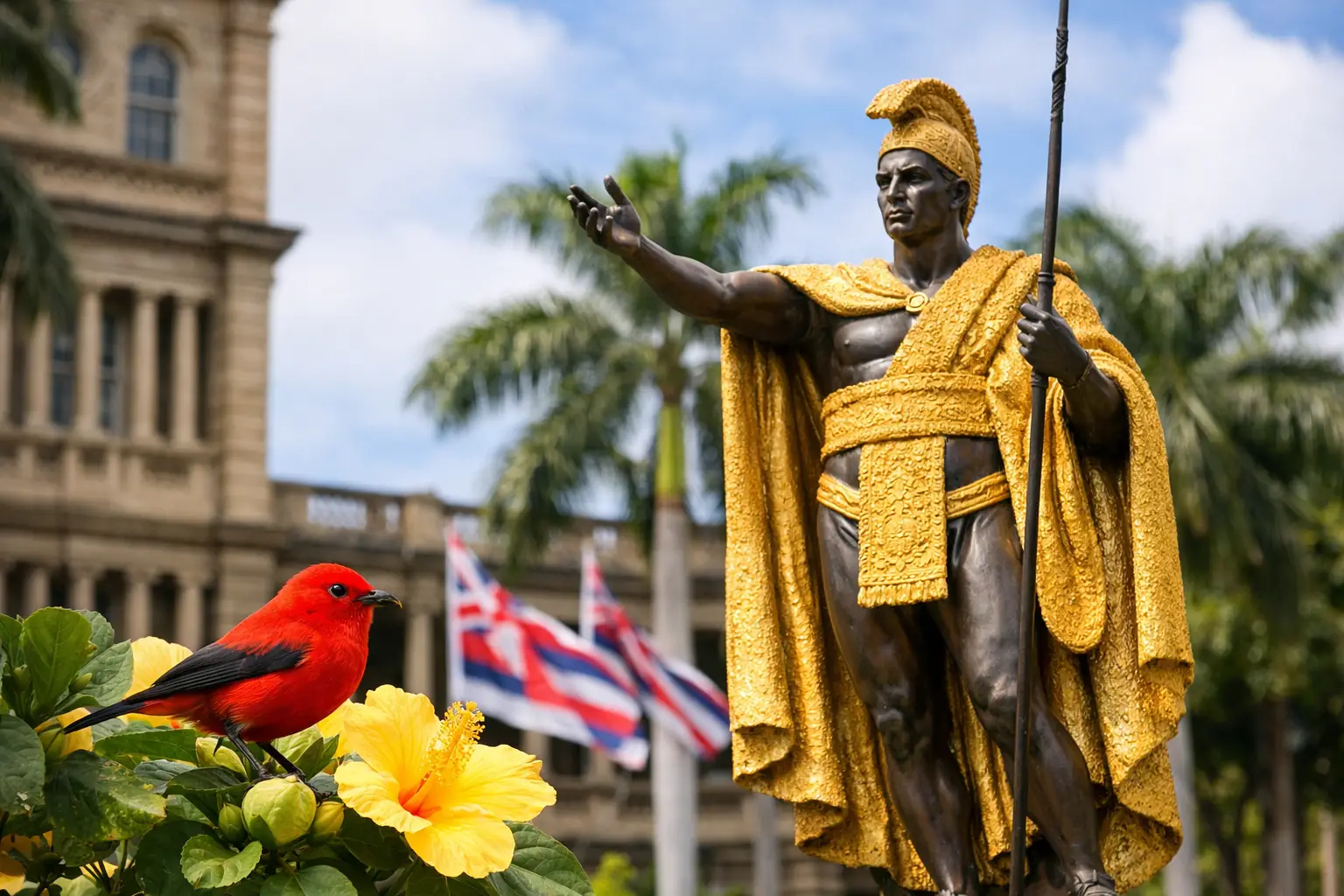
The most iconic tradition is lei draping. Statues of King Kamehameha I, especially the well-known one in Honolulu, are covered with long strands of fresh floral lei in a formal ceremony that draws attention from across the state. The visual is striking, but it is also symbolic. Lei are not casual decoration here. They communicate honor, respect, and connection.
Floral parades are another major part of the observance. Riders on horseback, marching groups, decorated floats, and representatives of Hawaiian civic organizations often take part. These parades can feel festive and family-friendly, but they also function as public storytelling. They place Hawaiian imagery, leadership, and tradition directly in the streets.
Hula performances, music, craft fairs, and cultural demonstrations are often scheduled around the holiday as well. Depending on the island and the year, events may range from highly ceremonial to broadly community-focused. Some are rooted in protocol and heritage, while others are designed to welcome residents and travelers into the celebration.
That mix is part of what makes the holiday distinctive. It is not locked into a single format. A formal ceremony, a neighborhood event, and a tourism-facing celebration can all happen under the same holiday banner. The trade-off is that visitors may only see the festive layer unless they take time to understand the history behind it.
The history behind the holiday
Kamehameha I was born in the 18th century, though the exact year remains debated. He rose to power during a period of conflict among island chiefs and became known for military skill, political strategy, and state-building. By 1810, he had unified the islands under one rule, creating the Kingdom of Hawaii.
That achievement is the foundation of the holiday, but history is rarely simple. Kamehameha's rise involved warfare, changing foreign relationships, and the difficult realities of power. Public memory often highlights unity and leadership, yet scholars and cultural educators also point to the complexity of how that unity was achieved.
This is where king kamehameha day stands apart from a simple heritage festival. It honors a figure of enormous significance, but it also opens the door to larger questions about monarchy, governance, and identity in Hawaii. Readers looking for quick definitions will find them easily. Readers looking for the full picture need to hold both celebration and complexity at the same time.
What visitors should know before attending
If you are in Hawaii during the holiday, it helps to approach events with the mindset of a respectful guest rather than a spectator chasing a photo opportunity. The ceremonies are public, but they are not theme park performances. They carry meaning for local communities, especially when tied to Hawaiian protocol and cultural practice.
Dress appropriately, follow event guidance, and pay attention during formal moments. If a ceremony includes chants, blessings, or speeches, treat those with the same respect you would give any civic or religious observance. Taking photos is often fine in public settings, but timing and behavior still matter.
It also helps to understand that schedules can vary by island and by year. Some events are large and widely promoted. Others are local and community-centered. Travelers who expect one single statewide format may miss the fact that Hawaii's celebrations often reflect the identity of each island and town.
For news-minded readers who track public events through multiple sources, this is one of those observances where local coverage can add valuable context. RobinsPost-style readers who like to scan updates, videos, and event features in one place will likely find that the holiday works best when viewed through both breaking coverage and background history.
Common misconceptions about King Kamehameha Day
One common misconception is that the holiday is only for Native Hawaiians. In practice, it is a public state holiday, and many communities participate. At the same time, it is rooted in Hawaiian history and should be understood on those terms, not flattened into a generic summer festival.
Another misconception is that it celebrates Hawaiian independence in a broad modern sense. The day specifically honors Kamehameha I and his role in unifying the islands. It may connect to wider conversations about Hawaiian identity and political history, but it is not the same as every other discussion about Hawaii's past or present.
A third misunderstanding is that the holiday is mostly tourist-facing. Visitors do attend, and tourism materials often highlight the visual appeal. Still, the observance existed long before modern travel marketing turned it into a seasonal attraction. Its core meaning is local, historical, and civic.
King Kamehameha Day in the larger American calendar
For mainland audiences, king kamehameha day can be easy to overlook because it is state-specific rather than federal. Yet that is exactly why it deserves attention. State holidays often reveal a clearer local identity than national observances do.
In Hawaii, this day tells you something central about public memory: history is not stored away only in museums or archives. It is carried into the streets through flowers, horses, chants, and ceremony. That kind of visibility is powerful. It turns history from background information into something people gather around.
For readers trying to keep up with cultural events across the U.S., this holiday is a useful reminder that American public life is not one-size-fits-all. Different states elevate different stories. In Hawaii, the story of Kamehameha remains one of the biggest.
If you come across king kamehameha day on a calendar, treat it as more than a date or a colorful parade headline. It is a chance to pay attention to how Hawaii honors leadership, culture, and memory in public view - and that is worth showing up for.