Hundreds of athletes, one legendary Hawaiian channel.
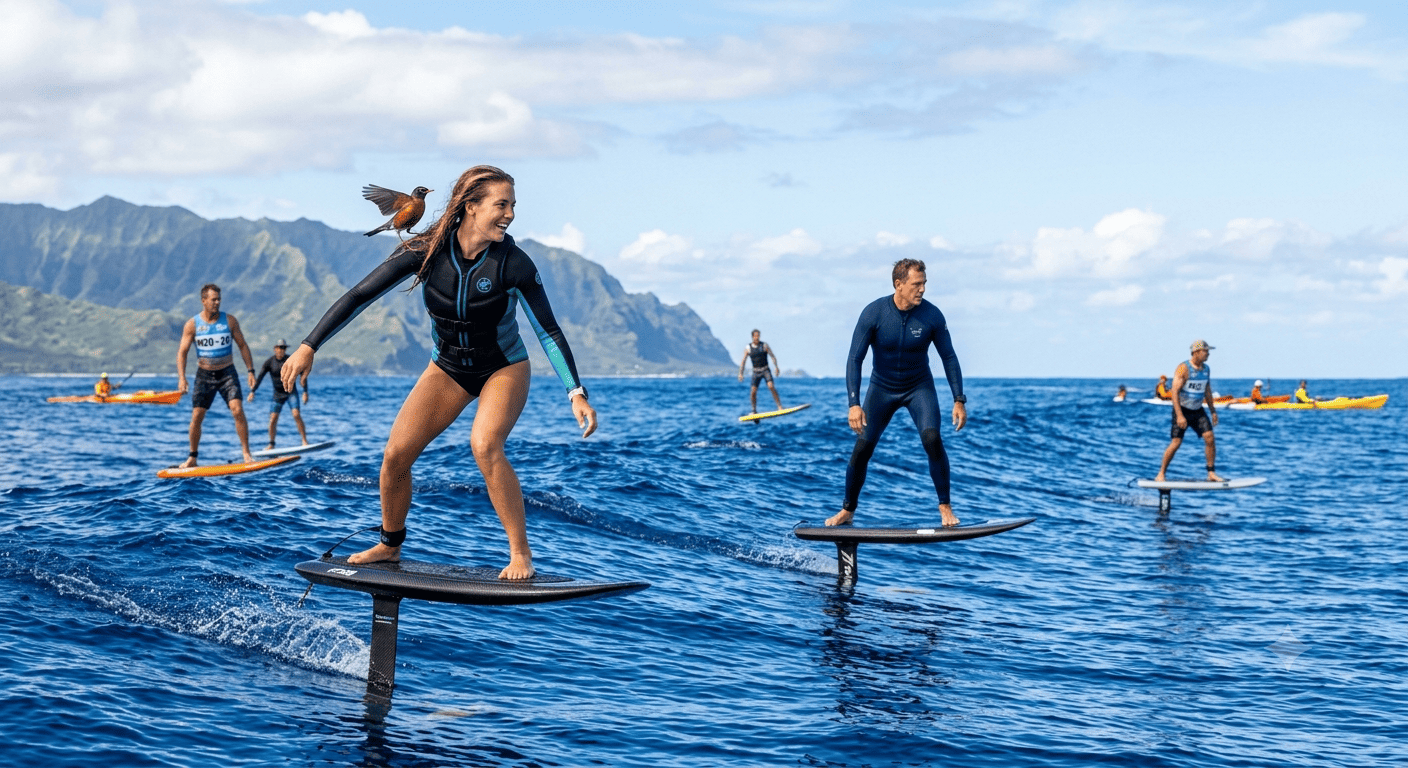
This week, hundreds of athletes from across the world are preparing for the world championship in downwind foiling, a cutting-edge ocean sport that sends riders flying above the water on hydrofoil boards. The race course crosses the legendary Kaʻiwi Channel, a roughly 40-mile / 36–42-mile stretch of open ocean between Molokai and Oahu that has long been known as the “Channel of Bones” for its powerful swells, shifting winds, and unforgiving conditions.
Launching from the rugged west end of Molokai near ʻIlio Point and finishing at Kaimana Beach on Oahu, the downwind foil world championship represents the pinnacle of the sport: a full-channel crossing where athletes must read the ocean in real time, linking open-ocean bumps and trade wind swells to stay airborne and fast.
What Is Downwind Foiling?
Downwind foiling uses hydrofoil boards that lift above the surface, allowing riders to glide on the energy of the ocean rather than relying solely on breaking waves. In Hawaii’s trade wind conditions, athletes pump their boards onto foil and then surf long, rolling swells, connecting one bump to the next for miles at a time.
The Molokai to Oahu race features multiple disciplines, including stand-up paddle (SUP) foil and wing foil, with divisions for men, women, juniors, and both escorted and unescorted riders. It is the final and most prestigious stop of the Downwind Foil World Tour and the Koa Kai Triple Crown, a series that links downwind races across Maui, Molokai, and Oahu.
The Kaʻiwi Channel: A Legendary Test
The Kaʻiwi Channel has been the stage for decades of iconic ocean racing, from prone paddleboard and SUP crossings to the modern era of foiling. Strong trade winds, long-period swells, and powerful currents combine to create a fast but unforgiving environment where small mistakes can cost minutes or an entire race.
For foilers, the challenge is not just surviving the crossing, but staying on foil as much as possible. Top athletes can complete the route in under two hours, linking swells at high speed on specialized downwind boards and high-aspect foils designed for efficiency and control in open-ocean conditions.
A Global Field Converges on Hawaii
The 2026 edition of the Molokai to Oahu Foil World Championship brings together Olympic-caliber athletes, seasoned watermen and waterwomen, and a rising generation of juniors from across the globe. With the event fully sold out and serving as the final stop of the Koa Kai Crown, every second on the channel matters; world titles and series rankings will be decided in real time on the open ocean.
Growth in women’s and junior divisions signals a new era for the sport, as more athletes embrace foiling as the next frontier in ocean racing. For many competitors, simply finishing the crossing is a lifetime achievement; for the fastest, it is a chance to etch their names into the history of Hawaii’s most storied channel.
More Than a Race
Beyond the competition, the Molokai to Oahu foil race is a celebration of Hawaiian ocean culture and the deep relationship between athletes and the sea. Pre-race gatherings, safety briefings, youth clinics, and community events on Molokai and Oahu turn race week into a full festival of downwind paddling and foiling.
As hundreds of athletes launched into the Kaʻiwi Channel, one thing is certain: this world championship is not just about speed. It is about reading the wind, respecting the ocean, and carrying forward a legacy of channel crossings that has defined Hawaiian endurance sport for generations.
2026 M2O Foil Champions
Men's Division: Edoardo "Edo" Tanas (Three-peat)
- Winner: Edoardo "Edo" Tanas (Oʻahu, HI)
- Winning Time: 2 hours, 13 minutes
- The Story: Tanas made history by claiming his third consecutive M2O world title. With light winds making it extremely difficult to connect open-ocean swells, his winning time was roughly 17 minutes off his course record. Despite the tough bump, Tanas navigated a smart tactical line to hold off a competitive field, including standout performances from Tahitian dark horses Raiarii Fadier and Axel Pham.
Women's Division: Annie Reickert
- Winner: Annie Reickert (Maui, HI)
- Winning Time: 2 hours, 52 minutes
- The Story: Reickert's victory came down to a brilliant pre-race call. Spotting a light breeze building across the channel, she made a clutch decision to swap her front wing setup just 10 minutes before the starting horn. The last-minute equipment change paid off, giving her the extra lift needed to power through the low-wind sections and claim the women's title.
The Kaiwi Channel Effect: Known as one of the most unforgiving open-ocean proving grounds on Earth, this year's low-wind crossing rewarded equipment adaptability and ocean-reading experience over pure downwind speed.