Rockin Robin SongFlying The Web For News.
RobinPost Logo Amazon Prime Deals


Consumer Daily Reports

Shorter mortgage terms and bigger down payments can lower housing costs

By Dieter Holger of ConsumerAffairs
April 24, 2025

Key takeaways

  • Iowa, West Virginia and Kansas are the three best states for spending less income on owning a home in 2025.
  • For spending less income on renting, Kansas, Iowa and Wyoming are the three best states.
  • Both homeowners and renters should strategize a budget and aim to spend no more than 30% of their yearly income on housing.

Budgeting how much of your income is spent on amortgage or rent is critical when finding affordable housing.

States in the West and Northeast of the U.S. generally had more affordable housing, while states in the Midwest and South were less so, according to financial-advice websiteWalletHub, which analyzed the costs of rent, mortgages and energy compared with median incomes.

Iowa was the best state for spending less income on owning a home, costing nearly 19% of yearly income, followed by West Virginia (20%), Kansas (20%), Nebraska (20%) and Ohio (20%).

Consumer News: Best states for affordable housing in 2025

Financial planners recommend spending no more than 30% of income on housing, before taxes and deductions.

"Setting a clear, realistic budget from the start is one of the smartest moves you can make," Chip Lupo, analyst at WalletHub, told ConsumerAffairs.

The good news is costs for owning a home, including mortgage and energy,took less than 30% of typical incomes in 37 states, according to the WalletHub data, which showsthere are many pockets of affordable housing across the country,

On the other hand, Hawaiiwas the worst state for how much income went to owning a home, costing nearly 47% of income. The other five worst states are California (46%), Oregon (36%), Nevada (35%) and Washington (35%).

The rankinghighlights pitfalls and opportunities in affordable housing among states after the cost to buy a home has outpaced inflation, pricing out would-be homebuyers from the market.

"With home prices rising and interest rates bouncing back from historic lows, buying a home today requires some strategic planning," Lupo said. "So to keep control of your finances, consider a shorter mortgage term, work on improving your creditand strive for a large down payment to reduce interest costs."

What were the best states for affordable rent?

Rent cost less than 30% of yearly income, the recommended level for affordable housing, in 32 states, according to WalletHub.

The best state for spending less income on rent is Kansas, costing around 19% of a typical yearly income, followed by Iowa (19%), Wyoming (20%), Minnesota (21%) and Oklahoma (22%).

The worst state for spending less income on rent is New York, costing nearly 55% of income. The other five worst states are Hawaii (53%), Massachusetts (49%), Florida (43%) and Maine (42%).

Hawaii andMassachusetts both ranked in the top 10 worst states for homeowners and renters.
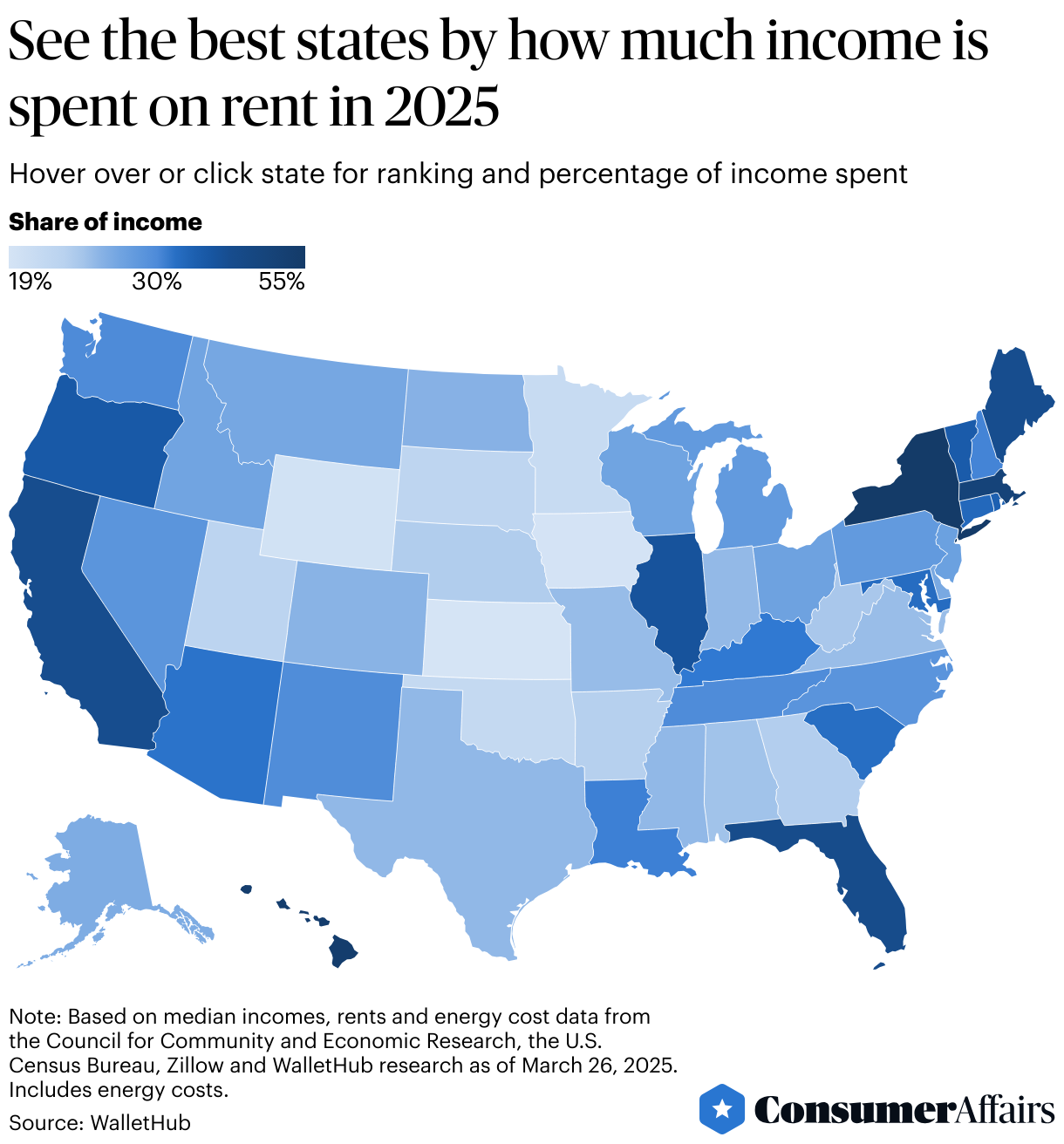
Consumer News: Best states for affordable housing in 2025

Lupo said that the real-estate market is putting pressure on renters, too. He saidrent can cost more than 40% of yearly income instates with expensive homes such as New York and Florida.

Energy bills should also be top of mind for both homeowners and renters, he said.

"Remember, housing costs are more than just mortgage or rent," Lupo said, pointing to how Hawaii hassome of the highest home energy costs in the country. "Cutting down on water, heatand electricity use can make a noticeable difference in your monthly expenses, whether you own or rent."


Sign up below for The Daily Consumer, our newsletter on the latest consumer news, including recalls, scams, lawsuits and more.


Posted: 2025-04-24 11:16:40

Get Full News Story On Consumer Affairs


Listen to this article. Speaker link opens in a new window.
Text To Speech BETA Test Version.


More News From This Category
Consumer News: The 5 best return policies in ‘brick & mortar’ retail
Wed, 22 Apr 2026 01:07:05 +0000

Let this list help you decide where to shop

By Kyle James of ConsumerAffairs
April 21, 2026
  • Retailers like Costco and Nordstrom stand out for their flexible, low-risk return policies that give shoppers more confidence when buying.

  • A strong return policy means more time to decide, easier refunds, and less risk of being stuck with items or forced into store credit you may not use.

  • Stores like Target, Kohls, and Walmart combine convenience and flexibility, making returns faster, simpler, and less stressful.


Most people think saving money is all about finding the lowest price.

But experienced shoppers know something else matters just as much: the return policy.

A flexible return policy gives you plenty of time to change your mind, or fix a bad purchase, or test something out without much risk. A bad one can cost you money and lock you into items you dont want. Or even force you into taking store credit that you might forget to use.

Heres a breakdown of the current five best brick andmortar return policies.

1. Costco (best overall)

Costcos return policy is famously generous. Its designed to build long-term trust with members, even if that means it can (and does) get abused by some shoppers.

Here are the details:

  • There is no time limit on returns for most items.
  • Expect to get a full refundwith noquestions asked.
  • Electronics have a 90-day return window.
  • No receipt is needed for returns.
  • Only things that cant be returned: alcohol, gift cards, cigarettes, airline tickets, and concert tickets.

Why it stands out:

Costco removes urgency as youre not forced to decide within 30 days whether something works. You can actually live with the product and see how it performs over time.

Thats especially valuable for:

  • Appliances
  • Mattresses
  • Bulk purchases

Pro tip: Use Costco for purchases where performance matters in the long-term. Think of it this way, if something fails after a few months, youre still protected. That effectively lowers the risk of trying and testing out those higher priced items.

2. Nordstrom (most flexible)

Nordstrom takes a completely different approach to their return policy. They actually have a case-by-case policy where they use their judgment instead of strict rules.

This translates to the following:

  • Amazingly, they dont have a formal return window.
  • Returns are often accepted without receipts.
  • Even worn items are often accepted.

Why it stands out:

Its built around customer loyalty with the ultimate goal of making their customers happy. This means theyll take back pretty much anything as long as they dont feel youre abusing the policy with an excessive number of returns.

That flexibility is very rare, especially in apparel, as most stores look for reasons to deny your return.

Pro tip: If youre unsure about sizing, fit, or quality, Nordstrom is one of the safest places to shop, as it reduces the risk of buying clothing online or trying new brands.

3. Target (best structured flexibility)

Target offers one of the most practical policies for everyday shoppers, especially when it comes to their own in-house brands.

Here are the keys to know:

  • 90-day return window + an extra 30 days with the Target Circle Card.
  • One-year returns for their store-brand items.
  • Electronics are limited to a 30-day return window,and Apple products have a 14-day return window.
  • They always extend their return policy until late January for things bought after October 1.

Why it stands out:

Target strikes a strong balance between clear rules and real flexibility. In other words, they give you more time and options than most retailers without being overly complicated.

Pro tip: Prioritize Targets one-year return policy on their private-label brands (Cat & Jack, Good & Gather, Threshold, etc.). The extended return window gives you far more time to evaluate whether something is worth keeping. Just dont abuse it or its bound to get stricter in the future.

4. Kohls (also very flexible)

Kohls quietly offers one of the better standard return policies in retail:

  • 90 day returnson most items (120 days with your Kohls card).
  • Baby registry items get a whopping 365 days.
  • No receipt required. (They can use your credit card or order number.)
  • They also offer a holiday return policy. Items bought in October can be returned all the way up until January 31.

Why it stands out:

If you make a purchase using Kohls Cash, and you return the item, youll get the Kohls Cash back as long as it hasnt expired. If it has expired, theyll actually give you new Kohls Cash for the same amount.

5. Walmart (most practical)

Walmart doesnt have the longest return window on my list, but their return policy is definitely one of the easiest to use.

Here are the details:

  • 90-day returns for most items.
  • Often flexible with or without receipts.
  • Their large number of store locationsmakes returning anywhere fairly easy.
  • Theyextend holiday returns until January 31 for anything bought in early October.

Why it stands out:

They make returns very convenient, as you can return to any store, via the mail, and now they even allow you to schedule an InHome return pickup.

The bottom-line is if youre prone to losing receipts or making quick purchases, Walmarts flexibility makes it a safer everyday option for consumers.


Read More ...


Consumer News: Beauty budgets are getting a reality check — but self-care still comes first
Tue, 21 Apr 2026 22:07:06 +0000

New data shows Americans are cutting back elsewhere, not on wellness and what that shift means for your routine (and your wallet)

By Kristen Dalli of ConsumerAffairs
April 21, 2026

  • Self-care isnt optional anymore: Many Americans are prioritizing beauty and wellness routines even if it means cutting back on essentials like groceries or delaying other expenses.

  • Spending habits are shifting, not disappearing: Instead of giving up treatments, consumers are spacing out appointments, choosing more affordable options, and turning to DIY alternatives.

  • Its about more than looks: For a growing number of people, beauty and wellness are tied to stress relief, confidence, and overall well-being making them feel worth the cost, even in a tight economy.


For many Americans, beauty and wellness routines are no longer a nice-to-have theyre part of how people cope, stay confident, and manage everyday stress. Even as costs rise and financial pressure builds, consumers arent walking away from self-care. Instead, theyre reshuffling their budgets to make it work.

New data from Zenoti reveals just how far people are willing to go: some are cutting back on groceries, delaying vacations, or even taking on debt to keep up with their routines.

But the bigger trend isnt about overspending its about adaptation. From spacing out appointments to opting for DIY treatments at home, consumers are finding ways to maintain their routines without completely breaking the bank.

ConsumerAffairs spoke with Sudheer Koneru, CEO and Co-founder, at Zenoti to learn more about how this trend is reshaping not just how people spend, but how the entire beauty and wellness industry operates signaling a future where flexibility, affordability, and personalization matter more than ever.

Making sacrifices for a beauty routine

Koneru broke down some of the biggest data points that surprised even the research team. Heres a look at where consumers are making sacrifices for their beauty routines:

  • 22% of respondents scaled back on groceries

  • 21% delayed medical or dental care

  • 28% said theyd cut beauty spending before making major life expenses like home repairs, skipping savings contributions, and putting off vehicle maintenance for the same reason.

That's not reckless behavior, Koneru said. That's a signal. When people protect something this fiercely, it means it's doing something essential for them managing stress, restoring confidence, maintaining a sense of self during uncertain times.

Beauty and wellness have always been about feeling good. Our data just confirms that people know it, even when their budgets don't make it easy.

Impacting credit

Koneru also explained that these trends are affecting how shoppers are using their credit.

Our research found that 41% of consumers used credit cards for beauty and wellness in the past year, and nearly half said they'd be willing to take on debt to maintain their routines if they lost their primary income, Koneru said. That's not impulse spending. That's a considered decision; the same kind people make about rent or health care, and points to a mindset shift where these services are seen as ongoing commitments vs. the occasional treat yourself splurge.

Can you save money?

The short answer: yes.

Zenotis research shows that many consumers (45%) are spacing out their appointments further in an effort to stretch their budgets. Additionally, about 33% are opting for more affordable treatments or options instead of ditching them entirely. Another option: DIY beauty treatments.

Koneru said that there are plenty of ways for consumers to maintain their beauty routines while also being cost-effective.

  • Switching from impulse buying to intentional spending

  • Switching to more affordable product alternatives going from premium to drugstore brands

  • Subscription boxes and at-home tools

The smartest savings often come from better guidance, not just cheaper products, Koneru said. We've seen that consumers who work closely with their provider and use the right retail products to extend the benefits of their services at home actually spend less over time. They stop cycling through products that don't work and start investing in what does. That's a conversation providers should be having at every appointment.

Feeling good isnt a luxury

Koneru says that these findings express something deeper about human perception: feeling good isn't a luxury.

More than three in five people told us that cutting back on beauty and wellness would make them more stressed, less confident, or worse off emotionally, Koneru said. That's not a small thing; it's infrastructure for daily life.

Consumers are now behaving more like long-term planners, adjusting their frequency and spending, but staying committed to maintaining these routines. The broader takeaway for me is that in uncertain times, people don't give up the things that make them feel like themselves. They find creative ways to hold onto them.


Read More ...


Consumer News: Home insurance costs are climbing — and first-time buyers are feeling the squeeze
Tue, 21 Apr 2026 22:07:06 +0000

New data shows rising premiums are putting pressure on budgets

By Kristen Dalli of ConsumerAffairs
April 21, 2026
  • Home insurance is getting more expensive: The average premium is now nearly $3,000 a year and much higher in high-risk states adding new pressure to already tight home-buying budgets.
  • First-time buyers are feeling it most: Nearly half say theyd struggle to afford their mortgage if insurance costs rise, and the typical first-time buyer is now 40 years old.

  • There are ways to manage costs: Shopping around, adjusting coverage, and investing in home upgrades can help but experts say its important not to sacrifice essential protection just to save money.


Buying a home has never been cheap but for many Americans, the real sticker shock is hitting after they get the keys. Homeowners insurance premiums are on the rise nationwide, adding a growing layer of financial stress for both new and longtime homeowners.

According to new data from The Zebras 2026 State of Insurance report, the average homeowner now pays nearly $3,000 a year for coverage and in some states, its dramatically higher. Thats making it harder for first-time buyers to enter the market and even harder to stay afloat once they do. In fact, nearly half say theyd struggle to afford their mortgage if insurance costs go up.

ConsumerAffairs spoke with David Seider, chief commercial officer at The Zebra, to learn how extreme weather risks, rebuilding costs, and market shifts continue to drive prices higher.

The factors driving premiums up

Seider explained that there are a combination of factors at play that increase homeowners insurance premiums:

  • An increased risk of natural disasters

  • Larger economic factors like tariffs and inflation driving up construction costs

  • Less competition due to insurers leaving more high-risk insurance markets

Each state has their own unique challenges, though, Seider said. With Florida as an example, the state has an increased vulnerability to hurricanes and tropical storms and each large-scale event can cause billions of dollars in claims. This forces insurers to have reinsurance policies (essentially insurance policies for insurance companies) to limit their own risk. The cost of reinsurance policies has skyrocketed in recent years and those costs get passed down to homeowners.

The impact on first-time homebuyers

The report found that the median age of first-time homebuyers is reaching 40, and increasing insurance premiums is impacting that.

First-time buyers should know they still have options when rising insurance costs put pressure on their monthly mortgage payment, Seider said. It is worth shopping around for coverage, even when insurance is paid through escrow, because homeowners can still usually choose their insurer and update the mortgage servicer if they switch. Buyers should compare coverage details, deductibles, and exclusions, not just price, since the cheapest policy is not always the best value.

Some other tips include:

  • Use an independent agent, broker, or comparison platform to review several quotes at once.

  • Keep an open mind about smaller or regional insurers that may better understand local risks.

  • Ask about available discounts and look into grants or mitigation programs that could help pay for upgrades that make the home more resilient.

  • Budget for the full cost of homeownership, including taxes, insurance, and upkeep, rather than focusing only on the base mortgage payment.

Managing the costs

Seider said that some homeowners are adjusting their insurance to try to keep monthly mortgage payments more manageable especially when premiums are paid through escrow.

He explained that raising deductibles to lower premiums is a common strategy. However, that also means taking on more out-of-pocket risk after a claim.

Here are some tips from Seider on how to manage the costs:

  • Shop around, bundle policies, or scale back coverage to cut costs (even though those options do not always produce major savings and can leave people more exposed financially).

  • Make home upgrades that may help reduce premiums over time (such as adding a FORTIFIED roof, improving fire mitigation, or investing in other resilience upgrades).

  • Stay on top of general home maintenance. Routine upkeep matters, especially as insurers pay closer attention to roof condition, plumbing, electrical systems, and other signs of risk. Keeping the home in good shape can help prevent losses and may also make it easier to keep coverage affordable over time.

  • Understand what your policy does and does not cover. A lower premium is not always a better deal if it comes with important coverage gaps. First-time buyers should make sure they understand exclusions and whether they may need separate coverage for risks like flood damage, depending on where they live.

  • Be thoughtful about filing smaller claims. Homeowners should talk to their insurer or agent before filing a minor claim, since frequent small claims can sometimes lead to higher premiums or make coverage harder to find later. Insurance is often most valuable for larger losses, not every repair.


Read More ...


Consumer News: The bank withdrawal scam that’s costing elderly victims thousands
Tue, 21 Apr 2026 19:07:06 +0000

The urgent 'bank call' thats draining accounts

By Kyle James of ConsumerAffairs
April 21, 2026
  • Scammers pose as trusted bank officials and pressure victims to withdraw cash and send it through untraceable methods like Bitcoin.

  • They create urgency and coach victims, making it hard for banks to intervene even when it looks suspicious.

  • Protect yourself by slowing down, verifying calls directly with your bank, and never moving money based on someone elses instructions.


The scam often starts with a phone call. A scammer pretends to be from your banks fraud department and claims theres suspicious activity on your account. Then they create fake urgency and tell you not to talk to anyone else about it, including bank employees.

The InvestigationsTeam at CBS-13 in Portland, Maine, recently did a fantastic report on this scam. They reported that victims are instructed to go to their bank, withdraw large amounts of cash, and move the money. Theyll often insist on you depositing it into a Bitcoin ATM, or sending it in ways that are nearly impossible to trace.

In some cases, victims have withdrawn $20,000 or more without being stopped.

Whos behind these ?

The people running these are often part of a larger organized fraud operation.

But what really matters isnt who they are, its more about how they present themselves.

Scammers are trained to sound convincing. They often pose as:

  • Your banks fraud department
  • Law enforcement or government agencies
  • Tech support or financial security teams

Why this scam is so effective

This scam works so well because it flips your instincts against you.

  • You think youre simply protecting your account.
  • Youre told to act quickly, which causes confusion.
  • Youre discouraged from asking questions.

Scammers often coach elderly victims on exactly what to say if a bank employee asks about the withdrawal, making it harder for staff to step in.

And because the transaction is technically authorized by you, banks have limited ability to stop it if you insist everything is fine.

Many banks are stepping in to help

The state of Maine introduced legislation in 2025 that allows banks to delay certain transactions made by elderly customers if they suspect they might be part of a scam.

Its a step in the right direction as many financial institutions in the past didnt prevent, or question, a customer from withdrawing large amounts of cash.

Its a fine line between respecting the customers privacy, but still trying to protect them from a scam. Now, many banks are training tellers to spot red flags and build trust with customers, so they can have a private conversation when they feel it might be warranted.

How to protect yourself (and stop this before it starts)

This scam is very preventable, but only if you slow down and take control of the situation.

1. Break the urgency immediately. If someone is pressuring you to act fast, thats your first red flag. Pause. Even waiting 1015 minutes can help you think clearly and break their control.

2. Hang up and verify independently. Never trust a phone call, even if the caller ID looks like its from your bank. Call your bank directly using the number on your debit card or their official website. Do NOT call back the number that contacted you.

3. Be completely honest with your bank. If you go into a branch and something feels off, tell the teller exactly whats happening. If you simply repeat what a scammer told you to say, it limits their ability to intervene.

4. Never move money based on instructions from a caller. This is the biggest rule. No legitimate bank, government agency, or company will ever ask you to:

  • Withdraw large amounts of cash
  • Deposit money into a Bitcoin ATM
  • Buy gift cards to secure your account

If youre asked to do any of these, its 100% a scam.

5. Use built-in protections from your bank.Many banks now offer extra safeguards:

  • Set up a trusted contact who can be alerted if something looks suspicious.
  • Enable transaction alerts for large withdrawals.
  • Ask about fraud flags or temporary holds on unusual activity.

These tools create an extra layer of protection when you might not catch it yourself.


Read More ...


Consumer News: Leftovers: An overlooked strategy to trim your food bill
Tue, 21 Apr 2026 16:07:06 +0000

Many dishes can be economically prepared in quantity

By Mark Huffman of ConsumerAffairs
April 21, 2026
  • Cook once, eat twice (or more): Plan meals that intentionally produce leftovers you can repurpose.

  • Choose stretchable ingredients: Staples like rice, beans, pasta, and potatoes can anchor multiple meals.

  • Reinvent, dont repeat: Transform leftovers into new dishes to avoid boredom and reduce waste.


As grocery prices continue to strain household budgets, more families are adopting a simple but effective approach to saving money: cooking with leftovers in mind. The so-called leftovers strategy is less about reheating last nights dinner and more about planning meals that can be efficiently transformed into multiple dishes over several days.

Financial experts and home economists say the approach can significantly reduce food waste one of the biggest hidden expenses in American households while also lowering overall grocery bills.

Cooking in quantity pays off

At the core of the leftovers strategy is batch cooking preparing large portions of versatile meals that can be repurposed. Dishes that store well and adapt easily tend to deliver the most value.

Among the most cost-effective meals:

  • Roast Chicken:A whole roasted chicken is one of the most economical proteins. It can serve as a main dish on the first night, then be shredded for tacos, salads, sandwiches, or soups later in the week. The bones can even be used to make homemade broth.
  • Chili and Stews:Big pots of chili, lentil stew, or vegetable soup are inexpensive to prepare and often taste better the next day. They freeze well and can be stretched further by serving over rice or baked potatoes.
  • Rice and Grain Bowls:Rice, quinoa, and other grains are low-cost staples that can be paired with different toppings throughout the week vegetables, eggs, leftover meats, or beans creating entirely new meals with minimal effort.
  • Pasta Dishes:Large batches of pasta can be reinvented easily. One nights spaghetti can become baked pasta the next, or be turned into a pasta salad for lunches.
  • Casseroles:Casseroles are designed for efficiency, combining proteins, vegetables, and starches into one dish. They are easy to portion and reheat, making them ideal for busy families.

Reinventing leftovers

One common challenge is leftover fatigue, when family members tire of eating the same meal repeatedly. The key, experts say, is transformation.

Instead of serving the same dish twice, families can change flavors and formats. For example, roasted vegetables can become a wrap filling, soup ingredient, or pizza topping. Grilled meat can shift from a dinner entre to a lunchtime sandwich or stir-fry component.

Another strategy involves staggering the days the leftover meals are served. Meal one can be served on Monday and meal twoon Tuesday. Then, meal one is served again on Wednesday and meal two leftovers are served on Thursday.

Reducing waste, increasing savings

The strategy also tackles food waste, which the USDA estimates costs the average family hundreds of dollars annually. By planning meals that build on each other, households are less likely to discard unused ingredients.

Shoppers can further maximize savings by buying in bulk, choosing seasonal produce, and sticking to a weekly meal plan that accounts for leftovers.

Ultimately, the leftovers strategy requires a shift in how families think about cooking not as preparing a single meal, but as creating a sequence of meals. Over time, the savings can be substantial.

With food prices expected to remain volatile, that mindset could make a meaningful difference at the dinner table and in the monthly budget.


Read More ...


Related Bing News Results
Consumer Reports: How to use digital coupons to maximize your savings
Mon, 20 Apr 2026 16:12:00 GMT
WELCOME BACK. PAPER COUPONS ARE STILL AROUND, BUT IN MANY STORES, THE BEST DISCOUNTS HAVE GONE DIGITAL. IN TODAY’S CONSUMER REPORTS. KCRA 3’S LISA GONZALES SHOWS US HOW TO USE DIGITAL COUPONS TO ...

Consumer Reports analysis of multiple at-home hair dyes and hair chalk found issues with all of them
Sat, 18 Apr 2026 05:00:00 GMT
It can be fun to switch up your personal aesthetic with hair dye. However, a Consumer Reports analysis of several at-home hair dyes found issues with each one.

Ready to try digital minimalism? | Consumer Reports
Fri, 17 Apr 2026 14:23:00 GMT
Americans check their phones 200 times daily. Consumer Reports has simple steps to cut back and reconnect with what matters. How do you manage screen time?

Home hair dye kits | Consumer Reports Investigation
Fri, 17 Apr 2026 12:21:00 GMT
Consumer Reports reveals chemicals in popular hair dyes could be linked to health concerns. Do you know what's inside your favorite brand?

Consumer Reports gives tips on how to keep your current electronics clean and working longer
Thu, 16 Apr 2026 17:40:00 GMT
If your phone, TV, or computer has been acting glitchy lately, Consumer Reports says you may not need to replace it just yet. Sometimes, a little routine maintenance can solve common tech problems and ...


Blow Us A Whistle


Related Product Search/Búsqueda de productos relacionados

Amazon Logo

Visit Our New Print-On-Demand Stores On Printify and Zazzle
Printify Zazzle