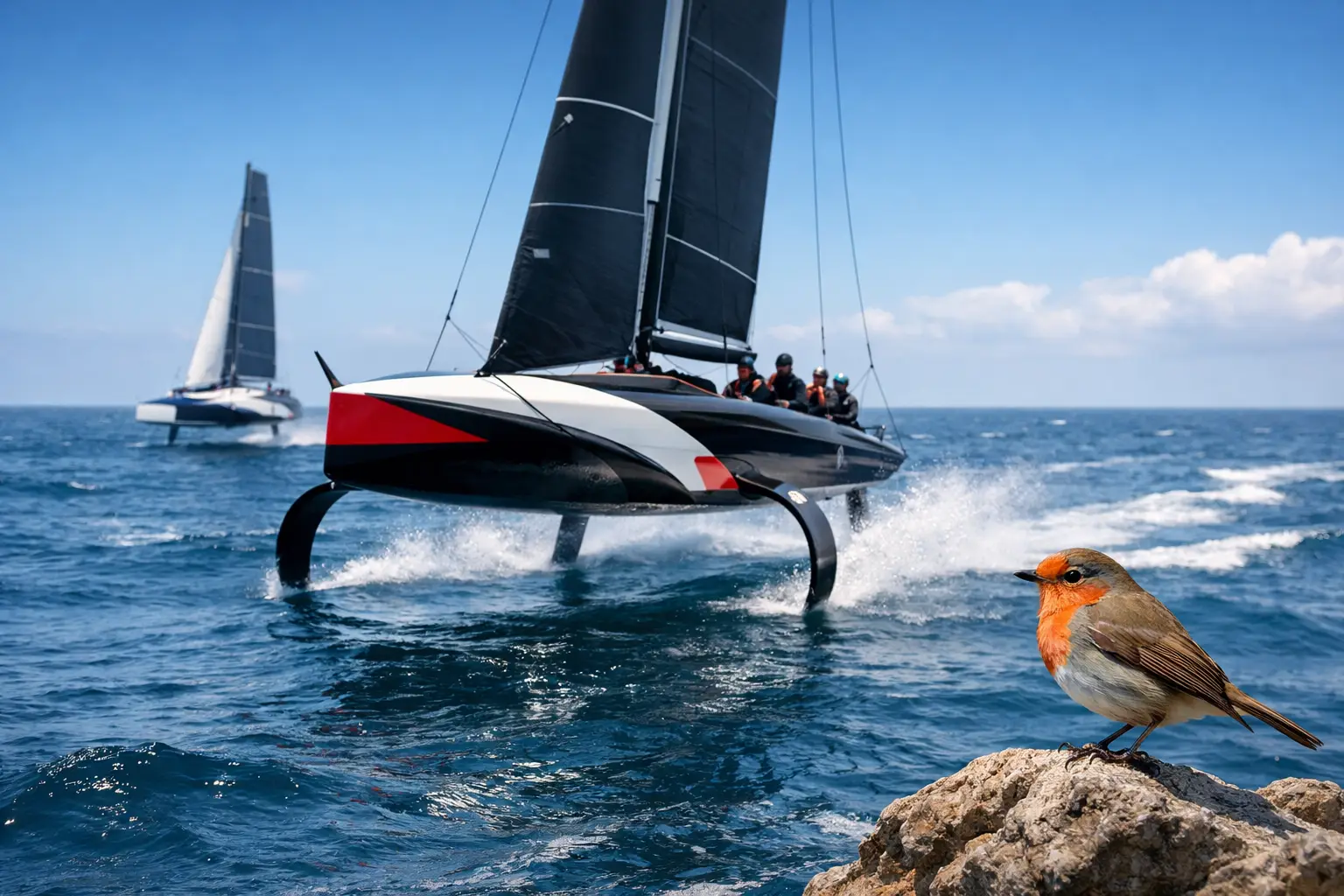
A racing yacht lifting clear of the Atlantic on its underwater foils is an arresting sight, but the image only captures part of the challenge. The ocean yacht foil race Atlantic story is not simply about speed records or spectacular video clips. It is about taking a technology built for lift and low drag, then asking it to survive thousands of miles of changing weather, steep seas, darkness, equipment stress, and exhausted crews.
For general news readers, foiling can make offshore racing look almost unreal: hulls appear to skim above the water while boat speeds climb well beyond what traditional displacement yachts can achieve. For sailors, designers, and race followers, the bigger question is more practical. Can a foiling boat maintain that advantage when the ocean stops cooperating?
What a Foiling Yacht Actually Does
A foil is an underwater wing. As water flows over it at speed, it generates lift. On a racing yacht, that lift can raise much of the hull out of the water, reducing drag and allowing the boat to move faster with the same wind power.
The result is not always a fully airborne yacht. Offshore designs may use foils to reduce hull resistance, stabilize the boat, or partially lift it depending on sea state and point of sail. The exact setup varies widely, from large ocean-racing monohulls with curved or retractable appendages to multihulls designed to fly for extended periods.
That distinction matters when reading race coverage. A boat that can foil brilliantly in flatter water may be more conservative in big Atlantic waves. Crews and skippers are constantly balancing outright pace against control, structural loads, and the risk of a damaging crash when a foil ventilates, strikes floating debris, or loses grip in aerated water.
Why the Atlantic Is the Real Test
The Atlantic is central to offshore sailing because it combines major race routes with conditions that can change quickly. A crew may begin under warm trade-wind skies, then face squalls, confused seas, cold fronts, or long periods of uncomfortable high-speed motion. It is a very different proving ground from a short inshore race course where support boats, shore teams, and sheltered water are close at hand.
A transatlantic race also turns weather routing into a major sporting decision. Sailing the shortest line on a map is rarely the fastest or safest choice. Teams study wind models, currents, wave direction, storm tracks, and the position of high-pressure systems. Choosing a route farther north or south can add distance while avoiding conditions that could cost more time - or break the boat.
Foils complicate those calculations. Strong wind alone does not guarantee a fast ride. Wave shape, cross-seas, and boat angle can determine whether a yacht can use its foils effectively. A route that looks quick for a conventional boat may be too punishing for a high-performance foiler, especially when the crew must protect equipment over several days or weeks.
Speed Creates Its Own Problems
Fast offshore boats cover huge distances in a day, which changes the rhythm of racing. Weather systems arrive sooner. Decisions have less time to mature. A small navigation error can become a large loss when rivals are traveling at highway-like speeds over water.
Higher velocity also increases impact loads. When a yacht falls off a wave or lands after lifting, the forces travel through the hull, appendages, rig, and crew. Designers use advanced composites, engineering analysis, and safety margins, but ocean racing remains a harsh environment for any lightweight machine. A structural problem far from land is not a minor inconvenience.
Then there is human performance. Offshore crews sleep in short shifts, work in wet gear, manage sail changes, monitor electronics, repair damage, and stay alert around moving hydraulic and mechanical systems. On fully crewed campaigns, teamwork can distribute the workload. On shorthanded boats, the mental strain becomes just as significant as the physical one.
The Ocean Yacht Foil Race Atlantic Story Is Also a Technology Story
Modern offshore racers are floating data platforms. Instruments measure wind angle, boat speed, heel, foil position, loads, heading, and sea conditions. Routing software turns weather forecasts into recommended courses. Satellite communications allow shore teams, race organizers, and audiences to follow a campaign in far greater detail than was possible in earlier eras.
But data does not eliminate judgment. Forecasts are estimates, sensors can fail, and the best computer route may not account for a crew’s fatigue, a developing repair issue, or waves that are more violent than predicted. The strongest campaigns combine analytics with experienced sailors who know when to press and when to back off.
Foil design itself remains an area of rapid experimentation. Teams seek a balance between lift, drag, stability, reliability, and ease of adjustment. Larger foils may offer more potential speed, but they can bring greater loads and more complex handling. Smaller or more conservative configurations may lose peak performance while delivering a boat that is easier to manage through rough conditions.
This is why an Atlantic result should not be reduced to a single top-speed number. An offshore winner is often the boat and crew that sustained a high average speed, avoided major failures, made better weather calls, and preserved enough margin to finish strongly.
What Viewers Should Watch Beyond the Leaderboard
For people following offshore racing through news updates, live trackers, or race videos, the leaderboard is only the first layer. The distance to finish can be misleading because boats are rarely sailing directly toward the destination. A competitor that appears behind may be positioned for better wind 24 hours later.
Watch the fleet’s routing patterns. When boats split north and south, they are usually making different bets about the weather. Look for changes in average speed rather than isolated bursts, and pay attention to reports of sail damage, foil trouble, rudder issues, or communications problems. These can reshape an event faster than a small gap on the tracker.
It also helps to know the race format. Some Atlantic events are solo, some are double-handed, and others carry full professional crews. A record attempt is different from a fleet race, and a route with mandatory waypoints creates different tactical choices from a straight ocean crossing. The phrase “foil race” covers a range of boats and rules, not one standardized competition.
The Trade-Off: Innovation Versus Access
Foiling has made sailing more visible to audiences accustomed to fast-paced sports footage. It has also pushed naval architecture, materials science, weather analysis, and onboard safety forward. Technologies tested at the highest level can influence future designs, from performance cruising yachts to systems that help sailors better understand loads and conditions.
There is a trade-off, however. The most advanced campaigns are expensive. Design programs, custom parts, shore crews, data specialists, and logistics can create a gap between elite professional teams and smaller operations. Race organizers face a continuing challenge: encourage innovation while keeping competition credible, safe, and understandable for spectators.
Sustainability is part of that discussion as well. Offshore racing depends on composite materials, international transport, technical support, and communications infrastructure. At the same time, the sport offers a highly visible demonstration of wind-powered travel and increasingly puts ocean health, marine debris, and climate research into public view. The environmental value depends on how seriously teams and organizers address the full footprint, not on wind power alone.
Why It Matters to a Wider Audience
The appeal of the Atlantic foiling race reaches beyond dedicated sailing fans because it brings together familiar themes: advanced technology, changing weather, global travel, competition, risk, and teamwork under pressure. It is also one of the few sports where the playing field can change by the hour and where the natural environment remains a direct opponent.
As race updates arrive, the most useful way to follow them is to look past the dramatic footage. Notice the route choices, the sea-state reports, the equipment decisions, and the patience behind a crew choosing not to chase every possible knot of speed. That is where the real Atlantic contest takes shape - and where the next major move may already be underway.