Rockin Robin SongFlying The Web For News.
RobinsPost Logo RobinsPost Amazon


Consumer Daily Reports

[unable to retrieve full-text content]

But a new report shows there were a lot more victims than in previous years

By Mark Huffman Consumer News: There were more than 3,000 data breaches in 2024 of ConsumerAffairs
January 29, 2025

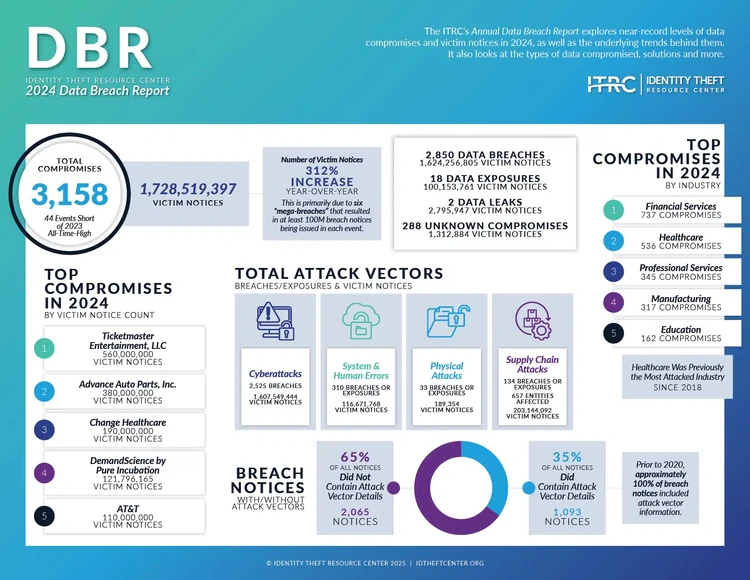
In 2024, the landscape of data breaches remained largely unchanged in terms of the number of incidents, with 3,158 compromises reported, mirroring the previous year's figures. However, the year was marked by significant shifts in the nature and impact of these breaches, according to a report by the Identity Theft Resource Center.

One of the most striking trends was the dramatic 312% increase in victim notices, totaling over 1.7 billion. This surge was primarily driven by six "mega-breaches," each resulting in at least 100 million notices, collectively accounting for more than 1.4 billion of the total notices issued. These mega-breaches underscored the growing scale and impact of cybersecurity incidents on individuals and organizations alike.

Despite the overall stability in the number of breaches, there was a 58% decline in compromises linked to system and human errors. Physical attack-related breaches, such as those involving skimmers and stolen devices, also reached a six-year low, with only 33 incidents reported.

Publicly traded companies, although representing a mere 7% of all compromised organizations, were responsible for issuing a staggering 76% of victim notices. This disproportionate figure highlights the significant impact of breaches within these entities.

Among the 133 cyberattacks against publicly traded companies, stolen credentials emerged as the leading attack vector. However, a concerning 74% of these organizations did not specify the attack vector in their breach notices, reflecting a growing trend of non-disclosure.
Photo

Banks were prime targets

The Financial Services sector, led by commercial banks and insurance companies, emerged as the most breached industry in 2024, overtaking Healthcare, which had held this position since 2018. Other affected sectors included professional services, manufacturing, and technology.

Cyberattacks continued to be the primary cause of data breaches. Yet, the specificity of attack vectors in breach notices has been on a decline for five consecutive years. In 2024, approximately 70% of cyberattack-related notices lacked detailed attack information, a significant increase from 58% in 2023. This trend contrasts sharply with 2019 and earlier years, when nearly all breach notices included such details.

Excluding the mega-breaches, the remaining victim notices amounted to approximately 266 million, representing a 36% decrease compared to the previous year. This decline suggests improvements in certain areas of cybersecurity, although the overall impact of mega-breaches continues to overshadow these gains.

As the digital landscape evolves, the need for robust cybersecurity measures and transparent reporting becomes increasingly critical to safeguard against the growing threat of data breaches.


Photo Credit: Consumer Affairs News Department Images


Posted: 2025-01-29 19:29:49

Get Full News Story On Consumer Affairs


Listen to this article. Speaker link opens in a new window.
Text To Speech BETA Test Version.


More News From This Category
Consumer News: Inflation rose more slowly than expected in November
Thu, 18 Dec 2025 17:07:05 +0000

But energy and housing costs continue to pressure consumers

By Mark Huffman of ConsumerAffairs
December 18, 2025
  • Inflation rose modestly in recent months, with the Consumer Price Index for All Urban Consumers (CPI-U) increasing 0.2% on a seasonally adjusted basis from September to November 2025.

  • Prices were up 2.7% over the past year, marking a slowdown from the 3.0% annual increase recorded through September.

  • Data gaps remain because of the federal shutdown, as the Bureau of Labor Statistics (BLS) did not collect survey data in October 2025 due to a lapse in appropriations.


U.S. inflation showed signs of cooling in late 2025, even as energy costs and some household expenses continued to rise, according to the latest Consumer Price Index report from the Bureau of Labor Statistics.

Over the two-month period from September to November, overall consumer prices increased at a measured pace, reflecting modest gains across several major categories. Core inflation, which excludes volatile food and energy prices, also rose 0.2% during the same period, suggesting underlying price pressures remained contained.

Shelter costs, a major driver of household expenses, edged up 0.2% over the two months, while food prices rose 0.1%. Energy prices were a notable outlier, climbing 1.1% during the period, driven by higher gasoline and utility costs. At the same time, some categories provided relief for consumers: prices for lodging away from home, recreation, and apparel declined.

Looking at the broader picture, inflation slowed on an annual basis. The all-items CPI rose 2.7% in the 12 months ending in November, down from a 3.0% increase through September. Core inflation increased 2.6% over the past year, slightly below the headline rate.

Restaurant checks rose faster than grocery bills

Food prices continued to rise faster when consumers ate out than when they shopped for groceries. Food away from home increased 3.7% over the year, compared with a 1.9% rise for food at home. Within grocery prices, meats, poultry, fish, and eggs posted one of the largest gains, up 4.7%, while dairy prices declined 1.6%.

Energy costs remained a key pressure point for households. Over the past year, the energy index rose 4.2%, with fuel oil prices jumping more than 11% and electricity costs climbing nearly 7%. Natural gas prices also rose sharply, increasing just over 9% year over year.

The report was affected by the federal government shutdown in October, when BLS was unable to collect survey data. While some non-survey data were later recovered, October CPI figures are unavailable, and November data reflect a partial resumption of collection that began on November 14.

Separate inflation measures tracked similar trends. The CPI for Urban Wage Earners and Clerical Workers rose 2.7% over the past year, while the Chained CPI increased 2.6%, though recent figures for the chained index remain subject to revision.


Read More ...


Consumer News: Customer service AI bots not ready for prime time, survey suggests
Thu, 18 Dec 2025 17:07:05 +0000

The survey shows that speed alone failed to deliver customer satisfaction

By Mark Huffman of ConsumerAffairs
December 18, 2025
  • Glance releases its 2026 CX Trends Report, revealing how last years rush toward AI reshaped and often damaged customer service experiences

  • Survey of more than 600 U.S. consumers shows frustration rising despite faster, automated responses

  • Report urges companies to refocus on resolution, trust, and human-supported AI as they plan 2026 CX strategies


Companies are increasing the use of artificial intelligence to assist with customer service and a new report suggests those efforts are not always satisfying for consumers.

Glance, a provider of enterprise cobrowse and guided customer experience technology, has released its 2026 CX Trends Report, offering a clear-eyed assessment of how the customer experience industrys aggressive push into AI-powered service has played out in 2025.

The report, based on a small survey, paints a picture of widening disconnects between the promises of automation and the realities customers encountered. While companies invested heavily in AI tools designed to accelerate service, many customers reported being trapped in loops, forced to repeat themselves across channels, and ultimately left with less confidence in the brands they interacted with.

One of the most interesting findings shows that speed alone failed to deliver satisfaction. Seventy-five percent of respondents said they received fast, AI-driven responses that still left them frustrated.

Instead, customers overwhelmingly prioritized outcomes: 68% said achieving a complete resolution mattered more than how quickly a response arrived.

Risks of overautomation

The report also highlights the loyalty risks tied to over-automation. Nearly nine in 10 consumers said removing access to human support reduced their loyalty to a brand. Only 7% reported that they rarely or never had to repeat information when switching between channels, underscoring persistent breakdowns in omnichannel continuity. More than a third of respondents said AI-based support actively made interactions harder, and a majority expressed a preference for human-first service pathways.

At the same time, the findings suggest customers are not rejecting AI outright. Forty-four percent said they always try self-service options first, and another 50% said they sometimes do signaling strong interest in AI-enabled tools when they are designed to truly resolve issues rather than deflect them.

The industry spent much of 2025 chasing speed and automation, said Tom Martin, CEO of Glance. But our research shows that customers felt increasingly disappointed by digital systems that were supposed to help them. The future isnt AI replacing people its AI strengthening the foundation so humans can deliver clarity, empathy, and trust at the moments that matter.

Problems of implementation

According to the report, many of the problems stemmed from how organizations implemented AI rather than from the technology itself. Bots were often built to reduce contact volume instead of solve problems, while personalization efforts crossed the line into feeling intrusive. Automation also exposed deeper operational weaknesses, including inconsistent data, broken workflows, and fragmented handoffs between channels.

This report doesnt sugarcoat the lessons from 2025, said Heather Nightingale, senior director of Product Marketing at Glance. Were honest about what failed because leaders cant build credible AI strategies without addressing the foundation first. 2026 will belong to companies that refocus on resolution, rehumanize digital experiences, and use AI as a co-pilot rather than a gatekeeper.

Looking ahead, the report outlines how top-performing CX teams are expected to evolve in 2026. Key priorities include building AI on clean, consistent data; deploying intent-aware automation that knows when to escalate to humans; delivering true context continuity across channels; and shifting personalization toward approaches that feel purposeful rather than invasive.

The report also emphasizes empathy as a driver of loyalty and urges companies to move away from vanity metrics in favor of measures tied to retention, repeat engagement, and reduced customer effort.


Read More ...


Consumer News: Inflation is cooling, so why is there an ‘affordability crisis?’
Thu, 18 Dec 2025 14:07:05 +0000

In short, prices that went up during the pandemic arent coming down

By Mark Huffman of ConsumerAffairs
December 18, 2025
  • Housing and insurance costs remain stubbornly high, keeping monthly bills elevated even as overall inflation cools.

  • Food prices have stopped rising rapidly but are still far above pre-pandemic levels, stretching household budgets.

  • Everyday services from utilities to car repairs continue to climb, quietly eroding purchasing power.


Inflation has been relatively tame for several months, a welcome change after years of rapid price increases that rattled consumers and policymakers alike. Official measures show price growth has slowed across much of the economy, and in some categories, increases have nearly stalled.

Yet for many Americans, relief feels elusive. The reason is increasingly clear: while inflation may be low, affordability is not improving at the same pace.

Inflation measures how quickly prices are rising, not whether prices are high to begin with. After several years of sharp increases, many essentials remain far more expensive than they were before the pandemic. Even modest price growth today is being layered on top of already elevated costs, leaving households feeling financially squeezed.

Housing leads the pain

Compounding the price pain is the fact that some important spending categories remain elevated. For example, housing-related expenses remain the biggest source of strain.

Rent increases have slowed nationally, but rents are still significantly higher than just a few years ago. Homeownership has become even more challenging as elevated mortgage rates push monthly payments out of reach for many buyers.

Property taxes, homeowners association fees, and especially insurance premiums are adding to the burden. Home and auto insurance costs have surged due to higher repair costs, extreme weather losses, and increased claims, hitting consumers regardless of whether they rent or own.

Food prices: Stabilized, not reversed

Grocery prices are no longer climbing at the dizzying pace seen in 2022 and early 2023, but they also havent meaningfully fallen. Shoppers still face higher prices for staples such as meat, dairy, and packaged foods compared with pre-pandemic norms.

For families living paycheck to paycheck, this matters more than the inflation rate itself. Even small weekly increases accumulate over time, forcing tradeoffs like buying cheaper brands, cutting back on fresh foods, or relying more heavily on credit.

Another key pressure point is services the costs that are hardest to avoid or substitute. Utilities, medical services, childcare, car repairs, and personal services continue to rise steadily. Labor costs, which make up a large share of service prices, have remained elevated, and those increases are often passed directly to consumers.

Unlike goods such as electronics or furniture, services rarely get cheaper. Once prices rise, they tend to stay high, locking in affordability challenges even when overall inflation appears under control.

Why it feels worse than the numbers suggest

Wages have risen, but not always fast enough or evenly enough to offset higher living costs. Many households are also dealing with depleted savings after years of inflation, making them more sensitive to everyday expenses. Credit card balances are higher, and interest rates mean carrying debt is more expensive than it used to be.

As a result, consumers may hear that inflation is low and wonder why their finances dont reflect that improvement. The answer lies in the difference between slowing price growth and genuinely lower prices a gap that remains wide.

Unless incomes rise faster or key categories like housing, insurance, and services begin to ease, affordability is likely to remain a dominant concern. Inflation may no longer be the headline economic problem, but for many households, the cost of simply getting by is still uncomfortably high.


Read More ...


Consumer News: Coffee hasn’t been this expensive in decades — and your receipt is proving it
Thu, 18 Dec 2025 05:07:06 +0000

You dont have to quit caffeine to stop overpaying

By Kyle James of ConsumerAffairs
December 18, 2025
  • Grocery-store ground roast coffee averaged $9.14/lb in September, up from $6.47/lb a year earlier a 41% jump thats showing up on receipts fast

  • Weather-driven supply hits + a surge in wholesale arabica prices pushed costs up, and tariffs added fuel at the worst time. Even with tariff rollbacks, shelf prices usually lag

  • Do quick cost-per-cup math (home brew is still far cheaper), buy extra duringsales and freeze abag, and watch the unit price for shrinkflation


If your normal bag of ground coffee is starting to feel like more of a splurge item, youre not imagining things. Federal pricing data shows supermarket coffee is up sharply. As of September, a pound of ground roast coffee averaged about $9.14, up from $6.47 a year earlier. Thats a whopping 41% jump in just 12 months.

Whats behind the coffee spike

Weather problems tightened supply

Coffee is considered a picky crop, and production disruptions like bad weather in the major growing regions, can affect supply quickly. When harvests come up short, roasters and importers scramble, and so costs naturally climb.

Wholesale coffee prices surged

In early 2025, arabica coffee futures pushed above $4.30 per pound at one point, with traders pointing to limited availability and even some panic in the market.

Think of futures prices as a benchmark for what many buyers pay for their beans. So, when you see a big jump like we saw earlier this year, it tends to show up down the road at grocery stores and coffee chains.

Tariffs added cost at the worst time

In April 2025, the U.S. imposed a 10% base tariff on many imports and layered on additional duties that varied by country. These included goods the U.S. doesnt really produce domestically, like coffee.

In mid-November, the White House rolled back tariffs on more than 200 food products, including coffee, with the changes taking effect retroactively.

The National Coffee Association said removing reciprocal tariffs should ease cost pressures for coffee drinkers and the businesses that depend on imports.

Then, on Nov. 21, Reuters reported the administration removed a remaining 40% tariff on many Brazilian agricultural imports, including green coffee beans. This was a big deal because Brazil supplies about a third of U.S. coffee beans.

Why prices may not drop overnight

Even if the tariff line item disappears, retail prices usually lag behind for a while. This is because roasters buy beans months ahead, retailers adjust prices in cycles, and brands rarely cut shelf prices the moment their costs ease.

Coffee shops have nudged prices up, too. Toasts menu data shows the median price of a regular coffee on restaurant menus was $3.57 in October 2025, up 3.2% from a year earlier.

The coffee price playbook for shoppers

Here are five money moves that will help you saveon your next cup:

1. Do the cost-per-cup math (its sobering)

A pound of coffee can make roughly 22 standard 12-ounce cups at home if youre using about 20g per cup.

At $9.14 per pound, thats about 42 cents per cup before milk and sugar versus about $3.50 for a basic caf coffee. I know its boring and you've probably heard it a hundred times, but brew your own cup of joe at home and save big.

2. Buy on deal, then bank the savings

When your coffee go-to brand hits a real sale, grab two bags and freeze one. Sealed coffee holds up well in the freezer, and buying at the low point beats paying whatever the shelf tag says next week.

3. Use store brands strategically

If your go-to brand jumped 30% to 50%, a private-label or club-store option can bring your cost per cup back to earth. Test one bag before you commit, then buy larger sizes when you find a winner.

4. Stop paying the add-on tax at coffee shops

If youre buying out of habit, keep the ritual but downgrade the order: drip instead of latte, fewer pumps, skip the foam. Most of the coffee inflation you feel at cafs comes from extras.

5. Watch for shrinkflation

Coffee brands love to keep the sticker price steady and quietly reduce the ounces. Always compare the unit price (per ounce or per pound) on the shelf tag, not the number printed on the bag.


Read More ...


Consumer News: Walmart, Pepsi accused of manipulating prices
Wed, 17 Dec 2025 23:07:07 +0000

The price-fixing scheme went on for a decade, the suit charges

By James R. Hood of ConsumerAffairs
December 17, 2025
  • Plaintiffs allege Pepsi and Walmart coordinated pricing to inflate soft drink costs nationwide
  • Lawsuit claims Walmart received preferential wholesale prices while rivals paid more

  • Case follows FTCs decision to drop a Robinson-Patman Act lawsuit against Pepsi

PepsiCo and Walmart have been accused in a new consumer class action lawsuit of orchestrating a decade-long price-fixing scheme that allegedly inflated the cost of Pepsi soft drinks at retailers across the United States.

The lawsuit, filed Monday in federal court in New York, alleges the two companies entered into an unlawful agreement that gave Walmart preferential wholesale pricing on Pepsi products while forcing competing retailers to pay higher prices. Plaintiffs say the arrangement violated federal antitrust law and ultimately harmed consumers by driving up retail prices outside Walmart stores.

Allegations of preferential pricing

According to the complaint, Pepsi offered Walmart favorable pricing and other incentives designed to maintain a consistent price gap that allowed the retail giant to sell Pepsi products at lower prices than its competitors. To preserve that gap, the lawsuit alleges, Pepsi raised wholesale prices charged to other retailers, effectively shifting higher costs onto consumers who did not shop at Walmart.

The plaintiffs contend that the pricing arrangement discouraged competition among retailers and insulated Walmart from price pressure, while smaller chains and independent stores were left at a disadvantage.

Link to prior FTC enforcement

The consumer lawsuit follows the Federal Trade Commissions decision in May to drop a case brought during President Joe Bidens administration accusing Pepsi of violating the Robinson-Patman Act, a 1936 law aimed at preventing discriminatory pricing practices that favor large buyers over smaller competitors.

The FTCs case named Pepsi as the sole defendant and did not include Walmart. In that matter, the agency alleged Pepsi had offered preferential pricing and promotional benefits to Walmart while denying similar terms to other retailers. Pepsi denied wrongdoing, and the case was later withdrawn by the agency.

Plaintiffs in the new lawsuit cite similar conduct, arguing that Pepsis alleged preferential treatment of Walmart went beyond lawful discounting and crossed into anticompetitive coordination.

Proposed nationwide consumer class

The proposed class includes all U.S. consumers who purchased Pepsi soft drinks from non-Walmart retailers since January 2015. The lawsuit seeks damages and other relief on behalf of consumers who allegedly paid higher prices as a result of the claimed scheme.

Pepsi and Walmart have not yet publicly responded to the new lawsuit. The case adds to ongoing scrutiny of pricing practices between major manufacturers and dominant retailers, particularly as regulators and private plaintiffs examine whether discount arrangements unlawfully harm competition and consumers.


Read More ...


Related Bing News Results
Consumer Reports |Experts warn against daily use of protein supplements
Mon, 20 Oct 2025 22:57:00 GMT
Protein powders and shakes are more popular than ever, often touted as workout fuel or even meal replacements. But a new Consumer Reports investigation reveals a hidden risk: some of these supplements ...

Consumer Reports Is Fearmongering Again
Thu, 16 Oct 2025 06:46:00 GMT
We preselected all newsletters you had before unsubscribing.

Your Daily Protein Shake Might Be Exposing You to Lead, Consumer Reports Finds
Tue, 14 Oct 2025 03:10:00 GMT
Plant-based powders, particularly those made with pea protein, were found to have the highest lead levels — and only a handful of brands were deemed safe for regular use in the nonprofit’s analysis. A ...

Your Daily Protein Shake Might Be Exposing You to Lead, Consumer Reports Finds
Mon, 13 Oct 2025 17:00:00 GMT
A Consumer Reports investigation found that more than two-thirds of tested protein powders and shakes contained more lead per serving than what food safety experts deem safe for daily consumption.


Blow Us A Whistle


Related Product Search/Búsqueda de productos relacionados

Amazon Logo