Rockin Robin SongFlying The Web For News.
RobinPost Logo Amazon Prime Deals


Consumer Daily Reports

Direct deposit and electronic filing speeds up the process

By Dieter Holger of ConsumerAffairs
March 6, 2025

Tax refunds are showing positive signs in 2025.

Americans have received more than $102.2 billion in direct deposit tax refunds as of Feb. 21, up from around $92.8 billion at the same point in 2024 andmarking an increase of around 10%,according to the Internal Revenue Service.

The average tax refund paid via direct deposit also rose 7.1%, reaching$3,505 compared with$3,272 in 2024, the IRS said.

And the number of direct deposit refunds sent wasup 2.8% at morethan 29.1million refunds.

Bigger tax refunds can help Americans pay off debt and make everyday purchases, which can be helpful to the economy in the short term.

To get a tax refund the fastest, the IRS recommends electronic filing and choosing direct deposit.

Tax refunds typically arrive within 21 days if received through direct deposit, which requires providing a bank account number and routing number,the IRS said.

Some 54% of Americans expectto get a tax refund in 2025, according to a survey by the National Retail Federation.

The survey said 47% plan to file taxes in February, 32% in March and 22% in April.

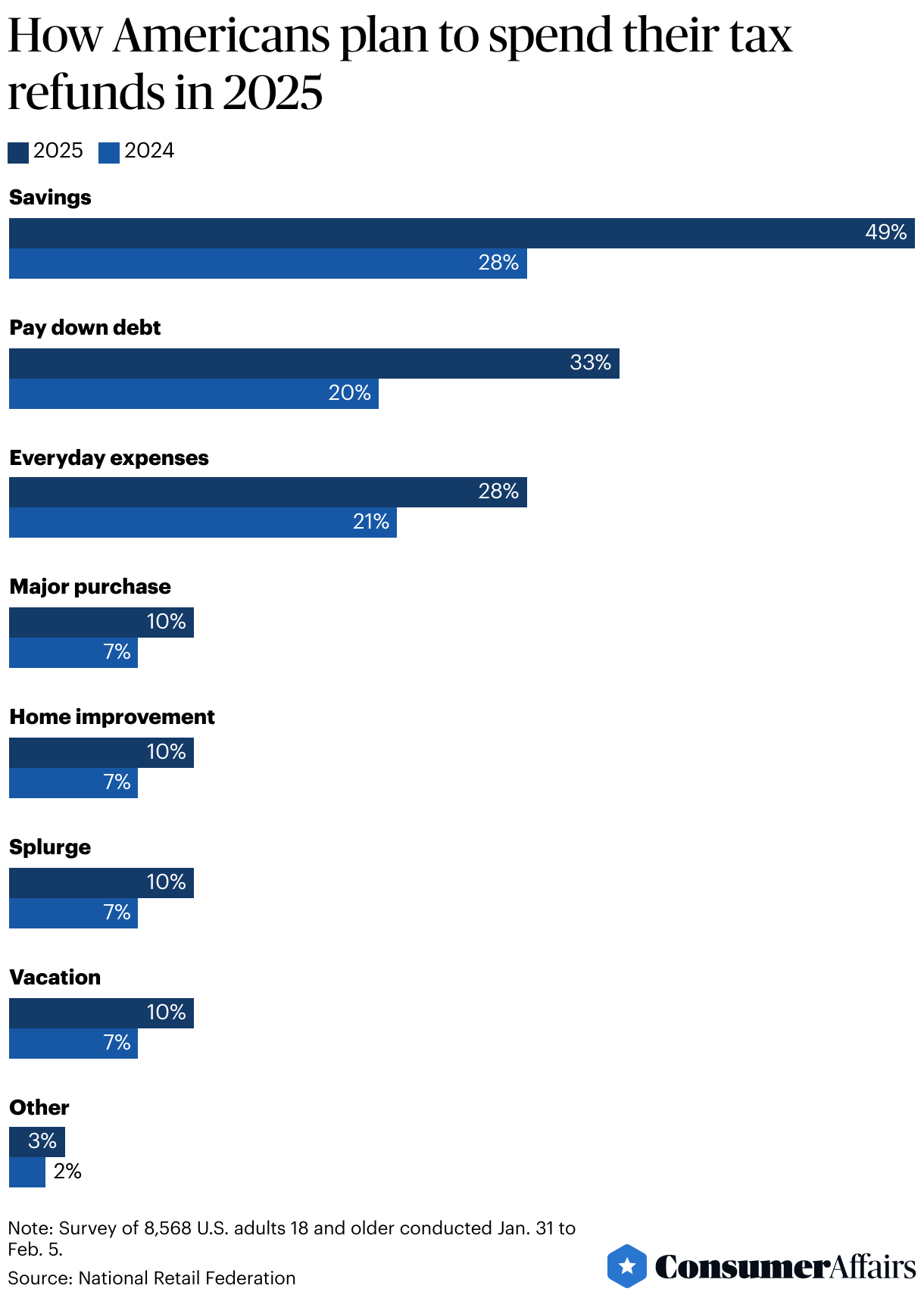
More Americans plan to spend their tax returns on savings, paying down debt and everyday expenses than last year, the survey said.

Consumer News: Average tax refund up 3 as of Feb. 21, IRS says

Sign up below for The Daily Consumer, our newsletter on the latest consumer news, including recalls, scams, lawsuits and more.


Posted: 2025-03-06 21:12:41

Get Full News Story On Consumer Affairs


Listen to this article. Speaker link opens in a new window.
Text To Speech BETA Test Version.


More News From This Category
Consumer News: Shrinkflation isn’t slowing down — It’s just getting harder to spot
Wed, 14 Jan 2026 02:07:06 +0000

Why your groceries cost more without looking smaller

By Kyle James of ConsumerAffairs
January 13, 2026
  • Shrinkflation went quiet. Brands now hide it with redesigns, formula tweaks, and multi-pack tricks instead of obvious size cuts.

  • You get fewer real uses. Smaller portions or weaker formulas mean youre paying more per load, serving, or use.

  • Unit price tells the truth. If price per ounce jumps while the package looks the same, value already shrank.


A few years ago, shrinkflation was easy to catch. Manycereal boxes suddenly lost a few ounces andbags of chips started to feel suspiciously lighter. Consumers noticed, many complained, and even shared side-by-side photos online to give everyone a heads up.

Well guess what? Brands noticed that too.

Today, shrinkflation hasnt gone away. Its simply evolved. So now instead of seeing obvious size cuts, companies are now using packaging redesigns, quiet formula changes, and multi-pack math tricks. All designed to make you not notice the smaller size.

For consumers, the result is the same: you pay more for less. You just dont realize it as quickly, or at all.

Smaller packages disguised by redesigns

One of the most common tactics is shrinking the product at the same time as a visual refresh or package redesign.

In other words, when the packaging looks new, most shoppers dont remember exactly how big it used to be.

Youll see things like:

  • Taller or wider containers that hold less volume
  • Softer bags replacing rigid boxes, creating more empty space
  • Opaque packaging that hides how full the product really is

Snack foods are especially prone to this. Large manufacturers like PepsiCo regularly refresh branding across entire product lines. A redesign gives cover to reduce net weight without drawing attention to the change.

Ice cream is another category where this has been especially visible. Containers that once held a true half-gallon quietly dropped to smaller sizes years ago, and further reductions often happen alongside fancy new labels or lid changes.

How to spot it fast:

Skip the front of the package entirely. Train your eyes to go straight to the net weight and compare price per unit (ounces, grams, pounds, etc) with the competition. That number is the only thing that matters, and its the one brands hope you forget to check.

Formula changes instead of size cuts

When shrinking the package risks too much attention, brands often change whats inside instead.

Instead of reducing volume, companies adjust formulas to lower production costs. The product may look the same, but it doesnt perform or taste the same as before.

Common examples include:

  • More water or fillers in cleaning products
  • Lower concentrations that require more product per use
  • Flavor changes marketed as lighter, smoother, or less intense

Laundry detergent is famous for this trick. Brands like Tide and Gain, both owned by Procter & Gamble, have rolled out multiple Ultra, Turbo, and HE-focused formulas over the years.

Along with many of these new formulas came subtle changes like redesigned measuring caps, higher recommended fill lines, and updated dosing instructions for large or really dirty loads.

The result is fewer real-world loads than the label suggests. A bottle advertised for 64 loads might realistically deliver closer to 5055 for many families, especially those with large-capacity washers. That gap doesnt look dramatic on the shelf, but it adds up over time.

How to spot it fast:

Check the usage instructions. If a new formula suddenly recommends a larger dose for the same task, you know that youre paying more per use.

Multi-packs that hide per-unit increases

Multi-packs used to be one of the safest ways to save money. Im here to tell you those days are over in many cases.

Brands have started to hide shrinkflation inside multi-pack bundles, knowing shoppers focus more on the total pack price rather than the size of each pack.

Tactics include:

  • Same number of items, but smaller individual sizes
  • Value packs that quietly lose bonus items
  • Mini versions replacing standard sizes without a clear label change

You see this a lot with things like yogurt cups, snack packs, and beverages. Soda brands in particular, including Coca-Cola, have leaned heavily into mini cans and smaller bottles with a price per-ounce that keeps increasing.

How to spot it fast:

Ignore the pack price altogether. Always look at the unit price on the shelf label. If the unit price isnt posted, thats your cue to be cautious.

Where shrinkflation is most aggressive right now

Shrinkflation isnt evenly distributed across the grocery store and youll often have to seek it out.

But it definitely tends to show up most in categories where:

  • Products are purchased frequently
  • Brand loyalty is strong
  • Serving sizes are flexible or subjective

Right now, the highest-risk categories to be aware of include:

  • Packaged snacks and chips
  • Paper goods and cleaning supplies
  • Coffee and beverages
  • Pet food and treats

The main thing these items have in common is that consumers tend to buy them on autopilot and dont look for price increases or smaller packaging.

Knowing this, companies are keenly aware that they can make small change and slip them into stores, often without immediate backlash from shoppers.

How to spot shrinkflation without doing aisle math

If youre like me, you dont want to pull out a calculator in the middle of the store every time something looks fishy. The good news is you dont have to.

Here are some practical shortcuts that work:

Trust the unit price over the sales sticker.

Grocery stores tend to update shelf unit prices quickly, but the new packaging often lags behind and takes some time to make it to the shelf.

For example, lets say last month the unit price for Tide read $0.18 per ounce. This month, its now $0.21 per ounceeven though the bottle and label appear unchanged. This is simply because the new packaging hasnt made it into the store yet. But by simply paying attention, you know its on its way.

Take photos of your regular buys.

Take the guess work out of it completely and snap a quick photo of the net weight on products you buy all the time. Add the photos to a shopping folder in your camera roll. This will give you a great reference point the next time you shop and a price looks different.

Be suspicious of new look packaging.

Any time you see a new label, or redesign, your internal radar should start beeping.

Thats when you double-check the size and usage instructions to make sure youre not being messed with. If you are, it could be time to try a different brand, maybe even the private label.

Compare store brands.

Speaking of private-label products, they often lag behind national brands when it comes to shrinkflation. So, if the store brand suddenly looks much bigger for the same price, thats a clue the national brand probably shrunk right in front of your eyes.

When shrinkflation actually makes sense

To play devils advocate for a minute, not all downsizing is automatically bad.

Sometimes smaller packages can translate to less food waste for smaller households, and often when products get reformulatedits to improve shelf life or fix a safety issue.

The real issue here isnt about changing sizes though; its about transparency.

Problems arise when shrinkflation happens quietly and prices stay the same or go up. It leaves consumers in the dark, without a clear way to compare value. When shoppers cant tell upfront that theyre paying more, its natural that their trust for the brand starts to erode. But hopefully this guide will help you spot it easier so you can adjust your buying patterns.


Read More ...


Consumer News: The cheapest places Americans can travel in 2026 — without sacrificing the fun
Tue, 13 Jan 2026 23:07:06 +0000

New Skyscanner data reveals where your dollar goes the furthest this year, and when to book to save even more

By Kristen Dalli of ConsumerAffairs
January 13, 2026

  • Affordable travel is still possible in 2026. New Skyscanner data shows Americans can find roundtrip flights for a few hundred dollarsor lessby staying flexible on destinations and travel dates.

  • Timing matters more than you think. Wednesday is the cheapest day to fly on average in 2026, reinforcing that midweek travel can unlock meaningful savings.

  • Booking smart can stretch your budget further. Jumping on deals early, using price alerts, and keeping an open mind about where to go can make a big difference in what you pay.


With the holidays behind us and a fresh year ahead, many Americans are already dreaming about their next getaway but actually choosing where to go (and how much it will cost) isnt always easy.

Thats where new data from Skyscanner comes in. The report takes a closer look at the cheapest destinations Americans can fly to in 2026, along with the most budget-friendly days of the week to travel.

The findings push back on the idea that travel is only getting more expensive and show that a little flexibility with timing and destination can go a long way. ConsumerAffairs spoke with Lourdes Losada, Director of the Americas for Skyscanner, who encourages travelers to stay open-minded, as thats how you get rewarded with surprisingly affordable options you may not have considered before.

The biggest takeaway is that affordable travel in 2026 is achievable if travelers stay flexible and use data to guide decisions, Losada said.

Many Americans assume flights will be expensive, but Skyscanners data shows there are still incredible deals available, sometimes starting under $50 roundtrip. Being open to alternative destinations, traveling midweek, and using tools such as price alerts can make a big difference in stretching travel budgets.

Cheapest travel locations

To create the top 10 list, experts at Skyscanner evaluated round-trip flights booked on the site between January 1, 2025 and October 31, 2025, for travel between January 1, 2026 and December 31, 2026.

Heres the full list:

  1. Las Vegas, Nevada

    1. Average Roundtrip Flight Price: $232

  2. San Salvador, El Salvador

    1. Average Roundtrip Flight Price: $282

  3. Miami, Florida

    1. Average Roundtrip Flight Price: $284

  4. Kahului, Hawaii

    1. Average Roundtrip Flight Price: $329

  5. Orlando, Florida

    1. Average Roundtrip Flight Price: $353

  6. San Juan, Puerto Rico

    1. Average Roundtrip Flight Price: $365

  7. Punta Cana, Dominican Republic

    1. Average Roundtrip Flight Price: $375

  8. Mexico City, Mexico

    1. Average Roundtrip Flight Price: $402

  9. Cancun, Mexico

    1. Average Roundtrip Flight Price: $411

  10. Milan, Italy

    1. Average Roundtrip Flight Price: $559

Flying cheaper

In addition to the top 10 list, Skyscanner looked at other aspects of travel that can help consumers get the best deal.

One of the most surprising findings is that Wednesday, not Tuesday or Monday, is the cheapest day to fly on average in 2026, Losada explained. Only a quarter of Americans expected that result.

While prices still vary by route and time of year, this reinforces the idea that midweek travel often delivers better value and that checking flexible date tools can uncover savings people might otherwise miss.

Lock in deals early

If youre looking to get away, Losada encourages consumers to jump on deals that they find, as they may not be around for too long.

Waiting too long can mean missing out on price drops and lower fares that appear earlier in the booking window, she said. With only about half of travelers having booked flights so far, those who delay risk paying more as demand increases, especially for popular routes and peak travel months. Setting price alerts and monitoring fares early gives travelers the best chance to lock in deals when prices dip.


Read More ...


Consumer News: Scientists question high-profile microplastics studies after contamination concerns
Tue, 13 Jan 2026 23:07:06 +0000

Plastic pollution is real, but health impacts inside the body remain uncertain, scientists say

By Truman Lewis of ConsumerAffairs
January 13, 2026

  • Researchers say some widely reported findings of microplastics in human organs may be false positives

  • Critics warn rushed methods and weak controls could mislead policymakers and the public

  • Scientists stress plastic pollution is real, but health impacts inside the body remain uncertain


Scientists are raising serious doubts about a wave of high-profile studies claiming to have found microplastics throughout the human body, warning that many results may be driven by contamination, flawed methods or false positives rather than real plastic particles.

The studies, which reported microplastics and nanoplastics in organs including the brain, blood, testes, arteries and placentas, were widely covered by global media, including the Guardian. But multiple researchers now say the evidence behind some of the most striking claims is far less solid than it appeared.

There is no doubt that plastic pollution is everywhere in the environment, scientists say. But what we actually know about how much plastic ends up inside the human body and what it does there is still very limited.

Race to publish raises concerns

Micro- and nanoplastics are extremely small, often near the detection limits of current analytical tools, especially when scientists are working with complex human tissue.

Researchers told the Guardian that while there is no suggestion of misconduct, the rapid expansion of microplastics research has led to mistakes. In some cases, teams with limited analytical chemistry experience may have rushed to publish results without applying basic quality controls.

The Guardian identified seven studies that have been formally challenged in scientific journals. A separate recent analysis flagged 18 studies that did not properly consider that human tissue itself can generate chemical signals that mimic common plastics.

Scientists warn that faulty evidence could have real-world consequences. Poor-quality studies could lead to misguided regulations or allow industry lobbyists to dismiss legitimate concerns by pointing to unreliable data.

Brain study sparks backlash

One of the most prominent disputed studies reported rising levels of microplastics in human brain tissue over several decades, based on postmortem samples. The findings generated global headlines.

But months later, other scientists published a formal critique, citing weak contamination controls and missing validation steps. One of the critics, Dr Duan Materi of Germanys Helmholtz Centre for Environmental Research, was blunt.

The brain microplastic paper is a joke, he said, noting that brain tissue is around 60% fat and that fat can create false signals for polyethylene, a common plastic. He suggested rising obesity rates could explain the apparent trend.

The studys lead author, Prof Matthew Campen, defended the work, saying the field is still young and that researchers are learning as they go. He acknowledged room for improvement but said critics have not produced data proving the findings are wrong.

Other studies also challenged

The brain paper is not an isolated case. A study linking microplastics in artery plaques to higher risks of heart attack and stroke was criticised for failing to test blank samples to measure background contamination.

Another study reporting microplastics in human testes was challenged by scientists who said the methods were not robust enough to support the conclusions. Campen, a co-author, responded that bioanalytical assays are never perfect and must improve over time.

Studies claiming plastic particles in blood, arteries and bottled water have also faced criticism, though authors have disputed those challenges.

Roger Kuhlman, a chemist formerly at Dow Chemical, called the growing doubts a bombshell.

This is forcing us to re-evaluate almost everything we think we know about microplastics in the body, he said. Many extraordinary claims are being made without ordinary levels of evidence.

Methods under scrutiny

A key source of concern is a technique called pyrolysis gas chromatography mass spectrometry, or Py-GC-MS, which involves vaporising samples and analysing the fumes.

Critics say chemicals released from fats and other biological material can be mistaken for plastics, especially if tissue digestion is incomplete. A January 2025 study concluded the method is currently unreliable for detecting some common plastics in human samples.

Dr Cassandra Rauert, an environmental chemist at the University of Queensland, said many reported concentrations are completely unrealistic and biologically implausible.

She added that while nano-sized plastic particles might cross biological barriers, current instruments cannot reliably detect them making some bold claims even harder to justify.

A July review in a German medical journal summed up the problem: At present, there is hardly any reliable information available on the actual distribution of microplastics in the body.


Read More ...


Consumer News: FDA announces recall of Modern Warrior Ready Supplement
Tue, 13 Jan 2026 23:07:06 +0000

Undeclared ingredients in the product may pose serious health risks

By Kristen Dalli of ConsumerAffairs
January 13, 2026

  • The FDA has recalled Modern Warrior Ready after finding undisclosed ingredients that could pose serious health risks.

  • The supplement contained hidden stimulants and drug-like substances that were not listed on the label.

  • Consumers are urged to stop using the product immediately and check FDA recall alerts before taking supplements.


Federal health officials issued a major recall affecting a widely sold dietary supplement called Modern Warrior Ready.

What started as routine testing revealed that this product contained several powerful substances that were not listed on the label and some of them may put your health at risk. The U.S. Food and Drug Administration (FDA) has now pulled all lots of the product from sale and is urging anyone who bought it to stop taking it immediately.

What happened and why it matters

Modern Warrior, a company based in Phoenix, voluntarily recalled Modern Warrior Ready after regulatory analysis found undeclared ingredients in the 60-capsule bottles sold online. The product was marketed to boost metabolism, support mental clarity, and help reduce cravings, but the label didnt tell buyers about everything inside.

Heres what the FDA found inside the capsules:

  • Tianeptine a substance not approved for use in dietary supplements in the U.S. and associated with serious side effects, including confusion, drowsiness, and even suicidal thoughts or behavior in people under 25. Overdose risks include seizures and trouble breathing, especially if mixed with alcohol or certain antidepressants.

  • 1,4-DMAA (dimethylamylamine) a stimulant that can raise blood pressure and has been linked to cardiovascular problems like heart attacks and chest tightness.

  • Aniracetam a nootropic compound thought to affect brain function; while used in some countries, its not approved for supplement use in the U.S. and was not disclosed on the label.

All of the recalled bottles were sold nationwide online between April 2022 and December 8, 2025, and the company has stopped distribution and pulled remaining stock to prevent further sales.

What consumers should do now

If you have any bottles of Modern Warrior Ready at home, stop using them immediately even if you feel fine. Because some of the ingredients can have serious cardiovascular or neurological effects, its better not to take any risks.

Here are some tips to protect yourself with supplements:

  1. Check official sources first. Before trying a new supplement, look up the product on the FDAs recall database or trusted health sites to see if any safety alerts exist.

  2. Talk to your doctor or pharmacist. If a product promises big results, especially for things like weight loss or brain boosts, ask a health professional if its safe for you.

  3. Watch for red flags. Undeclared or unfamiliar ingredients especially stimulants or drugs not approved as supplements are a warning sign that the product might not be trustworthy.

Supplements can seem harmless, but when hidden chemicals are involved, the risks can be serious. Staying informed and cautious helps keep you and your health safe.


Read More ...


Consumer News: ALDI’s big 2026 growth plans: Where new stores are opening
Tue, 13 Jan 2026 20:07:08 +0000

Plus some clever tips to save money at ALDI

By Kyle James of ConsumerAffairs
January 13, 2026
  • ALDI is adding 180+ stores in 2026, expanding into new states like Colorado and Maine while growing fast in major metros.

  • More ALDI means stronger price competition, which often helps keep grocery prices lower across an entire area.

  • Save more at ALDI: shop mid-week for better selection, watch for yellow-sticker markdowns, and plan meals around ALDI Finds.


ALDI is ramping up its growth in a major way in 2026, and budget-conscious shoppers are going to like the expansion. As the discount grocery chain marks its 50th year in the U.S., it announced plans to open more than 180 new stores across 31 states this year, pushing its total U.S. store count to nearly 2,800 locations by the end of 2026.

The expansion is part of ALDIs goal to reach about 3,200 stores by 2028, supported by a $9 billion investment in new locations, remodels, and supply-chain infrastructure.

Where ALDI is opening new stores in 2026

ALDIs growth plan focuses on both entering new states and strengthening its presence in fast-growing metro areas.

New Markets:

Colorado: ALDI is entering the state for the first time, with stores planned in Denver and Colorado Springs. The company expects to open up to 50 locations across the state over the next several years.

Maine: ALDI will open stores in the Portland area, making Maine the 40th state that theyve opened a location in.

Major Expansion Areas:

Phoenix, Arizona: Look for around 10 new stores to open in 2026, with additional growth planned all the way through 2030.

Las Vegas, Nevada: After very successfully entering the market in 2025, ALDI plans to double its store count in the Las Vegas area by 2030.

Southeast and South: ALDI will continue converting former Southeastern Grocers locations, including Winn-Dixie and Harveys stores. Nearly 80 store conversions are planned in 2026 alone.

To support the rapid growth, ALDI is also opening three new distribution centers in Baldwin, Florida; Goodyear, Arizona; and Aurora, Colorado, helping keep shelves stocked while controlling costs.

Shoppers can track specific upcoming openings and grand-opening announcements through ALDIs store locator and grand opening listings.

Why ALDIs expansion matters to shoppers

ALDIs aggressive growth comes at the perfect time when grocery prices remain high and are felt by families on a budget every time they hit the checkout aisle.

The major side-effect of discount grocerslike ALDI coming into your neighborhood is that they put pressure on traditional supermarkets to find ways to not raise prices. This can definitely help slow price increases in local markets.

In regions where ALDI is entering for the first time, shoppers often see more affordable options for staples like produce, dairy, meat, and pantry items. In some cases, the presence of ALDI has also pushed nearby grocery chains to run deeper promotions or improve their private-label offerings.

For communities with limited access to affordable food retailers, ALDIs arrival can meaningfully expand grocery options.

Benefits of shopping at ALDI

Lower everyday prices:

ALDI focuses on efficiency, smaller stores, limited product selection, and minimal overhead. Those savings are passed directly to shoppers.

Strong private-label quality:

Most items sold at ALDI are private brands, many of which are independently tested and designed to compete directly with national brands at lower prices.

Faster shopping trips:

Smaller store layouts and a streamlined checkout process make ALDI a popular choice for shoppers who want to get in and out quickly.

Limited-time ALDI Finds:

Each week, ALDI rotates special buys that include food, household items, and seasonal products. These limited-run items are often priced well below similar products at other retailers.

Delivery and pickup options:

ALDI continues expanding curbside pickup and delivery through partners such as Instacart, DoorDash, and Uber Eats, making it easier for shoppers to access low prices without going into the store.

How to save even more money at ALDI

ALDI is already low-priced, but smart shoppers can stretch their budgets further with a few simple strategies.

Use their "Twice as Nice" guarantee:

ALDI has a guarantee they call "Twice as Nice."If you're ever not 100% satisfied with a product, you can bring it back and they'll not only replace it, but they'll give you all of your money back. Just bring back your receipt and the product packaging as proof.

The only things the guarantee doesnt cover are non-food items and alcohol.

Check for markdown deals on perishables:

One of the easiest ways to save at ALDI is to scout for items that are nearing their sell-by dates and plan meals around whats on sale. Stores frequently discount fresh meat, dairy, bread, and produce with yellow or red stickers to move them quickly.

Shop around weekly specials and ALDI Finds:

ALDI has a weekly specials section called ALDI Finds thats packed full of deeply discounted food and household items, including homer dcor, apparel, and pet supplies. These items are found in ALDIs Middle Aisle and theyre limited-time (often seasonal) products sold at a big discount.

Theyre great for party planning, small gift ideas, and check ways to restock your pantry and kitchen.

Time your visit strategically:

While it seems obvious, most shoppers ignore this tip and then complain when they cant find any markdowns and the produce and meats are picked over.

Shopping at less crowded times, like right after they open or later in the day, increases your chances of snagging new markdowns and catching newly stocked deals. Also, dedicated ALDI shoppers note that mid-week visits often coincide with full shelves and the best selection of deals.


Read More ...


Related Bing News Results
How Much Lead Is in Protein Powder? Consumer Reports Shares Latest Findings
Wed, 14 Jan 2026 02:12:00 GMT
Consumer Reports has released its newest findings on lead and heavy metal content in protein powders. After data revealed high levels of lead in several protein powders in 2025, Consumer Reports ...

Consumer Reports: Skip cold & flu meds with this ingredient. Experts say it doesn't work!
Tue, 13 Jan 2026 11:21:24 GMT
"Skip oral cold medicines that contain phenylephrine. Research shows the drug is no more effective than a placebo for relieving nasal congestion, and the FDA has even proposed removing it as an active ...

Testing more protein powders for lead levels
Tue, 13 Jan 2026 01:26:00 GMT
Consumer Reports tests protein powders for lead content, finding some with high levels of heavy metals. Learn about the risks and safe alternatives.

Use protein powder? New report reveals that some have high levels of lead
Wed, 15 Oct 2025 14:14:00 GMT
Some protein powders and shakes are riddled with high levels of lead, a Consumer Reports investigation has found. The organization purchased multiple samples of protein products over a three-month ...

Your Daily Protein Shake Might Be Exposing You to Lead, Consumer Reports Finds
Mon, 13 Oct 2025 17:00:00 GMT
A Consumer Reports investigation found that more than two-thirds of tested protein powders and shakes contained more lead per serving than what food safety experts deem safe for daily consumption.


Blow Us A Whistle


Related Product Search/Búsqueda de productos relacionados

Amazon Logo