A coalition of 23 Democratic state attorneys general is urging a federal judge in Washington, D.C. to block the Trump Administrations efforts to shut down the Consumer Financial Protection Bureau (CFPB), arguing that doing so would harm consumer protection efforts across the country.
In a legal brief filed in support of a lawsuit brought by the National Treasury Employees Union (NTEU), the attorneys general claim that the administrations actions amount to a total dereliction of all mandatory statutory duties. A similar brief has also been filed in a separate lawsuit by the city of Baltimore, which makes similar allegations.
Legal battle over CFPBs future
The lawsuit, filed by the NTEU and several advocacy groups, seeks a court order requiring the CFPB to resume operations, arguing that halting the agencys work violates the Administrative Procedure Act.
Judge Amy Berman Jackson has ruled that no further changes be made to the agency until at least March 10, when she will hold an evidentiary hearing to review the case.
The Democratic attorneys general argue that shutting down the CFPB would severely impact consumer protection efforts, as many states rely on the agency for critical enforcement and investigative support.
Consumer protection concerns
According to the attorneys general, states depend on the CFPB for:
Handling consumer complaints, which provide vital data for investigating fraud and abuse.
Collaborating on investigations into predatory lending, deceptive financial practices, and fraud.
Accessing mortgage lending data under the Home Mortgage Disclosure Act, which helps enforce fair lending laws.
Distributing financial penalties already awarded to consumers through the CFPBs Civil Penalty Fund.
In the CFPBs absence, consumers will be left without critical resources, the brief states. Although some states have similar mechanisms in place, those mechanisms alone cannot replace the CFPBs vast nationwide complaint intake system overnight.
CFPBs fate is uncertain
While Jonathan McKernan, President Trumps nominee to head the CFPB, assured a Senate committee last week that the agency would continue to function, employees have been sent home, the headquarters hasbeen closed, and the CFPBs name has been removed from its windows.
This contradictory messaging has raised concerns among state officials, who say the sudden disruption is already affecting ongoing investigations and enforcement actions.
The attorneys general represent New York, California, Illinois, Massachusetts, New Jersey, and 18 other states that have historically worked closely with the CFPB to enforce consumer protection laws.
With the future of the agency hanging in the balance, the courts upcoming March 10 hearing could determine whether the CFPB resumes its operations or remains effectively shuttered under the Trump Administration.
Sign up below for The Daily Consumer, our newsletter on the latest consumer news, including recalls, scams, lawsuits and more.
Federal regulators are introducing new safety standards for water beads after thousands of children were injured by the popular toy.
The small, colorful beads can expand dramatically when exposed to liquid, causing choking or dangerous internal blockages if swallowed.
The new rules aim to limit how these products are sold and marketed, especially to protect young children.
Federal regulators are taking action against water beads the tiny, colorful pellets that expand dramatically in water after thousands of children were injured by the popular products.
The U.S. Consumer Product Safety Commission (CPSC) recently approved new safety standards designed to reduce the risks associated with these beads, which are often marketed as toys, crafts, or sensory play items.
The updated rules aim to better protect young children by addressing how the beads are sold, labeled, and marketed. Regulators say the changes are intended to prevent products that can expand dangerously inside the body from ending up in childrens hands. Consumer safety advocates have pushed for stronger action for years, arguing that water beads pose a unique hazard because they start out tiny but can grow much larger when they absorb liquid.
While the new standards are intended to reduce risks, many advocates say continued awareness among parents and caregivers will still be essential.
This overdue, commonsense step should reduce the risk of playtime turning into tragedy, Teresa Murray, Consumer Watchdog Director for U.S. PIRG Education Fund, said in a news release.
Children will be safer going forward because itll be difficult if not impossible to find these toys for sale, but this doesnt eliminate the risk posed by water beads already in peoples homes.
Why water beads can be dangerous
Water beads are made from superabsorbent polymers designed to soak up liquid. Originally developed for uses such as gardening and floral arrangements, they eventually became popular as sensory toys and craft materials because of their squishy texture and bright colors.
The problem is what happens if a child swallows one. A bead that starts out smaller than a pea can expand significantly once inside the body. In some cases, the bead can grow large enough to block the digestive tract, which may require emergency surgery to remove.
Injuries tied to water beads have been reported across the country. Federal safety data estimate that thousands of children were treated in U.S. emergency rooms between 2017 and 2022 after ingesting the beads. Doctors have also reported cases where children inserted the beads into their ears or noses, where they can swell and cause damage.
Because the beads are smooth, colorful, and often resemble candy, they can be especially tempting for babies and toddlers.
What parents should know
Even with new regulations in place, water beads may still be sold for certain purposes, including decorative or gardening uses. That means they can still make their way into homes where young children live or visit.
If you have water beads or are thinking about buying them experts recommend taking a few precautions:
Keep them away from small children, especially those under age three.
Store beads securely and carefully clean up any that spill, since the tiny dry pellets are easy to miss.
Act quickly if theres a concern, and seek medical help if a child may have swallowed one or placed one in their ear or nose.
BJs members can earn 50 off per gallon of gas by spending $150 or more in a single transaction.
The gas discount must be redeemed within seven days at BJs Gas locations.
The promotion is available through March 16, offering a timely way to offset rising fuel prices.
With gas prices creeping up across the country, saving at the pump can feel like a big win. Thats exactly what BJs Wholesale Club is aiming to offer with a new limited-time promotion that gives members a sizable fuel discount.
Through March 16, BJs members can receive 50 cents off every gallon of gas when they spend $150 or more in a single transaction at a BJs club or online at BJs.com. The discount is designed to reward shoppers who are already stocking up on groceries, household essentials, and other bulk items.
For drivers who fill up regularly, shaving half a dollar off every gallon can translate into noticeable savings, especially if you drive a larger vehicle or commute frequently.
How the discount works
When BJs members spend at least $150 in one transaction, either in-store or online, they automatically unlock the 50 per gallon gas discount.
Once the purchase is completed, the fuel savings become available at BJs Gas stations, which are located at many of the retailers warehouse clubs. Members will have seven days to redeem the discount after making their qualifying purchase.
The savings are applied instantly when members fill up at a BJs gas pump. Because BJs gas prices are often already competitive compared to nearby stations, stacking an additional 50 discount can make the deal even more appealing.
However, timing matters. The promotion itself runs through March 16, so shoppers who want to take advantage of the offer will need to complete their qualifying purchase before the deadline.
What shoppers should know before filling up
If youre planning to take advantage of the promotion, a little strategy can help you get the most value.
Try to combine planned purchases: Try to save things like groceries, cleaning supplies, or pantry staples for one single trip so you can easily reach the $150 spending threshold. BJs bulk packages make this relatively easy for many households.
Remember the seven-day redemption window: If you earn the discount but forget to stop by a BJs Gas station within that time, you could miss out on the savings.
Consider timing your fuel purchase with a low tank:Since the discount applies per gallon, filling up when you need the most gas will maximize the value of the deal.
Stack Amazons discount layers. Combine digital coupons, Subscribe & Save discounts, Lightning Deals, and credit card rewards. Using two or three together can often cut prices 3060%.
Look for hidden coupons. Thousands of items have clip-able coupons, many worth 2050% off. Try searching phrases like coupon laundry detergent to uncover discounts that arent obvious.
Pair coupons with Subscribe & Save. After clipping a coupon, add the item to Subscribe & Save for an extra 515% off, letting both discounts stack automatically at checkout.
Amazon may not look like a traditional coupon store. But in actuality, Amazon is one of the most coupon-friendly retailers online.
Instead of paper coupons, Amazon uses a layered system of digital coupons, subscription discounts, limited-time deals, and reward stacking.
Once you understand how these layers work, you can regularly cut 30% to 60% off everyday purchases without much effort.
The key is knowing where to find the discounts and how to stack them together.
First: understand Amazons five savings layers
Before you start clipping coupons or chasing deals, it helps to actually understand how Amazons savings system works.
Think of their discounts like layers in a stack. Each layer represents a different type of promotion, and in many cases, they can be combined.
The most important savings layers are:
Amazon digital coupons
Subscribe & Save discounts
Lightning Deals and limited-time promotions
Credit card or rewards stacking
Promotional credits
Most Amazon shoppers only use one of these layers at a time. But the biggest savings happen when two or three are stacked together.
For example, imagine buying a household item priced at $22.
You then clip a 20% coupon, enroll in Subscribe & Save for 15% off, and pay using a 5% Amazon rewards credit card. All of a sudden that $22 item drops to around $14 after everything stacks.
Once you start thinking about Amazon purchases this way, youll start to notice opportunities to save almost every time you shop.
Step 1: Start with Amazons hidden coupon page
One of the most overlooked areas on Amazon is their digital coupons page. Its not easy to find this from their homepage as they clearly hide it.
You actually have to filter your search by Coupons. The discounts are very solid too. Youll often find coupons that will get you 20-50% off the original price.
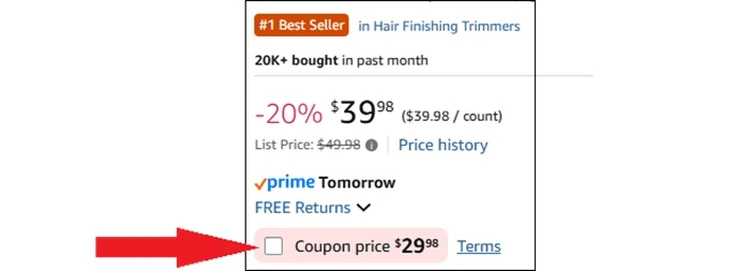
To get the savings, you simply tap the empty box next to coupon price, and the discount automatically applies at checkout.
The coupons are typically funded by manufacturers trying to boost visibility for their products. Thats why youll often see coupons for brand-name items like:
Electronics
Laundry detergent
Paper towels
Books
Vitamins and supplements
Coffee and snack foods
Pet supplies
Beauty products and skincare
Cleaning supplies
Home & Kitchen
Automotive
A simple habit that can save real money is browsing the coupon page once a week and clipping offers on items you buy regularly.
Clipping the coupon doesnt commit you to purchasing the item. It simply activates the discount so it is ready when you need it.
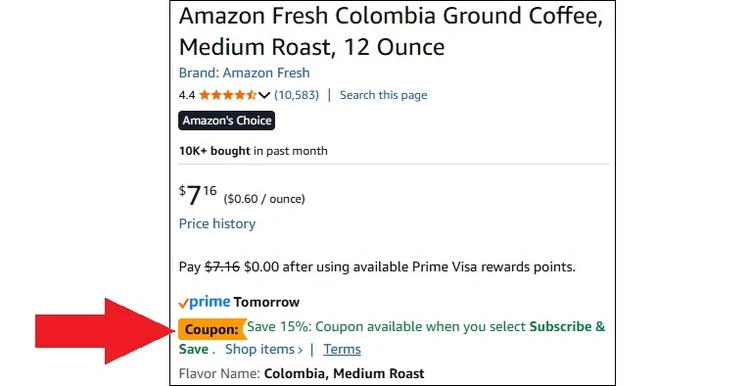
Pro tip: Not every Amazon coupon is easy to spot. Some are buried in product listings and dont show up on the main coupon page. One really smart pro tip is to type the word coupon into Amazons search bar along with the product youre shopping for.
For example, try searches like coupon laundry detergent or coupon paper towels. This will quickly surface listings that have clip-able discounts attached.
At first glance, it appears to simply be a way to automate deliveries for items you buy regularly. But the real advantage is the extra discount Amazon applies to subscription orders.
The discount looks like this:
5%-15% off your first Subscribe & Save order of a specific product.
Up to 15% off when you have fiveor more subscriptions in the same delivery cycle.
Many everyday household products are eligible, including:
Coffee and pantry staples
Diapers and baby supplies
Protein bars and snacks
Trash bags and paper products
Pet food
Shampoo and toothpaste
The biggest advantage is that Subscribe & Save discounts stack with coupons.
For example:
Item price: $19.99
Coupon clipped: 25% off
Subscribe & Save discount: 15%
Final Price: about $12.74
Thats some decent savings for stuff your household buys every month anyway.
And you can cancel or skip subscriptions anytime (without penalty) even immediately after the first delivery arrives.
Savvy Amazon shoppers will basically use Subscribe & Saveas a one-time discount tool.
Pro tip: If you want to trigger the 15% maximum discount, add several low-cost subscriptions to the same delivery cycle. After your order ships, you can cancel the ones you dont want.
These deals are especially popular because they offer steep discounts for a short period of time or until inventory sells out.
The deals frequently cut prices by 20% to 50%, but they can also be hard to find from the Amazon homepage.
From the homepage, or on the Amazon app, look for a link to Todays Deals near the top of the page.
For some odd reason, that link does not always exist, so you might have to look for the Shop Todays Deals section which includes an image of a product (see screenshot above).
And yes, Lightning Deals can often stack with other coupons.
For example:
Regular price: $35
Lightning Deal price: $24
Clipped coupon: 20% off
Final price: $19.20
Because Lightning Deals are limited, they can sell out quickly.
If youre planning to buy something specific, checking the deal section daily can help you catch price drops before they disappear.
Step 4: Stack your credit card rewards too
Another discount layer many shoppers overlook is your payment method.
Certain credit cards offer solid cash back on your Amazon purchases.
These credits usually range from $1 to $10 and they are for one-time use only. So, if you return the item that you used a promo credit to buy, you wont get the credit back its gone forever.
While the credits may seem small, they tend to add up quickly.
Many shoppers will accumulate credits they dont even realize they have, so be sure to check your balance.
You can check your promotional balance in your Account, then select Your Credit & Benefit Balances, which is under Shopping Programs and Rentals.
Pro tip: Whenever youre not in a hurry for delivery, be sure to select No-Rush Shipping. Amazon often rewards this choice with $1$3 promotional credits.
The store operator ofEddie Bauer plans to close 174 brick-and-mortar stores across the U.S. and Canada after failing to find a buyer during bankruptcy proceedings.
The closures follow a canceled auction for the companys store leases and come amid mounting debt and declining retail sales.
The retail operators filing does not impact Eddie Bauers manufacturing, wholesale, or e-commerce operations, nor does it impact retail operations outside of the U.S. and Canada.
The store operator of outdoor apparel retailer Eddie Bauer is preparing to close 174 brick-and-mortar stores across North America after failing to secure a buyer during bankruptcy proceedings, according to court filings and company statements.
The closures come after a planned auction of the companys retail leases was canceled due to a lack of qualified bids, leaving liquidation as the most likely path forward for the retailers store operations.
The move affects approximately 150 stores in the United States and about two dozen in Canada. Closing sales are already underway in many locations, and most stores are expected to shut their doors by the end of April as the company winds down its physical retail business.
Filed for bankruptcy earlier this year
Eddie Bauers store operator filed for Chapter 11 bankruptcy protection earlier this year, citing declining sales, rising costs, and ongoing challenges facing traditional retail. The bankruptcy marks the third such filing for the brand in the past two decades.
The entity that operates Eddie Bauers retail locations licenses the brand from Authentic Brands Group, which owns the companys intellectual property. Because of that structure, the bankruptcy applies primarily to the brick-and-mortar retail business rather than the brand itself.
As a result, Eddie Bauer products are expected to remain available online and through wholesale distribution channels even after the stores close. The brands e-commerce and licensing operations are being transitioned to a new partner, Outdoor 5.
106 years old
Founded in Seattle in 1920, Eddie Bauer built a reputation for outdoor gear and apparel, including down jackets and equipment used by military and expedition teams. At its peak in the early 2000s, the company operated nearly 600 stores.
Retail analysts say the latest closures reflect broader pressures facing mall-based retailers, including shifts toward online shopping, high lease costs, and competition from newer outdoor apparel brands.
Customers with gift cards or loyalty points are being encouraged to redeem them soon as the company continues its liquidation process and prepares to exit physical retail.
The company has not announced plans to reopen stores under new ownership, though the Eddie Bauer brand itself is expected to continue operating through digital and licensing channels.
Researchers are testing "smart underwear" sensors that track when people pass gaswhile also recording diet and daily habits.
Early results show people average about 32 gas events per day, though the range varies widely.
The goal is to better understand the gut microbiome and what actually counts as normal digestion.
Everyone does it. Whether you call it breaking wind, passing gas, or cutting the cheese, flatulence is a normal part of digestion.
However, heres something scientists still dont fully understand: how much gas is actually normal?
Researchers at the University of Maryland are now trying to answer that question with a nationwide study that uses what they call "smart underwear."
How the smart underwearworks
The study uses a small wearable sensor that clips onto participants underwear.
The quarter-sized device measures intestinal gas using electrochemical sensors that detect when gas is released.
Participants also track:
What they eat
Their daily habits
Demographic information
Researchers hope the data will help identify why some people pass gas far more often than others.
A window into the gut microbiome
The study might sound like bathroom humor, but the science behind it is actually serious. Researchers are trying to better understand how the gut microbiome works.
Your digestive system is home to trillions of bacteria that help break down the food you eat. When those microbes digest things like fiber and certain carbohydrates, they naturally create gases such as hydrogen, methane, and carbon dioxide.
By tracking how often gas is released and comparing that with peoples diets and daily habits, scientists hope to uncover new clues about:
Digestive health
Food tolerance
Gut bacteria behavior
Early signs of gastrointestinal disorders
Scientists say the findings could eventually help doctors give patients more personalized dietary advice and identify digestive problems earlier.
Researchers expect early findings from the larger study within about a year.
Early results already surprised scientists
In a small early study of 19 adults, the sensor tracked how often people passed gas in a typical day.
The result: about 32 times per day on average.
This is more than double the number often cited in medical literature.
However, the range was enormous. In one example, two participants with nearly identical diets passed gas 175 times and 5 times in the same day.
Thousands of people have volunteered
The new nationwide project, called the Human Flatus Atlas study, originally aimed to enroll 800 participants. Instead, more than 3,000 people across the U.S. have already signed up.
If interested, you can join the study as well. You'll be asked for your name, email address, and a few questions to determine your eligibility.
According to the research team, participants have been surprisingly open about sharing stories about digestive issues and embarrassing moments caused by excessive gas.
Researchers say the interest likely comes from a simple question many people have asked themselves at some point: Is this normal?
One thing scientists already know
One thing scientists already know is gas varies wildly from person to person.
So, if youve ever wondered whether youre normal when it comes to flatulence, youre definitely not alone. Researchers say thousands of Americans are curious about the exact same thing.
Related Bing News Results Consumer Reports investigates: Toxic ingredients in beauty products Mon, 09 Mar 2026 21:01:00 GMT Most of us don’t think twice about shampoo, deodorant, or lotion. Now, Consumer Reports reveals that some of those products may contain ingredients linked to cancer risk, hormone disruption, and other ... The 10 best cars of 2026, according to Consumer Reports Mon, 09 Mar 2026 17:30:00 GMT If you're eyeing a new vehicle purchase in 2026, due diligence is a must. Fortunately, Consumer Reports has a good idea of which cars really shine. Here Are The Cars That The Consumer Reports Testers Disliked Most In 2025 Sat, 28 Feb 2026 13:05:00 GMT The Tesla Cybertruck, Toyota 4Runner, and Volvo EX30 were the cars Consumer Reports testers disliked most in 2025. The Volvo got the most disapproval. Consumer Reports retests protein powders, finds safer options Wed, 18 Feb 2026 17:22:00 GMT USES THESE SUPPLEMENTS. HERE’S MARISSA TANSINO. LAST FALL, CONSUMER REPORTS TESTED DOZENS OF PROTEIN POWDERS AND READY TO DRINK SHAKES. WHAT THE LAB FOUND RAISED RED FLAGS MORE THAN TWO THIRDS ... Consumer Reports tests lead levels in popular chocolate protein powders Fri, 30 Jan 2026 14:09:00 GMT Last fall, Consumer Reports tested dozens of protein powders and ready-to-drink shakes. What the lab found raised red flags: more than two-thirds contained more lead in one serving than CR’s ...