Eli Lillys Zepbound transformed weight loss drug market since debut 18 months ago
4.5 million people reportedly taking Lillys GLP-1 drugs for weight and related health issues
Insurance changes could leave patients weighing steep costs or switching medications
A major shift in insurance coverage threatens to upend access to Zepbound, Eli Lillys blockbuster weight loss drug that has surged in popularity since its launch a year and a half ago.
Zepbound, the brand name for tirzepatide, quickly became a household name as millions flocked to new GLP-1 medications promising not only weight loss but benefits for conditions such as sleep apnea. Eli Lilly, the Indianapolis-based pharmaceutical giant, estimates that 4.5 million people now use one of its GLP-1 drugs for weight management or related health concerns.
But the drugs meteoric rise is facing a new obstacle: a coverage change by CVS, a leading pharmacy benefit manager, that may force patients to pay significantly more out-of-pocket or consider alternative therapies. Details of the coverage adjustment have not been publicly disclosed, but the move is poised to reshape howand whethermany patients can afford the high-priced medication.
The development underscores broader tensions in the weight loss drug market, where demand for new treatments has boomed, but insurance companies and pharmacy benefit managers are grappling with how to contain costs for medications that can run over $1,000 per month.
Pharmaceutical giants have been critical of PBMs, saying their role needs to change. Eli Lilly previously told FOX Business that the only way to lower prices for U.S. consumers is if "intermediaries take less for themselves."
For patients, the changes may soon bring difficult choices about their healthand their finances.
To find out whether your specific vehicle is included in a recall, you can check by VIN or license plate on NHTSA's recall lookup page: NHTSA.gov/recalls.
If your vehicle has an unrepaired recall, contact your local dealership to schedule a repair recall remedies are provided at no cost.
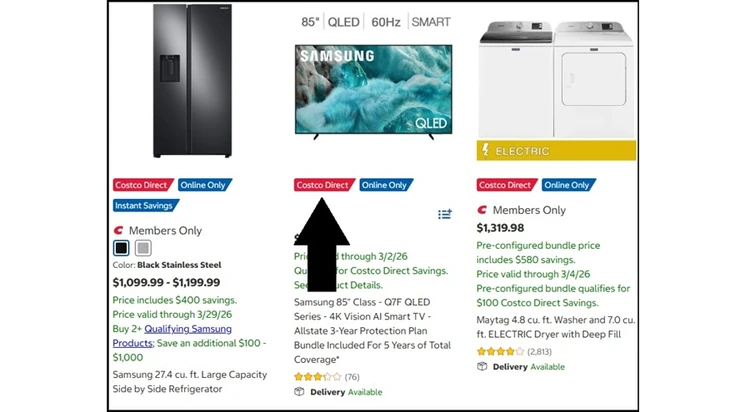
Costco Direct automatically saves you money when you buy 2+ qualifying big-ticket items (appliances, TVs, furniture). Look for the red Costco Direct label.
Combine items in the same promo (washer + dryer, fridge + dishwasher). The discount applies automatically at checkout.
Shop around major holiday sales and use the Costco Anywhere Visa Card by Citi to earn up to 4% back plus most appliance orders include delivery and haul-away.
Costco has a lesser-known online program for members called Costco Direct, and its a game changer when buying big ticket items like furniture, electronics, and appliances.
Heres what it is, how it works, and how to squeeze the maximum savings out of it.
What exactly is Costco Direct?
Costco Direct is an online-only savings program that offers automatic discounts when you buy multiple qualifying items at the same time.
Youll usually see promotions like:
Spend $1,999 on 2+ items Save $300
Buy 5+ qualifying appliances Save $500
Buy any 3 Costco Direct items Save $200
The item description must have the small red label titled Costco Direct.
They dont advertise the deals very well on the Costco website. Ive found the best way to find them is to actually search Costco Direct directly from their search bar.
The search results will typically include the following:
Appliances
TVs
Laptops
Furniture
Whole home generators
Patio furniture
Outdoor gazebos
BBQs
Toilets
They also occasionally have high-end seasonal items.
Unlike the regular Costco warehouse markdowns, this is an online only, bundle-based discount, that automatically applies at checkout.
The point of Costco Direct is simple
Its designed to reward you for buying multiple big-ticket items at once.
Instead of discounting just one refrigerator or one TV, Costco gives you a bigger automatic discount when you bundle qualifying items together.
Think of it like this:
Buy 1 appliance regular sale price.
Buy 2 or more qualifying appliances automatic extra savings.
Its Costcos way of:
Encouraging larger online purchases.
Moving high-value inventory faster.
Competing with big-box appliance package deals.
If youre already planning to replace multiple items, say a washer and dryer, or a fridge and dishwasher, Costco Direct can knock hundreds off your total.
But its not meant for small, everyday purchases. The savings is also beneficial if youre building a new home or doing a big remodel and replacing multiple appliances, furniture, or electronics.
Its built specifically for bundled, higher-dollar buys.
How to use Costco Direct
Go to Costco.com and search Costco Direct.
Click into the current promotion page.
Filter by category (appliances, TVs, etc.).
Add qualifying items to your cart.
The discount applies automatically once you hit the quantity threshold.
No coupon codes. No membership upgrade required.
Where the real savings happen
Dont assume that the savings Costco Direct provides is only useful if youre remodeling your entire house. Thats just not true.
Heres how the majority of us can take advantage of the savings:
1. Mix and match strategically
You dont have to buy two refrigerators.
You can combine:
A washer
A dryer
A microwave
A dishwasher
A couch
A reclining chair
A dining table set
As long as theyre in the same Costco Direct promotion, youre good to go.
This is perfect if you're outfitting a rental, helping a kid move out, or replacing multiple aging appliances or furniture items at once.
2. Time it around seasonal transitions
Heres when Costco runs the most aggressive Costco Direct promos:
Before Memorial Day
Before Labor Day
Around Black Friday
During appliance clearance cycles
If a manufacturer model refresh is coming, then know that youll be able to stack:
Manufacturer markdowns
Costco Direct bundle savings
Credit card rewards
Stacking like this is when your discounts quietly creep into the 2035% off range.
3. Stack with the Costco Credit Card
If you use the Citi Costco Anywhere Visa, you can earn:
A bipartisan group of U.S. senators has introduced legislation aimed at preventing private equity firms from purchasing single-family homes.
Lawmakers say the measure is designed to ease housing affordability pressures and curb investor-driven price spikes.
The proposal reflects growing concern in both parties over Wall Streets expanding role in the residential housing market.
Its not often these days that Republicans and Democrats in Congress can agree that a bill needs to be passed. However, Sen. Elizabeth Warren (D-Mass.) and Sen. Josh Hawley (R-Mo.) are cosponsoring a bill to bar private investment firms from buying up single-family homes.
In his State of the Union address last week, President Trump also lent his support to the idea.
Supporters argue that large-scale investor purchases have intensified competition for homes, driving up prices and rents and putting homeownership further out of reach for middle-class families.
Wall Street has exploited the American housing crisis, turning the nations housing stock into a portfolio of rental properties, Hawley said in a statement. Families deserve to be able to buy their own homes and achieve the American dream without competing with big investment companies that irrevocably drive up housing prices. Thats why I am introducing legislation to ban Wall Street from buying single-family homes once and for all.
Small investors not affected
The legislation would apply specifically to private equity firms and other institutional investors that manage pooled funds on behalf of outside investors. Individual landlords and smaller-scale real estate investors would not be subject to the ban. Lawmakers say the goal is to curb large-scale acquisitions that can shift entire neighborhood markets, rather than penalize small property owners.
Under the proposal, covered firms that currently own single-family rental homes would be required to sell those properties within a set timeframe, potentially three to five years. Penalties for noncompliance could include financial fines and restrictions on future real estate activity.
The legislation would reverse a trend that began during the housing market crash of 2009-10, when millions of subprime foreclosures flooded the market with homes, dragging down prices. Seeing bargains, large investors bought up thousands of homes for rental property, effectively taking them off the market and creating shortages, which in turn drove up prices.
The issue of affordability
Housing affordability has become an increasingly urgent issue nationwide. Home prices surged during the pandemic-era buying boom, fueled by low interest rates and limited housing supply. Although mortgage rates have since risen, prices in many markets remain elevated, and inventory continues to lag demand.
Supporters of the bill argue that when private equity firms purchase homes in bulk often making all-cash offers they can outcompete individual buyers and contribute to upward pressure on prices. Some research suggests institutional investors account for a significant share of purchases in certain markets, though nationally they still represent a minority of total homeownership.
The push-back
Industry groups have pushed back on similar proposals in the past, arguing that institutional investors provide rental housing options and professional property management at scale. They also contend that the primary driver of high housing costs is insufficient new construction, not investor ownership.
Real estate and private equity trade associations are expected to oppose the measure, saying it could reduce rental supply and discourage investment in housing development. They may also raise concerns about potential legal challenges, particularly regarding property rights and retroactive divestment requirements.
The bills prospects in Congress remain uncertain. While bipartisan sponsorship increases its visibility, housing policy proposals that directly restrict private investment often face strong lobbying opposition and procedural hurdles. Still, the introduction of the legislation underscores a rare area of cross-party agreement: that housing affordability has become a political and economic flashpoint demanding federal attention.
The IRS has launched a new Report Fraud web page to make it easier for taxpayers to confidentially report suspected tax fraud, and evasion.
The page consolidates multiple reporting options into a single location at IRS.gov/SubmitATip and through a new button on the IRS homepage.
The agency says internal improvements will help it better process referrals and crack down on illegal tax activity.
The Internal Revenue Service has unveiled a new online tool designed to simplify how
taxpayers report suspected tax fraud and related , part of a broader effort to strengthen enforcement and improve how tips are handled inside the agency.
The new web page, accessible through a Report Fraud button on the IRS.gov homepage or directly at IRS.gov/SubmitATip, centralizes previously scattered reporting options into one streamlined location. Taxpayers can use the page to confidentially report suspected tax fraud, evasion, or other tax-related illegal activities.
IRS Chief Executive Officer Frank J. Bisignano said the changes are intended to make the reporting process more user-friendly while addressing longstanding internal inefficiencies.
Improvements to the IRS fraud reporting system make reporting suspected wrongdoing easier and simpler and will address historic challenges that had prevented the IRS from making maximum use of the referrals it receives, Bisignano said.
By reporting suspected tax fraud or , taxpayers play an important role in uncovering fraud and supporting the integrity of the nations tax system.
Report fraud ASAP
The IRS is encouraging taxpayers to report suspected wrongdoing as soon as possible, saying timely tips can help the agency more effectively address fraud and noncompliance.
While the new web page represents the first phase of the effort, officials described it as part of a longer-term modernization plan. Future updates are expected to reduce the number of forms required to submit tips, automate certain processes and incorporate modern case management software to better track and evaluate referrals.
Historically, the IRS has faced challenges in fully leveraging the information it receives from the public. According to the agency, creating fewer work streams, simplifying submission procedures and improving internal processing will make it easier to act on credible leads.
The IRS said the changes are aimed at strengthening enforcement capabilities while making it more straightforward for taxpayers to participate in protecting the integrity of the federal tax system.
Nearly 651,000 gallons of bottled water recalled in Illinois and Wisconsin over sanitary concerns.
FDA classifies the action as a Class II recall, citing products bottled under insanitary conditions.
Recall remains ongoing; no press release has been issued by the company.
Valley Springs Artesian Gold, LLC is recalling nearly 651,000 units of bottled water distributed in Illinois and Wisconsin after federal regulators determined the products were bottled under insanitary conditions. Some bottles may have also been distributed to other states.
The recall, identified by the U.S. Food and Drug Administration as Event ID 98410, was initiated voluntarily by the Portage, Wisconsin-based company on Feb. 6, 2026. The FDA classified the action as a Class II recall on Feb. 26, indicating that use of the product could cause temporary or medically reversible adverse health consequences, though the risk of serious harm is considered remote.
The recall covers three one-gallon (128 fl. oz.) plastic jug products with plastic caps:
Valley Springs 100% Natural Bottled Water (UPC 0 31193-00701 9), totaling 379,868 units.
Valley Springs 100% Natural Bottled Water with Fluoride Added (UPC 0 31193-01301 0), totaling 7,840 units.
Valley Springs Steamed Distilled Water (UPC 0 31193-00601 2), totaling 263,440 units.
What to know
In total, 651,148 units are affected. The FDA report lists water was bottled under insanitary conditions as the reason for the recall. The agency did not specify the exact nature of the sanitary deficiencies in its enforcement report.
The company notified consignees and/or the public using multiple communication methods, including combinations of email, fax, letter, press release, telephone, or in-person visits, according to the FDA filing. However, the enforcement report notes that no formal press release was issued specifically for the recall.
As of the FDAs latest update, the recall remains ongoing and has not been terminated.
Consumers who purchased one-gallon Valley Springs bottled water products in Illinois or Wisconsin are advised to check the UPC codes and discontinue use of affected items. Retailers and distributors have been instructed to remove the products from sale.
Related Bing News Results Consumer Reports retests protein powders, finds safer options Wed, 18 Feb 2026 17:22:00 GMT Researchers have tested more popular brands, including five reader-requested chocolate protein powders from Clean Simple Eats, Equate, Premier Protein, Ritual and Truvani. CR Investigates: Toxic beauty ingredients Tue, 17 Feb 2026 17:52:00 GMT Most of us don’t think twice about shampoo, deodorant, or lotion. Now, Consumer Reports reveals that some of those products may contain ingredients linked to cancer risk, hormone disruption, and other ... Consumer Reports Investigates: What you need to know about toxic beauty ingredients Tue, 10 Feb 2026 00:57:00 GMT Most of us don’t think twice about shampoo, deodorant, lotion or makeup. We lather, rub, and apply daily without a second thought. But the cosmetics industry uses thousands of chemicals in the ... The Top 10 Cars And Trucks For 2026, According To Consumer Reports Sat, 07 Feb 2026 08:05:00 GMT Consumer Reports just released their 2026 Top Picks for autos, trucks and SUVs. They’ve chosen 10 vehicles, one per category, that score big on the stuff buyers actually live with such as road-test ... Consumer Reports tests lead levels in popular chocolate protein powders Fri, 30 Jan 2026 14:09:00 GMT Last fall, Consumer Reports tested dozens of protein powders and ready-to-drink shakes. What the lab found raised red flags: more than two-thirds contained more lead in one serving than CR’s ...



 of ConsumerAffairs