Federal judge dismisses class-action lawsuit over Amazons ad-supported Prime Video tier.
Court rules Amazon acted within its rights under existing user agreements.
Plaintiffs barred from refiling after third failed attempt to plead claims.
A federal judge has dismissed a class-action lawsuit against Amazon that claimed the company deceived Prime Video users by introducing advertisements unless they paid an additional monthly fee. The decision ends months of litigation over Amazons controversial change to its streaming service.
U.S. District Court Judge Barbara Jacobs Rothstein, ruling from the Western District of Washington on July 16, granted Amazons motion to dismiss the consolidated class-action complaint with prejudice, meaning the plaintiffs cannot try again.
Amazons right to modify upheld
Central to the courts ruling was the finding that Amazon had not violated its terms of service. Judge Rothstein referenced a previous ruling that determined the introduction of ads was not a price increase but rather a benefit modification a change the company was authorized to make under the membership agreement.
Amazons terms, the judge emphasized, gave the company sole discretion to add or remove Prime membership benefits at any time. Amazon never promised to Prime members or anyone else that Prime Video would be always, or entirely, ad-free, the company stated in its legal filings.
Plaintiffs' claims ruled unreasonable
The plaintiffs had argued that Amazons move amounted to a bait and switch, misleading customers who believed ad-free streaming was a guaranteed feature of their Prime membership. The lawsuit, originally filed in February 2024, said customers were unfairly forced to pay an additional $2.99 per month to maintain ad-free streaming, something they had already paid for.
Judge Rothstein was not persuaded. She ruled that it was not reasonable for customers to assume that Prime Videos ad-free model would remain unchanged. The decision criticized the plaintiffs for relying on personal expectations rather than the language of Amazons user agreement.
This ruling marks the third time the plaintiffs have attempted to bring similar claims against Amazon. Judge Rothstein noted that each version of the complaint failed to present new or viable legal theories and therefore denied any further opportunity for amendment.
[T]his is Plaintiffs third attempt to plead viable claims, Rothstein wrote. No further amendment will be permitted.
Background and impact
Amazon began rolling out ads on Prime Video content in early 2025, offering users an option to pay $2.99/month to continue watching without commercials. The change sparked widespread customer backlash and legal scrutiny.
Despite customer frustration, the courts ruling affirms that Amazons service agreements allow for such changes. The decision is a major legal win for Amazon and sets a precedent for subscription-based platforms seeking flexibility in adjusting their service offerings.
More than half of U.S. homes lost value over the past year, the highest rate of depreciation since 2012.
The decline in home values is especially pronounced in many Sun Belt and West Coast metro areas where rapid growth during the pandemic is now unwinding.
For potential buyers, 2025 is shaping up as a buyers market in many places, as elevated mortgage rates and growing inventory tilt leverage back toward purchasers.
Declining home affordability has usually been blamed on mortgage rates, but inflated home prices that surged during the COVID-19 pandemic are actually to blame. Todays mortgage rates are historically normal home prices are not.
But that may be changing. After years of historic growth fueled by pandemic-era demand, 2025 is seeing a broad correction in U.S. home values. While national indexes still show modest overall gains, the gains have flattened dramatically and in dozens of metro areas, home prices have actually fallen.
According to a recent analysis by real estate platform Zillow, 105 of the 300 largest U.S. metro areas reported year-over-year declines in home values during the 12 months leading into late 2025. In many of these places once the hottest hot-markets inventory has risen, demand has cooled, and buyers now have significantly more negotiating power.
Where prices are dropping most
Some of the hardest-hit markets include:
Austin, Texas Once emblematic of booming Sun Belt growth, Austin has seen home values slide by several percentage points.
Tampa, Florida Among the steepest declines in the country, reflecting a retreat in demand and rising supply of homes.
Miami, Florida Once red-hot, Miamis housing values have slipped as mortgage rates climb and buyers retreat from previously overheated markets.
Other notable markets with declines include Dallas, Texas, Phoenix, Arizona, Orlando, Florida, and Jacksonville, Florida.
Overall, many of the largest drops are in Sun Belt and West Coast areas places that saw dramatic gains earlier in the decade.
Whats driving the decline
Several broad trends are combining to push home values downward in many markets:
Higher mortgage rates Rates remain elevated compared with the pandemic lows, which suppresses buyer affordability and weakens demand.
Rising inventory and easing demand After a period of tight supply, more homes have been listed, giving buyers more choices and shifting leverage away from sellers.
Market correction after a boom Many of the markets seeing the steepest declines were big winners during the housing boom. As growth settles, price adjustments follow.
Economic uncertainty Broader concerns about inflation, interest rates, and job stability have made many potential buyers more cautious, reducing the pool of active purchasers.
What it means for buyers, sellers and homeowners
For buyers: 2025 presents opportunities. Buyers who were previously priced out might find more negotiable sellers, especially in Sun Belt or West Coast metros where values are falling.
For sellers: It may be a tougher market some may need to adjust expectations or offer incentives to attract buyers. Homes that remain on the market may sit longer than in recent years.
For homeowners who bought earlier (pre-2023), many still retain significant equity. Even where home values have dropped, most residences remain well above pre-boom valuations meaning that while prices are falling, many homeowners are not underwater.
That said, the shifting dynamics reinforce the need for buyers and sellers to pay close attention to local conditions not just national headlines especially as mortgage rates, supply, and demand continue to evolve.
The headline University of Michigan (UM) consumer sentiment index ticked up to 53.3 in early December 2025, from 51.0 in November.
Inflation expectations among households fell: the expected rate over the next year dropped to 4.1%, down from 4.5% in November, while long-term inflation expectations eased to 3.2%.
The modest improvement the first in five months was driven by greater optimism about personal finances and future prospects, even as many Americans continued to express concern over prices and labor-market uncertainty.
The University of Michigan preliminary reading for its monthly consumer-sentiment survey shows a moderate rebound after months of decline. The index rose modestly to 53.3 a gain of 2.3 points over Novembers reading.
Although that uptick beat economists forecasts, the broader context remains sobering. The index remains far below the roughly 71.7 level seen in January, and economic optimism is still a long way from pre-pandemic norms.
Survey respondents reported little change in how they view current economic conditions. However, their expectations for the future personal finances and the economy at large improved. That optimism helped lift the overall index.
Whats behind the shift?
Better outlook on personal finances. According to the survey, perceived financial prospects rose sharply a 13 % increase in those expecting their personal finances to improve over the coming year. This was reflected across different ages, income levels, education backgrounds and political affiliations.
Slowing inflation expectations. Short-term inflation expectations dropped to 4.1% (from 4.5%), the lowest reading since January 2025. Long-term inflation expectations also softened to 3.2%. For many households, that represents a glimmer of relief that prices may stabilize somewhat.
But headwinds remain strong
High prices still weigh heavily. Despite some easing in inflation expectations, many consumers still cited high prices as a key concern undercutting their sense of financial security.
Labor-market worries and economic uncertainty persist. Even though labor-market expectations improved slightly, they remain subdued compared with historical norms, reflecting broader pessimism around job security and economic growth.
Confidence still far below pre-year levels. At 53.3, the index is far below the level at the start of the year underscoring that many households remain fragile and cautious about spending.
Why these numbers matter
The consumer-sentiment index by the University of Michigan is widely watched because it offers a window into what households are likely to do next spend more, save, or hold back. Consumer spending drives a large portion of U.S. economic activity, so shifts in confidence can ripple out to influence growth, inflation, and even interest-rate decisions by policymakers.
The slight rebound this month may offer modest encouragement: if more people feel confident about their finances and inflation is expected to ease, that could translate into increased spending over the holidays supporting retailers and service industries.
But the underlying mood remains cautious. For many Americans, especially those facing price pressures or employment uncertainty, spending may stay subdued potentially slowing economic momentum heading into 2026.
What consumers should do
Revisit budgets and spending plans. With inflation still above historic norms, households may benefit from carefully reviewing discretionary spending, noting whats essential and what can wait.
Shop around for deals especially on big-ticket items. If many consumers remain cautious, retailers might offer discounts or promotions to stimulate demand.
Keep an eye on inflation and labor-market trends. Continued easing of price expectations could improve household budgets, but if inflation or job insecurity flares up, that may dampen any spending recovery.
Use confidence data as a reminder to build or maintain emergency savings. With economic uncertainty still present, having a buffer even a modest one can help households weather unexpected costs or job changes.
AI is rapidly reshaping how Americans search for homes, apply for rentals, and secure mortgages.
But federal regulators warn that these tools could also amplify discrimination, distort rents, and misuse personal data.
New government reports urge stronger oversight as AI weaves deeper into real estate markets.
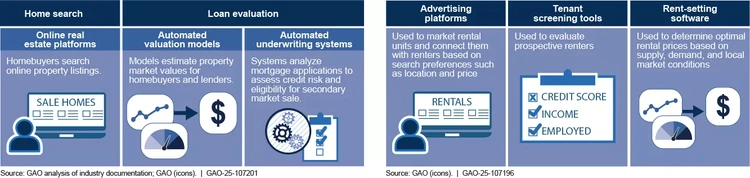
Buying or renting a home has never been more digital. Most consumers now start their search on platforms like Zillow, Realtor.com, and Redfin, using tools that surface listings, estimate home values, and even connect them with lenders. Increasingly, these services rely on artificial intelligence to power chatbots, virtual assistants, personalized recommendations, and automated valuations.
AI can make the process faster and cheaper. It can scan vast amounts of data to pinpoint listings that match a buyers preferences, answer questions in real time, or instantly estimate what a property might sell or rent for. But as these tools become ubiquitous, regulators say the risks are mounting.
Concerns about bias and discrimination
The biggest worry is that AI systems could inadvertently steer buyers or renters toward or away from certain neighborhoodsconduct that may violate fair housing and fair lending laws. If an algorithm fails to catch problematic search terms tied to race, ethnicity, gender, age or other protected traits, it could shape results in ways that reinforce discrimination.
Platforms also may collect sensitive personal data to personalize listings or marketing, raising additional privacy concerns.
Possible dangers in mortgage decisions
AI is increasingly being used behind the scenes in mortgage underwriting, reviewing documents such as employment and payroll records. But if these systems expand into decision-makingsuch as approving or denying a loanthey could obscure why an applicant was rejected or reinforce historical biases in lending.
Impact on rental prices
The same AI tools that help forecast home values are being adopted to set rents. Supporters say this makes prices more responsive to market dynamics, allowing landlords to adjust for vacancy and occupancy in real time. But critics warn that algorithms could push rents higher by basing them on ZIP codes rather than individual building conditions, while also weakening renters ability to negotiate.
Regulators step in
Several federal agencies are monitoring how AI is used across real estate markets, and some have already taken action:
The Federal Housing Finance Agency has reviewed AI-powered underwriting tools and valuation models used by lenders.
Other federal agencies have pursued cases against rental platforms accused of misleading or discriminatory advertising.
Regulators have also taken enforcement actions against companies that screen out tenants using outdated or inaccurate data.
While some oversight has begun to shift toward AI-specific compliance, officials say more guardrails are needed to prevent misuse and protect consumers.
What comes next
The federal government and private research organizations have released new reports detailing how AI is reshaping home buying and rentingand where regulation may need to catch up. As digital tools become standard in real estate, consumer advocates and policymakers are urging stronger protections to ensure that innovation doesnt come at the cost of fairness, privacy, or affordability.
A new law is intended to speed up introduction of advanced sunscreens in the United States
The U.S. has fallen behind other countries because of delays in approving new ingredients, critics say
Sunscreenis vital to protect against melanoma and other skin cancers
It. may be cold and overcast where you are now but, sooner or later, the sun will come blazing back and when it does, anew U.S. law aims to bring American sunscreen standards into the 21st century, potentially ending decades of stagnation in the ingredients available to consumers. While the legislation promises faster review of ultraviolet (UV) filters and improved labeling requirements, experts say the move mainly allows the U.S. to catch up to countries that have spent years using more advanced and effective sunscreen technologies.
For now, the gap is real. Europe, Asia, and Australia all approve UV filters that offer stronger, more stable protection against UVA radiation, the wavelength most responsible for premature skin aging and a major contributor to melanoma. Several of these filters including Tinosorb S, Tinosorb M, Mexoryl XL, and Uvinul A Plus have been in overseas products for more than a decade, yet remain unavailable in American sunscreens.
American consumers simply havent had access to the best UV protection science can offer, said one dermatology researcher involved in FDA advisory work. This law doesnt magically bring those ingredients here overnight, but it makes it much more likely they will eventually be approved.
The new law grew out of legislation introduced by U.S. Senators Maggie Hassan (D-NH) and Roger Marshall (R-KS). It requires the U.S. Food and Drug Administration (FDA) to modernize its process for reviewing and approving new sunscreens, helping Americans access sun protection products that have been safely used in other countries for years.
For too long, outdated regulations have prevented Americans from accessing the same safe and effective sunscreen products available in other countries,said Senator Hassan. Now, the FDA will finally update its approval process so that American manufacturers can produce modern, user-friendly sunscreens and American families can benefit from the sun protection options that have been safely used around the world for years. Im glad that we were able to work across the aisle to get this done.
Why the U.S. fell behind
Unlike Europe and Asia, which treat sunscreens largely as cosmetics, the U.S. regulates them as over-the-counter drugs. That classification requires additional safety data and longer review times. As a result, no new UV filter has been approved in the U.S. since the 1990s a startling reality in a world where skin cancer rates continue to rise.
The new law instructs the FDA to modernize and streamline its review framework, create clearer pathways for evaluating long-used international filters, and update broad-spectrum testing to better measure UVA protection. Consumer advocates say these steps are essential, given how central UVA exposure is to skin damage.
People assume a high SPF number means complete protection, said a spokesperson for the American Academy of Dermatology. But SPF mainly measures UVB the rays that cause sunburn. Many U.S. sunscreens still offer weak UVA defense compared to products available abroad.
What other countries are doing better
In the European Union, manufacturers can choose from more than 30 approved UV filters nearly double whats permitted in the U.S. allowing them to formulate sunscreens that are both cosmetically elegant and highly protective. Asias beauty markets, especially Japan and South Korea, emphasize lightweight, transparent formulas with strong UVA ratings using the PA system (PA++ to PA++++).
Australia, which has some of the worlds highest skin cancer rates, enforces some of the strictest sunscreen regulations globally. Its public-health campaigns have helped drive adoption of high-SPF, high-UVA products that have shown measurable impact on reducing melanoma incidence.
With this much innovation abroad, U.S. dermatologists and cancer-prevention groups have been pressing regulators to act for years.
Melanoma risk remains high
Melanoma is the deadliest form of skin cancer, and UV exposure is responsible for roughly nine out of ten cases. While early detection has improved survival rates, incidence continues to climb in the United States.
A long-term Australian study found that daily sunscreen use reduced melanoma rates by about 50%, a figure often cited by cancer-prevention advocates. Many of the formulations used in high-sunlight regions feature robust UVA filters that help prevent not just cancer, but also photoaging and other UV-linked skin disorders.
In addition to melanoma, basal cell carcinoma and squamous cell carcinoma far more common but usually less deadly are also tightly linked to UV exposure. UVA rays, which penetrate deeper into the skin, are thought to play a major role in cumulative DNA damage.
What the new law means for consumers now
Consumers wont see immediate changes on store shelves. The FDA must issue new guidance and begin evaluating pending UV filter applications before next-generation sunscreens can be marketed. Industry groups say the research is already available for many of the filters used abroad, meaning the potential pipeline could move quickly once the framework is in place.
In the interim, dermatologists recommend that consumers continue using broad-spectrum sunscreens with SPF 30 or higher ideally mineral sunscreens (zinc oxide or titanium dioxide) for stronger UVA coverage and reapply every two hours when outdoors.
This is an important regulatory milestone, said the AAD spokesperson. But for meaningful public-health impact, we need high-performance filters, accurate labeling, and consumer education. Sunscreen only works if people understand how and when to use it.
The bottom line: Better sunscreens are coming, and the U.S. may finally join the rest of the world in offering the full range of UV-filter technology. But until the new system is in place, consumers should stay vigilant and informed about what their sunscreen can (and cant) do.
Consumer Guide How to pick a sunscreen today
Even with regulatory changes coming, heres how to choose the best protection right now.
1. Look for Broad Spectrum
This ensures the product protects against both UVB (sunburn) and UVA (aging, long-term skin damage). UVA protection is where U.S. sunscreens often fall short, so broad spectrum is non-negotiable.
2. Minimum SPF 30
SPF 30 blocks about 97% of UVB rays. Higher SPFs offer marginally more protection but help compensate for under-application a common problem.
3. Consider mineral sunscreens for stronger UVA coverage
Mineral filters:
Zinc oxide offers the broadest spectrum of UV protection available in U.S.-approved filters.
Titanium dioxide helps but doesnt cover UVA-1 as well.
Minerals are especially good for sensitive skin, kids, and people seeking robust UVA defense.
4. If using chemical sunscreens, look for these ingredients
While the U.S. lacks the advanced UVA filters used abroad, you can still maximize whats available. Prioritize formulas containing:
Avobenzone (UVA protection; works best when stabilized with octocrylene)
Meradimate (moderate UVA coverage)
Avoid relying solely on octinoxate, homosalate, or octisalate these mainly protect against UVB.
5. Choose a formula youll actually use
The best sunscreen is the one youre willing to apply generously and reapply often. Gels, milks, sticks, sprays, and hybrids all work when applied properly.
6. Reapply every two hours (or after swimming/sweating)
Most users apply too little sunscreen and forget reapplication. A shot-glass amount for the body and a nickel-sized amount for the face is a good rule of thumb.
7. Dont Forget Physical Barriers
Hats, sunglasses, UPF clothing, and shade can dramatically reduce UV exposure. Sunscreen should be your last line of defense, not the only one.
Re-check carts, Google exact model names across retailers (including smaller ones), and sort by biggest percent-off to mine quiet Cyber Week leftovers
Use abandoned carts, email sign-ups, and Free Shipping Day (Dec. 14) to trigger extra coupons, free shipping, and one big stacked order
Set a firm walk-away price, let price tools track it, and stay flexible on brands (store brands, dupes, lookalikes) to grab the best deal
Have you noticed that retailers are throwing everything at you this holiday season to try and get your money? Fake limited-time discounts, celebrity denim campaigns, and shiny new flagship stores. Noneof which aregoing to save you any money, quite the opposite actually.
Now that your Black Friday hangover is finally wearing off, here are some highly clever real-life ways to save money on the rest of your Christmas shopping.
Work the quiet Cyber Week leftovers
Retailers blew all their fireworks on Cyber Week but a ton of those prices are still quietly hanging around with way less hype.
Heres how to find the leftovers and save:
I always recommend going back to your online carts and wish lists and re-check prices instead of starting from scratch. Youll often find the same pricing or better.
Google the exact product name and compare at 23 big rivals (Amazon, Home Depot, Walmart, Target, Best Buy). Youll see a lot of still Cyber-ish pricing hiding under boring online deal labels.
When in doubt, sort by biggest % off on sale pages. Leftover doorbusters float to the top even after the banners are gone.
Pro tip: Check out smaller retailers too. Just last night, on Ace Hardwares website, I found a Blackstone Grill Ive been wanting for $100 less than any other store. I found it by doing a Google search for the exact model that I wanted. I did a quick price check on Amazon to verify, and the Ace Hardware price was $50 less than Amazon has ever sold the grill for. I paid for it immediately, chose store pickup to avoid shipping fees, and Ill grab it from Ace this weekend.
Use the abandoned cart trick to shake loose better prices
Online retailers hate it when you leave stuff in your online cart and never complete the purchase. This is especially true in December when theyre chasing every last sale.
Use this information to your advantage and try and get them to send you a discount to come back and complete your purchase.
Heres how it works:
Add any big stuff youre eyeing for Christmas (TV, headphones, laptop, small appliance, toy sets) to your online cart while logged in, then sign-out completely and never complete the purchase. Many stores will nudge you to come back with a reminder email, often including a coupon, extra promotion, or free shipping offer.
Also, before you buy, try toggling back and forth between delivery and in-store pickup. Some retailers quietly offer a lower price or extra discount for pickup because its cheaper for them than shipping.
If you get a come back coupon in your inbox, use it on one big, planned order instead a few random add-ons. That way you get the most bang for your buck.
Think of it this way, youre basically letting the retailer negotiate with you first, then saying yes only when the price is right.
Pro tip: Stores where Ive personally had this work include Best Buy, Home Depot, Lowes, B&H Photo, and Newegg. Also, I recommend a mix and match strategy. Meaning logout of some sites completely, stay logged-in on others, or sign-up for theiremail list first, then log out. Try different things in an effort to trip the "please, come back"automated email with a discount inside.
Treat Free Shipping Day as your real deadline, not Christmas Eve
Free Shipping Day, on December 14th this year, is basically the last realistic day to get gifts delivered by Christmas Eve without paying rush fees.
Its the day when over 1,000 online retailers come together to offer free shipping with guaranteed delivery by December 24th.
Use this day to your advantage by doing the following:
Build one big cart for that day: gifts that are heavy, bulky, or annoying to ship yourself (small appliances, toys, board games, bedding).
Then stack any site-wide promos with any coupon codes you can find, PLUS the free shipping offer, and get a perfect storm of savings.
After the 14th has passed, assume shipping costs are part of the price and shift to more of an in-store clearance and gift cards strategy. By shifting strategies youll save more than if you chase those 40% off banners that get eaten by expedited shipping charges.
Set a walk-away price and makea few tools do the works
Between now and Christmas, your brain is the weak link. Youll see the same item at eight different prices and forget which one was actually a solid price.
To help with this, I like to pick a 'walk-away price' for each big gift (like Ill only buy this tablet under $249 or these headphones under $99) and then let a few online tools do the watching:
If it never hits your number by, say, Free Shipping Day, you either adjust or swap to a cheaper model.
This keeps you from panic-buying at a meh price just because a timer is yelling at you.
Swap brands (not categories) where the deals are best
If youre willing to switch labels and not be tied into a specific brand, December is a great month to find deals. Store brands and second-tier labels are where a lot of the real value is hiding this year.
Here are some smart ways to play it:
Keep the category but drop the brand flex. So instead of having the Dyson or nothing mindset, make the goal a decent stick vac at 40% off or more. Then filter your options by price + reviews and youre going to save a ton of money.
Change your grocery mindset. When shopping for groceries and pantry gifts (coffee, snacks, chocolates, baking stuff), check the store-brand version right next to the name brand. Why? Heres a hintmany are made by the name-brand manufacturer anyway.
Find cheaper holidaydcor dupes on Amazon. One of my favorite ways to shop on Amazon is to find the look I want, but at a major discount.
Instead of buying expensive dcor items from Pottery Barn, Anthropologie or Crate & Barrel, Ill just go to Amazon and search Pottery Barn furniture or Anthropologie holidaydcor.The search results will give me the exact look I want, but from much cheaper manufacturers.
Related Bing News Results Consumer Reports Revives “Bread & Butter” to Guide a New Generation on Substack Mon, 24 Nov 2025 06:47:00 GMT YONKERS, NY – Consumer Reports (CR) has launched the “Bread & Butter” newsletter on Substack as part of a broader effort to engage new audiences. Bread & Butter is a free, weekly newsletter that ... Consumer Reports |Experts warn against daily use of protein supplements Mon, 20 Oct 2025 22:57:00 GMT Protein powders and shakes are more popular than ever, often touted as workout fuel or even meal replacements. But a new Consumer Reports investigation reveals a hidden risk: some of these supplements ... Your Daily Protein Shake Might Be Exposing You to Lead, Consumer Reports Finds Tue, 14 Oct 2025 03:10:00 GMT Plant-based powders, particularly those made with pea protein, were found to have the highest lead levels — and only a handful of brands were deemed safe for regular use in the nonprofit’s analysis. A ... Your Daily Protein Shake Might Be Exposing You to Lead, Consumer Reports Finds Mon, 13 Oct 2025 17:00:00 GMT A Consumer Reports investigation found that more than two-thirds of tested protein powders and shakes contained more lead per serving than what food safety experts deem safe for daily consumption. Consumer Reports: Save money at the gas pump Mon, 22 Sep 2025 08:17:00 GMT TONIGHT. WELL, THIS IS A CHORE MANY PEOPLE DREAD, AND IT’S FILLING UP AT THE PUMP. YEAH, NO DOUBT ABOUT IT. AND GAS PRICES ARE UP ONE MONTH AGO FROM FROM ONE MONTH AGO IN WISCONSIN AND ACROSS THE ...